
FLORIDA · FEBRUARY · WES SKILES PEACOCK SPRINGS
Nobody drives to this corner of Suwannee County for the weather, and yet the weather decides the shape of the day. The nearest official thermometer, at Cross City, puts the average February afternoon at 69.6°F and the average night at 45.2°F. That 24-degree swing between the first coffee and the last gear rinse is the number that fills your car.
By the inch count, February is the driest of the three winter months here: 2.96 inches, against 3.38 in January and 3.53 in March. It also lands before the March break rearranges Florida, since the dry season runs November through April on our state calendar. What you trade away is warmth. March afternoons average 5.3°F warmer.
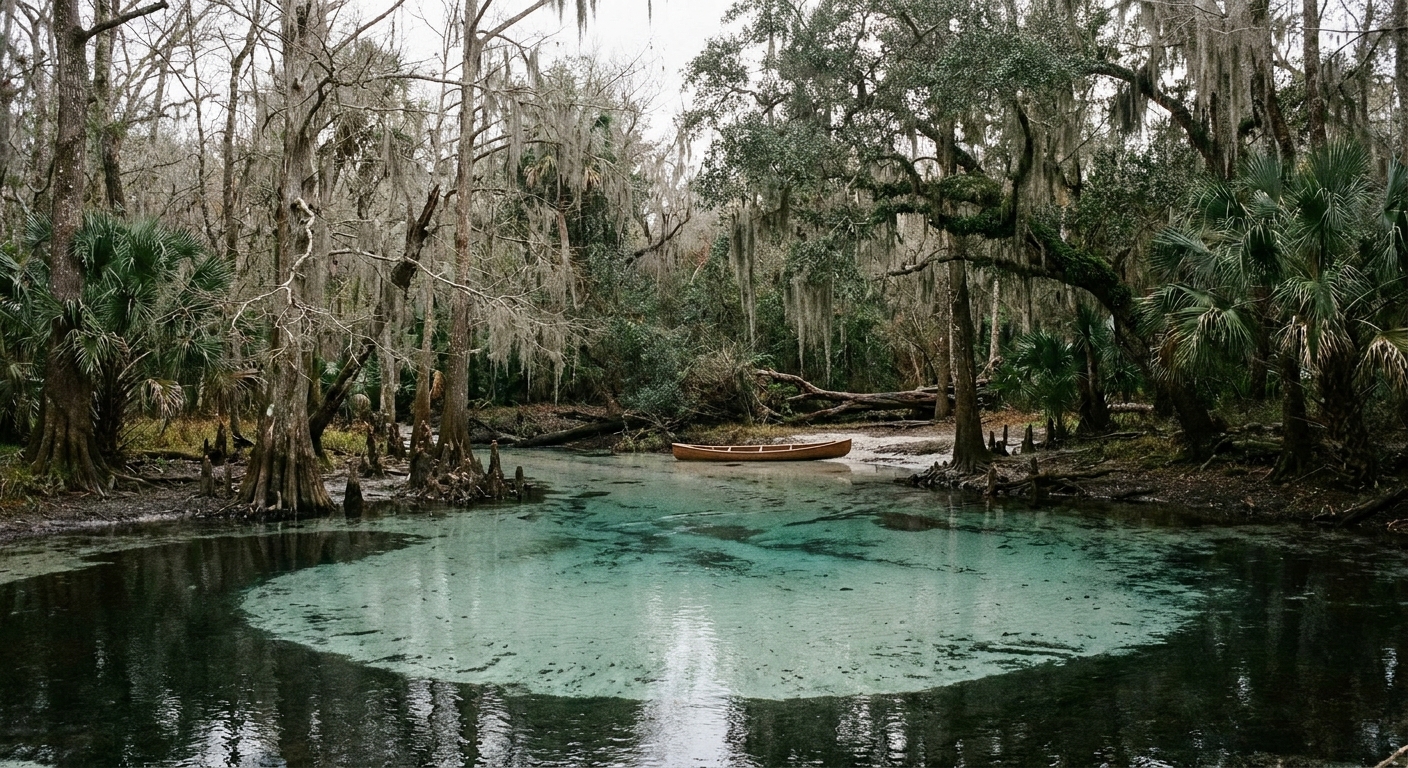
THE MONTH AT A GLANCE · FEBRUARY
February gives you 69.6°F afternoons, the lowest rainfall total of the winter and 11 hours of daylight, in exchange for roughly four nights at or below freezing.
DRY SEASON · HIGH 69.6°F · LOW 45.2°F · 4.8 WET DAYS · 11H 11M OF LIGHT
Go for: cool-air surface intervals, 2.96 inches of rain (the lowest of the three winter months), and afternoons averaging 69.6°F.
Think twice before: tent camping. An average February drops 4.1 nights to 32°F or below, and first light waits until 7:10 a.m.
Normals: NOAA NCEI 1991-2020, Cross City station · Daylight: sunrise-sunset.org · full sources at the end
On this page
- February weather at the springs69.6°F days, 2.96 inches, 4.8 wet days
- What to wear morning and afternoonA 24-degree day-night spread
- Crowds, booking and the lodging taxWhat we can and cannot price
- Things to do in FebruaryThe park, Troy Spring and the Suwannee
- A two-day planTwo days built on 11 hours of light
- February against January and MarchHow the three months compare, degree by degree
- Is February the right month for me?Our verdict, for divers and for swimmers
Two cautions before the figures. The normals below are measured at the NOAA station in Cross City, the same one that serves Troy Spring on this reach of the Suwannee, not at a gauge beside the sink. And we could not verify the park’s entry fee, its February hours or the temperature of its water, so we quote none of the three.
Wes Skiles Peacock Springs weather in February: average highs, lows and rain days
| February at Cross City (NOAA, 1991-2020) | Value |
|---|---|
| Average high | 69.6°F |
| Average low | 45.2°F |
| Precipitation | 2.96 in |
| Days with 0.10 in or more | 4.8 |
| Days with 1.00 in or more | 0.8 |
| Nights at 32°F or below | 4.1 |
| Sunrise / sunset, Feb 15 | 7:10 a.m. / 6:21 p.m. Eastern |
| Daylight, Feb 15 | 11h 11m |
Every figure here comes from one source: the NOAA NCEI monthly normals for 1991-2020, station USW00012833 at Cross City. February there averages a high of 69.6°F, a low of 45.2°F and 2.96 inches of precipitation. Cross City sits on the same reach of the Suwannee as Troy Spring, so read these as the regional picture rather than a reading taken at the water’s edge. A reanalysis grid cell would give you something smoother and a degree or two off; this is a real thermometer.
Measurable rain falls on 4.8 days in an average February, counting every day that records at least 0.10 inch. Call it one day in six. Spread 2.96 inches over those days and a typical wet one delivers about six tenths of an inch, which is proper rain rather than a passing mist. The other 23 days are dry enough that a wet forecast is the exception you plan around, not the default you plan for.
24.4°F separate the average afternoon from the average night, and no single layer covers both ends. Pack for two climates in one duffel: fleece, a beanie and gloves for the 7 a.m. gear check, a T-shirt for the 2 p.m. stretch. Anything wet at sundown stays wet until morning, so bring a second set of everything that touches skin and a dry towel per day rather than per trip.
On February 15 the sun clears the horizon at 7:10 a.m. Eastern and sets at 6:21 p.m., giving 11 hours 11 minutes of light. The practical consequence sits at the back end of the day: the temperature falls with the sun, and anything you break down after 6:30 p.m. gets broken down cold and in the dark. Load the vehicle while the light is still on it.
How warm is Wes Skiles Peacock Springs in February?
The month averages a high of 69.6°F and a low of 45.2°F, a 24.4-degree spread inside a single day. Those are normals across thirty years, not the extremes: plenty of February afternoons run warmer than 70°F, and plenty of February nights run a good deal colder than 45°F. The averages tell you what to expect; the spread tells you what to carry.
In practice that means a cold morning and a mild afternoon on the same date. At 7:10 a.m. you want long sleeves, a hat and something windproof, because standing still in the mid-40s while somebody sorts cylinders is colder than walking in it. By early afternoon the air is near 69.6°F and the jacket comes off. Sunlight matters more than the reading: shade in these woods stays several degrees behind the open.
Frost is a genuine part of the month. An average February drops 4.1 nights to 32°F or below, roughly one night in seven, which ices a windshield and splits a hose you left full. A 40°F sleeping bag is the wrong bag. We found no water-temperature record for the spring itself, so we give no figure for what you would actually be swimming in.
How busy is Wes Skiles Peacock Springs in February? Crowds, prices and the demand peak
February falls squarely inside Florida’s dry season, November through April, and ahead of the March break that fills the peninsula’s beach towns. That much is calendar, and our state guide lays it out. What we do not have is demand data: no occupancy series and no monthly room-rate series for Suwannee County reached us, so we crown no month cheap and no month expensive.
Booking lead times for cabins and campsites on this stretch of the river are equally unverified, so we give no number of weeks. The datable lever is the month boundary. Anything you can schedule in the first half of February sits further from spring break than the same trip at the start of March, and the weather cost of that choice is precise: 5.3°F off the afternoon.
We could not verify the Suwannee County lodging-tax rate, so no percentage appears next to your nightly total. Our Florida cost guide carries the state and county add-ons we have been able to confirm, and the general shape of what a night away from the coast runs.
One upgrade changes February more than any other, and it is not gear. It is a heated room instead of a tent. With 4.1 nights at or below freezing and 45.2°F as the ordinary low, the difference between a warm bed and a cold one decides whether you are alert for a 9 a.m. start or counting hours until sunrise. Where to stay in Florida covers the inland options.
Things to do in Wes Skiles Peacock Springs in February
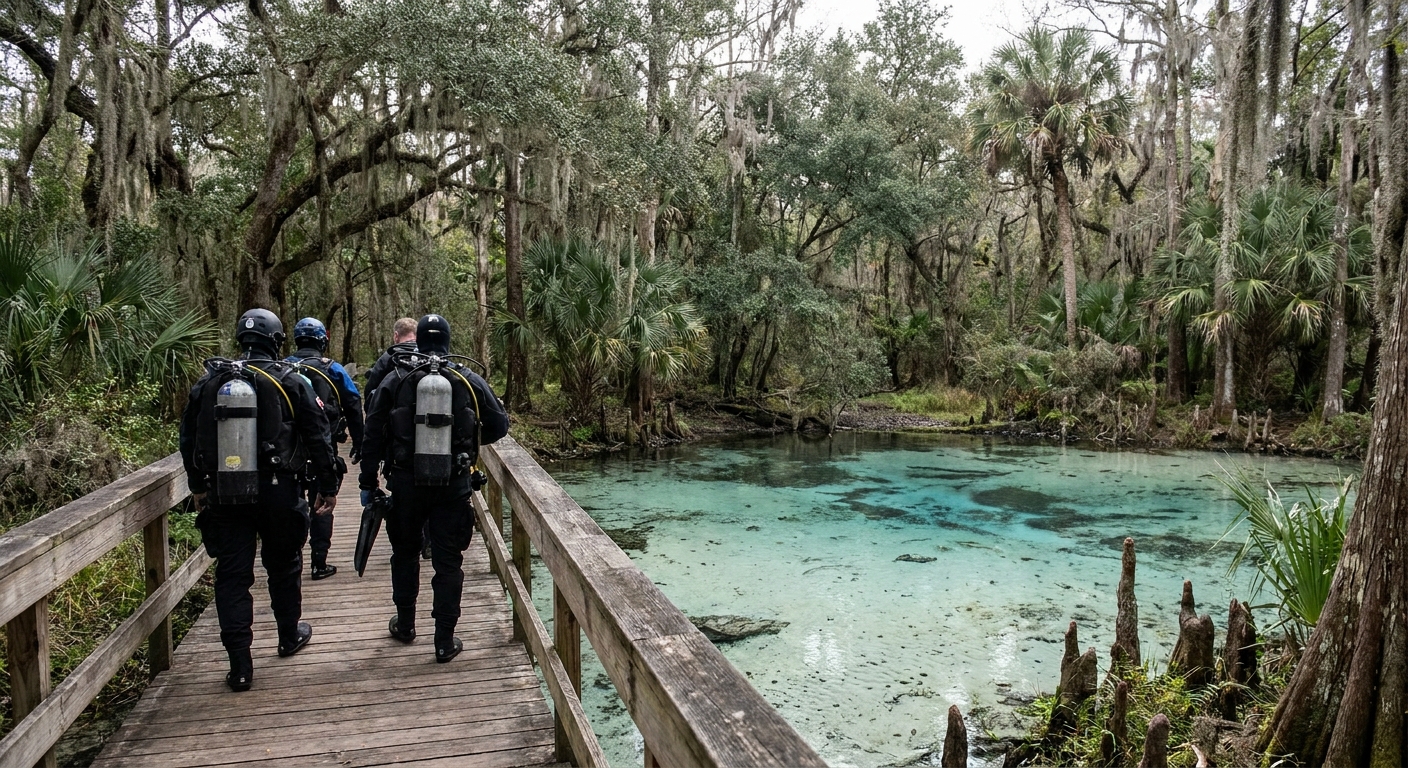
February offers one thing July cannot: you can stand around fully suited in air that averages 69.6°F, hauling weight and waiting your turn, without cooking. Add the dry season’s retreat of the mosquitoes, described across our Florida orientation, and the tedious parts of a spring day stop being a penance. Cool air is the month’s real product.
Wes Skiles Peacock Springs State Park, near Luraville, is a cave-diving park: a run of sinks and spring basins joined underground, not a beach with a snack bar. Troy Spring sits downriver on the same reach of the Suwannee and under the same Cross City thermometer, which makes it the obvious second stop. Entry fees, February hours and water temperatures at both went unverified by us, so we list none. For springs where manatees gather in winter, see our manatee guide.
Florida spring water holds close to the same temperature all year. The air above it does not: between January and March alone the average afternoon climbs 9.0 degrees, from 65.9°F to 74.9°F. February sits in the middle of that climb, which is why the same site feels like a different place in February and in late spring. The gap between water and air, not the water, is what makes the season.
We could not verify a fee-free day, a February program or a dated event at the park, so we name none and you should treat any you hear about as unconfirmed. What costs nothing is the daylight, and February gives you 11 hours 11 minutes of it, opening at 7:10 a.m. when the woods are still at their coldest and quietest.
Wes Skiles Peacock Springs in February: a two-day itinerary
Day one starts late on purpose. Sunrise at 7:10 a.m. arrives with the air near 45.2°F, so use the first two hours for coffee, gear checks and the drive in, and get wet from mid-morning once the sun is over the trees. Take the long surface break between 1 p.m. and 3 p.m., when the air is nearest 69.6°F and your suit has a chance of drying. Be out of the water by five and packed by 6:21 p.m., when the light goes.
Day two repeats the shape with Troy Spring or a stretch of the Suwannee added on the drive. If the forecast lands on one of the month’s 4.8 wet days, remember that rain changes nothing underwater and everything on the surface: six tenths of an inch turns hauling and changing into misery. That is the day to drive, and our getting-around guide has the road logic for north Florida.
Wes Skiles Peacock Springs in February vs January and March
| NOAA normals, 1991-2020 | January | February | March |
|---|---|---|---|
| Average high | 65.9°F | 69.6°F | 74.9°F |
| Average low | 41.8°F | 45.2°F | 49.6°F |
| Precipitation | 3.38 in | 2.96 in | 3.53 in |
| Days with 0.10 in or more | 5.7 | 4.8 | 4.6 |
February runs 3.7°F warmer by day than January and 5.3°F cooler than March, with nights 3.4 degrees above January and 4.4 below March. On rain the ranking splits: February is the driest by volume at 2.96 inches, while March counts the fewest wet days at 4.6 against February’s 4.8. No water-temperature series for the spring reached us for any of the three months, so the comparison stops at the air.
Shift four weeks later and you gain 5.3 degrees on the afternoon, lose 0.57 inch of dryness and walk into the month Florida’s beach towns fill. Shift four weeks earlier and you save nothing on rain, since January brings both more inches and more wet days, and you hand back 3.7 degrees. The clean trade is warmth against quiet, and February keeps the quiet.
Is February a good time to visit Wes Skiles Peacock Springs?
Yes, if you are coming for what happens under the surface or on a trail. Cool air is an asset when you are carrying cylinders, and 2.96 inches is the lightest rainfall of the winter. No, if the picture in your head involves a towel, a swimsuit and an afternoon of lounging. A 45.2°F dawn and four freezing nights are not a lounging climate, whatever the water is doing.
If that second description is yours, take March or later. March averages 74.9°F afternoons and 49.6°F nights, at the price of 3.53 inches of rain and the busiest weeks of the Florida spring. April and beyond sit in the twelve-month verdict, and the further you go, the more the air outpaces the water.
What February alone delivers is the winter’s lowest rainfall total paired with 11 hours 11 minutes of daylight and afternoons that average 69.6°F, which no other month on this reach of the Suwannee puts together.
The last word
Book the heated room, keep the dates in the first half of the month, and treat sunset at 6:21 p.m. as the end of the working day rather than a suggestion. One figure we have held back: an average February records 0.8 days of an inch or more, so most Februaries hand you exactly one genuine soaking. Plan the drive, the museum detour or the long lunch for it, and let the other twenty-seven days do what you came for.
Sources & data for this guide
- February normals: high 69.6°F, low 45.2°F, 2.96 in precipitation · NOAA NCEI monthly normals 1991-2020, station USW00012833 (Cross City) · checked Sep 24, 2026
- Wet days: 4.8 at 0.10 in or more, 0.8 at 1.00 in or more · NOAA NCEI 1991-2020, station USW00012833 · checked Sep 24, 2026
- Freezing nights: 4.1 at 32°F or below · NOAA NCEI 1991-2020, station USW00012833 · checked Sep 24, 2026
- Sunrise 7:10 a.m., sunset 6:21 p.m. Eastern, 11h 11m of daylight on February 15 · sunrise-sunset.org · checked Sep 24, 2026
- January and March normals used in the comparison · NOAA NCEI 1991-2020, station USW00012833 · checked Sep 24, 2026
- Station caveat: Cross City is the official thermometer for this reach of the Suwannee and also serves Troy Spring; it is not a gauge at the spring itself.
- Editorial admission: we could not verify the park’s entry fee, its February hours, its water temperature, the Suwannee County lodging-tax rate, any occupancy series or any dated February event, so none of those carry a figure.
To plan your stay
- Best Time to Visit Wes Skiles Peacock Springs: Weather, Rain and the Quiet Months
- Wes Skiles Peacock Springs in January: Weather, Rain Days, Frost Nights and Daylight
- Wes Skiles Peacock Springs in March: Weather, Freezing Nights and a Two-Day Plan
- Wes Skiles Peacock Springs in April: Weather, Rain Days and How It Compares With March and May