
FLORIDA · WAKULLA SPRING · DECEMBER
December hands you a swap at Wakulla Spring. The water stays where it always is, 70.3°F on the USGS gauge in the spring itself, while the air above it settles to an average high of 65.9°F. For once the swim is the warmest thing you will touch all day, by 4.4°F. The parking crunch that shuts a summer Saturday down is not the December worry. Sunset at 5:40 p.m. is what shortens the day.
The month charges for that in daylight and in cold mornings: about 10 hours 15 minutes of light on December 15, 5.8 days with measurable rain, and 7.4 nights at or below freezing at the nearest official thermometer. In exchange you get a boardwalk with room on it and a swim most of Florida saves for July. For the colder version of the same trip, see Wakulla Spring in January, and for the statewide dry-season picture, the best time to visit Florida.
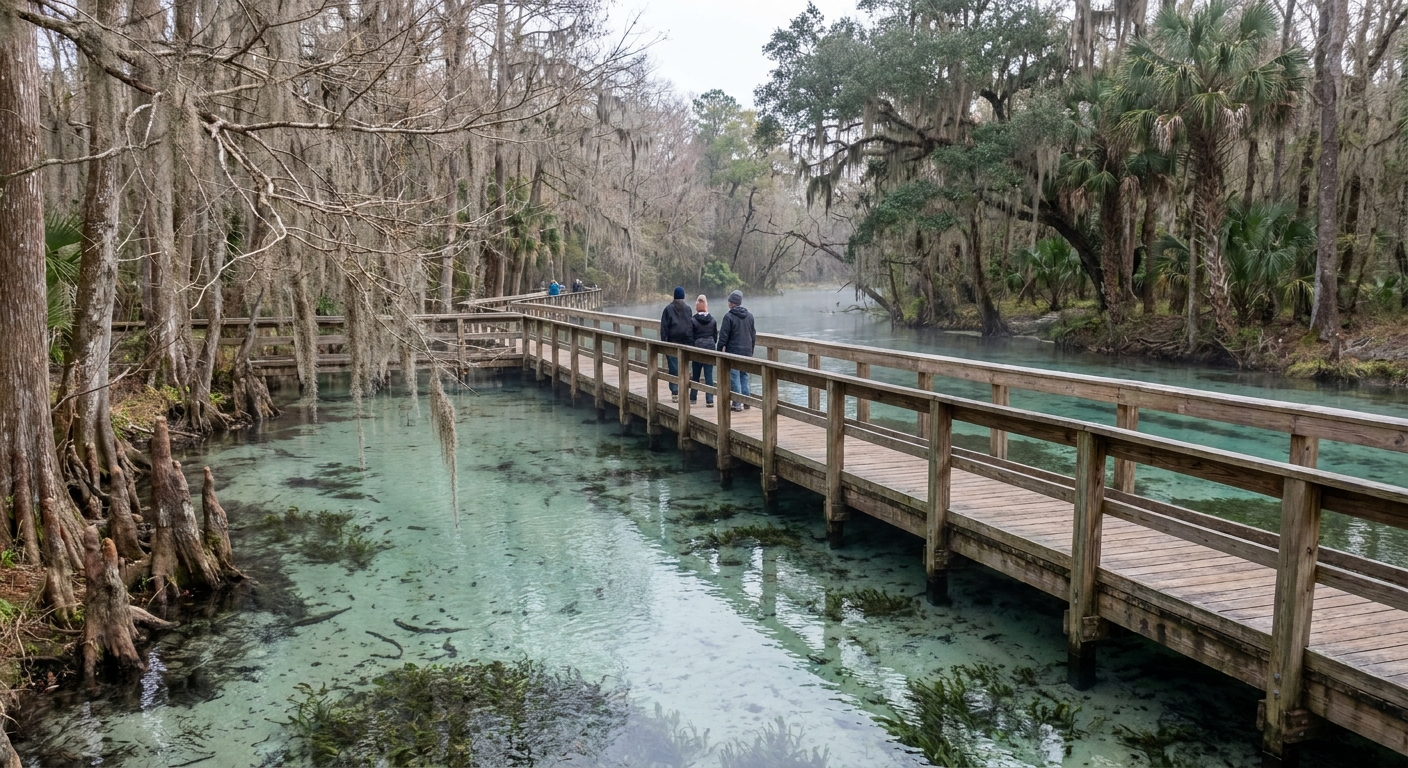
THE MONTH AT A GLANCE · WAKULLA SPRING · DECEMBER
December is the month the spring outruns the air: 70.3°F water against 65.9°F afternoons, with freezing dawns, short light and no summer gate closures to plan around.
NOAA 1991-2020 NORMALS · MEASURED AT TALLAHASSEE, ABOUT 27 MILES AWAY · ONE DESIGNATED SWIM AREA
Go for: a cold-water swim that is warmer than the air, low winter light on 285 feet of boardwalk, and a park whose 300-space limit stops mattering once summer ends.
Think twice before: bringing small children who will be wet at 43°F, or planning a hiking day here: the state counts 0.2 miles of trail.
Air: NOAA NCEI station USW00093805 · Water: USGS gauge 02327000 · Park counts: Florida DEP · full sources at the end
On this page
- Wakulla Spring weather in December65.9°F days, 42.9°F nights, 5.8 rain days
- Can you swim there in December?The spring at 70.3°F, the air at 65.9°F
- How busy the park gets, and what a stay costs300 parking spaces and the prices we could not verify
- Things to do at the park in winterThe swim area, 285 feet of boardwalk, two platforms
- A two-day plan around a 5:40 p.m. sunsetHour by hour, plus the rain version
- December, November or January?How the three months compare, degree by degree
- Is December worth the trip?Our straight answer, and who should wait
Two thermometers feed the normals below. The air figures come from NOAA NCEI, station USW00093805 at Tallahassee, roughly 27 miles from the spring, averaged over 1991 to 2020. The water figure comes from the USGS gauge in the spring itself, station 02327000. The air has a December. The spring does not.
Wakulla Spring weather in December: average highs, lows and rain days
| Measure | December figure |
|---|---|
| Average high | 65.9°F |
| Average low | 42.9°F |
| Precipitation | 4.24 inches |
| Days with 0.10 inch or more | 5.8 |
| Days with 1 inch or more | 1.3 |
| Nights at 32°F or below | 7.4 |
| Daylight, December 15 | 10 hours 15 minutes |
| Spring water | 70.3°F (single gauge reading) |
NOAA’s 1991-2020 normals give December an average high of 65.9°F, an average low of 42.9°F and 4.24 inches of precipitation. Every figure here is read at Tallahassee rather than at the spring’s parking lot, so take it as regional air, not as a measurement over the water. It matters which kind of number you are holding: a station normal comes from a real instrument with an identifier, a reanalysis figure comes from a grid cell, and the two can part company by several degrees on an overnight low.
Of those 4.24 inches, 5.8 days in an average December collect at least a tenth of an inch, about one day in five, and 1.3 days collect a full inch or more. Translated into a four-day stay, that is one damp day you should plan a fallback for and a decent chance the rest stay dry. Winter rain here comes with fronts rather than with afternoon heat, so it does not clear on the summer schedule of a 20-minute thunderstorm.
Between that 42.9°F low and that 65.9°F high sits a 23-degree swing inside a single day, and a December visitor feels both ends of it. Pack for two climates in one bag: a fleece and a beanie for the first hour, short sleeves for the middle of the afternoon, and a complete change of dry clothes if anyone is going in the water. Cotton that gets wet at 8 a.m. stays wet until noon.
On December 15 the sun rises at 7:25 a.m. and sets at 5:40 p.m. local time, which works out to 10 hours 15 minutes of daylight. That is the constraint that reshapes a winter day here. The swim and the boardwalk both belong to the middle hours, and anything pushed past 4 p.m. happens in falling light and falling temperature at the same time.
How warm is Wakulla Spring in December?
The gauge in the spring read 70.3°F (21.3 °C) on September 11, 2026, and it reads close to that on whatever date you pick, because groundwater arrives at its own temperature. That reading is one instantaneous measurement, not an average of daily maxima and not a monthly mean, so treat it as the level the spring sits at rather than a December value. Set against December air, the water runs 4.4°F warmer than a normal afternoon and 27.4°F warmer than a normal dawn.
In clothing terms that means a genuine jacket at 43°F for the first hour and shirtsleeves by early afternoon at 65.9°F. Swimmers get the strange December sensation of stepping into water warmer than the air they left. The exit costs more than the entry, so dry off fast and get a warm layer on within a minute of leaving the water. Two towels per swimmer is not overkill in this month.
Freezing is normal here, not an oddity: 7.4 nights in an average December drop to 32°F or below at the Tallahassee station, roughly one night in four. None of it reaches the spring. It does reach a tent, a windshield and the first hour of your morning, which is the argument for a room with a heater if you are traveling with anyone who feels the cold.
How busy is Wakulla Spring in December? Crowds, prices and the demand peak
December is two months wearing one name on the Florida calendar. The first three weeks sit in the quiet stretch of the dry season, and the holiday run is a statewide peak, as our best-time page sets out. We found no occupancy series and no monthly room-rate series for this corner of the panhandle, so we crown no month cheapest and none most expensive.
That splits the booking job in two. For the week between Christmas and New Year, lock the room when you lock the drive, because you are competing with every other family off work. For a Tuesday before December 20, we have no evidence of a sell-out and will not invent a lead time. Tallahassee is the nearest bed base of any size, about 27 miles from the spring, and our where-to-stay guide covers how Florida lodging prices move.
We could not verify a lodging-tax rate for the county, so we give no percentage. Florida bills tourist-development tax as a separate line, and the number you are quoted on a comparison site often excludes it. Read the tax line on the confirmation before you decide one property is cheaper than another. Our Florida trip-cost page has the rest of the budget arithmetic.
The single place money changes this month is sleeping close. Parking is the park’s hard ceiling, 300 spaces counted by the state, and when the lot fills the gate closes. The state ties that closure to summer Saturdays and we hold no December counts, so we predict nothing for the third week of the month. A bed within a short drive still buys the early hours and a second attempt if a front parks over the region for a day.
Things to do in Wakulla Spring in December
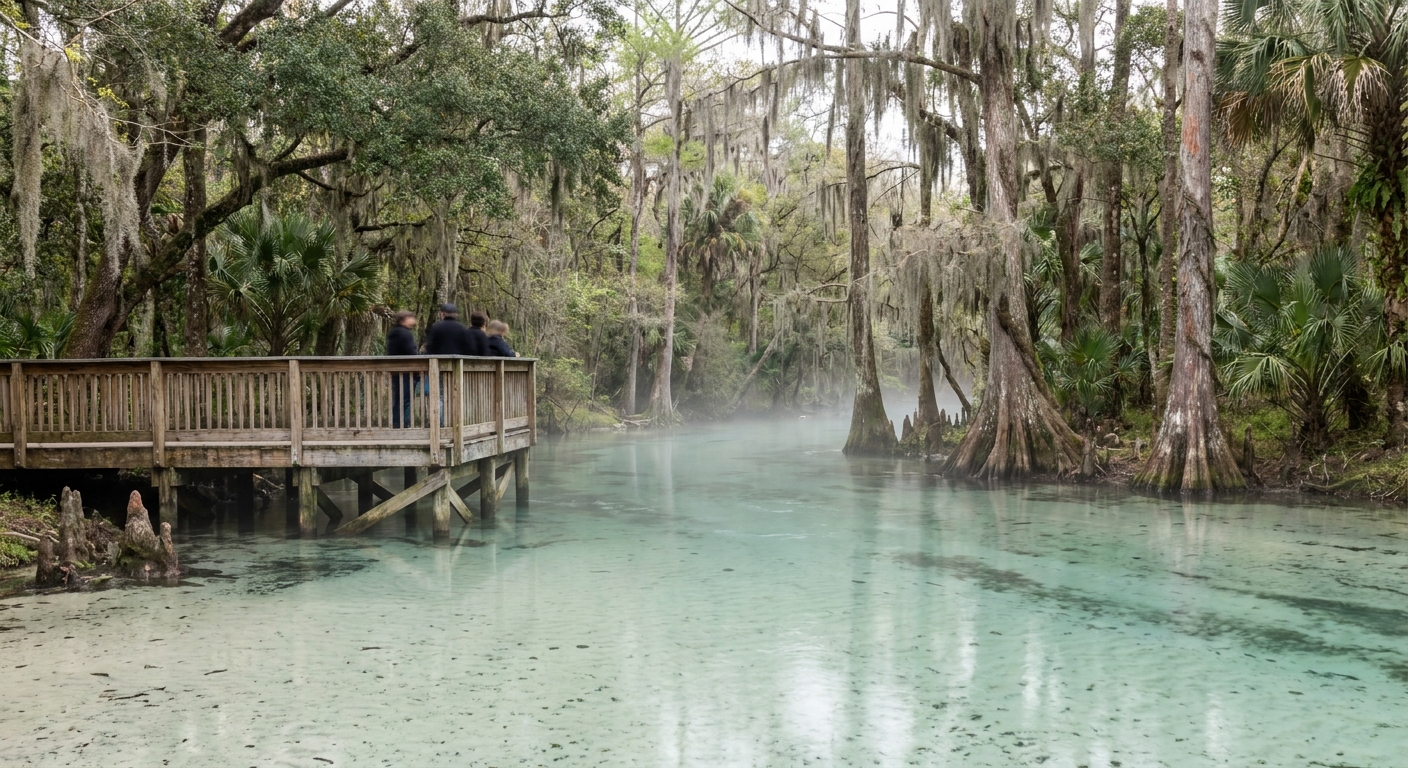
December inverts the usual reason to swim here. In July the spring is relief from the heat. In December it is the warmest thing on site, 4.4°F above the average afternoon, and getting in is a way to stop being cold. The second December-only gain is elbow room: the pressure that closes the gate on summer Saturdays has no winter equivalent that we could measure in the state’s own figures.
All of it happens inside Edward Ball Wakulla Springs State Park, and the state’s facilities inventory counts exactly what is there: one designated swimming area, 285 feet of boardwalk, two observation platforms, 0.2 miles of hiking trail and 300 parking spaces. This is a compact park, so the day is built around the water and the two platforms rather than around a trail network. Florida DEP also describes Wakulla Springs as a site for deep cave diving by researchers and scientists, not as a place where a recreational diver drops in.
Those counts hold all year. What the month changes is the air standing over them. Walking 285 feet of boardwalk at 43°F just after sunrise is a different errand from walking it in August, and the swim area holds identical water in both cases. Plan the platforms for the cold early hour, the water for the warm middle, and pick the sunny side of the deck rather than the shaded one.
We could not read the park’s fee schedule or its opening hours, because floridastateparks.org answers automated reads with a 403, so we quote no entrance price and label nothing free. The same gap covers wildlife. We found no manatee count for Wakulla Spring, so we promise none, and our manatee guide handles where that is actually done in Florida.
Wakulla Spring in December: a two-day itinerary
Day one opens at the gate around 7:25 a.m., sunrise, with the air near 43°F. Give the first hour to the boardwalk and the two platforms while the light is still low, then let the thermometer climb. By late morning a normal December day is in the low 60s, and that is the window for the single designated swim area. Dry off, eat, and take the 0.2-mile trail at about 2 p.m. The sun is gone by 5:40, so put dinner in Tallahassee rather than a late walk.
Day two runs the same shape with the swim pulled earlier, since the water reads the same at 10 a.m. as at 2 p.m. and the air does not. If one of the month’s 5.8 wet days lands on you, the plan bends rather than breaks: rain at 60°F on a boardwalk is fine in a shell, and the 1.3 days per December that deliver an inch or more are the ones to trade for an indoor afternoon in town. Our getting-around guide has the driving detail.
Wakulla Spring in December vs November and January
| Measure | November | December | January |
|---|---|---|---|
| Average high | 72.5°F | 65.9°F | 63.9°F |
| Average low | 48.0°F | 42.9°F | 40.5°F |
| Precipitation | 3.10 in | 4.24 in | 4.41 in |
| Days with 0.10 inch or more | 4.1 | 5.8 | 5.6 |
| Spring water | About 70°F | About 70°F | About 70°F |
November runs 6.6°F warmer by day and 5.1°F warmer by night, and it is the driest of the three: 3.10 inches across 4.1 wet days, against December’s 4.24 inches across 5.8. January takes another 2.0°F off the high and 2.4°F off the low, with 4.41 inches over 5.6 wet days, so the rain barely moves while the cold deepens. The spring holds near 70°F through all three, which is the one line on that table that does not change.
Move four weeks earlier and you buy warmer afternoons and a drier month. You also lose the December trick, because a normal November afternoon of 72.5°F is warmer than the spring, so the water stops being the warm option. Move four weeks later and the rain stays roughly where it was while both ends of the day drop, with more freezing nights behind them. Our January page works that month through in full.
Is December a good time to visit Wakulla Spring?
Yes for cold-water swimmers, for photographers who want low light across a 10-hour day, and for anyone based in Tallahassee who wants a half-day at the water without racing 300 cars for a space. No if you need warm air wrapped around the swim, if your group includes small children who will be wet and shivering at 43°F, or if the visit was meant to be a hiking day: 0.2 miles of trail is what the state counts here.
If the answer came out no, November is the month to take. Afternoons average 72.5°F, rain totals 3.10 inches over 4.1 wet days, and the mornings start at 48.0°F instead of 42.9. You give up the inversion that makes December interesting, and you gain a month where the air itself is comfortable rather than merely survivable before lunch.
What December offers that November cannot: a spring that reads warmer than a normal afternoon, by a measurable 4.4°F, on a day that still carries more than ten hours of light.
The last word
Book the middle of the day rather than the morning, bring far more dry clothing than a Florida trip usually suggests, and accept that one day in five will be wet. One fact we have kept back: Florida law puts this spring in a protected class, the Outstanding Florida Springs set out in Statute 373.802(5), covering every historic first-magnitude spring plus six named by hand in the text. That status is about nitrates and flow rather than visitors, and the public USGS gauge at station 02327000 is why anyone can quote 70.3°F at all.
Sources & data for this guide
- December air normals 1991-2020, high 65.9°F, low 42.9°F, 4.24 in, 5.8 days at 0.10 in, 1.3 days at 1 in, 7.4 nights at 32°F or below · NOAA NCEI monthly normals, station USW00093805, Tallahassee, FL, about 27 miles from the spring · checked Sep 24, 2026
- November and January normals used in the comparison table · NOAA NCEI, same station and same 1991-2020 period · checked Sep 24, 2026
- Sunrise 7:25 a.m., sunset 5:40 p.m. and 10 h 15 min of daylight on December 15 · sunrise-sunset.org, converted from UTC to local time · checked Sep 24, 2026
- Spring water 70.3°F (21.3 °C), one instantaneous reading rather than a monthly average · U.S. Geological Survey, National Water Information System, station 02327000 Wakulla Spring · checked Sep 24, 2026
- One designated swimming area, 285 feet of boardwalk, two observation platforms, 0.2 miles of hiking trail, 300 parking spaces · Florida Department of Environmental Protection, Recreational Facilities Inventory, 2024 annual report · checked Sep 24, 2026
- Outstanding Florida Springs definition · Florida Statutes 373.802(5), leg.state.fl.us · checked Sep 24, 2026
- Deep cave diving description · Florida DEP, Visit a Spring, floridadep.gov/springs/visit · checked Sep 24, 2026
- Our gaps, stated plainly: we could not read an entrance fee, an opening hour or a manatee count. floridastateparks.org returns 403 to automated reads and the FWC manatee page renders client-side · checked Sep 24, 2026