
FLORIDA · WAKULLA SPRING · THE 12-MONTH VERDICT
Take October and stop deliberating. Air highs average 81.7°F, rain totals 3.24 inches, and only 3.9 days in an average October record at least a tenth of an inch of rain, the fewest of any month in the 1991-2020 record. The spring makes the choice easier than any beach trip would: the water rising through the vent has no season, so what changes from month to month is the air you stand in before and after the swim.
So picking a month here is picking daylight and comfort, not water temperature. You get 14 hours 8 minutes of daylight on June 15 and 10 hours 15 minutes on December 15, and an average January puts 9.6 nights at 32°F or below. The quiet weeks are a school-calendar fact, not a discount: this page has no price series behind it and will not pretend otherwise.
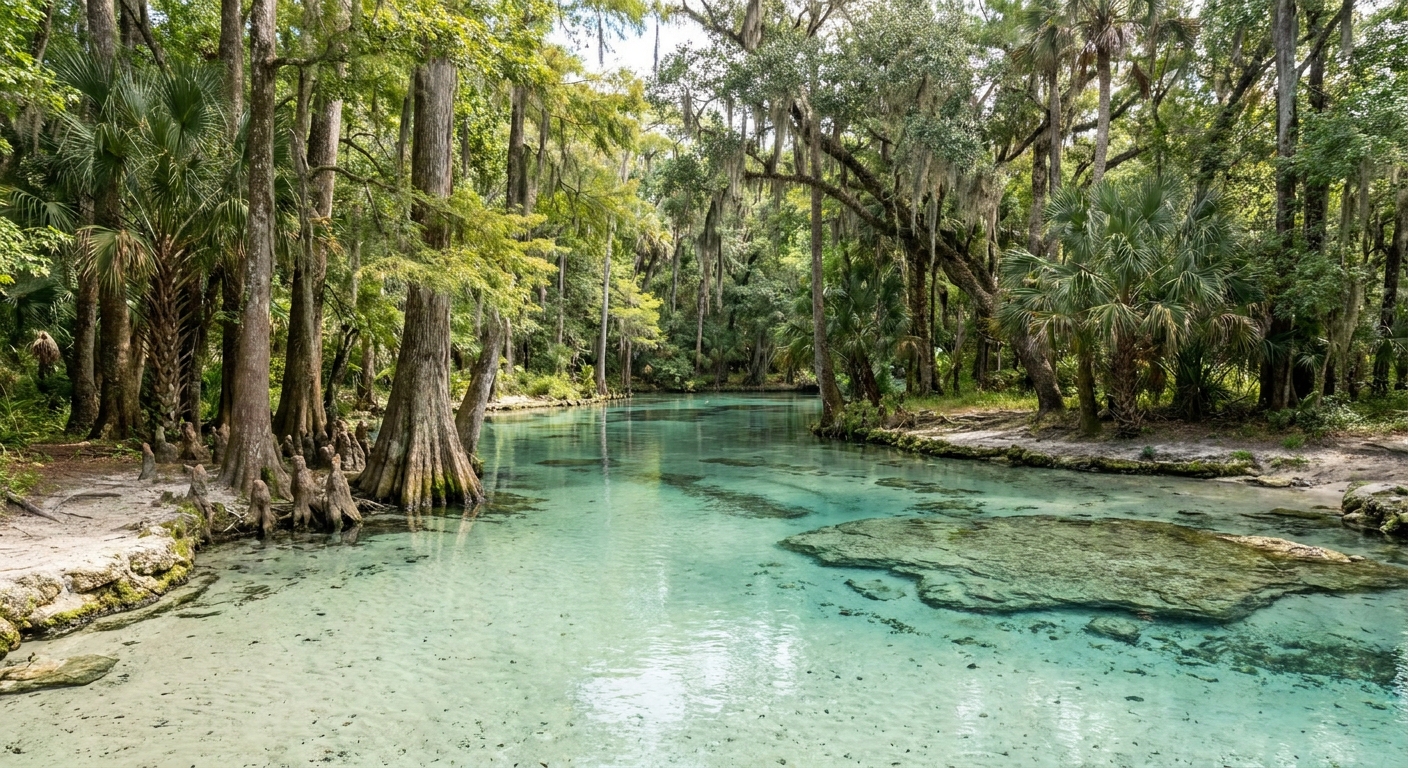
THE YEAR AT A GLANCE · WAKULLA SPRING
October is the pick: 81.7°F afternoons, 3.24 inches of rain and the year’s fewest wet days, above a spring that holds its temperature no matter the month.
BEST MONTH: OCTOBER · AIR NORMALS FROM TALLAHASSEE, ABOUT 44 KM AWAY · SWIM SEASON SET BY AIR, NOT WATER
Go for: October and April afternoons (3.9 and 4.3 wet days), June evenings if you want every one of those 14 hours, and winter weekdays if you want the lawn to yourself.
Think twice before: booking July for a land-heavy day: 92.1°F highs, 11.2 wet days and average lows of 73.0°F that keep the night from cooling.
Air normals: NOAA NCEI 1991-2020, Tallahassee station · Daylight: sunrise-sunset.org · full sources at the end
On this page
- Month-by-month highs, lows and rainfallThe twelve-month table
- The single best month to goOctober, 81.7°F and 3.9 wet days
- Summer heat and swimming weatherJuly at 92.1°F, nights at 73.0°F
- The quietest weeks of the yearDecember to February
- The month to skipJuly, and who it hurts
- Shoulder months: April, May, October, NovemberWhat the shoulder trades away
Wakulla has no separate month pages yet, so the whole year sits here. For the wider state calendar, dry season against wet season, see when to visit Florida; if the trip starts with a flight and a rental, the flights guide and what Florida costs carry that side.
Wakulla Spring weather month by month: highs, lows and rainfall
| Month | Avg high | Avg low | Rain | Days ≥ 0.10 in | Daylight (15th) |
|---|---|---|---|---|---|
| January | 63.9°F | 40.5°F | 4.41 in | 5.6 | 10h27 |
| February | 67.8°F | 43.5°F | 4.28 in | 5.5 | 11h10 |
| March | 74.2°F | 48.6°F | 5.24 in | 5.6 | 12h02 |
| April | 80.2°F | 54.4°F | 3.53 in | 4.3 | 12h58 |
| May | 87.4°F | 63.0°F | 3.36 in | 4.6 | 13h44 |
| June | 90.8°F | 70.8°F | 7.76 in | 9.9 | 14h08 |
| July | 92.1°F | 73.0°F | 7.14 in | 11.2 | 13h57 |
| August | 91.5°F | 73.2°F | 7.60 in | 10.0 | 13h16 |
| September | 88.6°F | 69.6°F | 4.91 in | 6.2 | 12h22 |
| October | 81.7°F | 58.8°F | 3.24 in | 3.9 | 11h28 |
| November | 72.5°F | 48.0°F | 3.10 in | 4.1 | 10h40 |
| December | 65.9°F | 42.9°F | 4.24 in | 5.8 | 10h15 |
Temperature climbs in one long ramp, 63.9°F in January to 92.1°F in July, then slides back to 65.9°F in December, with nine months averaging highs above 70°F. Rain refuses to follow that curve. It piles into June, July and August (7.76, 7.14 and 7.60 inches) and thins out in fall, October at 3.24 inches and November at 3.10, the two driest months of the year.
April and October are where the year turns. April cuts the wet-day count to 4.3 from March’s 5.6 and leaves freeze risk behind at 0.2 nights at or below 32°F. October undoes summer in a single step: 3.9 wet days against September’s 6.2, rain down from 4.91 inches to 3.24, and afternoons 6.9°F cooler than September’s 88.6°F.
July is the month that punishes a plan built on land time. Highs average 92.1°F, the nights hold at 73.0°F, and 11.2 days record measurable rain, more than any other month. Swimmers who cross the lawn and get in barely notice. Anyone building a day around a boat, a picnic and a walk feels all three numbers at once, which is why Florida with kids keeps summer plans short and early.
Every figure here comes from the NOAA 1991-2020 normals recorded at the Tallahassee station, about 44 km (27 miles) from the spring, and those normals describe the air. The water itself has no season. Our source set carries no measured water temperature for Wakulla, so none is printed. Rain days count calendar days at 0.10 inch or more; a second count tracks days reaching a full inch, 2.4 in an average August against 1.0 in October.
When is the best time to visit Wakulla Spring?
October, for almost everyone. Afternoons average 81.7°F, rain totals 3.24 inches, only 3.9 days reach a tenth of an inch, and just 1.0 day reaches a full inch. Nights ease to 58.8°F, which matters when you climb out wet, and October 15 still gives 11 hours 28 minutes of daylight, enough for a morning drive, a long swim and an unhurried afternoon before the light goes.
November is fractionally drier at 3.10 inches, and that is the whole of its case. It costs 9.2°F off the afternoon high, 48 minutes of daylight, and 2.3 freeze nights that October does not have. September runs 6.9°F hotter with 2.3 more wet days and 1.67 inches more rain. October sits between the two and gives up nothing worth naming.
Booking around it is straightforward: a weekend at the spring pairs with the coast or the springs belt rather than with a resort week, and the driving side is covered in getting around Florida. For what the same October looks like across the rest of the state, including the Gulf and the Everglades, the state calendar carries the detail this page delegates.
How hot does Wakulla Spring get in summer?
Summer afternoons average 90.8°F in June, 92.1°F in July and 91.5°F in August, and the nights stop cooling: average lows of 70.8°F, 73.0°F and 73.2°F. Rain arrives in volume rather than in drizzle, 7.76 inches over 9.9 days in June, 7.60 inches over 10.0 days in August, with 2.3 and 2.4 of those days delivering an inch or more. The water you are swimming in reads the same all three months.
One thing our data cannot tell you: humidity. The source set carries temperature, precipitation, freeze nights and daylight, and no dew point or heat index at all. That means we cannot put a number on how much heavier 92.1°F in July feels than 92.1°F would feel in April. Read the summer figures as a floor rather than a full account, and keep land time to the morning.
When is Wakulla Spring quietest?
December through February, and weekdays above all: school is in session, the holiday weeks aside, and North Florida’s swimming crowd has gone home. Those are calendar facts. No price series sits, so nothing here ranks months by cost, and any claim that one month is the cheapest of the year would be invented rather than measured.
What you gain is real. The spring delivers the same water in February as in August, midday air still reaches 67.8°F in February and 63.9°F in January, and winter rain, while frequent on paper, is thin: January’s 4.41 inches spread over 5.6 days against July’s 7.14 inches over 11.2. Add a parking lot with room in it and a boat tour without a wait.
What you lose, precisely: the drying-off half of the visit. December, January and February average 7.4, 9.6 and 5.2 nights at or below 32°F, 22.2 across the three months. December 15 gives 10 hours 15 minutes of light, the year’s shortest, so a late start eats the day. And a 63.9°F January afternoon is a poor reward for climbing out of the water, whatever the water is doing.
Which month should you avoid at Wakulla Spring?
July, if your day has more land in it than water. It leads the year on three counts at once: 92.1°F highs, 11.2 days with measurable rain, and 1.7 of those days delivering an inch or more, with nights that sit at 73.0°F. Heat-sensitive travelers, anyone pushing a stroller across open ground, and photographers who want an afternoon outdoors all pay for it. Swimmers, much less so.
July gives two things back. Daylight on the 15th runs 13 hours 57 minutes, with the sun up at 6:44 a.m. and down at 8:41 p.m. local, which puts a whole evening after the hottest hours. And a constant-temperature spring is at its most useful in exactly the month the air is worst. Florida’s wet-season rain also tends to fall in afternoon bursts rather than all day, a state-wide pattern set out in the Florida calendar.
Is the shoulder season worth it at Wakulla Spring?
The shoulder months are April, May, October and November. Measured against July’s 92.1°F, April runs 11.9°F cooler, October 10.4°F cooler, November 19.6°F cooler, and May only 4.7°F cooler, which makes May a summer month wearing a spring name. April lows average 54.4°F and October lows 58.8°F, against 73.0°F in July.
Dry days are what the shoulder buys. April records 4.3 wet days and October 3.9, against 11.2 in July and 10.0 in August, and rain totals fall to 3.53 and 3.24 inches from June’s 7.76. Freeze risk has effectively gone in both, 0.2 nights in April and 0.1 in October, so nothing stops an early start.
The bill comes in light. April 15 gives 12 hours 58 minutes and October 15 gives 11 hours 28, that is 1 hour 10 minutes and 2 hours 40 minutes less than June 15. Mornings are colder on exit too: April is 18.6°F below July at night, October 14.2°F below. A 9 a.m. swim in April asks more of you than the same swim in August.
Take the shoulder anyway, and take the October half of it. April is the strong second choice with 4.3 wet days and no freeze risk. Skip March if you can: 5.24 inches of rain, the wettest month outside June through August, and spring break loads North Florida’s water attractions at the same time.
The last word
Book October, drive in early, and let the spring do what it does in every month of the year. If the dates are fixed and they land in winter, come anyway and treat it as a midday trip rather than a day out: on December 15 the sun rises at 7:25 a.m. and sets at 5:40 p.m. local, which leaves a narrow warm middle worth aiming at. February, at 5.5 wet days, is the driest of the three cold months.
Sources & data for this guide
- Monthly air normals, highs, lows, precipitation, wet days and freeze nights · NOAA NCEI 1991-2020 monthly normals, station USW00093805 (Tallahassee, FL) · checked Sep 13, 2026
- Daylight, sunrise and sunset on the 15th of each month · sunrise-sunset.org, converted to local time · checked Sep 13, 2026
- Editorial note: the station sits about 44 km (27 miles) from the spring and measures air only. No measured water temperature for Wakulla was available in our source set, so none is printed here.
- Editorial note: no price series was available for this destination, so the quiet season is described by the calendar and no month is ranked by cost.
- Park hours, boat tour schedules and swimming-area rules change by season · check the operator before you drive.