
FLORIDA · WAKULLA SPRING · JANUARY
January is the month when the spring wins the argument with the sky. The air over this corner of the Panhandle averages a high of 63.9°F, and the water in the basin does not care: the USGS gauge in the spring read 70.3°F on September 11, 2026, and it reads close to that every day of the year. Step in on a January afternoon and the pool is the warm part of the trip.
What the month takes back is the morning and the evening. Nine or ten nights in an average January drop to freezing, the sun is not up until 7:32, and it is gone by 6:00. That shapes a visit far more than any question of what to see, because the seeing is the same in every month and the light is not.
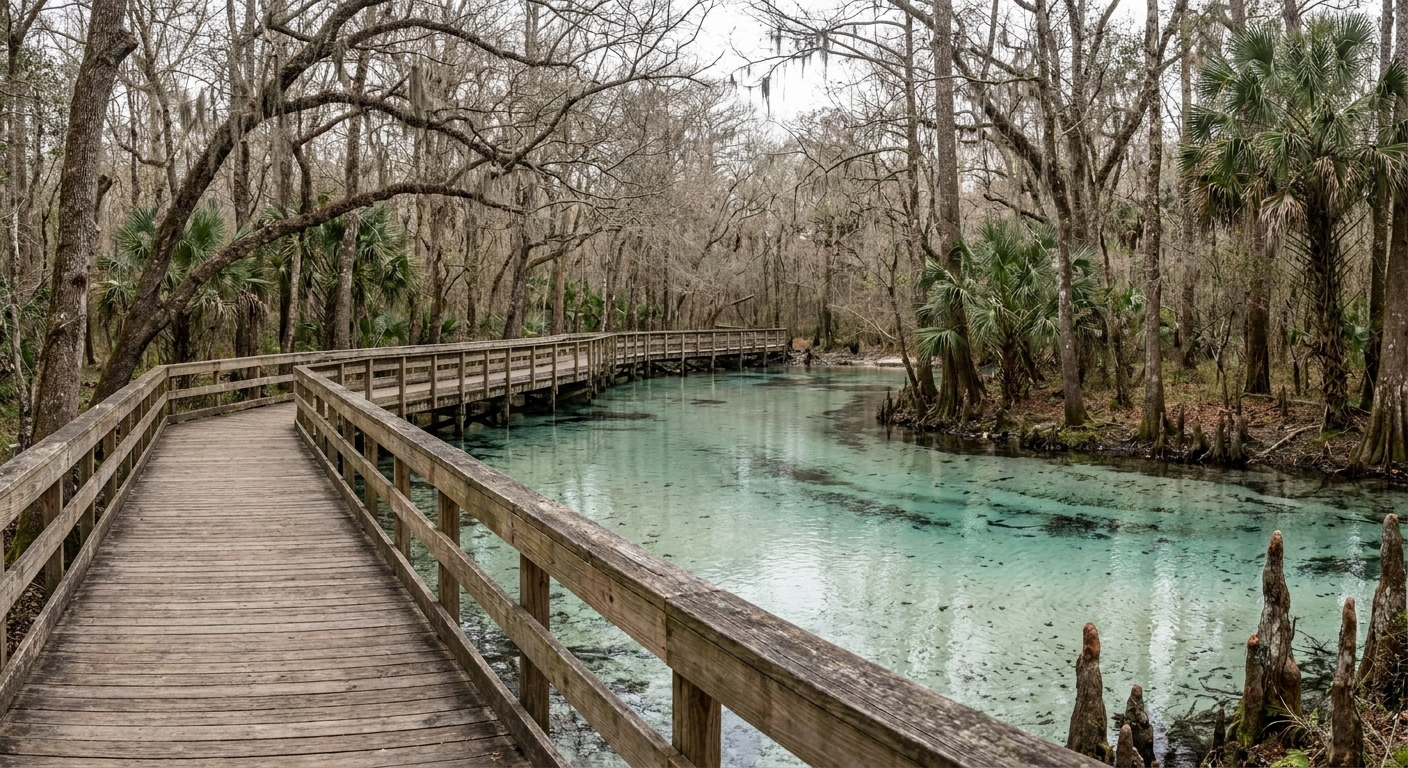
WAKULLA SPRING · JANUARY
January hands you the widest air-to-water gap of the winter: 63.9°F afternoons above a spring the USGS gauge read at 70.3°F, paid for with 9.6 freeze nights and a 6:00 sunset.
NOAA 1991-2020 NORMALS · AIR 63.9°F / 40.5°F · WATER 70.3°F ON THE GAUGE · 10 HR 27 MIN OF DAYLIGHT
Go for: a swim with cool air over warm water, 285 feet of boardwalk and two observation platforms, and a 300-space lot that summer Saturdays fill and January mornings do not.
Think twice before: planning a dawn start: 9.6 nights in an average January fall to 32°F or below, and sunrise on the 15th is at 7:32.
Air: NOAA NCEI 1991-2020, Tallahassee station · Water: USGS gauge 02327000 · Park counts: Florida DEP 2024 inventory
On this page
- January weather normals63.9°F days, 4.41 inches, 5.6 rain days
- How cold the water isThe gauge reads 70.3°F
- Parking and crowds at the park300 spaces, and what we could not verify
- Things to do at the spring in JanuaryThe boardwalk, the platforms, the swim area
- Two days at Wakulla SpringAn hour-by-hour plan around a 6:00 sunset
- January or February?How December and February differ
- Is January a good month to go?Our verdict, for swimmers and for families
Everything that holds true in every month, the park’s layout and the drive in, belongs to our Wakulla Spring guide. For the state’s winter in general, the 12-month verdict does that job. What stays here is dated: the normals, the light, and the three-month comparison.
Wakulla Spring weather in January: average highs, lows and rain days
| January measure | Figure |
|---|---|
| Average high | 63.9°F |
| Average low | 40.5°F |
| Precipitation | 4.41 in |
| Days with 0.10 in or more | 5.6 |
| Days with 1 in or more | 1.3 |
| Nights at 32°F or below | 9.6 |
| Daylight on January 15 | 10 hr 27 min |
| Spring water, USGS gauge, Sept 11, 2026 | 70.3°F |
The normals here are NOAA NCEI’s 1991-2020 monthly set, read at station USW00093805 in Tallahassee, about 27 miles (44 km) from the spring: average high 63.9°F, average low 40.5°F, 4.41 inches of precipitation. That is a real thermometer at a real station rather than a grid-cell reanalysis, and it measures the air around Tallahassee. The water in the basin has its own number, further down.
Rain reaches a tenth of an inch on 5.6 days in an average January, roughly one day in five or six. Of those, 1.3 days deliver an inch or more, so the bulk of the 4.41-inch total lands in one or two long grey soakings rather than in daily drizzle. About 25 days of the month stay dry or close to it, which is the figure worth carrying into a two-day plan.
A January day here climbs more than twenty degrees between dawn and mid-afternoon, and a bag has to cover both ends. Fleece and long pants for the first hours, a shirt for the middle of the day, and a second set of dry clothes for after the swim, because you will be walking back to the car with wet hair in air that is nowhere near 70 degrees.
On January 15 the sun is up for about 10 hours and 27 minutes: sunrise at 7:32 a.m., sunset at 6:00 p.m. local time. The useful consequence is that the warm middle of the day is short. Anything you want to do in the water wants to happen between noon and three, and the last light goes quickly after five.
How warm is Wakulla Spring in January?
Air maximum and minimum for the month run 63.9°F and 40.5°F, a spread of 23.4 degrees inside a single day. The water is a separate story: the USGS gauge at Wakulla Spring, station 02327000, read 70.3°F when we checked it on September 11, 2026, and a spring does not have seasons. In January that puts the pool about 6 degrees above the average afternoon and close to 30 above the average dawn.
Practically, you dress twice. At eight in the morning, with the thermometer in the low forties, a fleece and a hat are not overkill. By two in the afternoon, in sun, most people are in shirt sleeves and the swim feels like a reward rather than a dare. Cold comes back at the exit, so a towel, a dry layer and a warm car matter more than the swimsuit does.
Freezing is routine inland: 9.6 nights in an average January fall to 32°F or below at the Tallahassee station, about one night in three. Nothing about that closes the water, but it does mean a camping night or an early start is a genuinely cold proposition, and that a windshield can need scraping before you drive.
How busy is Wakulla Spring in January? Crowds, prices and the demand peak
January sits at the cool end of the park’s year, below both neighboring months on the thermometer. The capacity fact worth knowing: the state counts 300 parking spaces at Edward Ball Wakulla Springs State Park, and when the lot fills, the gate closes. That is a summer Saturday mechanism rather than a January one. We found no occupancy series and no monthly visitor count for the park, so we crown no month busiest and none cheapest.
Without a reservation system we could verify, the variable in January is your arrival hour, not how many weeks ahead you book. Tallahassee, 27 miles up the road, is the obvious base, and lodging there is the piece worth locking early if your dates fall on a weekend. Our where-to-stay guide handles the wider Florida question; the getting-around guide covers the driving.
On money, we are short of data and say so. We could not verify a lodging-tax rate for the county, so we give no percentage. We also could not read the park’s entrance fee or its opening hours, because the state park site refuses automated reads, and fees vary by park and season, so a price quoted for another spring does not transfer. Call the park before you drive and ask both.
The one place where spending more genuinely changes a January visit is the bed. A room close enough to be at the gate soon after the 7:32 sunrise buys you the empty end of the lot and the full warm middle of a 10-hour day. A cheaper room an hour away spends that same advantage on the road, and in January there is not much day to spend. The trip-cost guide has the state-wide tiers.
Things to do in Wakulla Spring in January
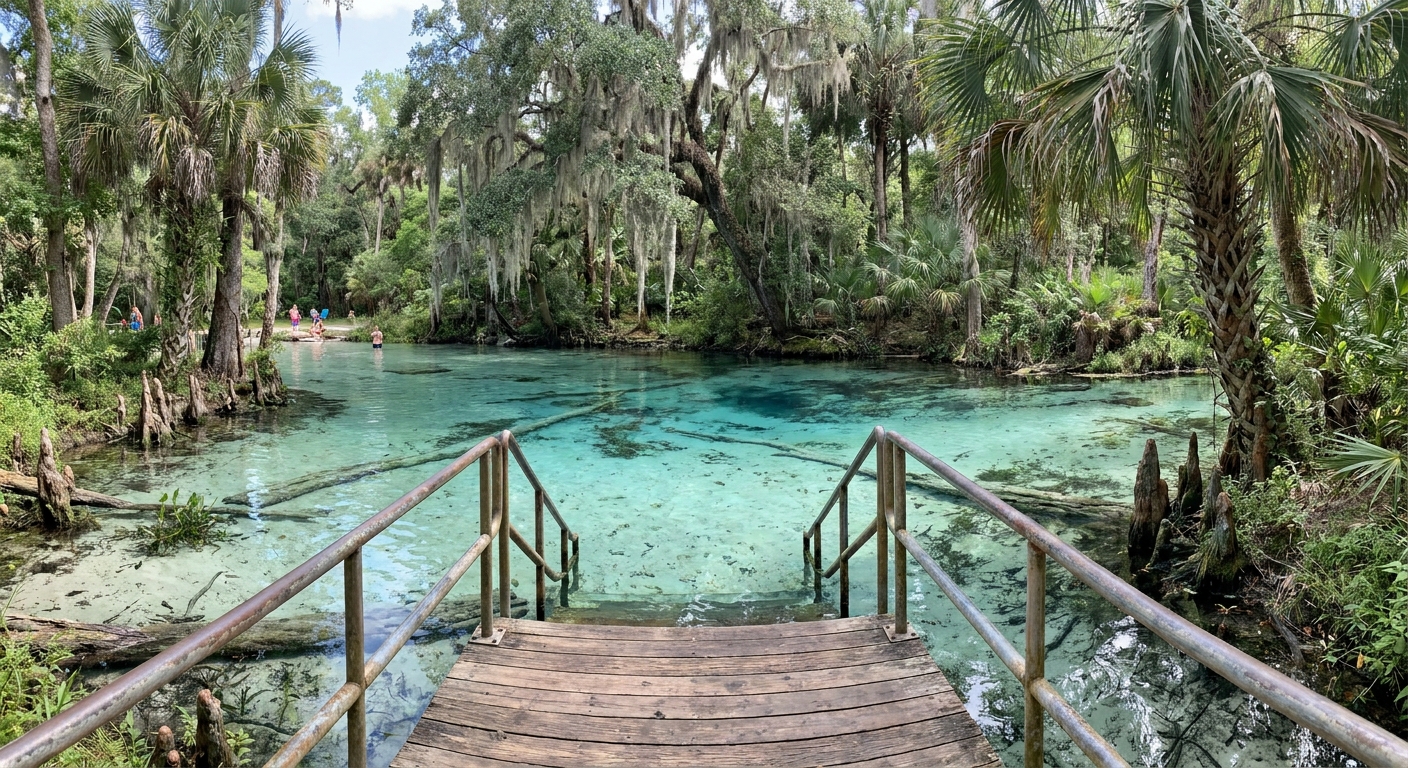
January gives you the one thing the hot months cannot: room. With 300 spaces deciding a summer Saturday, a cool winter weekday puts the boardwalk, the platforms and the water under far less pressure. The swim itself becomes an act of warming up rather than cooling down, and that reversal is the month’s whole character.
The park is compact, and the state’s own 2024 inventory counts it: 0.2 miles of hiking trail, 285 feet of boardwalk, 2 observation platforms and 1 designated swimming area. That single swim area is where swimming happens. Florida’s environmental department names Wakulla Springs for deep cave diving by researchers and scientists, not for visitors wandering in, and the depths it describes are not open to a recreational swimmer.
What the month changes is the air above all this, never the water below. In July the 70.3°F basin is relief from the heat; in January the same 70.3°F sits nearly 30 degrees above the average dawn and about 6 above the average afternoon. The observation platforms are the part that feels most seasonal, since standing still in 45-degree air asks for the fleece you were carrying anyway.
We cannot tell you what is free in January, and would rather say that than guess: the fee schedule and the hours could not be read, and we found no manatee count for the spring, so we promise no animals and no free days. Our manatee guide covers the winter gatherings that are documented elsewhere in the state.
Wakulla Spring in January: a two-day itinerary
Day one runs on the warm middle. Leave breakfast around 9, be parked by 10 while the air is still climbing out of the low forties, and take the 285 feet of boardwalk and both observation platforms first, when hands are cold and the walking helps. Swim between noon and 3, when the thermometer is nearest 63.9°F. Dry off, change, and be back in the car before the light goes at 6:00.
Day two is the flexible one, and the weather decides it. On 5.6 days in an average January the rain reaches a tenth of an inch, and on 1.3 it passes a full inch: if your second morning draws one of those, spend it in Tallahassee and keep the water for the afternoon, since the spring’s temperature is identical whether the sky is grey or blue. Our things-to-do guide holds the indoor options.
Wakulla Spring in January vs December and February
| Measure | December | January | February |
|---|---|---|---|
| Average high | 65.9°F | 63.9°F | 67.8°F |
| Average low | 42.9°F | 40.5°F | 43.5°F |
| Precipitation | 4.24 in | 4.41 in | 4.28 in |
| Days with 0.10 in or more | 5.8 | 5.6 | 5.5 |
| Spring water | No seasonal swing | No seasonal swing | No seasonal swing |
Across the three months the air moves less than four degrees and the water does not move at all. January is the coldest of the trio on both ends, 2.0°F below December’s high and 3.9°F below February’s, and it is also the wettest, at 4.41 inches against 4.24 and 4.28. Rain days barely separate them: 5.8, 5.6 and 5.5, a difference of one wet day every few years.
Shifting four weeks forward to February buys 3.9 degrees of afternoon and 3.0 of dawn, with a shade less rain, and costs nothing measurable. Shifting back to December buys 2.0 degrees and lands you in the holiday weeks, when Florida beds are at their most contested. Either way the swim is the same temperature, so the decision is about what you wear on the walk back.
Is January a good time to visit Wakulla Spring?
Yes, if the water is the point. Swimmers who do not mind a cold deck get a 70.3°F pool with almost no competition for the 300 spaces, and wildlife watchers get the platforms without a queue. No, if the point is lying in the sun: a 63.9°F average high is a sweater afternoon, and families with small children will spend real effort on the dressing and undressing at both ends.
If that tips you to no, take February. It is the warmest of the three months at 67.8°F by day and 43.5°F at night, with 5.5 rain days instead of 5.6, and it is still outside the summer window when the lot decides who gets in. Nothing about the spring itself improves; the hour before and after the swim simply gets easier. Our family guide is the one to read first if the party includes small children.
What January alone delivers is the widest gap of the winter between the air and the water: 6.4 degrees, against 4.4 in December and 2.5 in February.
The last word
Book the nearer bed, be at the gate mid-morning, and put yourself in the water between noon and three: that single decision is what a 10-hour January day rewards. One more thing worth knowing about the place you are swimming in. Florida law puts Wakulla in a protected class it calls Outstanding Florida Springs, covering every historic first-magnitude spring the Florida Geological Survey recognizes plus six more named by hand in statute 373.802(5). The state built a legal category around water like this.
Sources & data for this guide
- January, December and February normals (highs, lows, precipitation, rain days, freeze nights) · NOAA NCEI monthly normals 1991-2020, station USW00093805, Tallahassee, FL · checked Sep 24, 2026
- Daylight, sunrise and sunset on January 15 · sunrise-sunset.org · checked Sep 24, 2026
- Water temperature of 70.3°F · U.S. Geological Survey, National Water Information System, station 02327000 Wakulla Spring, instantaneous reading · checked Sep 24, 2026
- 300 parking spaces, 285 feet of boardwalk, 0.2 miles of trail, 2 observation platforms, 1 designated swimming area · Florida Department of Environmental Protection, Recreational Facilities Inventory 2024 · checked Sep 24, 2026
- Outstanding Florida Springs protected class · Florida Statutes 373.802(5) · checked Sep 24, 2026
- Deep cave diving framing · Florida DEP, Visit a Spring · checked Sep 24, 2026
- We could not read the park’s entrance fee or opening hours (the state park site returns 403 to automated reads), we could not verify a county lodging-tax rate, and we found no manatee count for the spring, so we give no price, no hour and no animal number.