
FLORIDA · WAKULLA SPRING · MARCH
March is the month the air catches up with the water at Wakulla Spring. Average afternoons reach 74.2°F, while the spring basin itself was reading 70.3°F at the USGS gauge the last time it was checked. Under four degrees separate the two, and no other month on the way up does that: February afternoons average cooler than the spring, April afternoons run about ten degrees above it.
The month takes its payment before breakfast. Average lows sit at 48.6°F, roughly two nights reach 32°F or below, and 5.24 inches of rain fall across the four weeks. A March day therefore carries two climates: a morning that wants a fleece and an afternoon that wants a towel. For the park outside of March, our Wakulla Springs guide covers it.
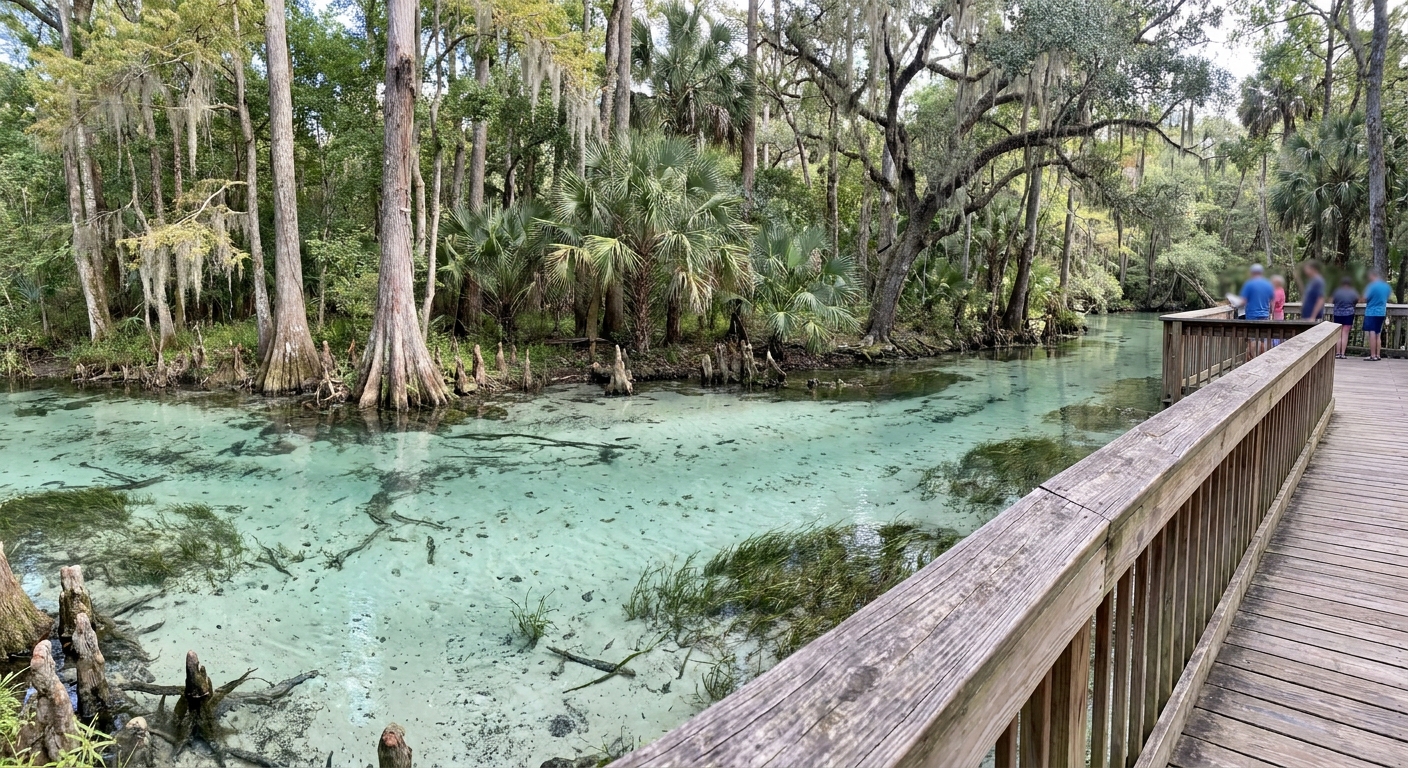
THE MONTH AT A GLANCE · WAKULLA SPRING · MARCH
March is the first month of the year when an average afternoon is warmer than the spring water, so swimmers finally get a reward for getting out, as long as they accept 48.6°F mornings.
AVG HIGH 74.2°F · WATER NEAR 70.3°F · 5.6 WET DAYS · 12H 02M OF DAYLIGHT ON THE 15TH
Go for: a swim in 70.3°F water under afternoons that are finally warmer than it, plus 0.2 miles of trail, 285 feet of boardwalk and two observation platforms you can stand on without sweating.
Think twice before: planning the whole trip around one swim: 5.24 inches of rain fall this month, 1.5 days of an average March bring an inch or more, and 2.1 nights drop to freezing.
Air: NOAA NCEI 1991-2020, Tallahassee station · Water: USGS gauge 02327000 · Facilities: Florida DEP inventory 2024
On this page
- Wakulla Spring weather in MarchHighs of 74.2°F, 5.6 wet days
- What to wear in March, morning and afternoon48.6°F at dawn, 74.2°F by two
- Crowds and parking in March300 spaces, and no fee we could verify
- Things to do at the spring in MarchThe swim area, the boardwalk, the platforms
- A two-day plan built on the lightFrom 7:44 a.m. to 7:46 p.m.
- March, February or April?How the three months compare
- Is March a good month to come?Our answer for swimmers and for walkers
- Wakulla Springs in any other monthThe park guide
Two instruments feed the normals below, and they sit in different places. The air figures are NOAA NCEI 1991-2020 monthly normals from a real station thermometer, not a grid-cell reanalysis. The water figure is a single instantaneous reading from a U.S. Geological Survey gauge inside the spring, not a monthly average of daily highs, and the gauge comes back close to that value every day of the year.
Wakulla Spring weather in March: average highs, lows and rain days
| Measure | March |
|---|---|
| Average high | 74.2°F |
| Average low | 48.6°F |
| Total precipitation | 5.24 in |
| Days with 0.10 in or more | 5.6 |
| Days with 1.00 in or more | 1.5 |
| Nights at 32°F or below | 2.1 |
| Daylight on March 15 | 12 hours 02 minutes |
| Sunrise and sunset, March 15 | 7:44 a.m. · 7:46 p.m. |
| Spring water at the USGS gauge | 70.3°F (21.3°C) |
NOAA’s National Centers for Environmental Information puts March at station USW00093805 in Tallahassee at an average high of 74.2°F, an average low of 48.6°F and 5.24 inches of precipitation over the 1991-2020 period. That thermometer stands about 27 miles (44 km) inland from the spring, so take these as the region’s March air rather than the basin’s own microclimate. The water belongs to a different instrument entirely.
Measurable rain shows up on 5.6 days in an average March, roughly one day in five, and only 1.5 of those days deliver an inch or more. The usual wet March day is a band that crosses and clears rather than a sky that settles in. For a spring visit that is workable: the swim can wait two hours, and the 285 feet of boardwalk stay walkable under a rain jacket.
From 48.6°F at dawn to 74.2°F by mid-afternoon, the average day swings 25.6 degrees, a bigger spread than most people pack for in Florida. Fleece and long pants for the first two hours, shorts and a shirt after eleven, a full change of dry clothes for after the swim. Towels do double duty in March, because a body leaving 70.3°F water before noon cools faster than the same body leaving it in July.
On March 15 the sun is up for 12 hours and 02 minutes, from 7:44 a.m. to 7:46 p.m. local time, with daylight saving already running. Those clock times are the UTC sunrise and sunset converted to the Eastern zone. The practical consequence is that an early start costs you nothing: there is still light at seven in the evening for a second turn on the platforms after the swim.
How warm is Wakulla Spring in March?
74.2°F is an average, not a ceiling: half the March afternoons in the record run warmer than that. Set against the neighbors, March highs land 6.4 degrees above February’s 67.8°F and 6.0 degrees below April’s 80.2°F, the larger of the two steps in the local spring. The month’s other pole is 48.6°F, and the distance between those two figures is what makes a March day feel like two days stitched together.
Pack for the morning and dress down for the afternoon. A start near 50°F calls for a fleece and closed shoes on the 0.2 miles of trail; by two o’clock the same walk is a t-shirt. The swim ignores both: 70.3°F water is cold enough that most people gasp on the first step, whatever the air is doing above it.
Freezing has not quite finished by March. The normals count 2.1 nights at 32°F or below in an average month at the Tallahassee station, and we cannot put a date on any of them, since monthly normals give a count and never a calendar. If your nights are spent outdoors anywhere in the area, that is the number to pack against.
How busy is Wakulla Spring in March?
We found no occupancy series and no monthly room-rate series for this corner of Florida, so we crown no month expensive and no month cheap. What the state does publish is capacity: 300 parking spaces at Edward Ball Wakulla Springs State Park, counted in the Florida DEP facilities inventory for 2024. When the lot fills, the gate closes, and that is the only demand mechanism we can document.
Lead time for a day visit is measured in hours rather than weeks. Sunrise on March 15 is 7:44 a.m., and a car in the lot before ten never has to negotiate with a closed gate. Which March weeks carry school vacations across the Southeast, we could not verify, so treat any Saturday this month as a filling day and any Tuesday as an easy one.
We could not verify a Wakulla County lodging-tax rate, so no percentage comes from us. The same goes for the gate: our sources carry no entrance fee and no opening hour for this park, and Florida fees vary by park and by season, so a figure borrowed from another spring would be a guess wearing a decimal point. Call the park before you build the budget, and use our Florida cost guide for the rest of the trip.
Money changes one thing in March, and it is not admission. A 70.3°F swim under a 48.6°F sunrise rewards gear a July swim never needs: a wetsuit top if you own one, a thick towel, dry clothes waiting in a warm car. After that, a second day beats any upgrade, because two mornings double your odds against a month that rains one day in five.
Things to do in Wakulla Spring in March
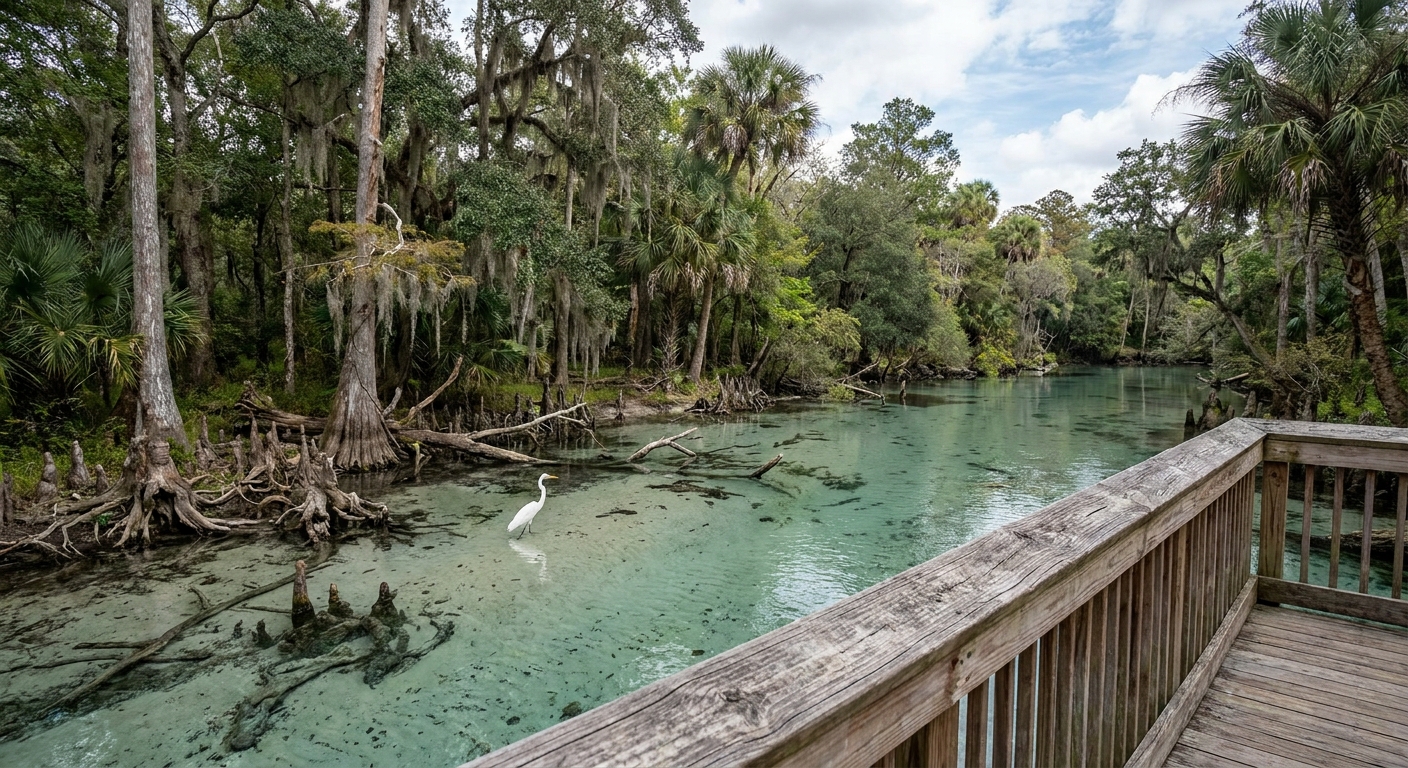
Swimming is what March adds. February afternoons average 67.8°F, which is 2.5 degrees cooler than the spring water itself, so a February swimmer climbs out into air that offers no reward. March reverses the arithmetic: 74.2°F above, 70.3°F below. April widens the same gap to about ten degrees and turns the swim into an ordinary summer pleasure.
Everything countable at Edward Ball Wakulla Springs State Park is small and specific: one designated swimming area, 0.2 miles of hiking trail, 285 feet of boardwalk, two observation platforms and the 300-space lot. Florida law also puts the spring in a protected class of its own, the Outstanding Florida Springs of Statute 373.802(5), which covers every historic first-magnitude spring plus six more named by hand in the text.
One of those numbers never moves. The gauge in the spring comes back near 70.3°F all year, while the air above it travels 12.4 degrees between the February and April normals. March changes nothing in the water, then. It changes how long you are willing to stand on the two platforms with wet hair. In February that is a short visit. By April the 300 spaces matter more than the thermometer does.
What a March day costs at the gate, we cannot tell you: floridastateparks.org returned a 403 to our automated reads on September 11, 2026, so we hold no entrance fee, no opening hour and no seasonal manatee count for this spring. We therefore promise no free hour and no manatee. If manatees are the reason for the trip, our manatee guide points at the water where the encounter is documented.
Wakulla Spring in March: a two-day itinerary
Day one runs on the light. Sunrise at 7:44 a.m. puts you on the trail in air near 50°F. That is walking temperature rather than standing temperature, so take the 0.2 miles of path first, then the 285 feet of boardwalk, and save the two observation platforms for half past eight when the low sun is still on the water. Swim between one and four, when the day is closest to its 74.2°F average, and come back to the platforms before the light goes at 7:46 p.m.
Day two is the hedge. One March day in five records at least a tenth of an inch, and 1.5 days of an average March bring an inch or more, so keep the second morning movable: swim on whichever day is clear, walk on whichever is not. If the rain sets in for an afternoon, the drive back toward Tallahassee, about 27 miles (44 km) inland, is the standard escape, and our getting-around guide has the driving rules for the state.
Wakulla Spring in March vs February and April
| Measure | February | March | April |
|---|---|---|---|
| Average high | 67.8°F | 74.2°F | 80.2°F |
| Average low | 43.5°F | 48.6°F | 54.4°F |
| Precipitation | 4.28 in | 5.24 in | 3.53 in |
| Days with 0.10 in or more | 5.5 | 5.6 | 4.3 |
| Spring water at the gauge | About 70.3°F | About 70.3°F | About 70.3°F |
| Afternoon air against the water | 2.5°F cooler | 3.9°F warmer | 9.9°F warmer |
Across the three months the water stays put and the air does all the traveling: 67.8°F in February, 74.2°F in March, 80.2°F in April, against a spring reading near 70.3°F throughout. Rain peaks in the middle, with 5.24 inches in March against 4.28 in February and 3.53 in April. Wet days barely separate the first two months, 5.5 against 5.6, and April is the drier month on both counts, 3.53 inches spread over 4.3 days.
Shifting four weeks in either direction is a straight trade. Going back to February saves 0.96 inch of rain and hands you afternoons that never beat the water, on mornings averaging 43.5°F. Going forward to April buys six degrees of afternoon, 1.71 inches less rain and a comfortable margin over the spring. Our February page makes the winter case in full, and the statewide calendar sets these weeks against the rest of Florida.
Is March a good time to visit Wakulla Spring?
Yes for swimmers who can take a cold entry and a cold start to the day, and yes for walkers, since 74.2°F is close to ideal for standing still on a boardwalk. No for anyone whose plan is an afternoon of sunbathing after the swim, and no for a family whose youngest will not get back into 70.3°F water a second time.
If the answer is no, take April instead: 80.2°F highs, 54.4°F lows, 3.53 inches of rain over 4.3 wet days, and nearly ten degrees between air and water, so the swim ends in warmth rather than a sprint to the towel. The cost of that comfort is competition for the same 300 spaces.
No other month gives you the crossing point: March is when the afternoon air first passes the spring’s own temperature, by 3.9 degrees, so neither reading has the upper hand over the other.
The last word
Book the morning, not the day. Florida’s own springs pages describe Wakulla Springs as a place for deep cave diving by researchers and scientists, a useful reminder that the water people swim in here is the lid on something much larger. You get 12 hours and 02 minutes of light on March 15 and one designated swimming area to spend it on: be at the gate at 7:44 with a fleece, swim at two, drive home with the heater running.
Sources & data for this guide
- March air normals (74.2°F high, 48.6°F low, 5.24 in, 5.6 days at 0.10 in, 1.5 days at 1.00 in, 2.1 nights at 32°F or below) · NOAA NCEI monthly normals 1991-2020, station USW00093805, Tallahassee, FL · checked Sep 24, 2026
- February and April normals used in the comparison · same NOAA NCEI series and period · checked Sep 24, 2026
- Daylight, sunrise and sunset for March 15, converted from UTC to Eastern daylight time · sunrise-sunset.org · checked Sep 24, 2026
- Spring water 70.3°F (21.3°C), a single instantaneous reading, not a monthly average · USGS National Water Information System, station 02327000 Wakulla Spring · read Sep 11, 2026
- 300 parking spaces, one designated swimming area, 0.2 miles of trail, 285 feet of boardwalk, two observation platforms · Florida DEP Recreational Facilities Inventory, 2024 annual report · checked Sep 24, 2026
- Outstanding Florida Springs definition · Florida Statutes 373.802(5) · checked Sep 24, 2026
- Description of the spring as a deep cave-diving site · Florida DEP, Visit a Spring · checked Sep 24, 2026
- What we could not verify: entrance fee, opening hours and any seasonal manatee count. floridastateparks.org returned 403 to our automated reads on Sep 11, 2026, and the FWC manatee page renders client-side. Call the park before you drive.