
WAKULLA SPRING · FEBRUARY · THE MONTH GUIDE
February sets up an arrangement Florida rarely offers: the water is warmer than the air above it. The USGS gauge inside the spring read 70.3°F (21.3°C) on September 11, 2026, and it reads close to that every day of the year. The average February afternoon in this corner of the Panhandle tops out at 67.8°F.
What you trade for that is an early alarm in the cold and a short usable afternoon: mornings average 43.5°F, 5.2 nights a month fall to freezing, and the sun is down by 6:26 p.m. mid-month. What you gain is room. The park counts 300 parking spaces, and in February nobody is racing you to one.
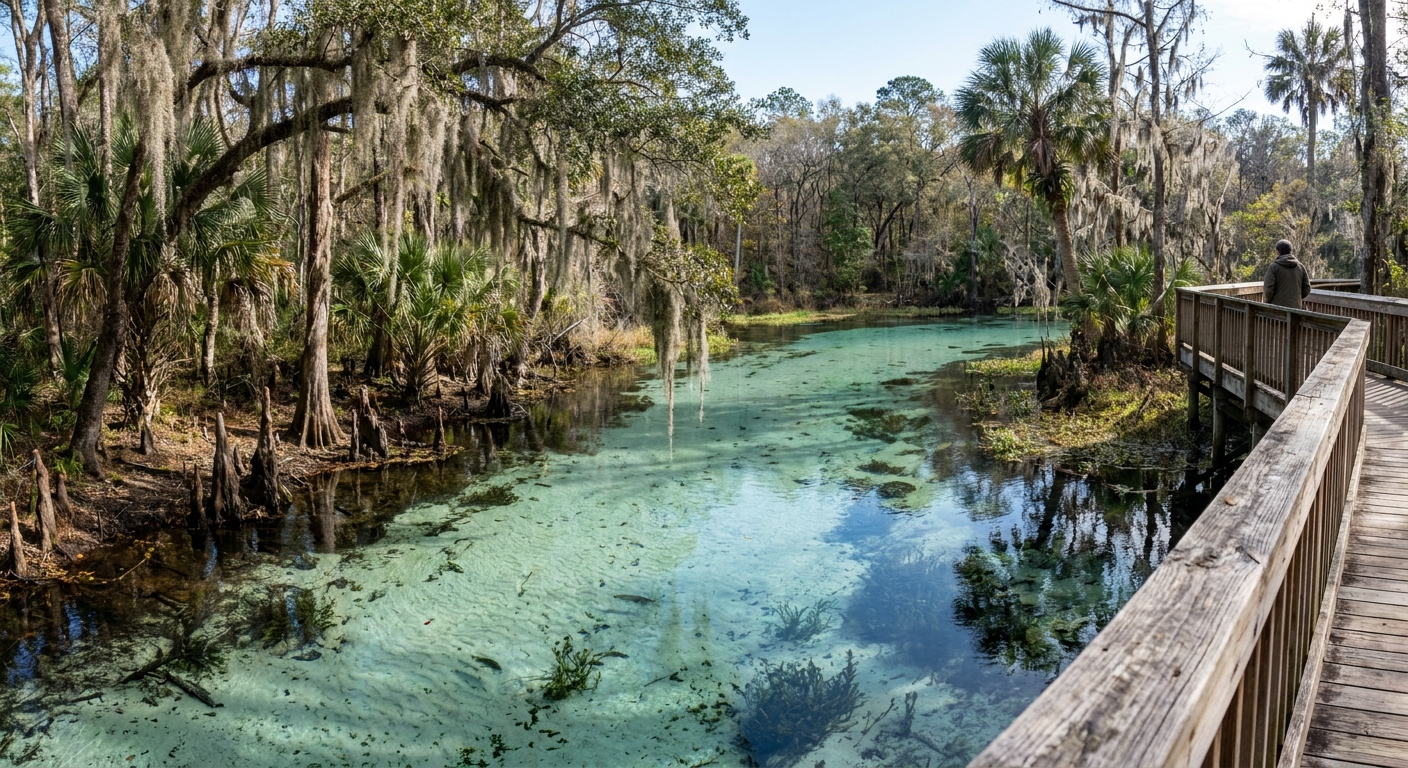
THE MONTH AT A GLANCE · WAKULLA SPRING · FEBRUARY
February hands you a spring running 2.5°F warmer than the average afternoon, cold dawns near 43.5°F, and a 300-space lot with room in it.
NOAA 1991–2020 NORMALS · TALLAHASSEE STATION, 27 MILES AWAY · SPRING 70.3°F ALL YEAR
Go for: a swim in water that outranks the air, an uncrowded 285-foot boardwalk, and wading-bird sightlines from two observation platforms.
Think twice before: building a sunbathing day around a 67.8°F average high, or promising anyone manatees: we could not verify a February count.
Air: NOAA NCEI 1991–2020, Tallahassee station · Water: USGS gauge 02327000 · Facilities: Florida DEP inventory, 2024
On this page
- Wakulla Spring weather in February67.8°F highs, 4.28 inches, 5.5 wet days
- How cold it gets overnight43.5°F lows and 5.2 freezing nights
- Is the park crowded in February?300 spaces, and what we could not price
- Things to do at the spring in FebruaryOne swim area, 285 feet of boardwalk
- A two-day plan around the daylightSunrise 7:16, swim at 1, out by 6:26
- February against January and MarchHow the three months compare
- Is February a good month to go?Yes for a midday swim, no for a beach day
One caveat before the numbers: every air figure here is measured at Tallahassee, about 27 miles from the spring, and it describes air only. The spring has no season. If you are still choosing a month for the state at large, our Florida calendar sorts all twelve, and the park itself, year-round, sits in the Wakulla Springs guide.
Wakulla Spring weather in February: average highs, lows and rain days
| Measure | February |
|---|---|
| Average high | 67.8°F |
| Average low | 43.5°F |
| Precipitation | 4.28 in |
| Days with 0.10 in or more | 5.5 |
| Days with 1.00 in or more | 1.3 |
| Nights at 32°F or below | 5.2 |
| Daylight on Feb 15 | 11h 10m |
| Spring water | 70.3°F (21.3°C) |
The air numbers come from NOAA NCEI’s 1991–2020 monthly normals at station USW00093805 in Tallahassee, roughly 27 miles (44 km) inland of the spring: a high of 67.8°F, a low of 43.5°F, 4.28 inches of precipitation. That is a real thermometer at a real airfield, not a reanalysis grid cell, and it is worth knowing which one you are reading, because the two disagree by a few degrees on winter minimums. Read it as the regional signal, not as a reading taken at the spring boil.
Rain of at least 0.10 inch falls on 5.5 days in an average February, roughly one day in five, and 1.3 of those days deliver an inch or more. Those 4.28 inches do not arrive as the fifteen-minute afternoon bursts an August visitor learns to plan around. A wet February day here can stay wet through lunch, which is the difference between waiting out a shower on the boardwalk and driving somewhere with a roof.
Between dawn and mid-afternoon the thermometer moves 24.3°F, from 43.5°F to 67.8°F. Pack for both ends of that in one bag: a fleece and a light shell for the 8 a.m. parking lot, a t-shirt for 3 p.m., and a second dry fleece for after the swim, since 67.8°F air dries nobody quickly.
On February 15 the sun rises at 7:16 a.m. and sets at 6:26 p.m. local time, giving 11 hours 10 minutes of daylight (sunrise-sunset.org). The warm block is narrower than the bright one. Treat 12:30 to 4 p.m. as the day’s working window and let the early hours go to birds and coffee.
How warm is Wakulla Spring in February?
Two anchor numbers carry the month: 67.8°F by day, 43.5°F by night, a spread of 24.3°F between the average afternoon and the average dawn. Set the spring against them and the ranking flips. At 70.3°F on the USGS gauge, an instantaneous reading taken at station 02327000 on September 11, 2026 and typical of the whole year, the water runs 2.5°F above the average February afternoon.
In practice you dress twice. A morning on the boardwalk wants long pants, a fleece and something windproof. By one o’clock most people are down to a t-shirt and regretting the third layer they carried. Swimmers should plan the exit, not the entry: a towel, dry clothes and a warm car matter more in February than anything you wear into the water.
Frost is a genuine part of this month. An average February records 5.2 nights at 32°F or below, so a windshield scrape before an early start is normal rather than freak weather. The spring does not notice. It was still reading 70.3°F when the gauge was checked, and it holds near that figure whatever the air did overnight.
How busy is Wakulla Spring in February? Crowds, prices and the demand peak
We found no occupancy series and no monthly room-rate data for the Wakulla area, so we crown no month cheap and no month expensive. What the state does publish is capacity: 300 parking spaces at Edward Ball Wakulla Springs State Park. The Florida DEP inventory is blunt that this number, not an opening hour, decides a summer Saturday, since the gate closes when the lot fills. February sits inside Florida’s dry season, and the pressure on those 300 spaces comes later in the year.
We could not verify any timed-entry or reservation system for the park, so we name no lead time in weeks. Your booking decision in February is really a lodging decision: the nearest bed clusters are around Tallahassee, 27 miles up the road, and the drive is what sets your arrival hour. Aim to be parked by mid-morning and the capacity question never reaches you.
We could not verify a lodging-tax rate for Wakulla County, so we give no percentage. Florida’s county tourist-development taxes are levied locally and change by ordinance, which is exactly why a rate copied from Miami-Dade would be wrong here. Budget the room at the quoted rate plus state and county tax, and see what a Florida trip costs for the shape of the rest.
Spend the money on the car. No transit line to the spring turned up in our checks, and a February day here is built from short drives: the park in the warm middle hours, Tallahassee for dinner and a roof if the weather turns. Our getting-around guide covers the rental transponder and the electronic-only tolls you will meet before you get this far north.
Things to do in Wakulla Spring in February
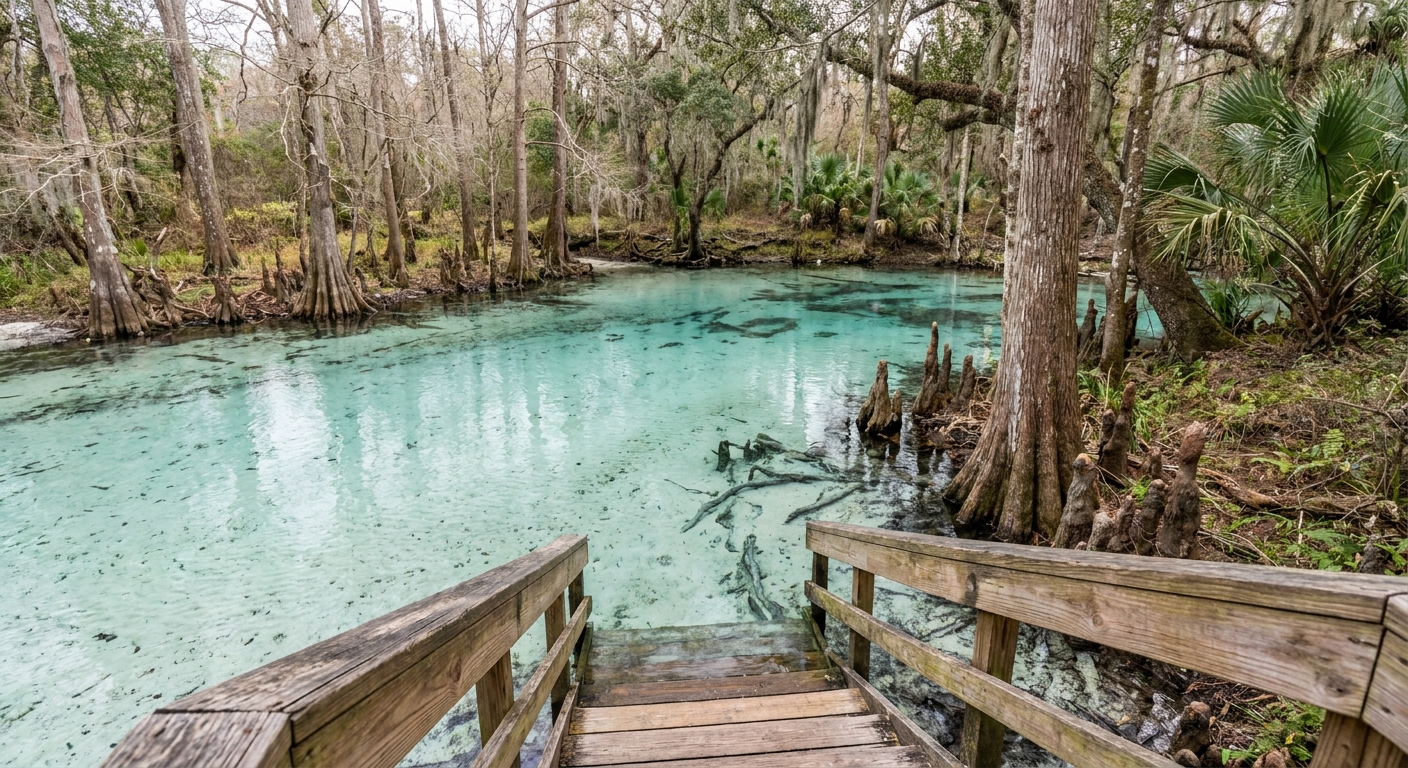
February is the stretch when you step down into water warmer than the air you left behind: 70.3°F against a 67.8°F average high. It is cold enough that most people gasp on the first step, in any month. The difference in February is what happens after. Instead of climbing out into heat, you climb out into air cooler than the pool, and the towel becomes the important piece of equipment.
Edward Ball Wakulla Springs State Park is compact, and the state counts it precisely: 0.2 miles of hiking trail, 285 feet of boardwalk, two observation platforms, one designated swimming area and those 300 parking spaces (Florida DEP Recreational Facilities Inventory, 2024). That inventory is a useful reality check. This is a place you experience in one small area and from two railings, not a park you hike across.
The 285 feet of boardwalk do not change through the year. The air standing on them does: 63.9°F on an average January afternoon, 67.8°F in February, 74.2°F by March. February is the narrow band where the platform is comfortable in a fleece and the water below still outranks it, and that gap is the whole seasonal argument for coming now rather than in eight weeks.
We could not verify the park’s entrance fee, its posted hours, or any February manatee count: the Florida State Parks site returns 403 to automated reads, and the FWC manatee pages render in-browser only. So we quote no price and promise no animals. What the law does say is that Wakulla belongs to the Outstanding Florida Springs, a class that Florida Statutes 373.802(5) builds from every historic first-magnitude spring plus six more named by hand. For warm-water manatee viewing elsewhere in the state, see our manatee guide.
Wakulla Spring in February: a two-day itinerary
Day one runs on the light. Sunrise is 7:16 a.m. mid-month and the first hours sit near 43.5°F, so drive in for 9 and give the cold part of the morning to the boardwalk and the two observation platforms. Break for an early lunch out of the wind. Swim between 1 and 3 p.m., when the day is closest to its 67.8°F average, dry off properly, then walk the 0.2 miles of trail before the 6:26 p.m. sunset takes the color away.
Day two repeats the warm-hours swim with less clock-watching, and adds the 27-mile run into Tallahassee for dinner. If one of the month’s 5.5 wet days lands on you, and 1.3 of them bring an inch or more, invert the plan: the water is the same 70.3°F in rain, so swim regardless and move the indoor half of the day forward. Our things-to-do guide lists what else the state keeps under a roof.
Wakulla Spring in February vs January and March
| Measure | January | February | March |
|---|---|---|---|
| Average high | 63.9°F | 67.8°F | 74.2°F |
| Average low | 40.5°F | 43.5°F | 48.6°F |
| Precipitation | 4.41 in | 4.28 in | 5.24 in |
| Days with 0.10 in or more | 5.6 | 5.5 | 5.6 |
| Spring water | near 70.3°F | near 70.3°F | near 70.3°F |
February runs 3.9°F warmer by day than January and 6.4°F cooler than March. Nights move the same way, 43.5°F against 40.5 and 48.6. Rain barely separates January from February, 4.41 inches against 4.28 on effectively the same 5.6 and 5.5 wet days, and then March adds almost an inch, 5.24 inches spread over the same number of days. The spring ignores the whole argument at about 70.3°F.
Shift four weeks forward and you buy 6.4°F of afternoon and an easier moment climbing out of the water. You pay with 0.96 inch more rain, heavier single downpours on the same day count, and a state that turns loud in March, as our month-by-month verdict spells out. Shift four weeks back and January costs you almost four degrees by day for no rain saving at all.
Is February a good time to visit Wakulla Spring?
Yes, if the swim is the point and you accept the exit. Anyone who wants an uncrowded railing, a short swim in 70.3°F water and a fast change into dry clothes gets a very good month. No, if you are picturing a lounging day on the grass: 67.8°F with a breeze is jacket weather for most people, and families with small children will find the getting-out harder than the getting-in.
If the answer is no, go in March. The reason is the 74.2°F average afternoon: the water will be exactly the same, so every degree you gain lands on the part of the day that February makes uncomfortable. The bill arrives as 5.24 inches of rain over the month and company in the lot, and for a spring day that trade is usually worth making.
February is the month when the 70.3°F water outranks the 67.8°F air by 2.5 degrees, and March’s warmer afternoons end that inversion.
The last word
Pick a weekday, drive the 27 miles from Tallahassee to be parked by ten, and give the water the warm middle of the day. One line from the state is worth carrying in your head as you look at that blue: Florida DEP names Wakulla Springs for deep cave diving by researchers and scientists rather than for recreational swimmers, and writes that Florida’s springs offer a chance to probe depths where few will ever go. You get the one designated swimming area, which is plenty. Call the park for the gate price and the hours before you set off, because we could not read either.
Sources & data for this guide
- February air normals, wet days and freezing nights · NOAA NCEI monthly normals 1991–2020, station USW00093805, Tallahassee, FL, about 27 miles from the spring · checked Sep 24, 2026
- January and March normals, same station and same 1991–2020 period · NOAA NCEI · checked Sep 24, 2026
- Spring water 70.3°F (21.3°C), instantaneous gauge reading · U.S. Geological Survey, National Water Information System, station 02327000 Wakulla Spring · read Sep 11, 2026
- Daylight, sunrise and sunset for February 15, converted from UTC to local time · sunrise-sunset.org · checked Sep 24, 2026
- 300 parking spaces, 285 feet of boardwalk, 0.2 miles of trail, two observation platforms, one designated swimming area · Florida Department of Environmental Protection, Recreational Facilities Inventory, 2024 annual report · read Sep 11, 2026
- Outstanding Florida Springs definition · Florida Statutes 373.802(5), leg.state.fl.us · read Sep 11, 2026
- Cave-diving description of the spring · Florida DEP, Visit a Spring · read Sep 11, 2026
- We could not verify the entrance fee, the opening hours or any February manatee count: floridastateparks.org returned 403 to automated reads and FWC’s manatee pages render client-side · Sep 11, 2026