
GINNIE SPRINGS · FLORIDA · MAY
The air over Ginnie Springs averages 87.4°F on a May afternoon. The water in the vents read 72.7°F the last time the USGS gauge there was checked, and it reads close to that in February too. Nearly fifteen degrees separate the two. Hot enough on the bank to want the water, cool enough in the water to make you catch your breath on the ladder.
April never quite gets there: afternoons average 81.5°F, and the swim stays optional. June overshoots the other way, at 90.3°F with 7.56 inches of rain across eleven wet days. May lands between them with 3.08 inches. For everything that stays true all year at the spring, from dive logistics to where the campsites sit, the Ginnie Springs guide holds it.
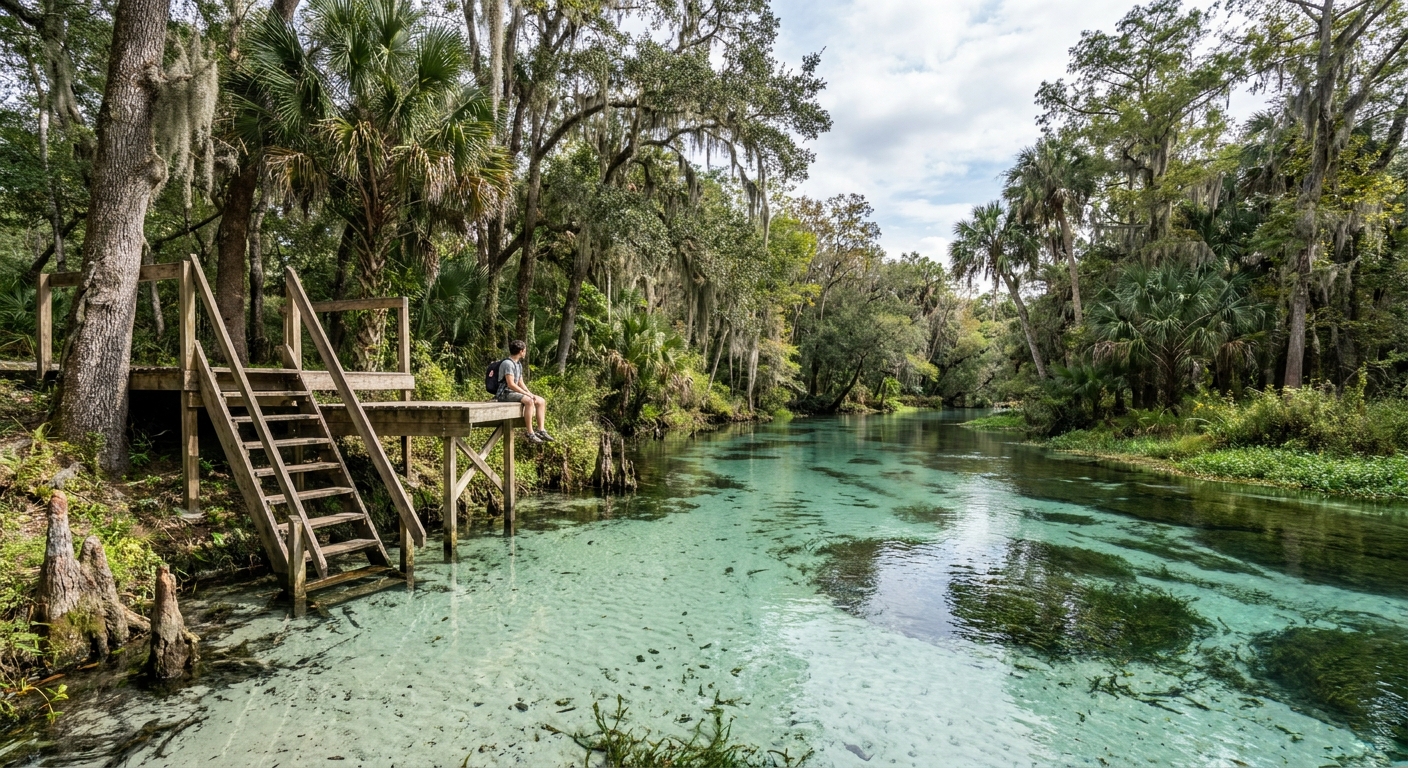
THE MONTH AT A GLANCE · GINNIE SPRINGS · MAY
May pairs 87.4°F afternoons with spring water near 72.7°F and only 3.08 inches of rain, the last full month before June’s 7.56 inches arrive.
AVG HIGH 87.4°F · AVG LOW 62.6°F · 3.08 IN OF RAIN · WATER NEAR 72.7°F
Go for: long warm afternoons on the bank, water near 72.7°F that ignores the season, and daylight running to 8:18 pm on May 15.
Think twice before: planning around a gate price or a quiet Saturday. Florida DEP names Ginnie among the state’s most popular springs diving destinations, and we could not verify an entrance fee or an opening hour.
Air: NOAA NCEI 1991-2020 normals, Gainesville Regional Airport · Water: USGS gauge 02322400 · full sources at the end
On this page
- Average highs, lows and rain days in May87.4°F, 62.6°F and 4.5 wet days
- What to wear on a 62.6°F May morningThe 24.8-degree day-night spread
- Crowds and what a May day costsThe gate price we could not verify
- Things to do at the springs in MayThe vents, Peacock Springs and the dive scene
- A two-day plan for Ginnie SpringsA 6:35 am swim and an 8:18 pm sunset
- May, April or June?How the three months compare
- Is May a good time to go?Who should go, who should wait
- Ginnie Springs in AprilCooler air, 2.74 inches of rain
One caveat before the numbers start. Every air figure here comes from NOAA NCEI’s 1991-2020 monthly normals for station USW00012816 at Gainesville Regional Airport, about 48 miles from the spring, so these are readings from one instrument rather than a smoothed reanalysis grid cell. They describe the air. The water figure comes from a single instantaneous USGS reading, not a monthly average, and the spring has no season anyway.
Ginnie Springs weather in May: average highs, lows and rain days
| May at Ginnie Springs | Figure |
|---|---|
| Average high | 87.4°F |
| Average low | 62.6°F |
| Total precipitation | 3.08 in |
| Days with 0.10 in or more | 4.5 |
| Days with 1.00 in or more | 1.0 |
| Daylight, May 15 | 13h 43m · 6:35 am to 8:18 pm |
| Spring water | 72.7°F (22.6°C), gauge reading |
NOAA NCEI’s 1991-2020 normals put May’s average high at 87.4°F, its average low at 62.6°F and its rainfall at 3.08 inches. That is a station record from Gainesville Regional Airport, the nearest official thermometer with a full normals period. Inland north Florida in May behaves like the end of the dry season: warm, bright, and not yet handed over to the daily storm pattern that the state’s wet season runs from June onward.
Rain falls on 4.5 days in an average May at 0.10 inch or more, which works out to measurable rain roughly one day in seven. The other 26 or so days record less than a tenth of an inch, dry enough to leave the towels on the line. A May shower at this latitude tends to be an afternoon build-up that passes in under an hour, so the plan that survives it is a plan with a shaded hour built in, not a plan with a spare day.
Nights give back almost 25 degrees: 62.6°F on average against that 87.4°F afternoon. Campers feel it far more than day visitors. A bathing suit that dried by four in the afternoon is genuinely cold at six the next morning, so the packing list needs a long-sleeve layer, a second dry towel and closed shoes for the walk up from the water. Nothing in the month calls for a coat.
On May 15 the sun rises at 6:35 am and sets at 8:18 pm local time, for 13 hours 43 minutes of daylight. An after-work swim is a real option in May, and a mid-afternoon arrival still puts you in the water with two hours of light to spare. Below the surface, light fades before the clock says it should, so the deeper part of a dive day belongs to the middle hours.
How warm is Ginnie Springs in May?
The warmest hours of a May day average 87.4°F and the coolest average 62.6°F, a spread of 24.8 degrees inside a single date. April opens wider, 81.5°F down to 55.5°F, and June closes to 20.8 degrees as nights hold at 69.5°F. The spring joins none of it: USGS gauge 02322400 read 72.7°F (22.6°C) on September 11, 2026, and it reads close to that number every day of the year.
That produces the small surprise of a May dawn. At around 62.6°F the air is roughly ten degrees cooler than the water, so the first swim of the day warms you up and the towel is what you need at the top of the ladder. By two in the afternoon the relationship has flipped by nearly fifteen degrees the other way. Morning calls for a fleece and shoes, afternoon calls for shade, sunscreen and the water itself.
We could not verify a count of nights at or below freezing for May, because the normals we read give monthly averages rather than daily tallies, so we give no number. What we can say is the scale of the gap: a monthly average low of 62.6°F sits 30 degrees above freezing, and even April, the coldest month in our set, averages 55.5°F overnight.
How busy is Ginnie Springs in May? Crowds, prices and the demand peak
We found no occupancy series and no monthly rate series for the springs, so we crown no month cheap and no month expensive. What the calendar supports is narrower: May is the last month before June’s 7.56 inches and eleven wet days, and the Florida Department of Environmental Protection names Ginnie Springs, with Peacock Springs, among the most popular and interesting springs diving destinations in the state. Assume company on a dry warm Saturday and a thinner bank midweek.
On booking, the same discipline applies. We could not verify a reservation window, a sell-out pattern or a cancellation policy for May weekends, so we give no lead time in weeks. The move that costs nothing is a phone call to the property before you load the car, and a refundable bed as backup while you wait for the forecast. Our Florida lodging guide covers the regional options around a springs trip.
We could not verify a local lodging-tax rate either, so we give no percentage and no total. Read the tax line on your own reservation before you set the budget, and price the rest of the trip from what a Florida week costs. A number lifted from a coastal county will not transfer to a spring on the other side of the state.
One place where spending more genuinely changes May: sleeping at the water instead of driving in for the day. A night on site puts you in 72.7°F water at 6:35 am, when the air is still at its 62.6°F floor and the surface is glass, and lets you come back out again at seven in the evening with an hour of light left. We could not verify camping rates here, so confirm them at the gate.
Things to do in Ginnie Springs in May
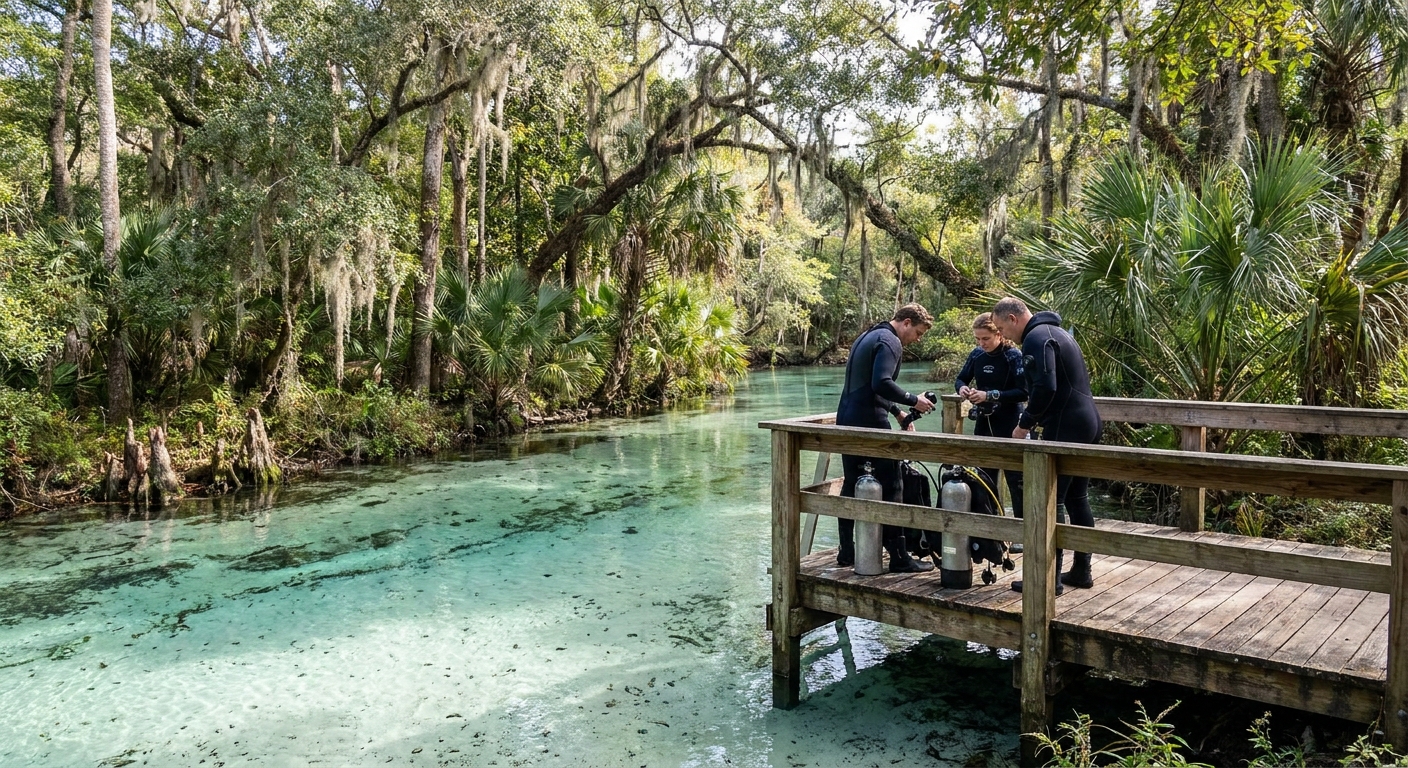
April afternoons average 81.5°F, warm enough to sit out all day and mild enough that the swim can wait until you feel like it. May’s 87.4°F removes the debate at about noon, and it does so on 3.08 inches of rain rather than June’s 7.56. That combination, heat that pushes you in and a sky that mostly stays open, belongs to May more than to the month on either side of it.
The main event is the water itself, measured at 72.7°F (22.6°C) by USGS gauge 02322400 on the spring run. Diving is the other draw: the state names Ginnie alongside Peacock Springs, a separate site, among Florida’s most popular springs diving destinations. Florida law reserves the label Outstanding Florida Springs for every historic first-magnitude spring plus six named by hand in statute 373.802(5). We could not verify whether Ginnie’s vents make that list, so we do not claim it.
None of the water changes in May. The air does, and that is the entire seasonal effect at a spring: the same 72.7°F that felt bracing in April, under an 81.5°F sky, reads like air conditioning under an 87.4°F one. Divers notice none of it below the surface and all of it on the walk back to the car in full gear, which is the argument for a first dive before nine.
We could not verify any free day, free entry window or published opening hour for May, so we name none and you should call. What costs nothing with certainty is the light: 13 hours 43 minutes of it on May 15, holding until 8:18 pm, against a winter afternoon that would have closed the bank hours earlier.
Ginnie Springs in May: a two-day itinerary
Day one runs early. In the water by 7 am, when the air sits near 62.6°F and the spring is about ten degrees warmer than it. Dry off and eat at nine, dive or drift the first run between ten and one, then take the 87.4°F peak out of play with shade and a long lunch from two to four. Back in the water at five, out at seven, and the sun still does not set until 8:18 pm.
Day two swaps the order if the sky looks unsettled, because the rain in May arrives with the afternoon heat far more often than at dawn. Front-load everything before one o’clock, keep the car close, and treat a dark hour as an hour. If a system parks itself over north Florida, the drive south toward the rest of the state’s springs and coasts is an easy pivot, and the driving notes cover the tolls.
Ginnie Springs in May vs April and June
| April | May | June | |
|---|---|---|---|
| Average high | 81.5°F | 87.4°F | 90.3°F |
| Average low | 55.5°F | 62.6°F | 69.5°F |
| Precipitation | 2.74 in | 3.08 in | 7.56 in |
| Days with 0.10 in or more | 3.8 | 4.5 | 11.0 |
| Spring water | near 72.7°F | near 72.7°F | near 72.7°F |
Across the three months the water is the constant and the air does all the moving. April to May adds 5.9 degrees to the afternoon and 7.1 to the night, on a third of an inch more rain. May to June adds only 2.9 degrees to the afternoon but 4.48 inches of rain, and wet days more than double from 4.5 to 11.0. That single jump is the clearest line in the whole table.
Shift four weeks earlier and you trade heat for calm: April gives 2.74 inches and 3.8 wet days, but a 55.5°F dawn makes an early swim a colder decision. Shift four weeks later and June hands you the warmest water entry of the three, since the air never drops below 69.5°F, at the cost of rain on roughly one day in three. May buys the dry sky and pays for it with one chilly hour at sunrise.
Is May a good time to visit Ginnie Springs?
Yes, for swimmers, tubers and divers who want heat on the bank and a sky that mostly stays open: 87.4°F afternoons, 3.08 inches of rain, 4.5 wet days. Less so for anyone who camps badly in a 25-degree temperature swing, or who wants a springs weekend with nobody else on it, since the state’s own listing tells you how well known this water is.
If the crowd matters more than the heat, April is the swap: cooler at 81.5°F, drier at 2.74 inches, with the same 72.7°F water waiting. If the animals are the reason for the trip, this is the wrong season entirely, and the winter manatee gathering at Crystal River is the trip to book instead. We could not verify any manatee count for this spring in any month.
What May alone offers, out of the three months, is an afternoon that clears 87°F while rainfall stays near three inches, so the contrast with 72.7°F water arrives without June’s wet-day tax.
The last word
Book the night rather than the day trip, and set an alarm for 6:30 am: the first hour of a May day is the one where the spring is warmer than the air above it, and it is gone by nine. If the sky darkens after lunch, keep some perspective. An average May records just one day with an inch of rain or more, and the other thirty are the kind you wait out under a roof with a sandwich before going back in.
Sources & data for this guide
- May air normals (87.4°F high, 62.6°F low, 3.08 in) · NOAA NCEI monthly normals 1991-2020, station USW00012816, Gainesville Regional Airport, FL · checked Sep 24, 2026
- Rain-day counts (4.5 days at 0.10 in or more, 1.0 day at 1.00 in or more) · same NOAA NCEI normals · checked Sep 24, 2026
- April (81.5°F / 55.5°F / 2.74 in / 3.8 days) and June (90.3°F / 69.5°F / 7.56 in / 11.0 days) · same NOAA NCEI normals and same period · checked Sep 24, 2026
- Daylight of 13h 43m, sunrise 6:35 am and sunset 8:18 pm on May 15, converted from UTC · sunrise-sunset.org · checked Sep 24, 2026
- Spring water 72.7°F (22.6°C) · USGS National Water Information System, station 02322400 Ginnie Springs, single instantaneous reading rather than a monthly average · checked Sep 24, 2026
- Outstanding Florida Springs definition, first-magnitude springs plus six named in statute · Florida Statutes 373.802(5) · checked Sep 24, 2026
- Ginnie and Peacock Springs named among the state’s most popular and interesting springs diving destinations · Florida DEP, Visit a Spring · checked Sep 24, 2026
- Entrance fee, opening hours and manatee counts: we could not read them. floridastateparks.org returned 403 to automated reads on Sep 11, 2026, and the FWC manatee page renders client-side. Call the property before you drive.
- Scope note: the air normals come from a station about 48 miles from the spring. Conditions at the water can differ, and the spring itself has no season.