
PORTUGAL · KNOW BEFORE YOU GO · TEN LESSONS FROM OUR FIRST TRIPS
The rules of a Portugal trip live on other pages of this site. This one collects the things that aren’t rules at all: the small local logic that our desks worked out slowly, over a first dinner that cost more than the menu said, a museum door closed on a Monday, and one memorable slide down a wet sidewalk in the wrong shoes.
Paperwork, risk and the suitcase are settled elsewhere, in the entry guide, on the safety page and in the packing list. Everything here is lived experience, in the first person, with the embarrassments left in.
THE LESSONS AT A GLANCE · PORTUGAL
Learn what the bread on the table costs, eat two hours later than you want to, buy shoes with grip, and read Lisbon’s map in vertical meters: after that the country stops feeling like a test.
THE COUVERT IS BILLED · DINNER STARTS LATE · THE PAVEMENT IS SLIPPERY · THE OCEAN IS COLD
If you keep one thing: Portugal is formal at the door and warm once you’re through it, so greet first, ask second, and never touch the olives you haven’t decided to buy.
Where the rules live: this page assumes you’ve done the five-minute homework on entry and skimmed how the trains and cars work. It repeats neither.
An experience page: desk notes from our own trips, with every checkable fact linked to the page that sources it
On this page
- The bread, olives and cheese I didn’t orderThe couvert, and cash in small tascas
- When Portuguese kitchens serve dinnerDinner hours, pastelaria breakfasts, Monday closures
- Greetings, cheek kisses, ordering coffeeBom dia first, and the café vocabulary
- Why the walk took twice as longCalçada, Lisbon’s hills, cold water
Couvert in Portugal: what the bread and olives cost, and cash or card
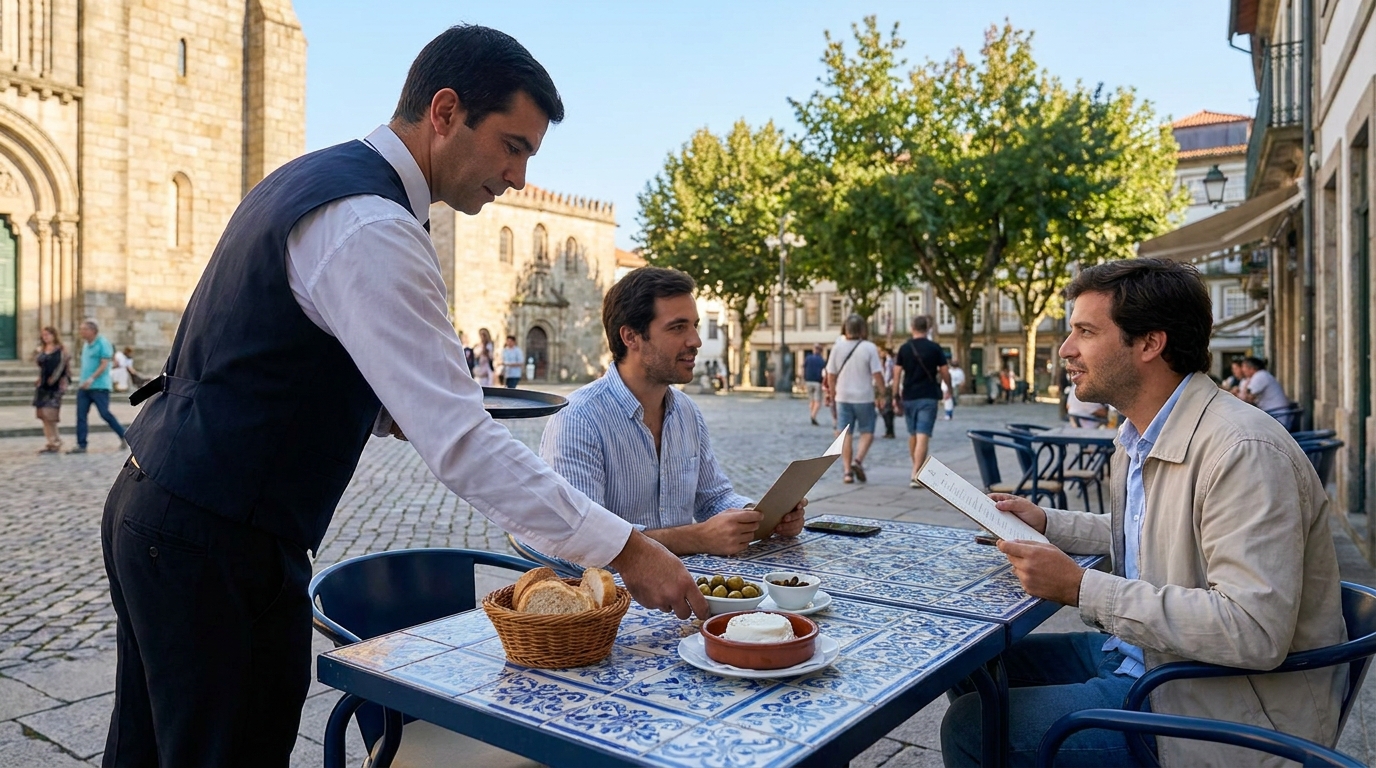
Our first dinner in Alfama arrived before we ordered: a basket of bread, a saucer of olives, a wedge of sheep’s cheese, a small dish of butter. We assumed hospitality. The bill assumed commerce, and listed each item separately. That’s the couvert, and it is neither a scam nor a tip. It’s a menu line, priced per person and usually modest, that you accept by touching it. The move is simple and nobody takes offense: a smile and não, obrigado as the plates land, and they go back untouched. The same applies to the entradas that follow in seafood houses, a plate of ham or a few shrimp set down conversationally. Keep what you want, return the rest immediately rather than after grazing. We now decide before the waiter’s hand leaves the table, which has spared us the small mathematical surprise at the end.
Cards run almost everywhere, but the country’s ATM and payment network, Multibanco, still leaves gaps where you least expect them: neighborhood tascas with a handwritten lunch board, market stalls, a village café pouring three coffees an hour. Twenty or thirty euros in notes in your pocket (est.) solves all of it. The wider budget picture, tiers and daily spending included, sits in the cost guide.
Portuguese meal hours: dinner from 8, pastelaria breakfasts, museums shut on Monday
Show up hungry at 6:30pm and you’ll be seated in a dining room where the chairs are still upside down on the tables. Kitchens in Portugal serve lunch through the early afternoon, then reopen for dinner around 7:30 or 8 (est.), and the room fills properly closer to 9. Our fix was to stop fighting it: a late afternoon pastry, a glass of vinho verde at 7, dinner when the locals arrive. The food is better when the kitchen is awake.
Breakfast runs on a different institution entirely. The pastelaria is the morning: you stand at the counter, order a galão in its tall glass or a coffee, eat something warm and buttery, pay a small amount and leave in six minutes. Hotel buffets exist for people who don’t know this. Sitting at a table often costs a little more than standing at the bar, which is why the counter is three deep at eight in the morning.
The weekly rhythm catches Americans out twice. Many Portuguese museums and palaces close on Mondays, so a first day off the plane is better spent on hills, markets and riverfronts than on ticket lines.
Sunday afternoons in small towns go genuinely quiet, shops shuttered, one café open. Plan Monday around walking, using the Lisbon list to pick what’s open, and buy your Sunday supplies on Saturday.
Portuguese greetings and etiquette: bom dia and cheek kisses
Portuguese politeness is front-loaded. A bom dia or boa tarde comes before the question, in the shop, at the ticket window, entering a small restaurant. Skip it and your perfectly friendly request reads as brusque, which is how we spent our first two days being served correctly but coolly. Faz favor gets a waiter’s attention across a room. Com licença gets you through a crowded tram.
The two-kiss greeting is real, and it is for friends and social introductions, not for the bakery. With strangers and in any transaction, a handshake and eye contact are the register. The reserve is not coldness. It’s a door that opens fast once you’ve knocked: ask a shopkeeper what she’d eat for lunch and you’ll get directions, an opinion on the neighborhood, and possibly a taste of something.
Coffee has its own short vocabulary, worth ten minutes of study. Um café means an espresso, full stop, and in Lisbon you’ll hear it called uma bica. Morning milk comes as a galão in a glass or a meia de leite in a cup. Ask for a large drip coffee and you’ll get a kind, puzzled improvisation. Our desks now order by pointing at what the person ahead ordered, which has never once failed.
Lisbon hills and calçada cobblestones: best shoes and Atlantic water temperature
The mosaic pavement underfoot, calçada portuguesa, is hand-set limestone polished by a century of shoes. Dry, it’s the prettiest sidewalk in Europe. Wet, it behaves like a tilted ice rink, and most of Lisbon and Porto is tilted. Leather soles and smooth-bottomed fashion sneakers are the two ways to fall. Grip is the entire criterion, which is why our packing list puts shoes at the top and everything else after.
Distances lie here, because the map is flat and the city is not. Five hundred meters between two points can mean twenty minutes (est.) of staircase, a wrong turn onto a dead-end alley, and a pause at a miradouro to pretend you were always stopping for the view. We plan Lisbon in vertical meters now: one hill per half-day, funiculars and the elevador treated as transport rather than photo stops. The city guide is built around the same arithmetic.
Then the water, which is the lesson visitors resist hardest. This is the Atlantic, not the Mediterranean, and the coastal upwelling keeps it bracing through the height of summer. People swim, briefly, loudly, and get out. Beach days here are about the cliffs, the sand and the sardines rather than a long float, and the month-by-month guide gives the sea temperatures their sources before you promise anyone a swimming vacation.
Portugal travel tips: couvert, meal times and Multibanco
| The lesson | The mistake it prevents |
|---|---|
| Decide on the couvert before you touch it | Paying for bread you never wanted |
| Send back the entradas you don’t keep | Grazing your way into an extra course |
| Carry notes for small tascas and markets | The card-machine standoff at a village counter |
| Book dinner for 8, not 6:30 (est.) | Eating alone in a room being set up |
| Take breakfast standing at a pastelaria | Missing the country’s best six minutes |
| Say bom dia before the question | Reading as brusque in your first sentence |
| Order um café when you want espresso | A kind, puzzled improvisation in a cup |
| Handshake first, cheeks only when offered | Mistaking formality for coldness |
| Buy shoes for grip, not for the photos | Meeting wet calçada on a slope |
| Read Lisbon in hills, not in meters | The twenty-minute five-hundred-meter walk (est.) |
| Check the museum’s closed day before Monday | The locked door at the top of the climb |
| Treat the Atlantic as cold water | Promising the family a warm swim |
The last word
None of these lessons appear on a sign, which is why they cost us money, ankles and one entirely wasted Monday in Lisbon. Together they point the same direction: Portugal runs slightly later, slightly more formally and slightly steeper than you expect, and it hands you the good version of itself the moment you stop hurrying it. Order the galão standing up. Say good morning to the woman selling the bread. Then put it to work on a real route: seven days, city to valley or ten days north to south. If Lisbon is your only base, the capital has its own set of unwritten rules, tram etiquette and hill logic included.
Sources & data for this guide
- This is an experience page: the lessons are editorial judgment from our desks’ trips in Portugal, deliberately unsourced because they are observations rather than published facts
- Amounts, meal hours and closing days here are field impressions marked (est.), not quoted prices or official schedules
- Every checkable fact touched on (entry rules, safety picture, sea temperatures, costs, transport) is sourced on its linked page · entry, safety, best time, trip cost, getting around · checked Sep 14, 2026
- Re-read in our monthly refresh alongside the rest of the Portugal file