
FLORIDA · MADISON BLUE SPRING · FEBRUARY
February here is a month of two temperatures. The air, measured at the nearest official thermometer, averages 67.0°F by day and 42.2°F at night. The water leaving the vent read 73.2°F when the USGS gauge was checked, and it reads close to that on every day of the year.
That gap is what you are buying. Mornings drop to 32°F or below on 3.8 nights in an average February, afternoons climb into the high sixties, and the spring takes no notice of either. Rain falls on about five days, and on the 15th the sun sets at 6:21 p.m.
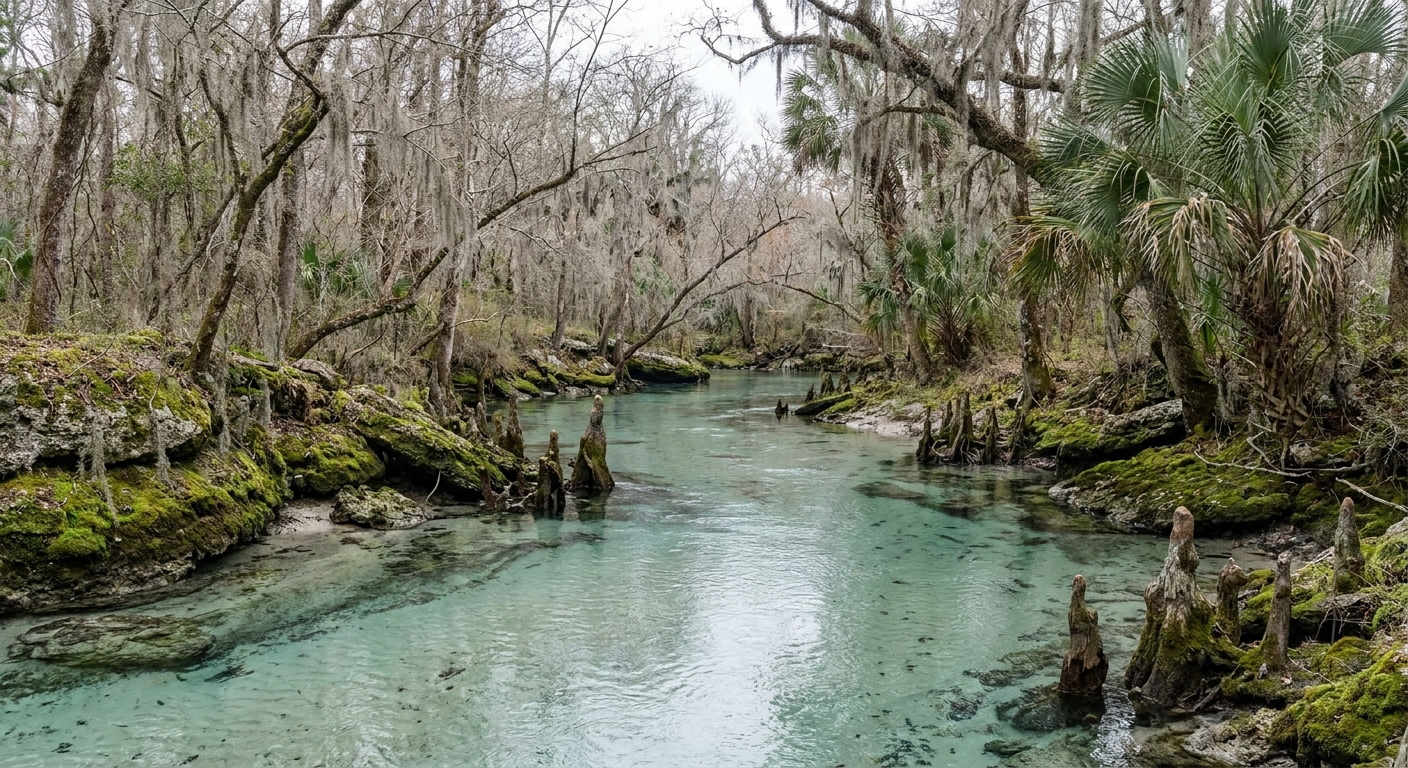
THE MONTH AT A GLANCE · FEBRUARY
Come in February for 67.0°F afternoons above water that sits near 73.2°F, and plan around 3.8 nights at or below freezing and 5.4 days with measurable rain.
NOAA 1991-2020 NORMALS · THERMOMETER 27 MILES AWAY · NO DESIGNATED SWIM AREA
Go for: water near 73.2°F under the driest of the three winter months (3.31 inches), bare hardwoods letting light onto the run, and 11 hours 10 minutes of daylight on the 15th.
Think twice before: planning a family float day: the state’s 2024 facilities inventory lists no designated swimming area at this park and no canoe, kayak or tube launch.
Air: NOAA NCEI 1991-2020 · Water: USGS gauge 02319302 · Facilities: Florida DEP 2024 inventory · full sources at the end
On this page
- February highs, lows and rain daysThe NOAA normals, and where the thermometer sits
- How cold it feels getting out of the water24.8 degrees between dawn and mid-afternoon
- Crowds, booking and the county lodging taxWhat we verified and what we could not
- Things to do at the spring in FebruaryThe park, the gauge and Statute 373.802(5)
- A two-day plan built on 11 hours of lightHour by hour, clear day and wet day
- February vs January and MarchHow the three months compare, degree by degree
- Is February a good month to come?Yes for the water, no for a float day
Everything below is dated to February. For the spring itself in any month, the main guide is the place to start, and the statewide calendar sets February inside Florida’s dry half of the year.
Madison Blue Spring weather in February: average highs, lows and rain days
| Measure | February | Where it comes from |
|---|---|---|
| Average high | 67.0°F | NOAA NCEI 1991-2020, Valdosta Rgnl AP |
| Average low | 42.2°F | NOAA NCEI 1991-2020 |
| Precipitation | 3.31 in | NOAA NCEI 1991-2020 |
| Days with 0.10 in or more | 5.4 | NOAA NCEI 1991-2020 |
| Days with 1 in or more | 1.0 | NOAA NCEI 1991-2020 |
| Nights at 32°F or below | 3.8 | NOAA NCEI 1991-2020 |
| Daylight on Feb 15 | 11 h 10 min | sunrise-sunset.org |
| Water at the vent | 73.2°F | USGS gauge 02319302, Sept 11, 2026 |
The normals below come from NOAA’s NCEI 1991-2020 series, station USW00093845 at Valdosta Regional Airport in Georgia, about 27 miles from the spring. February there averages 67.0°F by day, 42.2°F at night and 3.31 inches of rain. Every figure here describes the air: there is no long-run thermometer in the spring run, and the nearest official one sits across the state line. Read the highs as a fair guide to a February afternoon in the parking area, and no further than that.
An average February logs 5.4 days with at least 0.10 inch of rain, which works out to something measurable roughly one day in five. One of those days, on average, brings an inch or more. A two-day trip therefore has a decent chance of catching one gray stretch and a small chance of catching the single soaking day of the month.
Dawn near 42°F and mid-afternoon near 67°F, 24.8 degrees apart, is two climates inside one day. Pack for both: a fleece and a wool hat for the first two hours of light, a t-shirt for the middle of the day, and a towel plus a dry change of clothes kept in the car. Anyone getting in the water wants that warm layer waiting on the bank rather than in the trunk.
On February 15 the sun rises at 7:12 a.m. and sets at 6:21 p.m. local time, for 11 hours 10 minutes of daylight. Two of those hours are not much use: the first after sunrise is the coldest stretch of the day, and by 5 p.m. the light under the trees is already going. Aim to be in the water by late morning and out while the air is still near its high.
How warm is Madison Blue Spring in February?
The water answers first. A USGS gauge at the spring, station 02319302, read 73.2°F (22.9°C) on September 11, 2026. That is one instantaneous reading rather than a monthly mean, and a spring of this size holds close to the same figure every day of the year. The air is the part that moves: 67.0°F at its February average high, 42.2°F at its average low, a spread of 24.8 degrees.
At 7:30 a.m. you want the jacket and the hat, and gloves are not ridiculous. By two in the afternoon, 67°F in the sun is shirtsleeve weather at a picnic table, and still cool enough that a wet swimsuit turns miserable within minutes. Order matters more than gear here: get in when the air is at its warmest, not when you happen to arrive.
Frost is a normal February event at the Valdosta station, with 3.8 nights at or below 32°F, roughly one night in seven. Ice on a windshield at 7 a.m. changes nothing about the spring, which read 73.2°F when we checked the gauge and will be near that on the coldest morning of the month. If you are sleeping in a tent anywhere in the region, rate the bag for freezing and not for Florida.
How busy is Madison Blue Spring in February? Crowds, prices and the demand peak
February falls inside Florida’s dry season, November through April, the half of the year the state sells hardest, as our statewide calendar lays out. Past that calendar fact we can rank nothing: we found no occupancy series and no monthly room-rate series for this corner of north Florida, so we crown no month cheap and no month expensive.
Nothing at the spring takes a booking as far as our sources go. The Florida DEP inventory lists no launch and no designated swim area to reserve, and we could not read the park’s own page: floridastateparks.org answers automated requests with a 403. Call before you drive if your day depends on a gate being open. Beds and the drive are the parts to settle in advance, and our getting-around guide covers the rental and toll questions.
We could not verify a county lodging-tax rate, so we give no percentage and no nightly total. Rates are set county by county in Florida, and one copied from Orange or Monroe County would be a fiction at this latitude. Ask the property for the tax line before you compare two quotes.
The one place where spending more changes February is what you wear in the water. Air at 42.2°F at dawn makes getting out colder than getting in, and a thicker suit with a hood turns a ten-minute look into a full afternoon. We could not verify rental rates near the park, so bring your own exposure gear if you own it.
Things to do in Madison Blue Spring in February
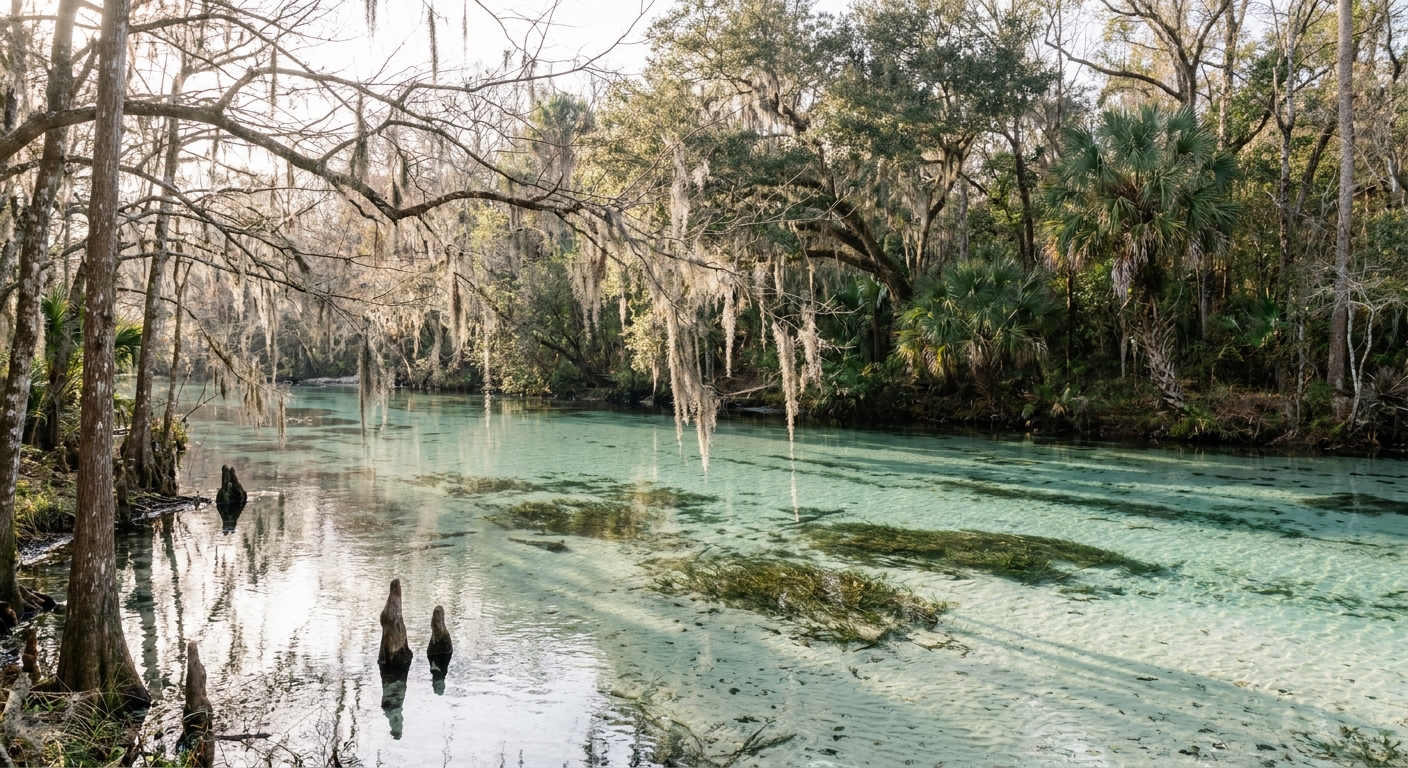
February is the month when the spring is warmer than the air above it for most of the day. The average high, 67.0°F, sits 6.2 degrees below the 73.2°F the gauge read at the vent. By March the two nearly meet, 72.9°F air against 73.2°F water, and in summer the order reverses. The bare hardwoods help too: no canopy means low winter sun reaches the water in a way it never does in July.
Madison Blue Spring State Park is the whole of the destination. The USGS gauge on site, station 02319302, gave that 73.2°F reading on September 11, 2026. Florida law places the spring in the class it calls Outstanding Florida Springs under Statute 373.802(5), covering every historic first-magnitude spring as the Florida Geological Survey determines them, plus six more named by hand in the text. The state’s 2024 Recreational Facilities Inventory lists no designated swimming area here and no canoe, kayak or tube launch.
The water has no season. The air does, and it moves the arithmetic month to month: the vent sits 10.4 degrees above January’s average high, 6.2 above February’s and 0.3 above March’s. That shrinking gap is what a four-week shift buys or costs. February also runs the lowest rainfall total of the three, 3.31 inches, so the odds of an open-air lunch are marginally better than on either side.
We could not verify a single price here, free or otherwise. Florida park fees vary by park and by season, and the official site returns a 403 to automated reads, so a figure borrowed from another spring would be invented rather than checked. Read the rate posted at the entrance before you build the day around it, and treat anything you find on a third-party page as unconfirmed.
Madison Blue Spring in February: a two-day itinerary
Day one runs on the light. Sunrise on the 15th is 7:12 a.m. and the hour after it is the coldest of the day, so spend it driving. Arrive between 9 and 10, walk the run while the sun climbs above the trees, and get in around 11 as the air heads toward its 67.0°F high. Out by early afternoon, dry layer waiting on the bank, lunch late and in the sun. Keep any long drive for after 3 p.m., because the light under the canopy fades well before the 6:21 p.m. sunset.
Day two is the one you adapt. Clear morning: repeat the sequence earlier, since you now know where everything is, and free the afternoon for the road home or for something else in north Florida. One of the 5.4 wet days: the water is still 73.2°F and rain stops mattering the moment you are under it. The exit is what changes, because a downpour plus 42.2°F air at dusk is the combination to avoid. Move the swim to the middle of the day and keep the dry clothes in the car.
Madison Blue Spring in February vs January and March
| January | February | March | |
|---|---|---|---|
| Average high | 62.8°F | 67.0°F | 72.9°F |
| Average low | 38.6°F | 42.2°F | 47.2°F |
| Precipitation | 3.83 in | 3.31 in | 3.73 in |
| Days with 0.10 in or more | 4.1 | 5.4 | 5.6 |
| Water at the vent | near 73.2°F | near 73.2°F | near 73.2°F |
Across the three months the daytime average climbs 10.1 degrees, from 62.8°F in January to 72.9°F in March, with February at 67.0 in the middle. Nights follow the same staircase: 38.6, then 42.2, then 47.2. February is the driest of the three by total rainfall, 3.31 inches against 3.83 and 3.73, yet it records more wet days than January, 5.4 against 4.1. The water is the flat line through all of it, near 73.2°F in every one of the three.
Shift four weeks earlier and you gain the widest spread between water and air, 10.4 degrees, plus the lowest wet-day count of the three; you lose 4.2 degrees off the afternoon and you add colder nights. Shift four weeks later and March hands you air within half a degree of the water and longer days, at the cost of 5.6 wet days and a thermometer that no longer makes the spring feel like a warm bath. Our January page makes the cold-air case in full.
Is February a good time to visit Madison Blue Spring?
Yes, if the water is the point and you arrive equipped for it: 73.2°F under 67.0°F air is the kind of contrast people drive for, and 3.31 inches makes February the least rainy of the winter months. No, if you pictured a family float day. The state’s 2024 inventory lists no designated swimming area and no launch at this park, and a 42.2°F morning with a wet towel is a hard sell to a nine-year-old.
If that is a no, move to March. Days average 72.9°F, nights 47.2, and the air lands within half a degree of the water, so the exit costs you nothing. The trade is more rain days, 5.6 against 5.4, and a busier statewide calendar once spring break reaches the roads.
What February holds alone among the three: the lowest rainfall total of the winter, 3.31 inches, with afternoons already 4.2 degrees warmer than January’s.
The last word
Decide on the water, not on the forecast. The same gauge that read 73.2°F measured 72 cubic feet per second leaving the vent, and that volume is why the spring stays clear in any weather: it is replaced faster than it can cloud. So book the bed, read the fee posted at the entrance rather than one found online, and shape the day around the 7:12 a.m. sunrise and the 6:21 p.m. sunset of February 15.
Sources & data for this guide
- February air normals (67.0°F high, 42.2°F low, 3.31 in, 5.4 days at 0.10 in, 1.0 day at 1 in, 3.8 nights at or below 32°F) · NOAA NCEI monthly normals 1991-2020, station USW00093845, Valdosta Rgnl AP, GA, about 27 miles from the spring · checked Sep 24, 2026
- January and March normals used in the comparison · same NOAA NCEI 1991-2020 series and station · checked Sep 24, 2026
- Sunrise 7:12 a.m., sunset 6:21 p.m. and 11 h 10 min of daylight on February 15 · sunrise-sunset.org · checked Sep 24, 2026
- Water at 73.2°F (22.9°C) and discharge of 72 cubic feet per second, one instantaneous reading rather than a monthly average · U.S. Geological Survey, National Water Information System, station 02319302 Madison Blue Spring · read September 11, 2026
- No designated swimming area, no canoe, kayak or tube launch listed at this park · Florida Department of Environmental Protection, Recreational Facilities Inventory, 2024 annual report · checked Sep 24, 2026
- Outstanding Florida Springs class and its definition · Florida Statutes 373.802(5), leg.state.fl.us · checked Sep 24, 2026
- We could not verify entrance fees, opening hours, manatee counts or a county lodging-tax rate: floridastateparks.org returns a 403 to automated reads and the FWC manatee page renders client-side · noted September 11, 2026
To plan your stay
- Madison Blue Spring: When to Go, Month by Month Highs, Rain and Daylight
- Madison Blue Spring in January: Weather, Water Temperature and Freeze Nights
- Madison Blue Spring in March: Weather, Water Temperature and Rain Days
- Madison Blue Spring in April: Weather, Water Temperature and How It Compares to March and May