
FLORIDA · WARM MINERAL SPRINGS · FEBRUARY
The calendar changes very little in the water here, and that is exactly why the date is worth choosing carefully. The USGS gauge at the spring read 84.6°F (29.2°C) on September 11, 2026, and it reads close to that on any day of any month. February changes the air above it: afternoons average 74.9°F, the hour before sunrise averages 54.6°F. Stepping into water almost ten degrees warmer than the day around you is a winter pleasure that no August visit can sell you.
February is also the driest of the three winter months in this corner of southwest Florida: 1.92 inches of precipitation, against 2.79 in January and 2.85 in March. Add 11 hours and 17 minutes of daylight on the 15th and you have a month built for two long swims with a dry lunch between them. Our Florida season guide takes the twelve-month view, and the January page covers the month before.
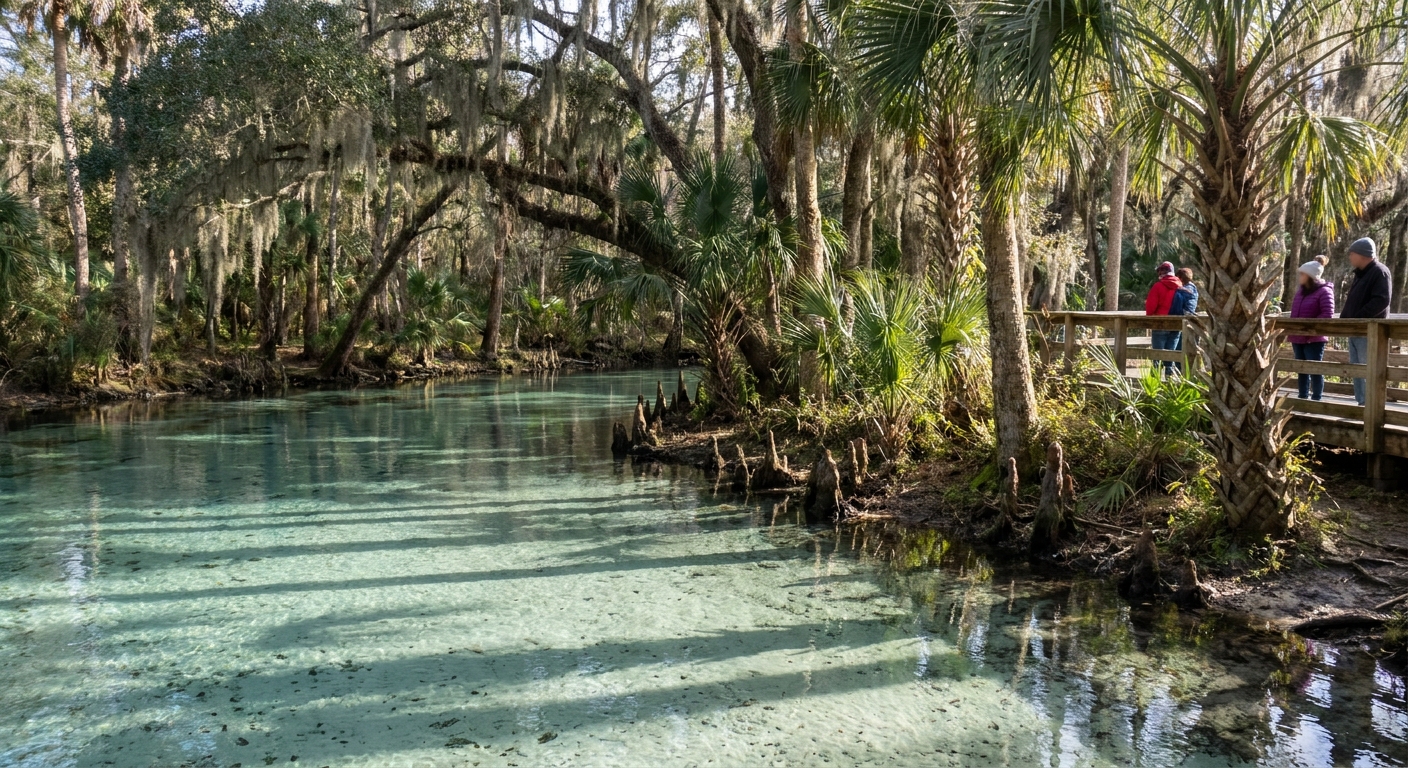
FEBRUARY AT A GLANCE · WARM MINERAL SPRINGS
February pairs the driest of the three winter months with water that sits near 84.6°F all year, so the only thing the date really decides is what you wear between dips.
1.92 INCHES OF RAIN · 11H 17M OF DAYLIGHT ON THE 15TH · NO FEE OR OPENING HOUR WE COULD VERIFY
Go for: 84.6°F water under 74.9°F afternoons, only 3.1 days of measurable rain in an average February, and a full day of light that runs to 6:21 p.m.
Think twice before: planning a dawn start in shorts. February mornings average 54.6°F, and about one February in ten records a night at or below freezing.
Air: NOAA NCEI 1991-2020, Sarasota Bradenton AP · Water: USGS gauge 02299260 · full sources at the end
On this page
- Average highs, lows and rain days in February74.9°F days, 1.92 inches of rain
- How cold the nights get54.6°F lows and 0.1 freezing nights
- Crowds, prices and booking a February roomDry-season demand, and what we could not verify
- Things to do in FebruaryThe 84.6°F spring and what the statute protects
- A two-day plan for FebruaryTwo days built around 11h 17m of light
- February vs January and March1.92 inches against 2.79 and 2.85
- Is February a good month to go?Yes, with one warning about March
One note before the numbers start. The air figures below are measured at an airport, not at the water, and the spring itself is the part of this trip that has no season. Both facts are spelled out where they matter.
Warm Mineral Springs weather in February: average highs, lows and rain days
| February measure | Figure (1991-2020 normal) |
|---|---|
| Average high | 74.9°F |
| Average low | 54.6°F |
| Precipitation | 1.92 in |
| Days with 0.10 in or more | 3.1 |
| Days with 1 in or more | 0.4 |
| Nights at 32°F or below | 0.1 |
| Daylight on February 15 | 11h 17m |
Every air figure here comes from NOAA’s National Centers for Environmental Information, the 1991-2020 monthly normals, recorded at station USW00012871 at Sarasota Bradenton Airport, about 27 miles (44 km) from the spring. That is a real thermometer with a long record rather than a modeled grid cell, and it is the nearest official one. Read the numbers as February on this stretch of the southwest coast, not as the air standing directly over the water.
The 1.92 inches arrives across 3.1 days that record at least a tenth of an inch, so measurable rain turns up roughly one day in nine. A day of an inch or more is rarer: 0.4 of one per February, or about two Februaries in five. Most of what falls is a short shower rather than a gray all-day drizzle, and a shower has almost no effect on a plan whose centerpiece is being in the water anyway.
Pack for the swing, not for the average. Twenty degrees separate the 54.6°F dawn from the 74.9°F afternoon, and a day can hand you both within six hours. A light fleece for the first hour, a T-shirt for the rest, a towel that actually dries, sandals you can walk out in, and a dry shirt left in the car for the walk back: that covers a February day without a single extra pound of luggage.
On February 15 the sun rises at 7:04 a.m. and sets at 6:21 p.m. local time, 11 hours and 17 minutes of daylight, calculated by sunrise-sunset.org from that day’s UTC times. The light goes before dinner, so decide early whether you are eating nearby or driving home in the dark.
How warm is Warm Mineral Springs in February? Highs, lows and freezing nights
A normal February day here climbs from 54.6°F around sunrise to 74.9°F in mid-afternoon, a spread of 20.3 degrees. Set that against the water: the USGS gauge at station 02299260 read 84.6°F (29.2°C) on September 11, 2026, and a spring does not keep a calendar. The soak is therefore about ten degrees warmer than a February afternoon and roughly thirty degrees warmer than a February dawn.
Dressed for it, the day divides neatly. Long sleeves and long pants until about ten in the morning, when the air has climbed through the sixties. After that the layer stays in the bag, because mid-seventies with February’s low humidity is shirt weather even standing still. The cold moment of the day is not the morning at all: it is the two minutes after you climb out of 84.6°F water into air in the fifties or low sixties.
Freezing nights are close to theoretical. The station records 0.1 nights at or below 32°F in an average February, which works out to roughly one such night per decade. Florida cold snaps do reach this far down the peninsula, and when one arrives the air drops and the gauge in the water keeps reading what it always reads.
How busy is Warm Mineral Springs in February? Crowds, prices and the demand peak
February falls squarely inside the dry season that the rest of our Florida coverage treats as the state’s busy half, November through April. We found no occupancy series and no monthly room-rate series for this area, so we crown no month cheap and no month expensive. What we can measure is rainfall, and February takes 1.92 inches against 2.79 in January and 2.85 in March: fewer wet days, and dry winter weeks in Florida do not go unnoticed.
That shows up in beds long before it shows up in traffic. Southwest Florida fills with winter residents through these months, weekends go before weekdays, and a Saturday in February is the worst night to improvise a room. Four to six weeks ahead (est.) is a sane target for a February weekend; a Tuesday in the same month is usually still available on short notice. Our where to stay guide covers the regional bases, and what a Florida trip costs handles the budget side.
On the tax line we have our cards on the table: we could not verify the county lodging-tax rate, so we give no percentage. Expect a Florida hotel bill to carry a county tourist development tax on top of state sales tax, and read the total rather than the advertised nightly rate before you confirm.
There is one upgrade that changes this month, and it is location. Paying more for a bed near the spring rather than out on the Gulf beaches buys the early start, and with sunrise at 7:04 a.m. and sunset at 6:21 p.m. a long commute at each end eats a visible slice of an eleven-hour day. Everything else you might spend extra on leaves February exactly as it is.
Things to do in Warm Mineral Springs in February
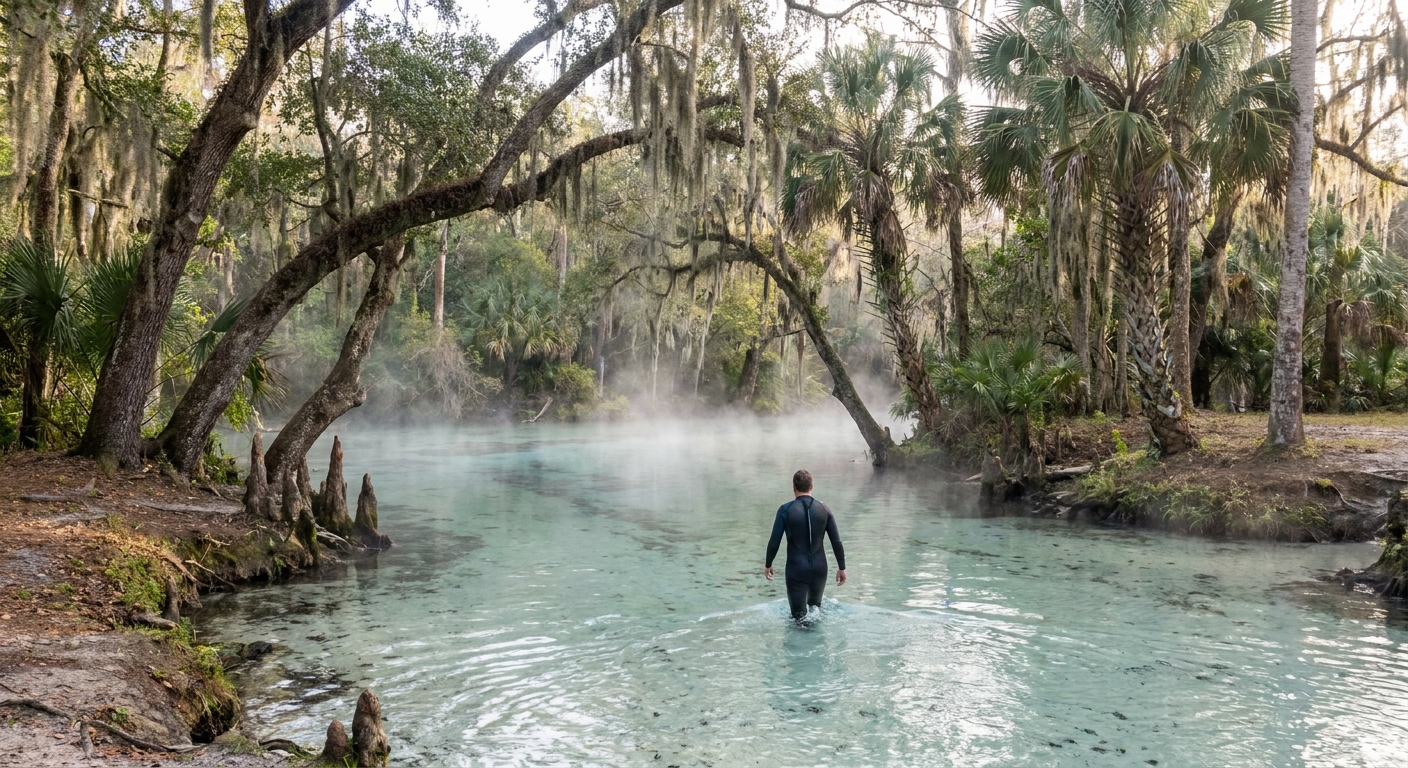
What this month offers that midsummer cannot is a warm swim under cool air. In August, an 84.6°F soak is simply more heat in a place that already has plenty of it, and the afternoon storms arrive on schedule. In February the same water sits 9.7 degrees above the average afternoon, the humidity is low, and with only 3.1 wet days in the month a plan rarely needs a backup.
The spring is the attraction, and it carries the numbers: 84.6°F at the vent on the USGS reading of September 11, 2026, taken at gauge station 02299260. Florida law also has a vocabulary for water of this order, the Outstanding Florida Springs class defined in Statute 373.802(5), which takes in every historic first-magnitude spring as the Florida Geological Survey determines them, plus six springs named by hand in the law.
The water holds still through the year and the air does all the moving, so each winter month sets a different gap. January opens the widest one, 12.1 degrees between the water and a 72.5°F afternoon. March narrows it to 6.4 degrees against 78.2°F. February’s 9.7 sits between the two, wrapped in the driest rainfall total of the three.
On costs we have to stop short. We could not read the official fee and hours page (it answers automated requests with a 403), so we publish no admission price and no opening time, and we would rather you call ahead than trust a figure we never checked. The state’s manatee pages render only inside a browser, so we carry no manatee count either. What February gives away free is the light, 11 hours and 17 minutes of it on the 15th, and the low odds of losing a day to rain.
Warm Mineral Springs in February: a two-day itinerary
Day one starts in the dark if the drive is long, because first light on the 15th comes at 7:04 a.m. and that first hour is the coldest of the day at around 54.6°F. Swim late morning, once the air has climbed through the sixties. Eat at noon. Swim again around two, when 74.9°F makes the walk back from the water painless rather than bracing. Be dry by five, because sunset at 6:21 p.m. leaves one hour of usable dusk and no more.
Day two repeats the shape with an earlier finish if you are driving out. If the sky turns, keep the swim and move the eating indoors: 3.1 days per February record a tenth of an inch or more, and a shower over warm water changes nothing about the water. A full inch falls on 0.4 of a day in an average February, so the genuine wash-out is rare, and when it lands the rest of the region is within a drive: our Florida things-to-do guide has the indoor options, and Siesta Key covers the beach side of the same coast.
Warm Mineral Springs in February vs January and March
| Measure | January | February | March |
|---|---|---|---|
| Average high | 72.5°F | 74.9°F | 78.2°F |
| Average low | 52.3°F | 54.6°F | 58.1°F |
| Precipitation | 2.79 in | 1.92 in | 2.85 in |
| Days with 0.10 in or more | 3.6 | 3.1 | 3.6 |
| Spring water | about 84.6°F | about 84.6°F | about 84.6°F |
Across the three winter months the afternoons climb 5.7 degrees, from 72.5°F in January to 78.2°F in March, and the nights climb 5.8, from 52.3°F to 58.1°F. Rain refuses to follow that line. January collects 2.79 inches and March 2.85, while February takes 1.92, nearly an inch less than either neighbor, spread over half a day fewer of wet weather (3.1 against 3.6). The spring itself is unchanged through all three at about 84.6°F.
Move four weeks later and you gain 3.3 degrees of afternoon and 3.5 degrees of night, which makes the walk to the water easier and the contrast in it milder. You also take on 0.93 inch more rain and the spring-break weeks that crowd Florida’s beach towns. Move four weeks earlier and January gives back 2.4 degrees of daytime warmth in exchange for the sharpest water-to-air gap of the winter, 12.1 degrees, plus 0.87 inch more rain. The January page makes that case in full.
Is February a good time to visit Warm Mineral Springs?
Yes for anyone coming for the water. You get the warmest soak of your winter under afternoons averaging 74.9°F, with rain measurable on only about three days of the month. No for a traveler who pictures long warm evenings outdoors: with nights averaging 54.6°F and full dark by around seven, dinner on a patio in February is a jacket affair, and swimming at dusk is a short, brisk idea.
If the cool start is what puts you off, March is the fix: 78.2°F afternoons and 58.1°F nights, bought with 2.85 inches of rain, half a wet day more, and the loudest weeks of the Florida beach calendar. If solitude matters more than warmth, January runs 2.4 degrees cooler by day and carries the same 3.6 wet days as March.
February’s own claim is narrow and real: the driest of the three winter months, 1.92 inches, with afternoons already in the seventies and water that never moved off 84.6°F.
The last word
Book the bed close, set the alarm for seven, and accept that the first hour outdoors is the cold one. The same USGS gauge that reads 84.6°F at the vent also measured 8 cubic feet per second coming out of it, and that volume is why the water looks the way it does: it is replaced faster than it can cloud. February serves that up with 11 hours and 17 minutes of light and the smallest rainfall total of the winter, and nobody driving away wet at five o’clock has ever argued with the arrangement.
Sources & data for this guide
- February air normals (74.9°F high, 54.6°F low, 1.92 in, 3.1 days at 0.10 in, 0.4 day at 1 in, 0.1 freezing nights) · NOAA NCEI monthly normals 1991-2020, station USW00012871, Sarasota Bradenton AP, about 27 miles from the spring · checked Sep 24, 2026
- January and March normals used in the comparison · same NOAA NCEI 1991-2020 series, same station · checked Sep 24, 2026
- Sunrise 7:04 a.m., sunset 6:21 p.m. and 11h 17m of daylight on February 15, converted from UTC · sunrise-sunset.org · checked Sep 24, 2026
- Water temperature 84.6°F (29.2°C) and flow of 8 cubic feet per second · USGS National Water Information System, station 02299260 Warm Mineral Springs · instantaneous reading, Sept 11, 2026
- Outstanding Florida Springs definition · Florida Statutes 373.802(5), leg.state.fl.us · checked Sep 24, 2026
- We could not verify an admission price, an opening hour or a manatee count: floridastateparks.org returns 403 to our automated reads, and the FWC manatee pages render only inside a browser · checked Sep 24, 2026
- We found no occupancy or room-rate series for this area and could not verify the county lodging-tax rate, so no month is ranked cheap or expensive and no percentage is given.
To plan your stay
- Best Time to Visit Warm Mineral Springs: Month-by-Month Highs, Rain Days and the Quiet Weeks
- Warm Mineral Springs in January: Weather, Crowds and the 84.6°F Water
- Warm Mineral Springs in March: Weather, Water Temperature and Crowds
- Warm Mineral Springs in April: Weather, Water Temperature and How March and May Compare