
NAZARÉ · MARCH · 39.6° N
Nazaré in March is a town coming out of its winter. The Atlantic still runs cold under the cliff at Sítio, the promenade that carries thousands of umbrellas in August belongs to whoever feels like walking it, and the official normals put the average high at 60.6°F, the average low at 52.7°F and the month’s rain at 1.92 inches. That is fleece-and-shell weather with real sun inside it.
March will not give you a beach day. The sea averages 59.4°F, colder this month than in either February or April, and measurable rain falls on 7.6 days of the month. Daylight helps: almost exactly twelve hours of it by mid-March, with the sun down at 6:46 p.m. rather than at five.
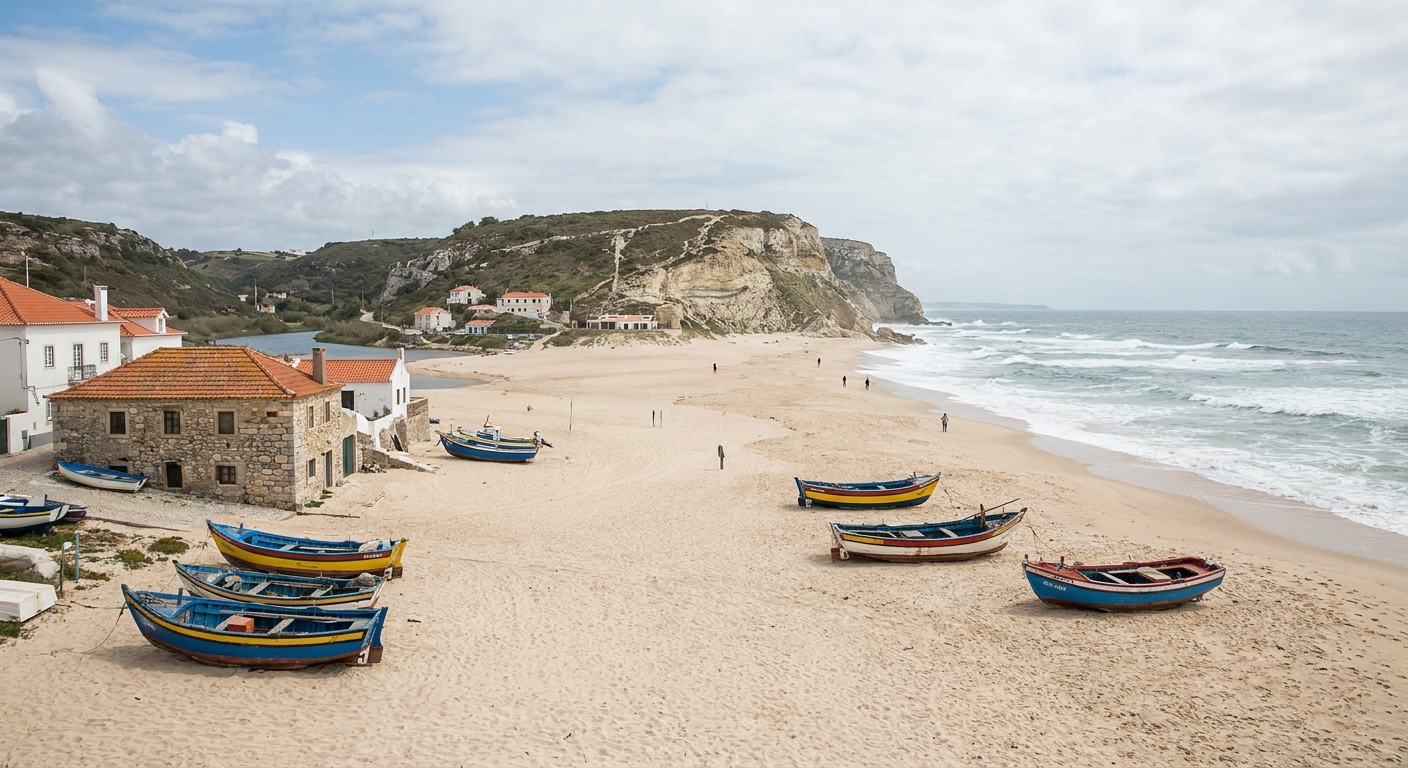
MARCH AT A GLANCE · NAZARÉ
March gives Nazaré back to walkers: 60.6°F afternoons, close to twelve hours of daylight and an empty seafront, with a 59.4°F ocean that rules out swimming.
AVERAGE HIGH 60.6°F · SEA 59.4°F · 7.6 WET DAYS · OFF SEASON
Go for: the cliff walk at Sítio, the swell at Praia do Norte, a seafront you can cross end to end, and afternoons that ask for a fleece and nothing heavier.
Think twice before: booking March as a swimming trip. The sea averages 59.4°F, the coldest of the February-to-April stretch, and the average night sits at 52.7°F.
Air normals: IPMA station 531, Cabo Carvoeiro · Sea: Open-Meteo Marine · Daylight: sunrise-sunset.org · full sources at the end
On this page
- Nazaré weather in March60.6°F days and 7.6 wet days
- Sea temperature in March59.4°F, wetsuit water
- How busy Nazaré is in MarchOff season, and what we could not price
- Things to do in MarchSítio, the funicular and Praia do Norte
- A two-day plan for MarchHour by hour, from 6:46 a.m. light
- March against February and AprilHow the three months compare
- Is March a good month for Nazaré?Yes for walkers, no for swimmers
- Nazaré beyond MarchThe town guide
- The best month to visit PortugalThe 12-month verdict
One thing to hold on to before the numbers start: these are climate normals, an average of thirty years, not a forecast for your week. And the thermometer behind them stands on the exposed coast at 32 meters (105 feet), so it describes the shoreline, not the hills behind it.
Nazaré weather in March: average highs, lows and rain days
| Measure | March, 1991 to 2020 |
|---|---|
| Average high | 60.6°F (15.9°C) |
| Average low | 52.7°F (11.5°C) |
| Precipitation | 1.92 in (48.8 mm) |
| Days with 0.04 in (1 mm) or more | 7.6 |
| Days with 0.39 in (10 mm) or more | 1.6 |
| Sea surface, mean of daily maxima | 59.4°F (15.2°C) |
| Daylight on March 15 | 11h 59m |
Those normals come from IPMA, Portugal’s sea and atmosphere institute, and from a real thermometer rather than a model grid cell: station 531 at Cabo Carvoeiro, on the exposed coast at Peniche, averaged over 1991 to 2020. Every figure here belongs to that stretch of shoreline. Go inland and uphill and the readings change, colder and a good deal wetter, so nobody should pack for a hill walk on a coastal reading.
Seven and a half wet days out of thirty-one means measurable rain about one day in four, with roughly 23 days recording none at all. Real soakings are rarer still: 1.6 days in an average March bring 0.39 inch (10 mm) or more. A caution on the counting, though. Those are IPMA’s own thresholds of 1 mm and 10 mm, not the 0.10-inch line that US monthly tables use, so the day counts are not interchangeable with the ones you may know from home.
Between afternoon and night the gap is narrow: 7.9°F separates the 60.6°F high from the 52.7°F low, the small spread an ocean gives a coast. Pack a fleece and a shell that folds into a bag, because an umbrella is useless on the cliff. No winter coat is needed here in March, and no shorts either. Our Portugal packing guide has the full list.
On March 15 the sun rises at 6:46 a.m. and sets at 6:46 p.m. local time, for 11 hours 59 minutes of daylight. That buys a whole day outdoors without a headlamp: sand in the morning, a long lunch, the clifftop still lit at five. Evenings stretch week by week through the month, so a late-March dinner starts in more light than the mid-month figure suggests.
Can you swim in Nazaré in March? Sea temperature and what it feels like
The water off Nazaré averages 59.4°F in March. That reading is the mean of daily maxima from 2015 to 2024, taken from the Open-Meteo Marine API, so it sits a shade warmer than a 24-hour mean would; a table showing a degree or two less is not contradicting it, only measuring differently.
At 59.4°F the Atlantic here is wetsuit water, and surfers wear rubber accordingly. A plunge and a sprint back to a towel is on the table if that is your temperament. Twenty minutes of floating is not. Look at the air, too: an average high of 60.6°F stands just 1.2°F above the sea, so the cold part of a March swim is getting out of the water rather than going in.
We found no monthly wind or wave series for Nazaré, so no wave heights and no gust figures appear here. The giant winter swell that made Praia do Norte famous is outside what our sources measure month by month, and we will not put a number on it. For the break itself and how the town is laid out around it, our Nazaré guide is the place to start.
How busy is Nazaré in March? Crowds, prices and the demand peak
March lands in Nazaré’s off season. That is a calendar fact, not a price claim: a beach town’s demand follows its water, and the water is at 59.4°F. We found no occupancy series and no monthly room-rate series for the town, so we crown no month the cheapest and quote no nightly figure.
Two or three weeks ahead is our own rule of thumb for a March room, and we flag it as judgment because no data sharpens it. Out of season in a small coastal town the live question is what is open rather than what is full, and we could not verify which guesthouses and kitchens close for the winter, so ask the property directly. Two nights covers the town and the cliff comfortably; a third buys an inland day. Our where-to-stay guide compares the bases, and flights from the US set the rest of the calendar.
We could not verify whether Nazaré charges a per-person tourist tax, or at what rate, so we give no percentage and no daily total. Confirm it at booking or at check-in, and see what a Portugal trip costs for the lines we can price.
The one upgrade that changes this month is the car. With 7.6 wet days in an average March and 1.6 of them heavy, a rental turns a washed-out afternoon into the walled lanes of Óbidos instead of a second coffee; read our rental and tolls guide before you book one. Next on that list is heating, since the average March night sits at 52.7°F and a radiator that works is not universal in a beach town.
Things to do in Nazaré in March
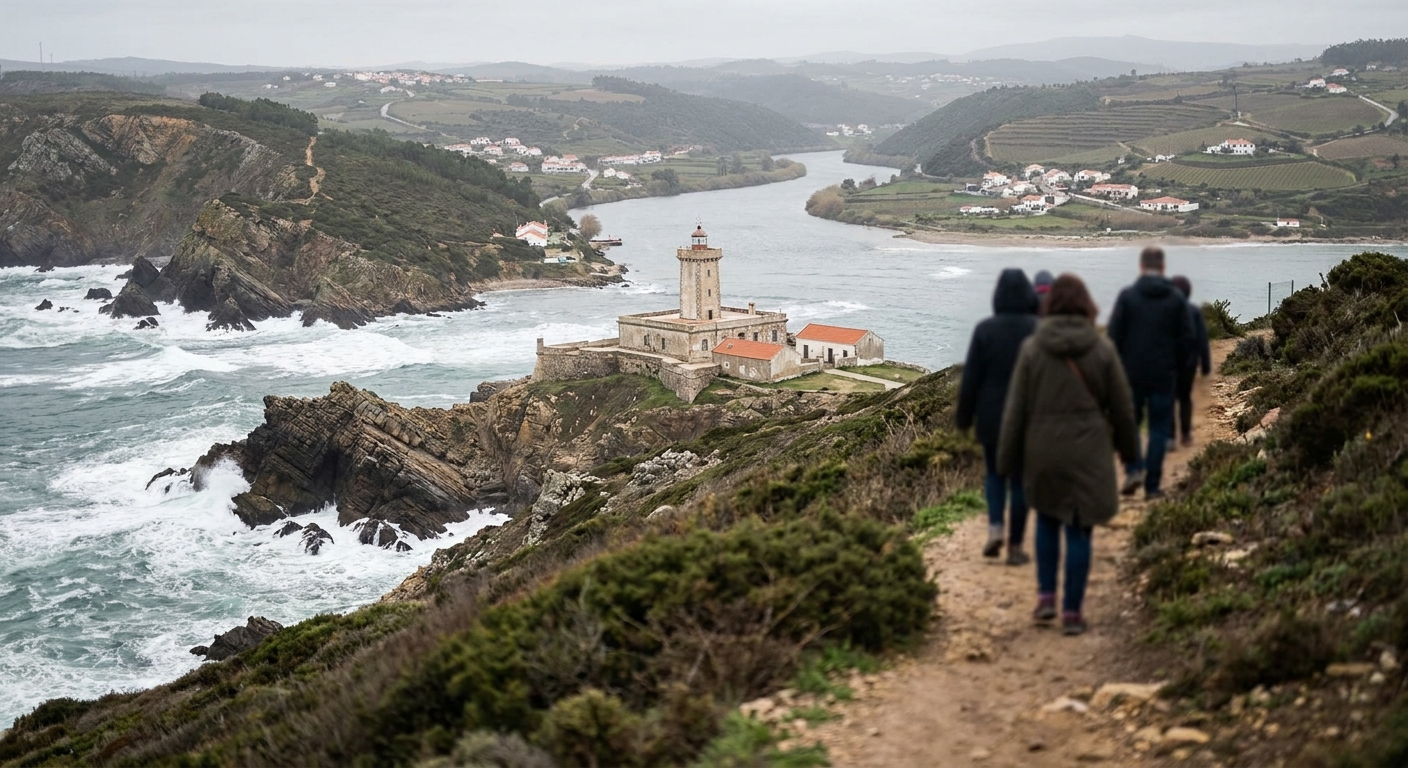
March hands the town back to walking. An average high of 60.6°F and close to twelve hours of daylight suit the climb to Sítio and the full length of the promenade better than midsummer does, and the sand is there to cross rather than to lie on. Photographers get the other bonus of a low sun: the cliff face is lit at an angle all afternoon.
The set pieces are easy to name. The Ascensor da Nazaré, the funicular, hauls you from the beach-level town up to the Sítio quarter on the clifftop. Up there, the Suberco balcony looks straight down onto roofs and sand, with the Sanctuary of Nossa Senhora da Nazaré a few steps behind. North along the cliff stands the Forte de São Miguel Arcanjo lighthouse, above Praia do Norte. We could not verify current fares or opening hours for the funicular, the fort or the sanctuary, so none appear here: check them the week you travel.
The ocean changes slowly across the year and the air changes faster, and the gap between them is what a month means on this coast. A 60.6°F afternoon on the clifftop, with wind arriving straight off 59.4°F water, feels cooler than the same hour on the sheltered town side. On the 1.6 days a March brings 0.39 inch or more, the sanctuary interior and a funicular ride are the plan that survives the weather.
Plenty of the best of it costs nothing: the Suberco viewpoint, the cliff walk out toward the lighthouse, the beach itself. We verified no free-admission day and no reduced winter rate at any Nazaré site for March, so we promise none.
Nazaré in March: a two-day itinerary
Day one runs on the light. Coffee by eight, on the promenade by nine while the sun is still low over the water. Ride the funicular up to Sítio around eleven, give the Suberco balcony and the sanctuary an hour, then come back down for a long lunch out of the wind. Two to four is the warmest slice of a 60.6°F day, so spend it walking the sand toward the north end. Sunset at 6:46 p.m. means dinner still feels like evening.
Day two belongs to the cliff north of town: the lighthouse, the view down over Praia do Norte, and whatever the Atlantic is doing below it, with the shell in the bag. If the sky turns, invert the order. Indoors in the morning, the drive inland to Óbidos after lunch, and the cliff on whichever half-day comes up dry. Measurable rain misses three days in four here, so the odds sit with you.
Nazaré in March vs February and April
| Month | Average high | Average low | Rain | Days ≥ 0.04 in | Sea, daily max |
|---|---|---|---|---|---|
| February | 58.5°F | 50.5°F | 2.17 in | 7.6 | 59.7°F |
| March | 60.6°F | 52.7°F | 1.92 in | 7.6 | 59.4°F |
| April | 61.9°F | 54.5°F | 1.88 in | 7.7 | 60.8°F |
Across the three months the air climbs steadily and the rain eases: IPMA highs of 58.5°F, 60.6°F and 61.9°F, nights of 50.5°F, 52.7°F and 54.5°F, precipitation of 2.17, 1.92 and 1.88 inches. The wet-day count barely budges, 7.6, 7.6 and 7.7 days at 0.04 inch or more, so what changes is how much falls rather than how often. The sea runs its own way: on the marine API’s 2015 to 2024 daily maxima, February reads 59.7°F and March 59.4°F, which makes March the coldest water of the three, with April at 60.8°F.
Shift four weeks later and April hands you 1.3°F more by day, 1.8°F warmer nights, 1.4°F warmer water and longer evenings, against a town moving into spring demand. Shift four weeks earlier and February costs you 2.1°F of daytime warmth and adds a quarter inch of rain, in exchange for water 0.3°F warmer than March’s. Neither move buys you a swimming beach.
Is March a good time to visit Nazaré?
Yes, if your Nazaré is the cliff, the swell and a town not performing for anyone. Afternoons at 60.6°F, nearly twelve hours of daylight and rain on about one day in four make a fine deal for walkers, photographers and people who watch the ocean rather than enter it. No, if you booked to swim or to sunbathe. A 59.4°F sea and a 52.7°F night settle that argument.
When the answer is no, April is the smallest correction that helps, with 60.8°F water, 61.9°F days and 1.88 inches of rain. For water you would actually stay in, the answer is summer, and our month-by-month verdict for Portugal lays out the whole curve, region by region.
What no other month here offers: a 60.6°F afternoon over a 59.4°F ocean, twelve hours of light, and a promenade you can walk end to end without weaving through anyone.
The last word
Book the room with working heating, pack the shell rather than the umbrella, and leave one afternoon open for the sky to decide. A Nazaré March is gentler than the word March suggests: 1.92 inches spread over 7.6 wet days works out to roughly a quarter inch on a day it rains, the kind of weather a shell handles while you keep walking the cliff. And the light up there holds until 6:46 p.m.
Sources & data for this guide
- March air normals, 1991 to 2020 · IPMA, station 531 Cabo Carvoeiro (Peniche), 32.0 m · checked Sep 24, 2026
- Rain-day counts at the 1 mm and 10 mm thresholds, and the warning that they are not the 0.10-inch US threshold · IPMA, same station and period · checked Sep 24, 2026
- Sea surface 59.4°F, mean of daily maxima 2015 to 2024 · Open-Meteo Marine API · checked Sep 24, 2026
- Daylight of 11h 59m, sunrise 06:46 and sunset 18:46 UTC on March 15, converted to local time · sunrise-sunset.org · checked Sep 24, 2026
- February and April figures · air from IPMA (same station and period), sea from Open-Meteo Marine 2015 to 2024 · checked Sep 24, 2026
- What we could not verify, and therefore do not quote: occupancy or monthly room rates, any Nazaré tourist-tax rate, fares and opening hours for the funicular, fort and sanctuary, monthly wind and wave statistics, and any dated March event. Night counts, booking lead times and pacing are our editorial judgment.