
ALENTEJO · AUGUST · 38.6° N
The Alentejo’s August runs to an average high of 92.3°F and a whole-month rainfall of 0.24 inches. That reading comes from a real thermometer at Évora, 248 meters up on the plain, averaged over 1991 to 2020. Mornings open near 60.8°F, cool enough for sleeves, and the heat arrives fast after breakfast.
You have already picked the region, so the only live question is the date. August gives long dry evenings, a coast in full swing and sunset at 8:26 p.m.; it takes away the middle of the day. Four weeks later, September’s afternoons run 7.2°F cooler and its rain days multiply by five. Both trades are priced out below, with July alongside.
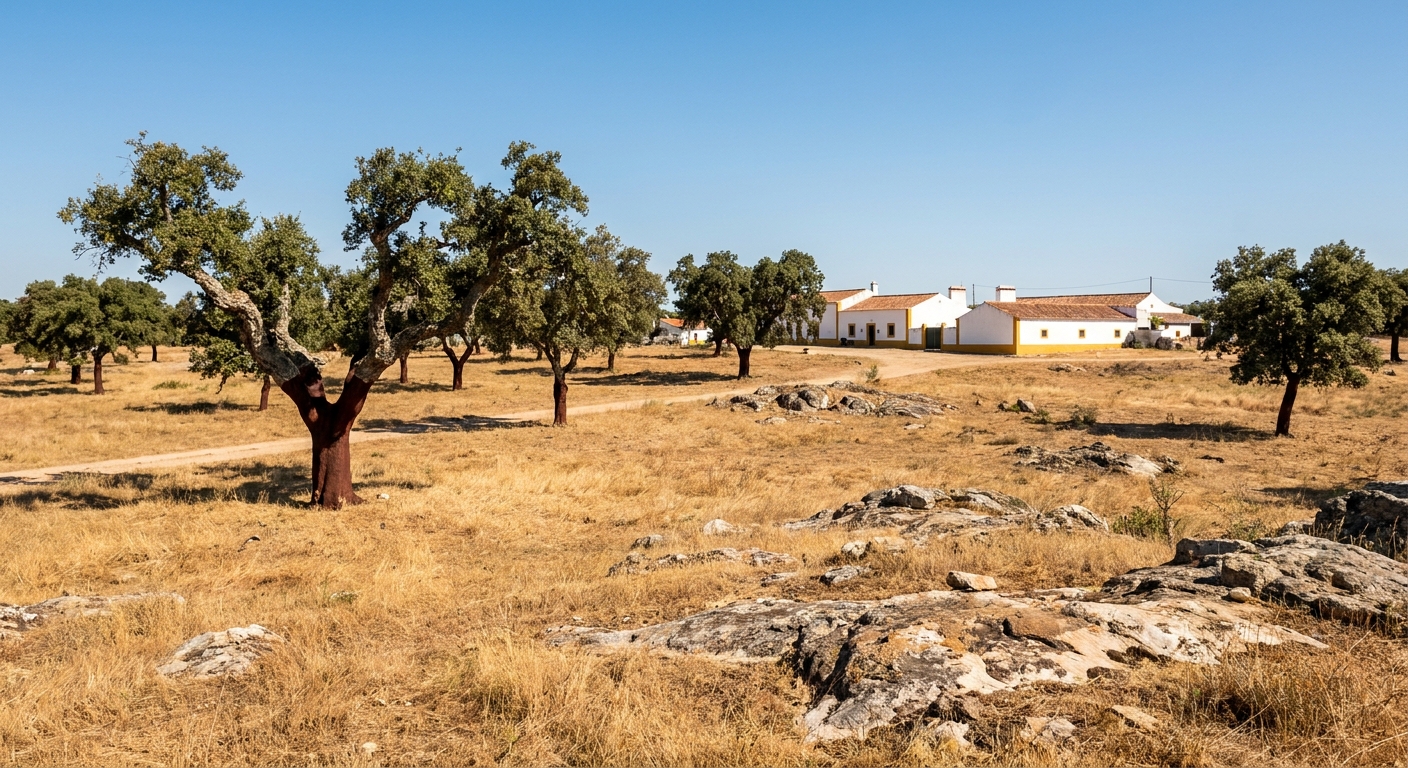
AUGUST AT A GLANCE · ALENTEJO
August is the Alentejo at its hottest and driest, 92.3°F afternoons over a quarter-inch month: excellent on the coast and after 8 p.m., punishing for anyone planning a midday walk inland.
PEAK SEASON · DRY AND HOT INLAND · SOURCE: IPMA ÉVORA, STATION 558
Go for: Atlantic beaches at Vila Nova de Milfontes and Zambujeira do Mar, dinner outdoors at 9 p.m. with light still in the sky, and dark nights over the Alqueva water.
Think twice before: booking a room with no cooling, or putting a coastal walking stage of the Rota Vicentina anywhere after 11 a.m.
Normals: IPMA station 558, Évora, 1991–2020 · Sun times: sunrise-sunset.org · full sources at the end
On this page
- Average highs, lows and rain days in AugustThe IPMA normals for Évora
- How hot the afternoons get92.3°F highs over 61°F dawns
- Crowds, prices and booking in peak seasonWhat we can price and what we cannot
- Things to do in Alentejo in AugustÉvora, Monsaraz and the west coast
- A two-day plan built around the heatDawn starts and 9 p.m. dinners
- Alentejo in August vs July and September7.2°F cooler, five times the rain days
- Is August a good month to visit?Yes for the coast, no for long walks
Every figure here comes from one instrument: IPMA’s station 558 at Évora, 247.6 meters above sea level, standing on the plain rather than by the sea. The region is large and the readings shift across it. Higher ground runs colder and far wetter, and the shoreline gets an Atlantic breeze Évora never feels. Pack from the inland numbers and you will be slightly over-dressed at the beach, which is the cheaper of the two mistakes.
Alentejo weather in August: average highs, lows and rain days
| August at Évora (1991–2020) | Figure |
|---|---|
| Average high | 92.3°F (33.5°C) |
| Average low | 60.8°F (16.0°C) |
| Total precipitation | 0.24 in |
| Days with 1 mm (0.04 in) or more | 0.7 |
| Days with 10 mm (0.39 in) or more | 0.2 |
| Daylight on August 15 | 13h 42m |
| Sunrise and sunset, August 15 | 6:44 a.m. and 8:26 p.m. |
IPMA, Portugal’s national weather service, publishes 92.3°F as the August average high at Évora and 60.8°F as the average low, measured over 1991 to 2020 at station 558. That is a station record, not a grid cell from a reanalysis, and the difference is worth a line: model estimates and thermometers disagree most on overnight minimums. Monthly rainfall normal: 0.24 inches, about six millimeters spread across the entire month.
Two counts sit under that total. An average August records 0.7 days with at least 1 mm of rain, so most Augusts pass with a single damp day and plenty pass with none at all. Days of 10 mm or more average 0.2, which works out to a genuine soaking roughly one August in five. Those are IPMA’s thresholds rather than the 0.10-inch cut used in American tables, so the counts do not transfer between sources.
From 60.8°F at dawn to 92.3°F in mid-afternoon is a 31.5-degree swing inside twelve hours, and it defeats a suitcase packed only for the beach. Bring a long-sleeved layer for early starts and late tables, a hat that survives being sat on, and more water than feels reasonable. Our packing guide handles the rest of the trip.
August 15 holds 13 hours 42 minutes between sunrise at 6:44 a.m. and sunset at 8:26 p.m., local time. The genuinely useful cool hours are the two after sunrise and the two before sunset, and the glow hangs on past the official minute long enough for a late table outdoors. Anything involving walking in the open belongs before 11 a.m.
How warm is Alentejo in August? Afternoon highs and 61°F dawns
That 92.3°F is an average of thirty Augusts of daily maxima, so it describes a typical afternoon rather than a ceiling, and individual days climb well past it. The average low of 60.8°F is just as real a number. A 31.5-degree gap separates the two, and a single day here serves you both ends of it.
At 7 a.m. in Évora, 61°F wants sleeves and the streets are a pleasure. By 1 p.m. you plan around shade rather than hope for it: linen, a brim, a room with a fan or thick walls. Out on the coast the Atlantic wind takes the edge off the same air temperature, which is why a mid-afternoon at Milfontes feels workable while the same hour inland does not.
Frost plays no part in an Alentejo August, and IPMA’s monthly normals carry no frost-day count for the month in any case. The reserve worth flagging is the water: we could not verify a sea-surface temperature series for this coast, so we give no figure. If you find one quoted elsewhere, check whether it averages daily maxima, which runs a touch warmer than a true 24-hour mean, and arrive expecting a brisk Atlantic.
How busy is Alentejo in August? Crowds, prices and booking the coast
August is Portugal’s own holiday month, with school out and the summer shutdown emptying Lisbon offices, and the Alentejo coast is one of the places the country goes. That puts the month squarely in high season, which is a fact of the calendar. We found no occupancy series and no monthly room-rate series for the region, so we crown no month the expensive one.
For booking, the direction is clear and the size is not: we verified no lead-time data, so we give no number of weeks. The practical shape is easy to picture. Évora is a city with hotels; Comporta, Vila Nova de Milfontes and Zambujeira do Mar are villages. Reserve the car alongside the room rather than after it, since the region runs on driving, and our car guide covers tolls and pickup.
We could not verify a municipal tourist tax for Évora or for the coastal councils, so we give no per-night amount and no exemption age. Ask at check-in, and read the reservation’s fine print for any line billed apart from the room rate. Payment habits that catch Americans out are in our know-before-you-go guide.
One upgrade changes this month more than any other: a room that stays cool between 1 p.m. and 6 p.m. Air conditioning, a pool, or old walls with working shutters decide whether the hottest five hours are a siesta or a sentence. Shaded parking is the quiet version of the same purchase, because a car left in the open under a 92-degree sun is unusable for its first ten minutes. Tier-by-tier budgets sit in our cost guide.
Things to do in Alentejo in August: Évora, Monsaraz and the coast
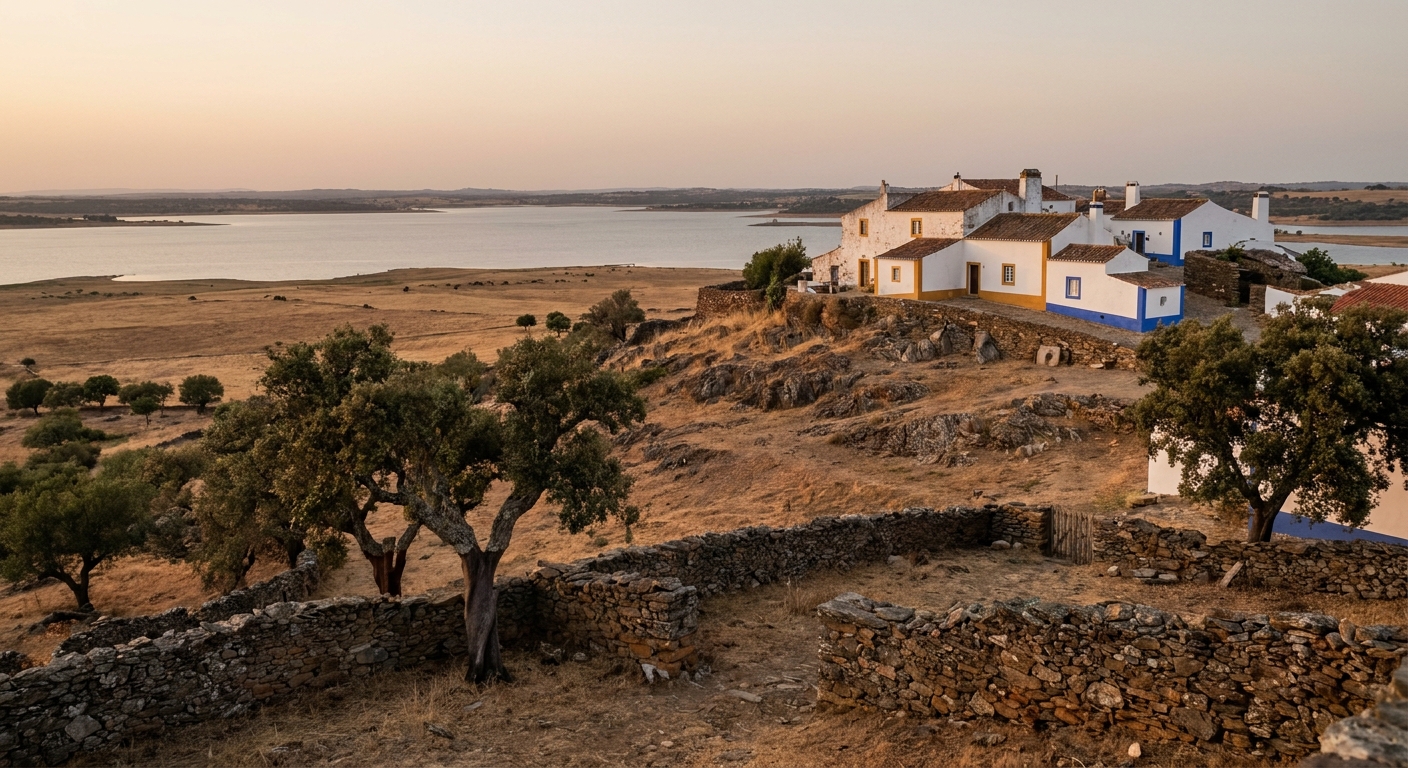
Dry evenings are what this month hands you, and they are close to guaranteed: 0.24 inches of rain across 31 days means a 9 p.m. table outdoors almost never needs a fallback. Sunset at 8:26 p.m. pushes the usable day past the heat, and the Alqueva reservoir sits far enough from any city for the sky over it to go properly dark. September cannot promise the same run of clear nights, with its rain days five times as many.
Évora carries the heaviest sightseeing: the Roman temple on the high ground, the bone chapel at São Francisco, a cathedral you climb for the rooftop. We could not verify current summer opening hours or admission prices, so we quote none. West of the plain, Vila Nova de Milfontes sits where the Mira meets the Atlantic, Zambujeira do Mar and Porto Covo hold cliff-backed beaches, and the Rota Vicentina links that shoreline on foot. Monsaraz keeps watch over the Alqueva water from its walls.
August moves the air over these places far more than the water beneath them. Inland, the stretch from 11 a.m. to 6 p.m. is not walking time: a cliff stage that is easy in April becomes a 7 a.m. errand, and Monsaraz offers little shade on its walls. On the coast the same 92-degree air arrives with wind behind it, so the gap between an inland afternoon and a beach afternoon is wider this month than the map suggests.
What costs nothing in August is mostly measured in hours rather than tickets: the walled lanes of Évora before the shops open, the Alqueva shoreline at dusk, and the beaches themselves, since Portuguese sand is public even where the sunbed is not. We found no verified free-admission dates for museums this month, so we name none.
Alentejo in August: a two-day itinerary
Day one, inland. Leave the room by 7:15, with sunrise already behind you at 6:44, and walk into Évora while the stone is still cool: temple, cathedral roof, bone chapel, coffee sitting down. Lunch long and indoors from 1 p.m. Swim or sleep through the worst of the 92-degree block. Out again at 6:30 for Monsaraz, under an hour east by car (est.), for the walls and the reservoir at sunset, then dinner at 9 p.m. in the last of the light.
Day two, coast. Drive west early, park at Vila Nova de Milfontes before ten, and take a cliff section of the Rota Vicentina while the air is still mild, then move to the sand from midday when the wind does the cooling. Should the weather turn, and 0.7 wet days a month says it rarely does, Évora absorbs an indoor half-day of museums and a slow lunch. Either way the drive between plain and coast runs under two hours (est.).
Alentejo in August vs July and September
| Measure at Évora (1991–2020) | July | August | September |
|---|---|---|---|
| Average high | 91.9°F | 92.3°F | 85.1°F |
| Average low | 60.1°F | 60.8°F | 58.3°F |
| Precipitation | 0.11 in | 0.24 in | 1.33 in |
| Days with 1 mm (0.04 in) or more | 0.6 | 0.7 | 3.6 |
| Sea temperature | Not verified | Not verified | Not verified |
July and August are near twins at this station: 0.4°F apart on the average high, 0.7°F on the low, both under a quarter inch of rain. September is where the year bends. Its average high drops 7.2°F to 85.1°F, rainfall climbs from 0.24 to 1.33 inches, and days with 1 mm or more go from 0.7 to 3.6, five times as many. Nights give back only 2.5°F, so what you actually feel changing is the afternoon.
Move four weeks later and you buy back the middle of the day: 85.1°F walks, a cathedral climb at noon, a cliff stage that needs no headlamp start. You pay in daylight, in the near-certainty of an outdoor dinner, and in a real chance of the first Atlantic weather. Going the other way, July serves August’s heat with half its rain and the same peak-season calendar, and the twelve-month verdict sets all three against the rest of the year.
Is August a good time to visit Alentejo?
Yes, if your Alentejo is coastal, nocturnal, or both: Milfontes and Zambujeira in the afternoon wind, dinner at nine with light still in the sky, the Alqueva dark afterward. No, if your Alentejo is the walking, cycling, hilltop-village version, or if someone in the party wilts in heat. An open plain at 92.3°F with 0.24 inches of rain to cool it is an endurance question, not a scenery one.
When the answer is no, September is the shift to make. Afternoons at 85.1°F put the cork-oak country and the walled towns back within reach at noon, evenings still stretch, and 3.6 days with measurable rain hardly counts as a wet season. Families locked to school calendars rarely get that choice, which is the honest limit of the advice.
No other month combines 13 hours 42 minutes of light on the 15th with a rainfall normal of 0.24 inches, which is why an August evening plan here needs no contingency.
The last word
Book the cool room first and build everything else around it. The thermometer behind every number here stands at 247.6 meters, about 812 feet, out on the inland plain, so a coastal afternoon at Milfontes is not the thing it measured. Set the alarm for 6:44, keep the plain for the early hours and the beach for the windy ones, and August gives back an evening that almost never needs a plan B.
Sources & data for this guide
- August normals, rain-day counts and thresholds · IPMA (Instituto Português do Mar e da Atmosfera), 1991–2020 normals, station 558 Évora, 247.6 m · checked Sep 23, 2026
- July and September normals at the same station · IPMA 1991–2020 · checked Sep 23, 2026
- Sunrise 05:44 UTC and sunset 19:26 UTC on August 15, converted to local summer time · sunrise-sunset.org · checked Sep 23, 2026
- Sea-surface temperature: we found no series we could verify for the Alentejo coast, so we give no water figure.
- Tourist tax rates, museum admissions and summer opening hours: we could not verify current figures, so we give none · check with operators when you book.
- Crowd levels are our editorial reading of the holiday calendar. We found no occupancy or rate data for the region.
To plan your stay
- Things to Do in the Alentejo: Évora, the Almendres Stones, Alqueva's Dark Sky and the Wine Towns
- Best Time to Visit the Alentejo: Weather Month by Month, Summer Heat and the Quiet Season
- Alentejo in July: Weather, Crowds and a Two-Day Plan
- Alentejo in September: Weather, Rain Days and a Two-Day Plan from Évora