
ÉVORA · SEPTEMBER · INLAND ALENTEJO
August in Évora averages a high of 92.3°F. September averages 85.1°F, and that seven-degree retreat is most of what the date buys. Rain comes back, though not much of it: 1.33 inches over the month, falling on 3.6 days that record at least 0.04 inch. Nights settle at 58.3°F on average, cool enough that a walled town of whitewashed houses genuinely lets go of its heat before breakfast.
The other half of the trade is light. On September 15 the sun is up for 12 hours 29 minutes, rising at 07:12 and setting at 19:40 local time, so an outdoor dinner still begins in daylight. Our Évora guide carries the monuments in any month and the Alentejo page the wider region. September’s own figures, and what they change about a two-day trip, start below.
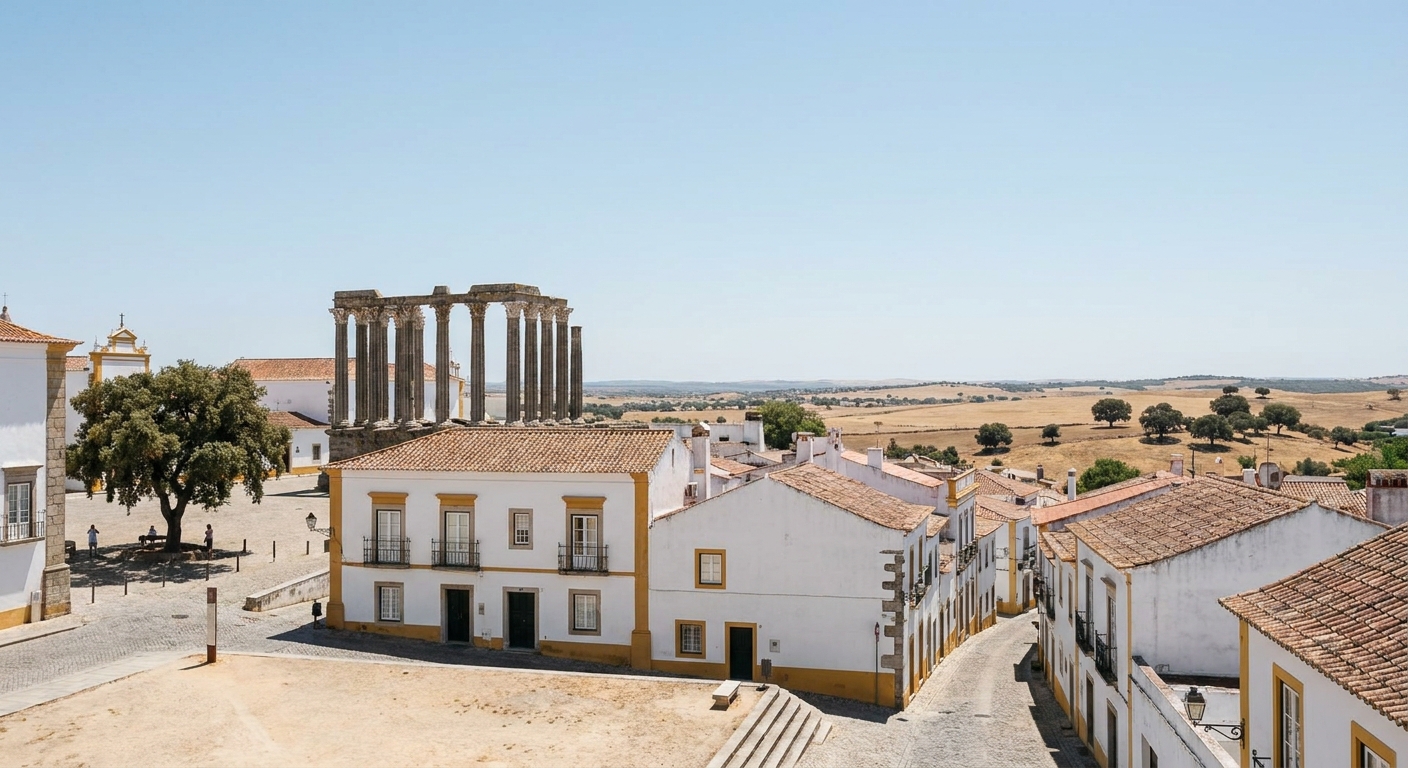
THE MONTH AT A GLANCE · ÉVORA · SEPTEMBER
September hands you August’s city at 85.1°F instead of 92.3°F, with measurable rain on fewer than four days and 12 hours 29 minutes of daylight in mid-month.
HIGH 85.1°F · LOW 58.3°F · 1.33 IN OF RAIN · 3.6 WET DAYS · IPMA NORMALS 1991-2020
Go for: walking a UNESCO center on consecutive dry days, mornings at 58.3°F, and evenings that stay outdoors until after 19:40.
Think twice before: planning a 3pm walking tour. The afternoon average is 85.1°F and the shade in Évora comes from walls, not trees.
Normals: IPMA station 558, Évora, 1991-2020 · Daylight: sunrise-sunset.org · Monuments: UNESCO file 361 · full sources at the end
On this page
- Évora weather in SeptemberHighs, lows, 1.33 inches and 3.6 wet days
- How cold the nights get58.3°F lows and a 26.8-degree daily swing
- Crowds, prices and when to bookWhat we can date, and what we could not verify
- Things to do in Évora in SeptemberThe Temple of Diana, the Cathedral, São Francisco
- A two-day Évora itineraryTwo days built around a 07:12 sunrise
- September vs August and OctoberHow the three months compare, degree by degree
- Is September a good time to visit Évora?Our verdict, and the case for October
Every figure here comes from IPMA, Portugal’s national weather service, and specifically from station 558 at Évora, a real thermometer standing at 247.6 m, not a model grid cell. That matters for scope: these normals describe the inland Alentejo town and nothing beyond it. High ground elsewhere in the region is colder and far wetter, and the coast keeps its own weather, so do not pack for a hill walk on an Évora reading.
Évora weather in September: average highs, lows and rain days
| September at Évora (IPMA 1991-2020) | Figure |
|---|---|
| Average high | 85.1°F (29.5°C) |
| Average low | 58.3°F (14.6°C) |
| Monthly rainfall | 1.33 in |
| Days with 0.04 in (1 mm) or more | 3.6 |
| Days with 0.39 in (10 mm) or more | 1.1 |
| Daylight on September 15 | 12h 29m · 07:12 to 19:40 |
IPMA’s 1991-2020 normals for Évora put the average September high at 85.1°F and the average low at 58.3°F, with 1.33 inches of rain. Thirty years of readings from one instrument at one altitude is as close to the ground truth of an Alentejo September as a traveler gets, and it is worth knowing which kind of number you are reading: a station normal, not a reanalysis estimate spread across a grid square.
Those 3.6 wet days work out to measurable rain roughly one day in eight, and 1.1 days of 0.39 inch or more means about one properly soaking day per September. In practice you plan outdoors and keep one museum morning in reserve. Note the thresholds: IPMA counts from 1 mm and 10 mm, while US tables usually count from 0.10 inch, so the day-counts you see on American sites are not interchangeable with these.
The gap between day and night runs 26.8 degrees. At 8am you want sleeves on a granite doorstep; by 4pm you want linen and a shaded table. One packable layer covers the whole month, plus shoes that take cobbles, since the medieval street plan inside the walls is uneven throughout. Our Portugal packing guide handles the rest of the suitcase for a mixed-region trip.
Daylight on the 15th runs 12 hours 29 minutes, sunrise at 07:12 and sunset at 19:40 in local time. That pushes the good photographic light on the Roman columns to around seven in the evening and leaves the first two hours after sunrise genuinely cool. By month’s end the light is noticeably shorter, so an early start matters more on the 28th than on the 2nd.
How warm is Évora in September, and how cold does it get at night?
85.1°F by day, 58.3°F by night, a swing of 26.8 degrees. August swings wider still, 92.3°F down to 60.8°F, a spread of 31.5 degrees. Évora sits inland, so there is no sea temperature to report for this trip: the measure that replaces it on the Alentejo plain is that daily swing, and it is the reason a September day here feels like two different climates eight hours apart.
Dress for the morning and carry for the afternoon. A long-sleeved shirt at 58.3°F becomes a shoulder cover inside the Cathedral by eleven and a sunblock substitute at two. Water is the other constant: the walled center is compact enough to cross on foot, but there is very little canopy over it, and the hottest three hours are better spent in a stone interior or at a lunch table than on the ramparts.
On frost, our IPMA reading gives monthly means rather than a count of nights at or below freezing, so we publish no such count for September. What the means do say is that a 58.3°F average low leaves a wide margin, and that October’s average low of 54.1°F is the first real step down. Cold nights are a winter question in Évora, not a September one.
How busy is Évora in September? Crowds, prices and when to book
We found no occupancy series and no monthly room-rate series for Évora, so we crown no month cheap or expensive. What we can date is the weather around the calendar: September still belongs to the dry stretch that left an average August with just 0.24 inch of rain, and it ends with October’s 3.21 inches in view. Demand and weather move together in the Alentejo, and only one of the two is measured in our sources.
Without rate data we will not invent a number of weeks in advance. Two practical moves stand anyway. Lock the weekend nights before the midweek ones, since a two-night stay is the shape most Évora trips take. And settle the car question early, because an Alentejo itinerary built around this town usually runs on one: tolls, insurance and the Lisbon pickup are covered in our rental car guide and our getting-around guide.
We could not verify a lodging-tax rate for Évora, so no percentage appears from us. Ask at check-in whether one applies and how it is charged, because a municipal tax is usually collected at the property rather than inside an online total. For the broader budget of a Portugal trip, our trip cost breakdown sets the tiers.
One upgrade genuinely changes September rather than flattering it: a room inside the 17th-century walls with shutters and working air conditioning. At 85.1°F afternoons, a bed you can walk back to at two in the afternoon turns the hottest hours from endurance into a nap, and puts you back out at six for the best light. Spending more beyond that buys the same city it buys in March. Our where-to-stay guide frames the choice nationally.
Things to do in Évora in September: the Temple of Diana, the Cathedral and the walls
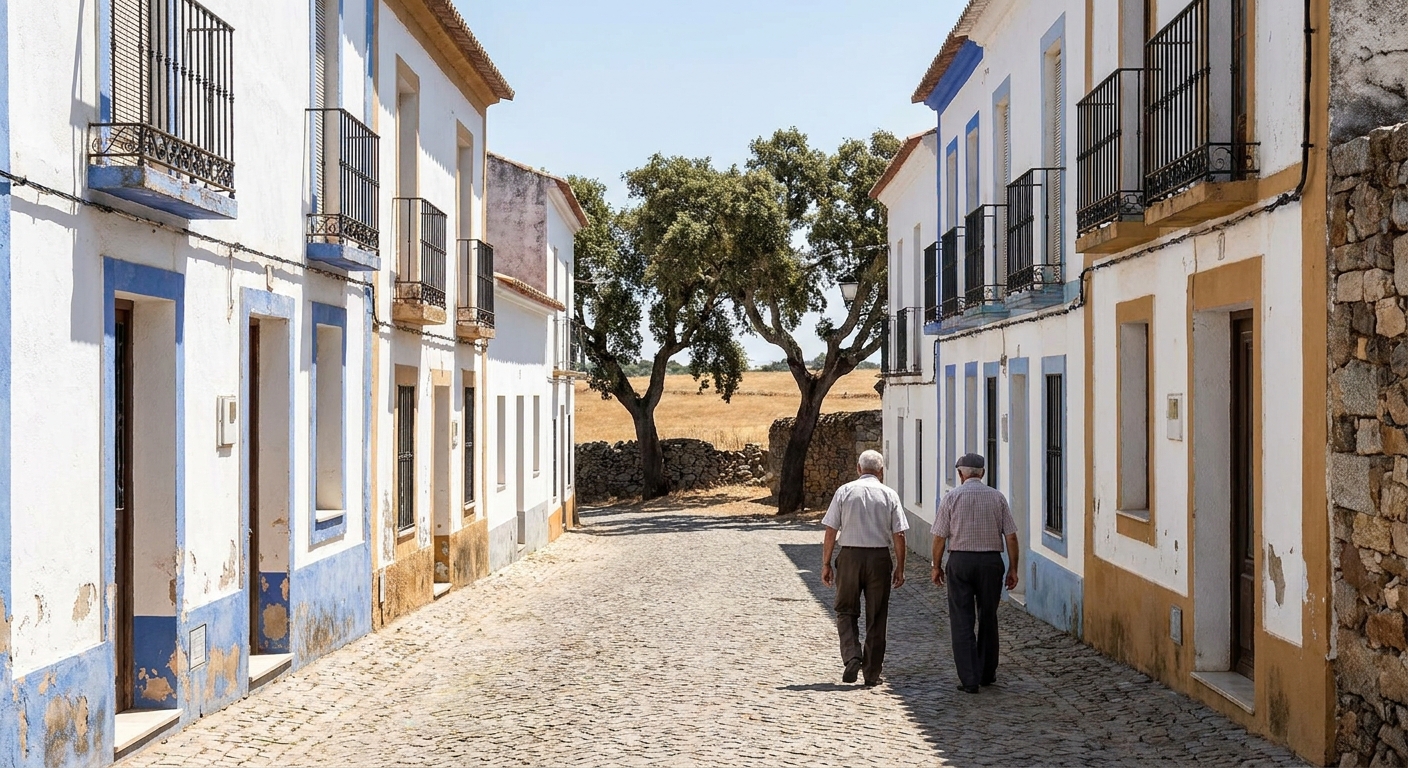
September gives you what neither neighbor does: consecutive walking days. August runs 7.2 degrees hotter, October records rain on 7.7 days against September’s 3.6. Between those two, this month lets you cover the UNESCO center on foot three mornings running without rearranging anything, which is the whole argument for visiting a town whose value lies in its streets rather than in any single ticket.
The Historic Centre of Évora was inscribed by UNESCO in 1986 under criteria (ii) and (iv). The shortlist inside the walls: the Temple of Diana and stretches of Roman wall reworked in Visigothic times, a Moorish gate and the remains of the Kasbah left when that rule ended in 1165, the Cathedral completed in the 13th century, the golden-age convents of St Claire, São Francisco and Os Loios with the church of São João Evangelista, and two 16th-century patrician houses, the Cordovil house and the house of Garcia de Resende.
Stone interiors barely register the season, the air outside does, and the gap is the point in September. A cathedral nave that felt merely cool in June is a 25-degree relief at three in the afternoon here. The same goes for the 17th-century Vauban-style wall drawn by the French engineer Nicolas de Langres: walk its circuit at 8am or at 7pm, never at two, and the 20th-century ring road that helped preserve it keeps traffic off your route.
The walled center itself costs nothing to walk, and in a city UNESCO calls the finest example of the Portuguese golden age after the 1755 earthquake destroyed Lisbon, that is the main event. Beyond it we could not verify a single opening hour or admission fee for any Évora monument, so we quote none: confirm times and tickets with each site before you plan a morning around it.
Évora in September: a two-day itinerary
Day one starts with the 07:12 sunrise and breakfast at 58.3°F. Take the upper town first: the Temple of Diana and the Cathedral before ten, the Roman and Visigothic wall sections after. Lunch indoors from one, and stay in until four while the 85.1°F afternoon does its work. Come back out for the Vauban circuit at five, and aim to be somewhere with a table facing west by seven, half an hour before the 19:40 sunset.
Day two goes to the golden-age city: São Francisco, the Convent of St Claire, Os Loios with São João Evangelista, then the Cordovil house and the Garcia de Resende house on the way back. If the weather turns, remember what the odds say. About one day in eight records measurable rain and roughly one day a month delivers 0.39 inch or more, so the wet-day plan is simply to reverse the order and spend the morning inside the Cathedral and the convent churches.
Évora in September vs August and October
| IPMA normals 1991-2020 | August | September | October |
|---|---|---|---|
| Average high | 92.3°F | 85.1°F | 75.4°F |
| Average low | 60.8°F | 58.3°F | 54.1°F |
| Rainfall | 0.24 in | 1.33 in | 3.21 in |
| Days with 0.04 in (1 mm) or more | 0.7 | 3.6 | 7.7 |
Read across and the shape of the autumn is plain. Afternoons fall 7.2 degrees from August to September, then another 9.7 degrees into October. Rainfall rises from 0.24 inch to 1.33, then to 3.21. Wet days climb from 0.7 to 3.6 to 7.7. No sea figure belongs in this comparison at all, since the town sits well inland on the Alentejo plain and the nearest coast keeps a different climate entirely.
Shift four weeks earlier and you gain near-certain dry weather, roughly one wet day for the whole of August, at the price of 92.3°F afternoons that shorten every walk. Shift four weeks later and you trade 9.7 degrees of comfortable sightseeing heat for more than double September’s wet days. Our August page and October page make each case at length.
Is September a good time to visit Évora?
Yes, for anyone whose trip is mostly walking. An 85.1°F afternoon is hot but workable when the mornings start at 58.3°F and rain interrupts fewer than four days in the month. It is a weaker month for travelers who wilt above the low eighties, and for families with small children on an afternoon schedule, since the shade inside the walls is architectural rather than leafy. Our Portugal with kids guide has the pacing.
If the answer is no, October is the month to shift to: highs of 75.4°F and lows of 54.1°F make midday walking easy, and the cost is 3.21 inches of rain spread over 7.7 days, which means booking a flexible plan rather than a fixed one. For the country-wide calendar, start with the best time to visit Portugal.
No other month pairs 85.1°F afternoons with 12 hours 29 minutes of daylight and fewer than four wet days: August is 7.2 degrees hotter, October is wetter by 4.1 days.
The last word
Two nights is the decision worth making. One day covers the Temple of Diana and the Cathedral, the second turns a stop into a trip, and September’s dry run gives you a real chance of both being clear. Spend part of that second morning on the university the Jesuits ran from 1553, when Évora was Portugal’s second city, until the Marquis of Pombal expelled the order in 1759 and the teaching drained away. Start at 07:12 with the sun, hand the 85.1°F afternoon to a stone interior, and be back on the walls by six.
Sources & data for this guide
- September, August and October normals (highs, lows, rainfall, days at 1 mm and 10 mm) · IPMA, Instituto Português do Mar e da Atmosfera, climate normals 1991-2020, station 558 Évora, altitude 247.6 m · checked Sep 24, 2026
- Wet-day thresholds are IPMA’s own (1 mm and 10 mm), not the 0.10-inch convention of US tables · counts are not interchangeable · checked Sep 24, 2026
- Daylight, sunrise 06:12 UTC and sunset 18:40 UTC on September 15, converted to Europe/Lisbon · sunrise-sunset.org · checked Sep 24, 2026
- Inscription (1986, criteria ii and iv), Roman and Moorish remains, 13th-century Cathedral, golden-age convents, patrician houses, the Nicolas de Langres wall and the 1920 classification · UNESCO World Heritage Centre, file 361 · checked Sep 24, 2026
- We could not verify any opening hour or admission fee for an Évora monument, and we found no lodging-tax rate and no occupancy or room-rate series for the city · no such figure is quoted above · confirm with each site and property when you book