
DE LEON SPRINGS · FLORIDA · THE 12-MONTH VERDICT
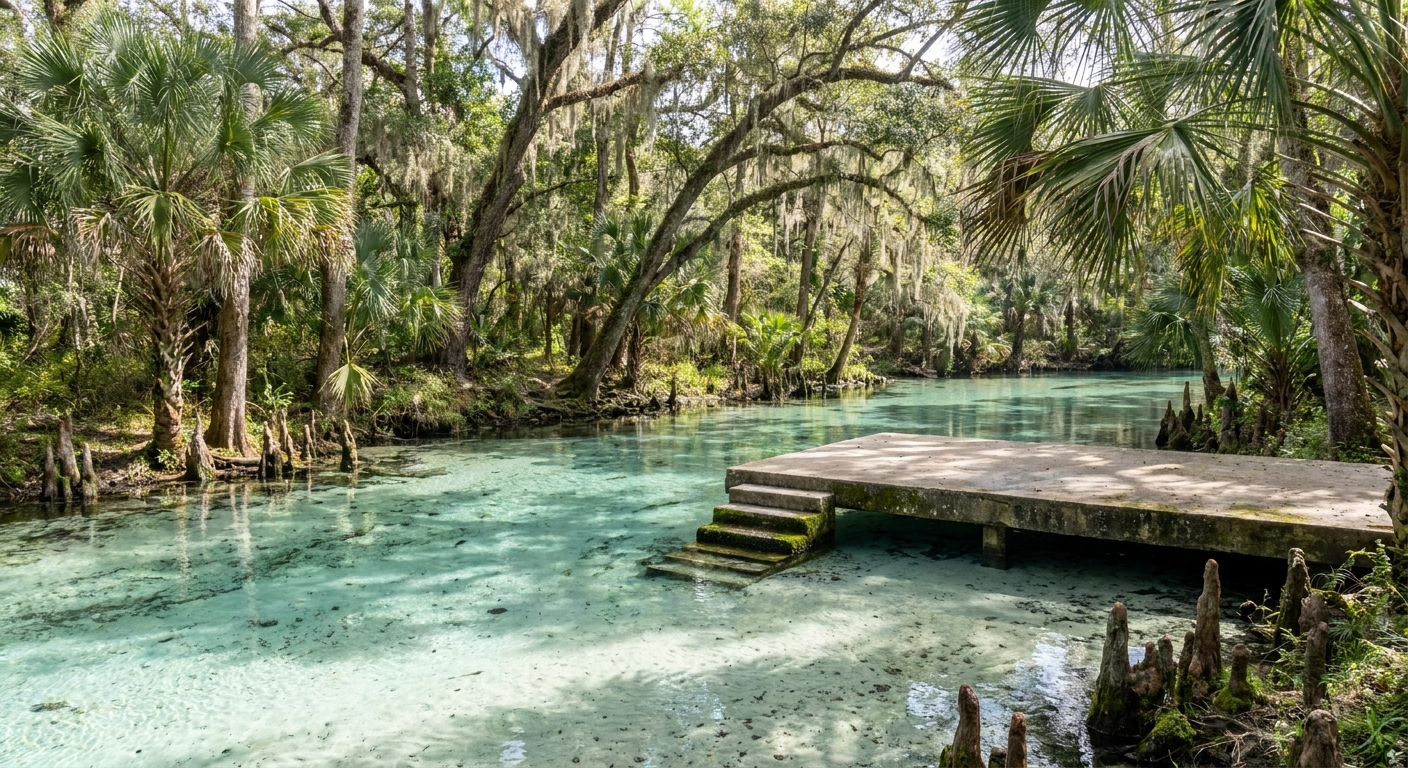
De Leon Springs sits in the quiet middle of Florida, just north of DeLand, where a spring run pools under live oaks and the park’s Old Spanish Sugar Mill hands you batter to cook at your own griddle. Most visitors come for those two things, a cold swim and a plate of pancakes, and add the marsh trails of Lake Woodruff next door. All three go better in some months than in others.
The year splits hard. June through September deliver between 6.55 and 8.17 inches of rain a month, while November manages 1.73 inches across three wet days. Choose your side of that split and the rest of the trip, the drive up from Orlando (est. about an hour), the parking lot, the daylight you have left after a swim, follows from it.
THE YEAR AT A GLANCE · DE LEON SPRINGS
Book November: 77.8°F afternoons, 1.73 inches of rain and three wet days make it the driest and steadiest month of the twelve for a two-night trip.
DRIEST: NOVEMBER, 1.73 IN · WETTEST: JUNE, 8.17 IN · HOTTEST: JULY, 91.9°F · 2 NIGHTS IS PLENTY
Go for: a cold swim in a hot state, pancakes cooked at your own table, and the Lake Woodruff dikes when the ground is dry (October to May stays between 1.73 and 3.66 inches a month).
Think twice before: booking June or July, when 8.17 and 8.07 inches fall across nearly twelve wet days apiece and the afternoon belongs to the storms.
Normals: NOAA NCEI 1991-2020 · Daylight: sunrise-sunset.org · full sources at the end
On this page
- Highs, lows and rainfall for all twelve monthsThe 1991-2020 table
- The single best month to bookNovember, 77.8°F and 1.73 inches
- How hot July and August get91.9°F days, 75°F nights
- The quietest weeks of the yearAfter Labor Day and early December
- The month to skip with kidsJune, and 11.8 wet days
- Is March, April or October worth it?How the three shoulder months compare
- When to visit Florida overallThe statewide dry-season verdict
Two nights covers the place properly, one for the spring and the mill, one for Lake Woodruff and DeLand’s courthouse square, and most travelers fly into Orlando and drive north (est. about an hour). Our getting-around guide explains why the car is not optional here. The month you pick moves the swim, the trails and the crowd far more than it moves the hotel.
De Leon Springs weather month by month: highs, lows and rainfall
| Month | Avg high | Avg low | Rain | Days ≥ 0.10 in |
|---|---|---|---|---|
| January | 71.2°F | 51.8°F | 2.61 in | 3.8 |
| February | 74.3°F | 54.3°F | 2.06 in | 3.4 |
| March | 78.4°F | 58.3°F | 2.74 in | 4.0 |
| April | 83.2°F | 62.8°F | 2.70 in | 3.9 |
| May | 88.2°F | 68.7°F | 3.66 in | 5.3 |
| June | 90.7°F | 73.4°F | 8.17 in | 11.8 |
| July | 91.9°F | 75.0°F | 8.07 in | 11.9 |
| August | 91.8°F | 75.3°F | 7.66 in | 11.7 |
| September | 89.5°F | 73.9°F | 6.55 in | 9.8 |
| October | 84.4°F | 68.3°F | 3.24 in | 4.7 |
| November | 77.8°F | 60.1°F | 1.73 in | 3.0 |
| December | 73.1°F | 54.5°F | 2.28 in | 3.4 |
Eight months of the twelve, October through May, sit between 1.73 and 3.66 inches of rain, and then four months take almost all the rest: June, July, August and September pour 8.17, 8.07, 7.66 and 6.55 inches. That is the whole shape of the year at this latitude, a long dry stretch with a soaked summer punched into the middle of it.
The switch happens twice, and fast. Between May and June the rain jumps from 3.66 to 8.17 inches and the wet-day count more than doubles, from 5.3 to 11.8. The return trip is just as sharp: September’s 6.55 inches fall to 3.24 in October, and 9.8 wet days drop to 4.7. A trip booked for the last week of September and one booked for the second week of October are two different vacations.
June is the hardest month on the table, and it is hardest for anyone whose plan happens outdoors: campers at the state parks, hikers on the Lake Woodruff dikes, families with a picnic to defend. Along with its 8.17 inches, June averages 2.9 days of an inch or more of rain, the highest heavy-rain count of the year. Swimmers mind it least, since the water was the destination anyway.
One caveat on every figure here. These are NOAA 1991-2020 monthly normals from station USW00012841, the Orlando Executive gauge that also serves Blue Spring, roughly 15 km (9 miles) south in the same DeLand country. A wet day means 0.10 inch or more, and the heavier count means an inch or more. The gauge reads open air at an airfield, not shaded air under the oaks and not the water in the run.
When is the best time to visit De Leon Springs?
Come in November. It is the driest month of the twelve at 1.73 inches, with only 3.0 days reaching 0.10 inch and 0.3 day reaching a full inch. Afternoons average 77.8°F and nights 60.1°F, which is walking weather on the marsh dikes and swimming weather for anyone who does not flinch at cold water. On November 15 the sun sets at 5:32 pm local, leaving 10 hours 44 minutes of daylight to spend.
October is warmer, at 84.4°F, but it carries 3.24 inches of rain, nearly twice November’s total, and 4.7 wet days. December goes the other way and gives up the warmth: highs of 73.1°F, 4.7°F cooler than November, with rain back up to 2.28 inches. November is the only month that holds both ends, dry ground and air still in the high 70s.
Book two nights, keep the Saturday for the spring and go midweek if you can. Thanksgiving week is the one date to reserve early, since central Florida’s parks and the DeLand hotels fill for it. Flights and the airport choice are covered in our Florida flights guide, the wider dry-season case in the statewide calendar, and what a few days here costs in the trip-cost breakdown.
How hot does De Leon Springs get in summer?
July averages 91.9°F, August 91.8°F and June 90.7°F, so the three summer months hold the high 80s and low 90s from late morning onward. Nights barely help: average lows of 75.0°F in July, 75.3°F in August, the warmest night of the year, and 73.4°F in June. Daylight stretches to 13 hours 51 minutes on July 15, sunrise at 6:35 am and sunset at 8:26 pm local, which leaves a long evening once the storms have moved through.
Two numbers travelers ask for are not in our source and we will not invent them. The station gives air temperature, precipitation and wet-day counts, with no humidity or heat-index series that we could read, and we found no published water temperature for the spring run itself. Florida spring water is famously cold against a 91.9°F afternoon, but we cannot put a figure on this one, so check the park’s own page before you plan the day around a swim.
When is De Leon Springs quietest?
The school calendar does the work here, not a price list. The quiet stretch runs from the week after Labor Day through mid-November, minus Thanksgiving week, and picks up again for the first two weeks of December before the holidays start. Late January and early February are the other lull, once the New Year traffic has gone home. Weekends still draw Orlando and Daytona day-trippers all year, so aim your visit at a Tuesday.
Those weeks buy room. The lot at the spring turns over instead of closing, the mill’s griddle tables come faster, and the dikes at Lake Woodruff carry a handful of birders rather than a school group. September also improves on high summer while it is at it: 6.55 inches of rain against July’s 8.07, and 9.8 wet days against 11.9. Travelers with kids in tow get the same water with a third of the noise.
What you give up is spelled out in the table. September is still deep in the Atlantic hurricane season, which runs June 1 to November 30 (see the statewide seasons page), and it still averages 89.5°F with those 9.8 wet days. Early December trades the rain risk for the shortest days of the year, 10 hours 21 minutes on December 15, with the sun down at 5:31 pm and the water at its least inviting.
Which month should you avoid in De Leon Springs?
June is the month to move if your plan involves being outside and dry, which makes it a poor bet for campers, trail walkers and anyone driving up for a single day. It records 11.8 wet days of 0.10 inch or more, four more than May and eight more than November, and the night air stops at an average low of 73.4°F, so nothing cools off between one storm and the next.
What redeems it is the water and the clock. Swimmers get the whole point of the place at its best contrast against a 90.7°F afternoon, and June 15 carries 14 hours 2 minutes of daylight, the longest of the year, with sunrise at 6:25 am and sunset at 8:26 pm local. Arrive at opening, swim and eat before noon, and treat the afternoon as indoor time in DeLand.
Is the shoulder season worth it in De Leon Springs?
Three months do shoulder duty here: March, April and October. April runs 83.2°F against July’s 91.9, a gap of 8.7°F, on 2.70 inches of rain against July’s 8.07, almost exactly a third. October lands at 84.4°F with 3.24 inches, less than half of September’s 6.55, and cuts the wet-day count from 9.8 to 4.7. March is the coolest of the three at 78.4°F.
The reward is usable daylight on dry ground. April 15 gives 12 hours 56 minutes, with sunset at 7:53 pm local, long enough for a four o’clock swim and a walk afterward. March 15 gives 12 hours 2 minutes and sunset at 7:35 pm. October 15 still holds 11 hours 31 minutes to a 6:56 pm sunset, and with 4.7 wet days spread over the month the boardwalks are usually firm underfoot.
The cost lands at night and in the water. March lows average 58.3°F and April lows 62.8°F, so a swim before ten in the morning is short work for most people, and the picnic tables stay cold until the sun clears the oaks. March adds 2.74 inches over 4.0 wet days and brings spring break traffic from mid-month, when Volusia County’s beaches and parks take the overflow from Daytona.
April takes the shoulder. Its 83.2°F afternoons, 2.70 inches, 3.9 wet days and 12 hours 56 minutes of daylight beat March on every line except price of a hotel room, and beat October by half an inch of rain and a wet day. Build it into a longer drive with the Florida road-trip guide and give the spring the morning.
The last word
If one month has to carry the trip, make it November, book the midweek nights and keep Thanksgiving clear. Winter travelers should know one number the table does not show: January averages 0.8 nights at or below 32°F and December 0.3, so a January dawn at the picnic tables can start genuinely cold before a 71.2°F afternoon arrives. Order the batter at the Old Spanish Sugar Mill anyway, and swim after the sun has cleared the trees.
Sources & data for this guide
- Monthly normals for all twelve months, highs, lows, precipitation, wet days and freezing nights · NOAA NCEI 1991-2020 monthly normals, station USW00012841 · checked Sep 14, 2026
- Daylight length, sunrise and sunset on the 15th of each month · sunrise-sunset.org, converted from UTC to local time · checked Sep 14, 2026
- Atlantic hurricane season dates, June 1 to November 30 · NOAA National Hurricane Center, via our Florida seasons guide · checked Sep 14, 2026
- Where the gauge sits: the normals above are open-air airfield readings from the Orlando Executive station, which also serves Blue Spring about 15 km (9 miles) south in the same DeLand country. Shade, water and the spring run all read differently.
- We could not read a published water temperature for the De Leon Springs run, and the station carries no humidity or heat-index series, so neither figure appears above.
- Park hours, entry fees, capacity closures and the Old Spanish Sugar Mill’s opening days are not in our data set · check the park before you drive.
- Night counts, quiet weeks and the shoulder verdict are editorial judgments built on the table above.