
NAZARÉ · THE TWELVE-MONTH VERDICT · PORTUGAL
Nazaré splits in two: the long beach at sea level and the cliff village of Sítio above it. The Atlantic below both stays cold all year, topping out at 65.8°F in October and never reaching the warmth most American swimmers expect from a beach town. What really moves across the year is the rain, from 0.20 inches in July to a November peak, while the air barely shifts at all, from 58.1°F highs in January to 70.2°F in August.
For most travelers September settles it, and the reasons are arithmetic: 69.6°F days, 0.99 inches of rain across 4.1 wet days, and a sea at 62.9°F, second only to October’s. Every figure here comes from one coastal thermometer, which matters more than it sounds, and we say exactly where it stands before the first comparison.
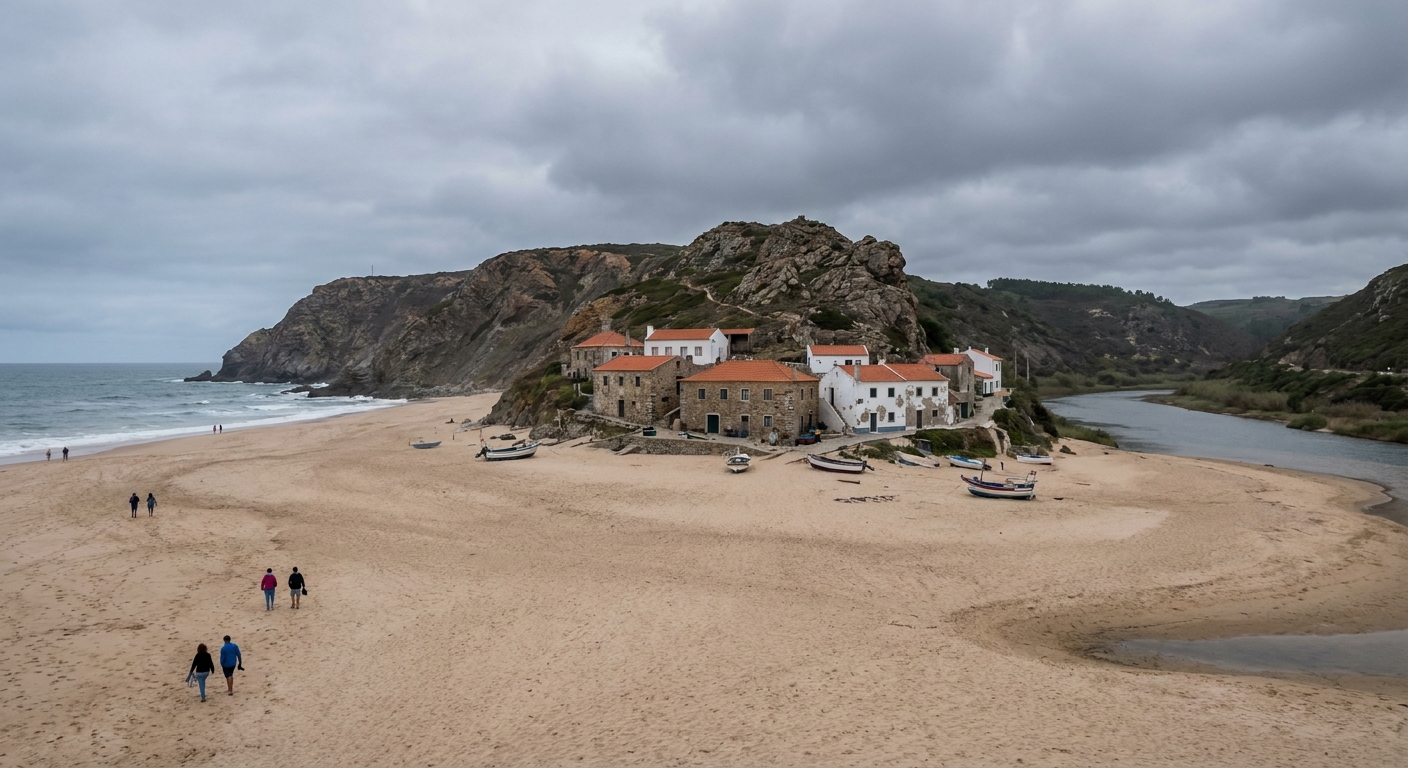
THE YEAR AT A GLANCE · NAZARÉ
September is the month to book: 69.6°F days, under an inch of rain across 4.1 wet days, and the sea close to its yearly warmest at 62.9°F.
BEST: SEPTEMBER · WARMEST WATER: OCTOBER, 65.8°F · DRIEST: JULY, 0.20 IN · NORMALS FROM CABO CARVOEIRO, 32 M
Go for: September and June, when rain stays at 0.99 and 0.48 inches and the water sits at 62.9°F and 64.4°F.
Think twice before: booking a beach week in November, with 10.5 wet days and 10 hours 4 minutes of daylight, or expecting warm water in August, when the sea falls to 61.4°F.
Normals: IPMA 1991-2020, station 531 · Sea: Open-Meteo Marine, 2015-2024 · full sources at the end
On this page
- Highs, lows and rain for all twelve monthsThe Nazaré weather table
- The best month to visit NazaréSeptember, with its figures
- Sea temperature and swimmingWater readings, June through October
- Nazaré out of seasonNovember to March on the calendar
- Which month to avoidNovember, and who it hurts
- Is the shoulder season worth it?How May, June and October stack up
Nazaré is a two-night town for most people, three with a day out to Óbidos, and the drive up from Lisbon airport runs about an hour and a half (est.). That scale is why the month decides the whole trip rather than one afternoon of it. If you are still choosing a base, where to stay in Portugal places it on the map, and the car guide covers the tolls on the way north.
Nazaré weather month by month: highs, lows, rain and sea
| Month | Avg high | Avg low | Rain | Days ≥ 1 mm | Sea |
|---|---|---|---|---|---|
| January | 58.1°F | 49.8°F | 2.98 in | 10.4 | 60.1°F |
| February | 58.5°F | 50.5°F | 2.17 in | 7.6 | 59.7°F |
| March | 60.6°F | 52.7°F | 1.92 in | 7.6 | 59.4°F |
| April | 61.9°F | 54.5°F | 1.88 in | 7.7 | 60.8°F |
| May | 64.8°F | 57.7°F | 1.41 in | 5.4 | 61.1°F |
| June | 67.6°F | 61.2°F | 0.48 in | 2.2 | 64.4°F |
| July | 68.9°F | 62.4°F | 0.20 in | 0.9 | 63.7°F |
| August | 70.2°F | 63.0°F | 0.42 in | 1.8 | 61.4°F |
| September | 69.6°F | 62.1°F | 0.99 in | 4.1 | 62.9°F |
| October | 67.3°F | 59.5°F | 3.33 in | 9.2 | 65.8°F |
| November | 62.6°F | 55.0°F | 3.86 in | 10.5 | 63.7°F |
| December | 59.5°F | 51.4°F | 2.70 in | 9.4 | 61.3°F |
The year is flat at the top and lopsided at the bottom: highs move only 12.1 degrees across twelve months, from 58.1°F in January to 70.2°F in August, while precipitation multiplies nineteen times over between July’s 0.20 inches and the late-autumn peak.
The rain hinges twice. Between April and May it falls from 1.88 inches over 7.7 wet days to 1.41 inches over 5.4, and June cuts it again to 0.48 inches over 2.2. The reverse takes six weeks at the other end of summer: September’s 0.99 inches over 4.1 days becomes October’s 3.33 inches over 9.2, and heavy days at 10 mm or more climb from 0.7 to 2.8.
November is the hardest of the twelve for anyone counting on outdoor hours, with 3.86 inches of rain over 10.5 days at 1 mm or more, 3.2 of them at 10 mm or more, and 10 hours 4 minutes of daylight on the 15th. December trails it closely on wet days, 9.4, and shortens the light to 9 hours 28 minutes, the year’s floor.
Every figure here comes from IPMA’s 1991-2020 normals at station 531, Cabo Carvoeiro at Peniche, 32 meters up on the same exposed stretch of coast, a real thermometer and not a model grid cell. Inland and on high ground the readings differ, colder and far wetter, so do not pack for a hill walk on a coastal number. The wet-day counts use the Portuguese service’s own thresholds, 1 mm (0.04 inch) and 10 mm (0.39 inch), not the 0.10-inch line US tables draw.
When is the best time to visit Nazaré?
Book September. It carries 69.6°F highs and 62.1°F lows, 0.99 inches of rain over 4.1 wet days, 12 hours 29 minutes of daylight on the 15th, and a sea at 62.9°F, warmer than anything spring offers. Only 0.7 days in the month record 10 mm or more, so a washed-out afternoon is the exception rather than the pattern.
August runs the warmest air of the year, 70.2°F, and yet its water drops to 61.4°F, three degrees colder than June’s 64.4°F, in the middle of the Portuguese holiday peak. October turns the sea up to its yearly best, 65.8°F, and charges 3.33 inches of rain over 9.2 wet days for it, against September’s 0.99 inches over 4.1. September sits between the two losses.
Two nights cover the beach, the headland at Sítio and a harbor dinner, and a September weekend slots easily into a wider trip. For how Nazaré compares with the Algarve and the Douro across the same twelve months, see the best time to visit Portugal; what to pack covers the wind layer this coast asks for even in summer.
When can you swim in Nazaré? Sea temperature month by month
No month clears the 70°F line most American swimmers treat as comfortable. The warmest water of the twelve months is October’s, 65.8°F, then June at 64.4°F, with July and November tied at 63.7°F. September holds 62.9°F, August slips to 61.4°F, and the floor is March at 59.4°F with February just above it at 59.7°F. In practice: wetsuits for surfers all year, and short bracing swims for everyone else from June through October.
Those readings are means of daily maxima over 2015-2024 from the Open-Meteo marine series, not 24-hour averages, so the all-day figure sits a shade lower and an early-morning swim is colder than the number promises. The August dip, 3.0 degrees under June, is this coast’s summer upwelling rather than a fault in the data.
When is Nazaré quietest?
The calendar sets the crowd here. July and August carry the Portuguese holiday peak, Easter and the late-spring weekends fill the town in bursts, and from November through March Nazaré runs on its residents, off-season visitors and the big-wave crowd at Praia do Norte. Christmas and New Year week is the one busy island in that stretch.
Out of season a room can be booked days rather than months ahead, parking near the seafront stops being a project, and the winter swell season at Praia do Norte is watched free from the headland by the fort. Rain also arrives in blocks rather than drizzle: January’s 2.98 inches fall on 10.4 days, which leaves roughly twenty without measurable rain.
What you give up is light and dry ground. December offers 9 hours 28 minutes of daylight on the 15th and January 9 hours 45, against June’s 14 hours 59. January records 2.98 inches over 10.4 wet days, with 2.4 days at 10 mm or more. The sea bottoms out in March at 59.4°F. Some seafront restaurants and smaller guesthouses shorten their weeks between the seasons, so confirm before you count on one.
Which month should you avoid in Nazaré?
November is the one to skip if your plan needs sand, the cliff path or a dry afternoon. It is the wettest of the twelve months, 3.86 inches of it, spread over 10.5 days at 1 mm or more with 3.2 days at 10 mm or more, and highs drop to 62.6°F, nearly five degrees below October’s 67.3°F. Surf watchers and storm photographers are the exception, and they come deliberately.
The water is what redeems it: 63.7°F in November, warmer than August’s 61.4°F, because the sea lags the air by a couple of months on this coast. Swell season is under way at Praia do Norte by then, and 10.5 wet days still leaves around nineteen days without measurable rain in the month.
Is the shoulder season worth it in Nazaré?
The shoulders are May and June on one side, September and October on the other, and their distance from peak August is small. May runs 5.4 degrees cooler at 64.8°F, June 2.6 degrees cooler at 67.6°F, October 2.9 degrees cooler at 67.3°F, and September gives up just 0.6 of a degree at 69.6°F.
What the shoulders add is water and light. June’s sea, 64.4°F, and October’s, 65.8°F, both beat anything August manages, and June 15 brings 14 hours 59 minutes of daylight, the year’s longest, sixteen minutes more than July 15. The holiday peak is behind or ahead of you in all four months.
The bill comes in rain and in hours. May takes 1.41 inches over 5.4 wet days where July takes 0.20 over 0.9, and October takes 3.33 inches over 9.2 wet days where August takes 0.42 over 1.8. October 15 also runs 3 hours 46 minutes shorter than June 15, at 11 hours 13 minutes.
So the shoulder is worth it in three of the four cases. September first, June second for the long evenings and 0.48 inches of rain, May third if cool and quiet suits you more than warm water at 61.1°F. October earns its place only for swimmers willing to trade 9.2 wet days for the year’s warmest sea.
The last word
Take September if the calendar allows it and June if it does not. April deserves the third slot nobody gives it: 61.9°F highs, 1.88 inches of rain and 13 hours 19 minutes of light on the 15th, enough for a two-night stop between Lisbon and Porto with an afternoon in Óbidos attached. Whichever month wins, pack a wind layer; these normals record temperature and rain, not the onshore wind that makes 64°F feel several degrees cooler on the sand.
Sources & data for this guide
- Monthly air normals, precipitation and wet-day counts at 1 mm and 10 mm · IPMA, normais climatológicas 1991-2020, station 531 Cabo Carvoeiro (Peniche), altitude 32.0 m · checked Sep 12, 2026
- Sea surface temperatures, means of daily maxima 2015-2024 · Open-Meteo Marine API · checked Sep 12, 2026
- Daylight length and sunrise/sunset on the 15th of each month · sunrise-sunset.org · checked Sep 12, 2026
- Scope caveat we are obliged to repeat: the station stands at Cabo Carvoeiro, on the same exposed coast south of Nazaré, and does not describe inland or high ground, which is colder and wetter.
- Crowd calendar, the winter swell season at Praia da Nazaré do Norte, the 70°F swimming comfort line and the upwelling reading of the August dip are editorial; opening days of restaurants and guesthouses change off season · check operators when you book.