
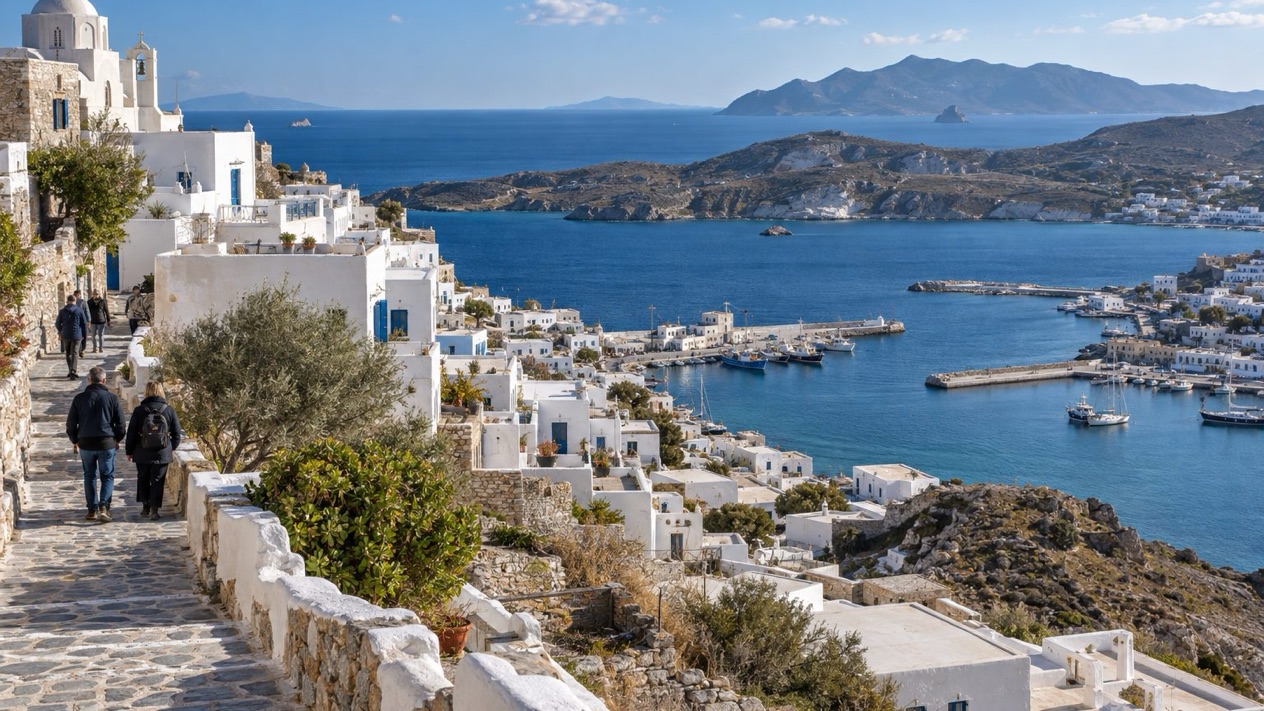
Milos is a Cycladic island built around the sea: white volcanic rock, turquoise water, fishing villages with painted boat houses, and long dinners with your feet near the sand. It suits beach people, boat people and anyone who likes a relaxed pace. It is no longer undiscovered, though, and the busiest spots draw real crowds in summer. The season runs May through October.
Where should you stay in Milos?
Milos has fewer hotels than Santorini, Paros or Mykonos, and the good ones fill months ahead. Demand outruns supply, so rates are often high and not always worth what you pay. Book early, and choose a flexible cancellation policy if you can. The island is small, so almost nowhere is far from a good beach. Some visitors split the stay between two areas, but one change is plenty.
Pollonia
Pollonia is a small seaside town on the northeast coast. Restaurants set tables on the sand under olive trees, the town beach is swimmable, and the evenings are sleepy, romantic and a little old-fashioned. The Kimolos ferry leaves from here, which makes it a good base for boat days.
Stay here if you want to walk to dinner and leave the rental parked. Phos Milos has larger, modern spaces with kitchens and private plunge pools, which families like, but no breakfast on site. Melian Boutique Hotel & Spa is a luxury pick with sea-view balconies. Salt Suites, next door, has the same views plus breakfast and is often cheaper. Captain Zeppos sits right in the center with direct sea access, and it's often booked out. Milos Breeze sits above town with a pool.
Adamas
Adamas is the port town and the practical hub. Ferries and cruise ships arrive here, tours leave from here, and the buses start here. It's busy at night with shops and restaurants, and it's more practical than charming. Choose it if you'll rely on buses or want a short walk to the ferry. Santa Maria Village Resort & Spa is a whitewashed, pool-centered option a few minutes' walk from the main road.
Plaka and Trypiti
Plaka, the island's capital, is a tiny, characterful village famous for its sunsets. Its small center is closed to cars, so many visitors park just outside and walk in. Trypiti sits close by, and both are about 15 to 25 minutes by road from the airport. Either makes an atmospheric base with restaurants a short walk away, though Plaka can feel a bit pricey and polished.
Fishing villages, beach bases and the south
For something special, book one of the old boat houses (syrmata) in a fishing village such as Klima. They're remote, and the approach is a rocky beach walk with no proper paths. Bring a backpack rather than a rolling suitcase, pack snacks and water, and have a car. They sell out fast.
Asterias Boutique Hotel is an affordable, comfortable, family-run place between Sarakiniko and Papafragas beaches. Domes White Coast, in the northeast, is adults-only, with sea-view suites and plunge pools that mostly look toward Sarakiniko. On the south side, Erema opened in June 2026 as a clifftop luxury retreat for travelers who want distance from the crowds. At Provatas, also in the south, Golden Milos Beach House sits on one of the island's few sandy beaches and suits several lazy beach days.
What are the best things to do in Milos?
Beach time sets the rhythm here, and a day works best with just a couple of plans.
Take a boat to Kleftiko
Kleftiko is a set of sea caves, lagoons and limestone cliffs along the coast, and a boat is the way most visitors get there. A former pirate hideout, it looks the part. It's also busy, with many tour boats playing loud music, so a small-group trip is the calmer choice. Full-day tours usually add swim stops at beaches you can't reach on foot, plus lunch on board. Tours fill up, so book ahead.
Visit Polyaigos and Kimolos
East of Milos, Polyaigos has some of the most surreal blue-green water in Greece. It's uninhabited apart from a part-time shepherd couple and some wild goats. Bring snorkeling gear, and watch the forecast, since the ride over from Pollonia gets rough on windy days.
Kimolos is a quieter, more traditional version of Milos, 20 to 30 minutes by ferry from Pollonia, and you can bring your rental car aboard. Tickets are sold the same morning, so a day trip is easy, but a couple of nights is better. Fishermen's houses line the waterfront, and the main town has a fortified old quarter.
Spend a morning in Plaka, Trypiti and Klima
In Plaka, the Archaeological Museum opens mornings to mid-afternoon in summer and closes on Tuesdays; hours change by season, so check before you go. Admission is €5, or €3 reduced (2026), and it's free every year on March 6, April 18, May 18 and the last weekend of September.
Just outside Trypiti are the early Christian catacombs, carved into volcanic rock between the first and fifth centuries, and the ancient theatre above the bay, which still hosts occasional performances. Seeing both takes under an hour. Then head down to Klima, where brightly colored boat houses sit right at the water. It makes a lovely lunch stop and photo spot, but watch your footing on the slippery stones.
Get lost on the roads
Spend at least one afternoon with no plan. An ATV can handle dirt tracks, which may lead you to quiet pebble coves away from the crowds. The rugged western half of the island is 4WD territory, and a guided full-day 4WD tour covers it well, with an inactive volcano, birdwatching at the Achivadolimni wetlands and the caves of an abandoned mine.
Watch the sunset
Plaka is the classic spot. Utopia's wide terrace over the Aegean fills up, so arrive early. Nearby Verina is a low-lit cocktail bar, and you can take your drink to the courtyard of the neighboring church, Panagia Korfiatissia. The Venetian Castle, one of the island's highest points, has panoramic views; expect stairs and arrive at least 20 minutes before sunset. Klima is lovely at sunset too, and so is Sarakiniko, where the sky turns pink and purple.
Go to a village festival
Mid-July through August 20 is panegyri season, with village feast days, live music and dancing almost every day. August 15 is the biggest night, in Zefyria.
What are the best beaches in Milos?
Milos has more than 70 beaches, and fewer than half are reachable by land. Their variety is the real draw.
Sarakiniko
This is the beach Milos is famous for. Its white, wave-smoothed rock against bright blue sea feels like another planet, and people come to swim, sunbathe, take photos and leap off the ledges. Tour buses start arriving in the morning and the water fills with swimmers, so come at sunrise or sunset. Food is usually limited to a single truck that isn't always there, so bring water and snacks. Cliff jumping is popular here, but it's best left to confident swimmers, and lifeguards are not something to count on.
Firopotamos and Mandrakia
Firopotamos is a tiny, sheltered cove below white fishermen's houses, with cliff jumping nearby and food close at hand. It gets crowded in summer and parking fills, so go early or late. Mandrakia is a minuscule fishing village on a serene bay, perfect for a few hours with a drink, and home to the taverna Medusa.
Paliochori
Paliochori is a red-rock beach with geothermal heat under the sand, and its restaurants use it to cook your food. You can even have your meal delivered to your lounge chair. It's fairly protected from the meltemi wind, so it's a smart pick on windy days. It also gets busy.
Firiplaka and Provatas
Firiplaka is a long beach below red cliffs, with a crescent of turquoise water and a small beach bar. Rising seas have washed some of the sand away, so seating is more limited than it used to be. Provatas, farther south, is sandy and calm with fewer people, and its beach clubs are good for afternoons.
Tsigrado
Tsigrado is a small cove reached by ladders, which have been reported missing some rungs, so you may want to skip it with kids or if you're not fully comfortable. The beach itself has no food or drink, but Firiplaka is within walking distance and has drinks and snacks.
Quieter choices
Papafragas is worth a stop to look down at the sea caves, but the original beach is now hard to reach; neighboring Kapros is the swimmable cove. Achivadolimni is a long sandy beach with tamarisk trees for shade. Ammoudaraki and Plathiena both suit families: Ammoudaraki for its soft sand, Plathiena for its good beach bar and plenty of parking. Alogomandra, in the northeast, is where locals go.
What should you eat in Milos?
Pollonia has some of the island's best tables. Yialos is a standout, a stylish waterside spot in Pollonia with excellent seafood and a lovely setting for a date night. Nama sets tables in the sand and serves classic Greek dishes. Ethos and Enalion are good alternatives, and Hanabi does sushi and cocktails at sunset. Kostantakis Winery ages its wine in a cave and is worth a tasting.
In Plaka, Kyra is an all-day spot at the base of the village with shaded seating on the square, brunch favorites and traditional Greek dishes. Avli-Milos serves authentic Greek food at tables along the side streets.
In Adamas, Mikros Apoplous is a casual taverna by the bay, and Nostos is known for seafood and wine. Akri, above the harbor, is the place for a quiet drink.
In Klima, Astakas is a waterfront restaurant made for sunset dinners; reserve ahead. In Mandrakia, Medusa is known for its octopus, but peak summer waits can reach two hours and quality can slip under the pressure, so it's nicer to visit when it's quiet.
Two more to know: Ergina serves homemade pasta and other Greek specialties, so reserve. For dessert, Café Palaios is loved for its homemade orange cake with olive oil.
How many days do you need in Milos?
Four or five nights cover the highlights, and six to eight let you slow down. This five-day plan groups things by area, so you spend less time driving.
Day 1: Arrive and settle in Pollonia
Collect your car or ATV, swim at the town beach and wander the waterfront. Have dinner at Yialos or Nama and stay for the sunset.
Day 2: Kleftiko by boat
Leave early for the caves and the swim stops along the coast. Back in Pollonia, have a drink at Hanabi, then a casual dinner.
Day 3: Sarakiniko and the north coast
Reach Sarakiniko at sunrise, then move on to Mandrakia and Firopotamos before the crowds build. Have lunch near the beach and rest through the heat, then return to Sarakiniko for sunset.
Day 4: Plaka, Trypiti and Klima
Spend the morning in Plaka for the museum and the lanes. Visit the catacombs and ancient theatre, then continue to Klima for a late lunch and a swim. Return to Plaka for sunset at Verina and dinner in the village.
Day 5: South coast beaches
Spend the day at Paliochori, with lunch cooked in the sand, or at Firiplaka and Provatas. Have dinner in Adamas or head back to Pollonia. With a sixth day, take the ferry to Kimolos or book a boat tour to Polyaigos.
How do you get to Milos and around?
By air, Milos Airport (MLO) is a 40-minute flight from Athens, where international travelers connect. It's a single small terminal about 3 miles (5 km) from Adamas. Summer flights have limited seats, so book a month or more ahead.
By ferry, boats from Piraeus take about 2.5 to 7 hours depending on the vessel and the weather, and Seajets runs the fastest crossing at just over 2.5 hours. All arrive at Adamas. If you're pairing Milos with another island, add a buffer day for schedule changes. Sifnos is roughly an hour away by ferry, and Paros is a ride of about two and a half hours.
Once on the island, rent a car, ATV or motorcycle at the airport or port, or have your hotel arrange one, and reserve before you land. Cars and ATVs share the same roads. A car gives you air conditioning, an ATV handles dirt tracks, and it's easiest to pick one for the whole stay. Many rental cars are manual, and a car that sits higher off the ground tends to cope better with the rough roads.
The main bus lines from Adamas to Plaka, Trypiti and Pollonia usually run year-round, while beach routes such as Sarakiniko and Paliochori mostly run in summer only. The local bus doesn't go anywhere that needs a dirt road, and a good share of the island's loveliest spots do. Milos has a small number of taxis, around a dozen licensed ones, and no Uber or Bolt, so arrange rides ahead and set up your airport pickup, whether a transfer, hotel pickup or rental car, before you fly.
When is the best time to go, and what about the wind?
July and August are the busiest months, and June and September still draw good crowds. May is quieter and cheaper, though the water can be cool and some restaurants and hotels may not have opened yet. At the end of summer the water stays warm, but by late October ferries are sparse and some places close.
Wind is part of island life. Because Milos has beaches facing many directions, ask a local which side is calm when it's gusty. Evenings stay mild, but bring a light sweater for dinners outdoors once the wind picks up.
What should Americans know before going?
U.S. citizens can visit Greece without a visa for up to 90 days, and your passport should have at least three months of validity beyond your planned departure date. Carry your passport or another photo ID at all times. Prices are in euros, many places take credit cards, and plenty of people speak English.
To drive, Greek law requires a valid U.S. driver's license, and insurance companies may require an international driver’s permit. Motorcyclists must wear a helmet, and talking or texting while driving is illegal. Greece has one of the EU's highest traffic fatality rates, so take the island roads slowly.
Greece is generally safe, but petty crime happens in tourist spots. Strikes can interrupt ferries and flights, and forest fires are common in the dry summer months and occasionally close roads. Thieves in Greece are known to break into rental cars to steal passports, valuables and luggage, so it's wise to take them with you rather than leave them in a parked car.
Sources
- finduslost.com (https://finduslost.com/milos-greece-travel-guide/), checked October 17, 2026
- luxury-executive.com (https://www.luxury-executive.com/blog/travel-guide-milos), checked October 17, 2026
- stokedtotravel.com (https://www.stokedtotravel.com/milos-travel-guide-most-beautiful-island-greece/), checked October 17, 2026
- eatsleepbreathetravel.com (https://eatsleepbreathetravel.com/the-best-of-milos-island-my-milos-greece-itinerary-for-3-5-days/), checked October 17, 2026
- cntraveler.com (https://www.cntraveler.com/gallery/milos-greece-things-to-do), checked October 17, 2026
- U.S. Department of State (https://travel.state.gov/content/travel/en/international-travel/International-Travel-Country-Information-Pages/Greece.html), checked October 15, 2026
- Hellenic Ministry of Culture, Odysseus (http://odysseus.culture.gr/h/1/eh155.jsp?obj_id=3300), checked October 15, 2026
- U.S. Department of State (https://travel.state.gov/content/tsg_aem/us/en/home/international-travel/travel-advisories/destination.grc.html), checked October 15, 2026
- minoan.gr (https://www.minoan.gr/en), checked October 15, 2026
- Visit Greece (GNTO) (https://www.visitgreece.gr/en/islands/cyclades/milos), checked October 15, 2026