
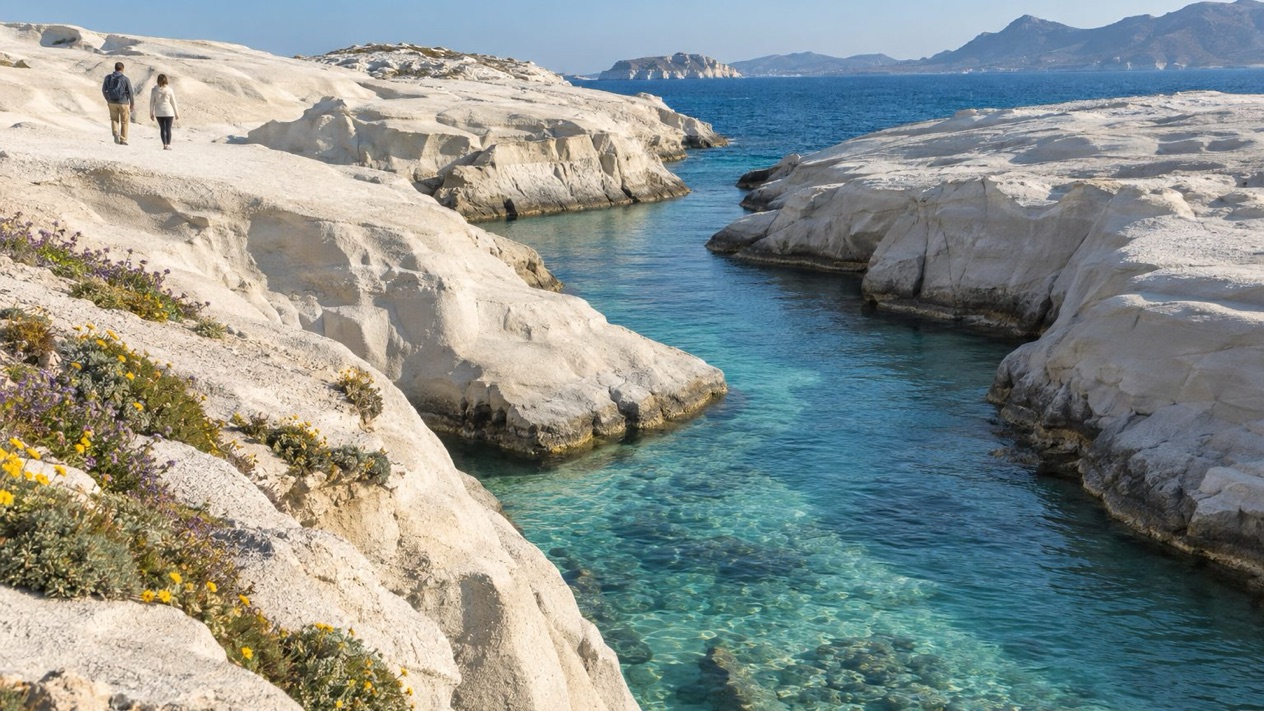
Kleftiko shows itself as pale, sculpted rock rising out of deep blue water, with arches and hollows where the sea slips in and out. The stone looks almost chalk white against the Aegean, and the shapes seem carved by hand rather than by wind and waves. It is a place on the southwestern edge of Milos that you come to look at, a landscape of caves and stone with a pirate story attached.
Is visiting Kleftiko worth it?
Yes, for anyone who likes rock formations, sea caves and a good legend, and especially for travelers who come to Milos for its coastline rather than for a long beach day. Kleftiko is a place to look at more than a place to settle in, and that is the difference between it and the many ordinary beaches around the island.
Milos is a volcanic island, and it shows. The coast is a patchwork of colors and textures, and the island counts over 70 beaches. Most of them are defined by their sand, their pebbles or the cliffs behind them. Kleftiko is defined by its architecture of stone. The white arches, the narrow passages and the cave mouths make it feel more like a sculpture garden that happens to be in the sea.
There is also the story. The name belongs to the same family as the Greek word for the klephts, the guerrillas and outlaws who lived outside the law during Ottoman rule. The caves are said to have sheltered pirates and bandits, and whether every detail is true hardly matters once you are looking at the dark openings in the rock. You can easily picture a ship slipping in unseen.
Milos is also a popular summer destination, so Kleftiko belongs to a wider island trip that might include the harbor town of Adamantas, the story of the Venus de Milo and the coves along the coast. As a single stop, it gives the island one of its most memorable images. As part of a longer stay, it gives the other beaches something to be compared against.
What to see at Kleftiko
What you see at Kleftiko is stone first and water second. The rock is the attraction, and everything else, the color of the sea and the shadows in the caves, takes its character from it. Each part of the place rewards a slower look.
The white rock and its arches
The first thing that catches the eye is the pale volcanic rock. It rises in rounded towers and blunt promontories, and in places the sea has worn right through it, leaving natural arches and bridges of stone. Milos is a volcanic island, and Kleftiko is one of the places where that origin is easiest to read in the landscape.
Look for the contrast between the bright rock and the water around it. Where the stone meets the sea, the surface changes from white to a cooler, greener shade, and the lines of the formations draw your eye from one hollow to the next. The shapes shift as your angle changes, so a formation that looks solid from one side may reveal a passage from another.
The sea caves and the pirate story
The caves are the heart of the legend. The tale goes that pirates and outlaws used these hollows as hideouts and as places to stash what they had taken, and the shape of the coast lends itself to the story. Narrow openings give way to larger chambers, and from the outside you cannot tell how deep a cave runs.
Take the story as a story. It is part of why the place carries its name, and it explains why local people talk about Kleftiko as a place of hiding. Standing in front of the cave mouths, you can easily imagine a lookout on the rocks and a ship drawn up out of sight. The imagination does the rest of the work.
The name and the dish
The word kleftiko appears twice in Greek life, once on the map and once on the menu. The dish called kleftiko is slow-roasted marinated meat, traditionally lamb or goat but also pork, usually cooked wrapped in parchment and served with potatoes. Its name comes from the klephts, who are said to have cooked meat on coals in a covered hole or underground pit so that no smoke would give them away.
That is a neat match for a coast of hiding places. Current recipes put the meat in the oven in parchment paper, and cooks sometimes add bell peppers, onions or a cheese such as kefalotyri. It is a dish loved on the Greek mainland, in Cyprus and among Greeks abroad, so ordering it at a taverna on Milos after seeing the place is a way to finish the story.
Milos around Kleftiko
Kleftiko sits within a wider island that is worth reading as a whole. Milos is the southwesternmost of the Cyclades, roughly midway between Piraeus and Crete, and its municipality also takes in the uninhabited offshore islands of Antimilos and Akradies. The harbor town is Adamantas, where many visits to the island begin.
The island is also where the statue of Aphrodite known as the Venus de Milo was unearthed. It now stands in the Louvre in Paris, but the name keeps the island in the conversation. Between the statue, the volcanic coast and the pirate legend, Milos gives Kleftiko a good deal of company in terms of stories.
When to visit Kleftiko
Summer is when Milos is at its busiest, as a popular tourist destination in those months, and it is also when the weather is steadiest for a coastal visit. July brings almost no rain, and the year’s warmest air.
At Santorini, close to Milos, highs average in the mid-80s in July and in the low 70s in October. Winter is cooler and wetter, with January showing many more rainy days, while April sits in between with mild air and little rain. The figures for each of these months are in the table.
| Month | Average high at Santorini (°F) | Average low at Santorini (°F) | Precipitation (inches) | Days with rain at Milos |
|---|---|---|---|---|
| January | 57.9 | 49.8 | 3.06 | 11.2 |
| April | 66.0 | 55.9 | 0.73 | 3.5 |
| July | 85.5 | 73.9 | 0.03 | 0.3 |
| October | 73.6 | 63.9 | 1.30 | 4.4 |
Summer and the meltemi
The meltemi is a strong, dry north wind that blows periodically across the Aegean from about mid-May to mid-September. Milos lies in the Aegean, so the wind belongs to the summer picture there. It can shape how the sea looks and feels along the coast, and it is a good reason to treat any summer plan for a coastal sight as one that depends on the day.
July is dry in the table, with almost no days of rain, and the warm air makes the white rock feel hotter against the blue water. The sea is warm in summer, as a general pattern in the Aegean, but a day’s conditions can change with the wind, so it pays to stay flexible rather than fix everything to a single date.
Spring, autumn and winter
April has mild air and few rainy days, which makes it a pleasant month for looking at the island’s rock formations, even if it is early for a long swim. The days are drier than in winter, and the landscape of Milos is still fresh from the months before.
October keeps much of the warmth of summer, with highs well above 70 degrees, but the rain begins to return, with a handful of wet days in the month. January is the other end of the scale, cooler and with more than a third of its days bringing rain. A rain jacket belongs in the bag for those months, and the pale rock looks quite different under gray skies.
Tips for your visit
Bring what you would bring to any exposed stretch of Aegean coast, plus the habit of looking carefully. Kleftiko rewards attention to detail, and the details are in the stone, the caves and the colors of the water. A camera is a good companion here, since the shapes change from every angle.
What to bring
In July, with highs in the mid-80s and almost no rain, sun protection matters most: a hat, sunglasses and sunscreen. The white rock reflects light, which adds to the glare.
In October and April, add a light jacket, and in the wetter months bring a rain jacket. Shoes with a good grip are a sensible choice anywhere on a volcanic coast, where the rock can be uneven and polished by the weather. A swimsuit and a towel are the usual companions on a Greek island trip in the warm months.
What to combine it with
Kleftiko fits naturally into a wider tour of Milos. Adamantas, the harbor town, is where a day on the island can start or end, with its waterfront cafes and tavernas. The island has over 70 beaches, so there is plenty of other coastline to set against the rock formations you have just seen.
The story of the Venus de Milo adds a cultural layer to the trip. The statue was found on the island and now stands in the Louvre, so Milos is a place to think about the ancient world as well as the landscape. A meal of kleftiko, the slow-roasted meat in parchment, ties the place name back to the table.
Planning around the weather
Because the meltemi blows periodically from mid-May to mid-September, a summer visit is best planned with a little flexibility. A day that does not suit the coast can be given to the town, the museum story or a meal, and the rock formations can wait for another day. In the shoulder months, the main variable is rain rather than wind.
Keep the rest of the trip loose, too. Look at the arches, follow the line of the cliffs with your eyes and let the legend fill in the gaps between the rocks.
Good to know before you go
Take your rubbish with you and leave the rock as you found it. Carry some euros for the island’s tavernas and cafes, since a meal of kleftiko or a coffee in Adamantas is part of the trip.
The meltemi and the summer heat are the two weather factors worth keeping in mind from mid-May to mid-September, and the winter months bring more rain. Beyond that, the trip asks little of you except curiosity and a good pair of shoes.
Sources
- Wikipedia, Kleftiko (https://en.wikipedia.org/wiki/Kleftiko), checked October 12, 2026
- Visit Greece (GNTO), Milos (https://www.visitgreece.gr/islands/cyclades/milos/), checked October 12, 2026
- Wikipedia, Milos (https://en.wikipedia.org/wiki/Milos), checked October 12, 2026
- Wikivoyage, Milos (https://en.wikivoyage.org/wiki/Milos), checked October 12, 2026
- Hellenic National Meteorological Service (HNMS), climatological normals 1991-2020 for Santorini station (https://www.emy.gr/climatic-data), monthly mean daily maximum and minimum; rain from the ECMWF ERA5 reanalysis, 1991-2020, grid cell of Milos (Open-Meteo), checked October 12, 2026
- ECMWF ERA5 reanalysis 1991-2020, grid cell of Milos (Open-Meteo), checked October 12, 2026
- Wikipedia, Blue Flag beach (https://en.wikipedia.org/wiki/Blue_Flag_beach), checked October 12, 2026
- Wikipedia, Meltemi (https://en.wikipedia.org/wiki/Meltemi), checked October 12, 2026
To plan your stay
- Agia Marina Beach near Chania: Setting, Seasons and the Old Town Next Door
- The Beaches of Antiparos: Sandy Shores, Nudist Coves, the Cave and Despotiko
- Agios Gordios Beach on Corfu: Ai Gordis Village, the Pink Palace, Weather by Season and Tips
- Agios Prokopios Beach: Naxos Setting, Seasons, Food and Nearby Sights