
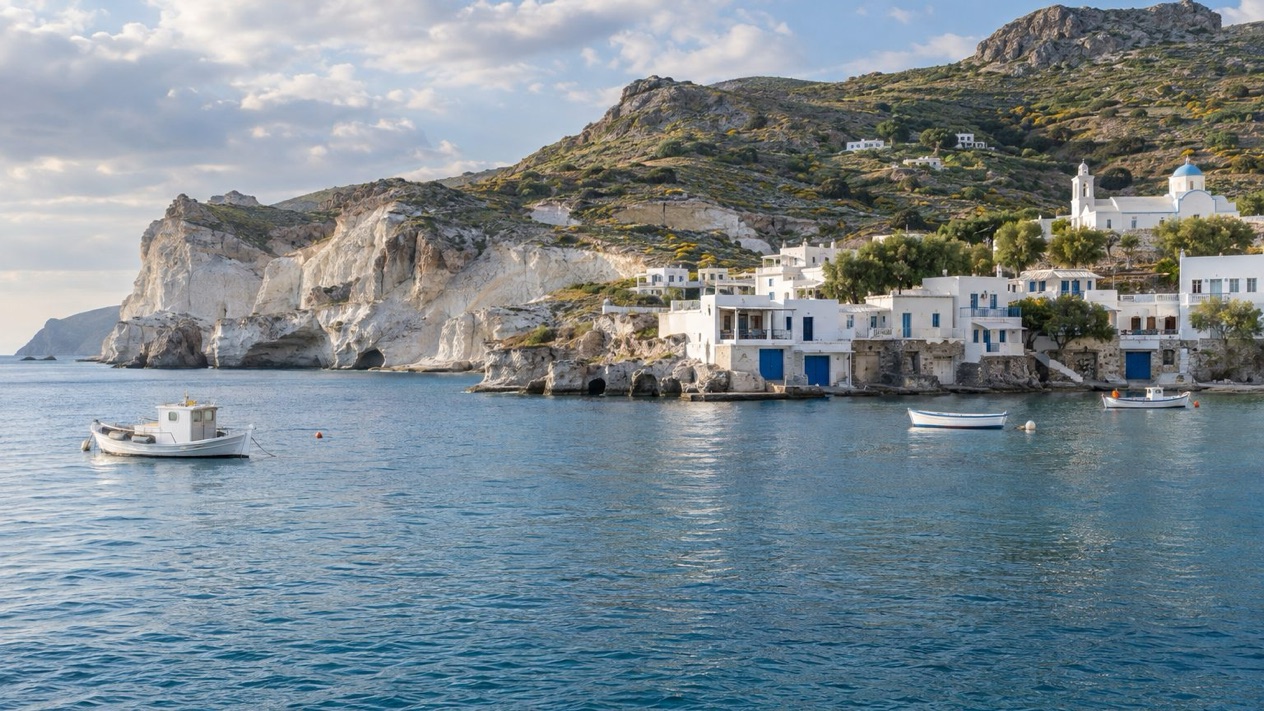
Milos is a small volcanic island in the western Cyclades. It has moonscapes of white rock, colorful cliffs and bright turquoise water. It has grown busier in recent years, with crowds at beaches like Sarakiniko and Firopotamos and waits at popular tavernas. When you visit each place now matters almost as much as which places you pick.
What are the best things to do in Milos?
For a first trip, rank them this way:
1. Sarakiniko at sunrise
2. A boat day to Kleftiko
3. A few south coast beaches
4. Klima and the other fishing villages
5. A sunset in Plaka
Four or five nights covers those highlights comfortably. Two or three days feels rushed. With a week you can slow down and work through the rest of this page.
Is Sarakiniko worth it, and when should you go?
Yes, and go at sunrise. Smooth white volcanic rock, shaped like meringue by wind and water, runs down to bright turquoise sea. The beach itself is small. The landscape is what you come for. You scramble over pale ridges, find caves and rock pools, and watch people leap from the cliffs. The rock grips well, so climbing is easy. Wander to the left of the beach for the best look at the chalk-white terrain.
The beach faces east, so at dawn it is quiet and the cliffs turn whiter as the sun climbs. Tour buses arrive from the morning onward, and by midday it is hot and crowded. Sunset is the second-best time, when the sky often goes pink and purple, though more people show up.
Food is limited to a small stand or food truck near the entrance, and it may not be there, so bring your own snacks and water. There are no other facilities. You can drive and use the parking lot, or take the direct bus from Adamas. If you want to jump, watch where locals do it first, and keep it to strong swimmers since there are no lifeguards.
How do you see Kleftiko?
Kleftiko is a cluster of sea caves, rock arches and lagoons on the southwest coast. The water is startlingly clear and the white rock towers overhead. Pirates once hid in its sheltered coves. Today you'll mostly find catamarans and snorkelers. Bring a mask, because there are plenty of fish. Boats drop anchor with nowhere to dock, so you explore by swimming.
A boat is by far the easiest way in, and you have several kinds to choose from:
Half-day trip
Shorter and simpler, and a sensible choice with a baby or small children.
Full-day sail
Covers far more. The 10-hour tour from Adamas circles the whole island. It stops to swim at Gerakas, Polyaigos (also spelled Poliegos) and other spots you can't reach on foot. Many full-day tours include lunch, snacks and drinks. The longer trips cost more, and they are worth it.
Your own boat
You can rent a small boat with or without a skipper if you want a more private way to explore. Kleftiko is about 20 minutes from the nearest beach.
Most trips leave from Adamas, with some from Agia Kyriaki or Kipoi, so check the departure point when you book. Tours fill up, so reserve ahead.
You can also hike in. Drive up into the mountains of western Milos, then walk 40 to 50 minutes to the coast. The roads there are very bumpy, and some rental companies bar their vehicles from that area or won't insure them there. Ask before you set out.
Which Milos beaches should you visit?
Milos has about 70 beaches, and they differ wildly, so choose by mood.
Firiplaka
This is a long crescent of sand on the south coast, with turquoise water and cliffs in orange, white and pink. It's kid-friendly and easy to enjoy for a full day.
The arch
A rock outcrop partway along the bay has an arch you can swim through.
Getting there
Depending on the tide, the path down may mean wading through shallow water.
Shade
Straw umbrellas line the beach and fill up quickly, so arrive early if you want a spot in the shade.
Food
A small beach bar sells snacks, drinks and basic lunches such as Greek salads and sandwiches.
Rising seas have washed away some of the sand, so space is tighter than it used to be.
Tsigrado
Tsigrado is a tiny beach next to Firiplaka at the bottom of a narrow crevice in the rock. You reach it by ropes and two steep ladders, and the water below is gorgeous. The ladder can be missing rungs, so check its condition before you commit. Skip the climb if you have mobility issues, a fear of heights or young children with you. The view from above is worth the stop on its own. Before you head down, look over the edge to get a sense of how crowded the little beach is. Tsigrado has no food or drink, but Firiplaka's beach bar is within walking distance.
Paliochori
Paliochori is backed by cliffs in yellow, red, white and black. At Sirocco, the restaurant on the beach, many dishes are cooked in the sand using geothermal heat from below. You can even have food brought to your lounge chair. The beach feels a little commercial and gets very crowded. It's also the best choice on a windy day, since it's well protected from the Meltemi winds.
Firopotamos
This is a beach by a fishing village of whitewashed houses, with cliff-jumping spots nearby. Summer brings crowds and a full parking area, so an early or late visit feels calmer.
Papafragas and Kapros
Papafragas and Kapros are sea channels carved into the cliffs on the north coast. The original Papafragas beach is hard to reach now: the sand has nearly gone and the climb down is risky. Treat it as a viewpoint over the caves and water. Kapros, right next to it, is a swimmable cove often mistaken for Papafragas. There's no food here, and the nearest lunch is in Pollonia.
Ammoudaraki and Achivadolimni
Ammoudaraki, with soft sand and clear water, is one of the best beaches for families. Achivadolimni is a long sandy beach with tamarisk trees behind it for shade. The pace is calmer than at Sarakiniko or Paliochori.
Which Milos villages are worth visiting?
Klima
Klima is a tiny fishing village of two-story boathouses, called syrmata, with brightly painted doors, set steps from the water. Fishermen once kept their boats on the ground floor and lived upstairs. Today some of the garages hold tourist shops or rentable stays, and just a handful of people live here full time.
The village is easy to see in an hour. The afternoon light is lovely here, and it makes a wonderful place to watch the sunset. Afterward, eat at one of the few restaurants. The Venus de Milo was found near Klima in 1820.
Mandrakia
Mandrakia is even smaller, with whitewashed homes, fishing boats bobbing in the bay and octopus drying in the sun. Walk to the right of the church to find a smaller bay, where syrmata sit tucked into the rocks and waves crash against them.
Medusa, the waterside taverna known for its octopus, has grown very popular. In peak summer, waits can stretch to two hours and quality can slip. Go when it's quiet.
Plaka and the Venetian Castle
The capital is tiny and pretty, with narrow whitewashed lanes, bougainvillea and blue doors. A winding path climbs past the churches of Panagia Korfiatissa and Panagia Thalassitra to the ruins of a 13th-century Venetian castle. Little of the castle remains, but the views take in most of the island.
The castle is a favorite sunset spot, so arrive at least 20 minutes early and be ready for stairs. Two other good sunset spots are the terrace of Panagia Korfiatissa and Utopia Cafe, which is a summer spot. All of them get crowded. Afterward, walk down for dinner in town, and save room for orange cake with olive oil at Café Palaios.
Pollonia
Pollonia is a seaside town on the northeast corner, with a shallow, family-friendly beach. Seafood restaurants line the waterfront, so come for dinner even if you're staying elsewhere. Yialos is a standout.
What else is there to do in Milos besides the beaches?
Catacombs and the Ancient Theater
The catacombs lie on the slopes below Trypiti. They are an early Christian burial complex carved into volcanic rock and dating from roughly the 1st to the 5th century. They rank among the most important catacombs in the world, and a visit is a 15-minute guided tour of two main chambers.
A short walk away, the Roman-era theater clings to the hillside above Klima and looks out over the sea.
Both sites are compact, so you can see them together in under an hour and then head down to Klima for lunch.
Archaeological Museum of Milos
The museum is in Plaka (+30 22870 28026), so it fits easily into an afternoon in town.
2026 prices:
- Full admission is €5 and reduced admission is €3.
- Entry is free on March 6, April 18, May 18 and the last weekend of September.
In summer the museum is open 8:30 a.m. to 3:30 p.m. and closed on Tuesday.
Mining history
Mining, more than tourism, has driven the island's economy for the past century. The Milos Mining Museum, near the heart of Adamas, tells that story.
For the real thing, visit the abandoned Theorychia sulphur mines above Paliorema Beach on the southeast coast. They worked from 1930 until the industry collapsed in 1958. Rusting machinery and tools still stand where the workers left them. The dirt road in is full of deep potholes and needs a 4WD. If you have more than two days, the mines are well worth it, paired with a swim at Paliorema.
Kimolos
Kimolos is a quieter neighbor, 20 to 30 minutes by ferry from Pollonia. You can buy tickets the morning you go. It works as a day trip, though a couple of nights is better. Some boat tours combine Kimolos with Polyaigos and its turquoise water.
How do you get around Milos?
Rent an ATV, motorcycle or car, and book it before you land. You can pick it up at the airport or port, or ask your hotel to arrange one, sometimes waiting at the property. A few things to know before you rent:
Transmission
Many rental cars and quads are manual, so keep that in mind.
Clearance
Roads are rough in places, and companies may rule some areas off-limits for a car that sits low to the ground. Ask about the western half of the island in particular. Some companies allow it for an extra insurance charge.
Without a rental, you'll rely on the local bus, which runs mostly from Adamas. If you plan to use it, stay there. The bus won't reach many of the remote beaches.
When is the best time to visit Milos?
The season runs from May through October.
May and September
May and September are the sweet spots, with warm weather, quieter beaches and lower rates. In early May the water can be chilly, and some restaurants and hotels may not have opened yet.
July and August
July and August are the busiest months.
August to October
The island can be very windy.
October
Some places may be closed or running a lighter schedule, so do a little research first.
Milos has few hotels, and the good ones book out months in advance. Book your hotel well ahead, especially for July and August when the nicer places fill up quickly.
How do you get to Milos?
By sea, Blue Star Ferries and Seajets sail from Piraeus, the port of Athens. The trip takes about 2.5 hours on a high-speed boat and up to 7 on a regular one. Milos also connects by ferry with Santorini, Paros, Naxos and other Cyclades islands, and with Crete. Book on Ferryhopper as early as you can.
By air, Olympic Air and Sky Express fly from Athens in under an hour.
Several ferries sail each day in July and August, but service thins out fast by October. When you pair Milos with another island, leave a spare day in case ferry schedules shift, particularly outside the summer months.
Sources
- finduslost.com (https://finduslost.com/milos-greece-travel-guide/), checked October 18, 2026
- stokedtotravel.com (https://www.stokedtotravel.com/milos-travel-guide-most-beautiful-island-greece/), checked October 18, 2026
- eatsleepbreathetravel.com (https://eatsleepbreathetravel.com/the-best-of-milos-island-my-milos-greece-itinerary-for-3-5-days/), checked October 18, 2026
- thesmoothescape.com (https://www.thesmoothescape.com/best-things-to-do-in-milos-greece/), checked October 18, 2026
- erikastravels.com (https://www.erikastravels.com/things-to-do-in-milos-greece/), checked October 18, 2026
- Hellenic Ministry of Culture, Odysseus (http://odysseus.culture.gr/h/1/eh155.jsp?obj_id=3300), checked October 15, 2026