
BLUE SPRING · FLORIDA · THE 12-MONTH VERDICT
The water at Blue Spring does not keep a calendar. The air above it does, and the air is what you are choosing between when you pick a month: how the boardwalk feels at noon, how full the lot is by ten, how many afternoons the rain takes away from you.
The swing is real. Average highs run 71.2°F in January and 91.9°F in July, a spread of 20.7 degrees, while rainfall goes from 1.73 inches in November to 8.17 inches in June. Rain days follow the same curve: three in an average November, nearly twelve in an average June. Those four numbers decide most of the year for you.
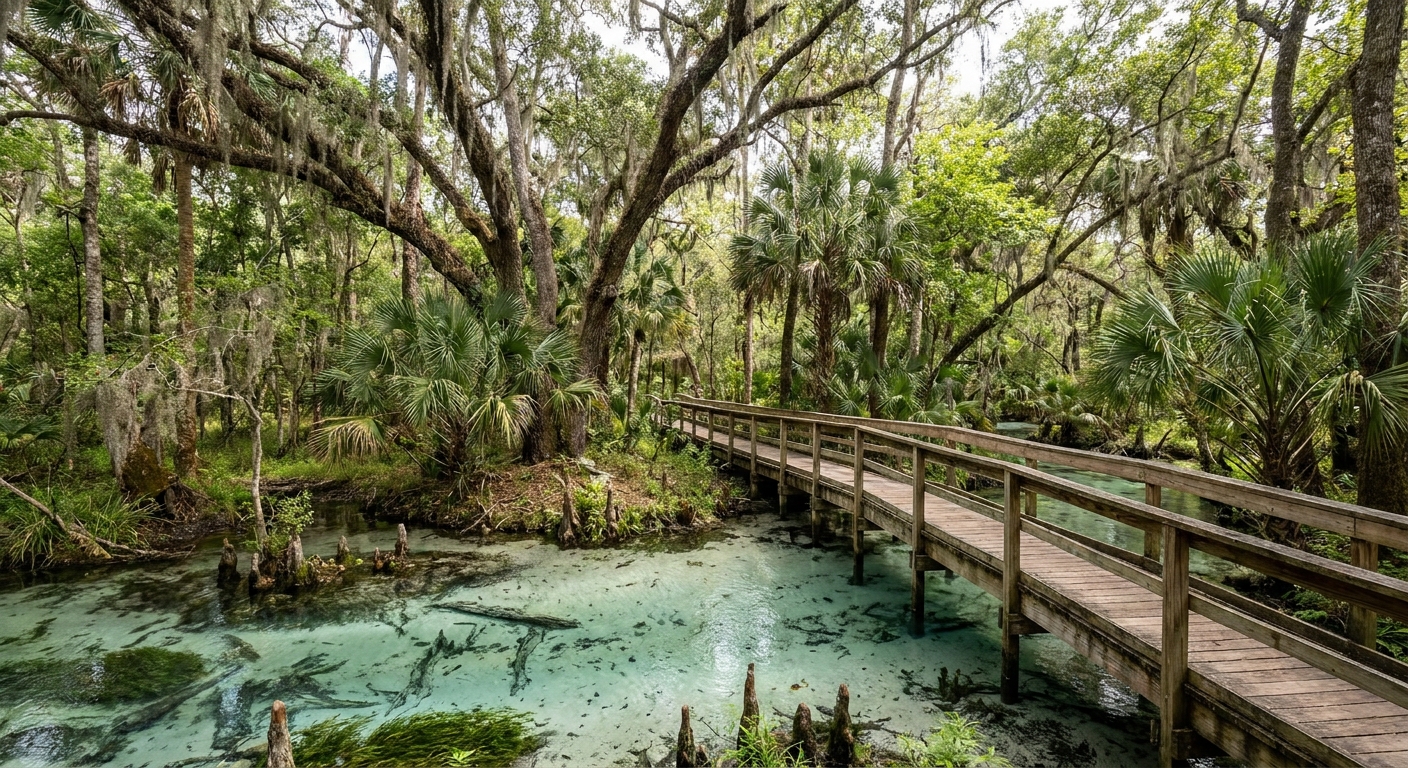
THE YEAR AT A GLANCE · BLUE SPRING
November is the pick: the driest month of the twelve at 1.73 inches, 77.8°F days, three measurable rain days, and a spring that is exactly as warm as it is in July.
PICK: NOVEMBER · WETTEST: JUNE, 8.17 IN · AIR NORMALS FROM ORLANDO EXECUTIVE AP, 44 KM AWAY
Go for: a swim that ignores the season, three-rain-day months from October to April, and winter mornings cold enough on the boardwalk to make the water feel tropical.
Think twice before: booking a June or July day around a picnic and a long drive: those two months average 11.8 and 11.9 days with measurable rain.
Air normals: NOAA NCEI 1991-2020, Orlando Executive AP · Daylight: sunrise-sunset.org · park rules and closures: Florida State Parks · full sources at the end
On this page
- Blue Spring weather month by monthThe 12-month table
- The best month to goNovember, 1.73 in and 77.8°F
- Summer heat at Blue SpringJuly and August near 92°F
- The quietest weeks of the yearLate fall and midwinter weekdays
- The month to skipJune, and who it hurts
- Shoulder season at the springMarch, April and October
Settle one thing before the table. The winter manatee gathering and the summer swim crowd are two different visits wanting two different months, and the swimming area can be closed while the animals are in the run. Florida State Parks posts the day’s status; our guide to swimming with manatees covers how the season works statewide.
Blue Spring weather month by month: highs, lows and rainfall
| Month | Avg high | Avg low | Rain | Days at 0.10 in or more |
|---|---|---|---|---|
| January | 71.2°F | 51.8°F | 2.61 in | 3.8 |
| February | 74.3°F | 54.3°F | 2.06 in | 3.4 |
| March | 78.4°F | 58.3°F | 2.74 in | 4.0 |
| April | 83.2°F | 62.8°F | 2.70 in | 3.9 |
| May | 88.2°F | 68.7°F | 3.66 in | 5.3 |
| June | 90.7°F | 73.4°F | 8.17 in | 11.8 |
| July | 91.9°F | 75.0°F | 8.07 in | 11.9 |
| August | 91.8°F | 75.3°F | 7.66 in | 11.7 |
| September | 89.5°F | 73.9°F | 6.55 in | 9.8 |
| October | 84.4°F | 68.3°F | 3.24 in | 4.7 |
| November | 77.8°F | 60.1°F | 1.73 in | 3.0 |
| December | 73.1°F | 54.5°F | 2.28 in | 3.4 |
Eight of the twelve months stay under 3.7 inches of rain, and the four that do not are stacked together: June through September deliver 8.17, 8.07, 7.66 and 6.55 inches. June, July and August also average above 90°F, with nights that never settle below 73°F.
Two hinges do the work. Between May and June rainfall climbs 4.51 inches and wet days more than double, from 5.3 to 11.8. Between September and October it collapses again, 6.55 inches down to 3.24, with wet days falling from 9.8 to 4.7 and average highs dropping 5.1 degrees. Everything from October to April behaves like one long dry stretch.
The punishing stretch is mid-June to mid-September, and it punishes the people who spend hours out of the water: grandparents on the boardwalk, anyone shepherding kids between the lot and the run, photographers waiting for light. July is the peak of it at 91.9°F by day, 75.0°F at night and 11.9 days with measurable rain. Swimmers feel almost none of this.
A caveat that matters more here than at a beach: every figure here is a NOAA 1991-2020 monthly normal read at Orlando Executive Airport, about 44 km from the spring, and it describes the air. The spring water has no season at all. The normals average daily maxima and minima across thirty years, so they predict no single day, and the wet-day counts use a 0.10 inch threshold, with a separate count for days reaching an inch or more.
When is the best time to visit Blue Spring?
Go in November. It is the driest month of the twelve at 1.73 inches, with the fewest measurable rain days of the year at 3.0 and only 0.3 days reaching an inch or more. Days average 77.8°F and nights 60.1°F, which is warm enough to dry off and cool enough to walk the run at noon without hunting for shade. November 15 still gives 10 hours 44 minutes of daylight.
Its neighbors both give something away. October runs 6.6 degrees warmer by day, 1.51 inches wetter and 1.7 rain days longer, and it sits inside the Atlantic hurricane season, which does not close until November 30. December cools the walk by another 4.7 degrees at the high end and trims the light to 10 hours 21 minutes by the 15th.
What actually reshapes a November day here is the operator’s board rather than the sky: manatee-season rules for the swim area, capacity closures when the lot fills early in the morning. Check Florida State Parks the day you drive, and use our statewide calendar for how the dry season behaves across the rest of the trip.
How hot does Blue Spring get in summer?
June, July and August average 90.7°F, 91.9°F and 91.8°F. The nights barely help: 73.4°F, 75.0°F and 75.3°F on average, so the heat that built during the day is still there at nine in the evening. May has already reached 88.2°F. June 15 brings 14 hours 02 minutes of daylight, three hours and forty-one minutes more than December 15, which stretches the hot part of the day well past dinner.
One number we cannot give you is humidity. The station record used here carries temperature and precipitation only, with no humidity or heat index figures, so putting a value on how those 91.9°F afternoons feel would be invention. Treat summer as a water visit with short land intervals, and read the wet-season pattern in the Florida guide before you plan an all-day outing.
When is Blue Spring quietest?
Quiet is a calendar fact here, not a weather one. The thin weeks are the school-year weekdays: early to mid-December before the holiday break, mid-January through February outside the long weekends, and early November once the fall vacation traffic has gone. March is the exception in that stretch, because spring break drops the state’s loudest crowd into the middle of it.
Those weeks buy you the cool version of the park. November days at 77.8°F and January nights at 51.8°F make the boardwalk a pleasure rather than a sprint, the rain stays scarce at 3.0 measurable days in November and 3.4 in December and February, and the cold snaps are precisely what pull the manatees into the run. Morning parking behaves itself on a Tuesday.
You pay for it in light and in access. December 15 offers 10 hours 21 minutes of daylight and January 15 offers 10 hours 32 minutes, the two shortest readings of the year, so a late start costs you the afternoon. An average January also records 0.8 nights at or below 32°F, December 0.3, and a dawn arrival in that window is genuinely cold. Winter is also when the swim area is most likely to be closed for the animals.
Which month should you avoid at Blue Spring?
June, and specifically for people whose day depends on staying dry. It records 8.17 inches, the most of any month, across 11.8 measurable days, and 2.9 of those days reach an inch or more, the highest such count of the twelve. Nights hold at 73.4°F. If your plan involves a two-hour drive, a picnic table and small children, June will test it. If your plan is to be in the water, June barely registers.
June still hands over the longest days of the year, 14 hours 02 minutes on the 15th, so a storm that clears at five leaves hours of usable light behind it. And 11.8 wet days in a thirty-day month means eighteen days that are not. Families weighing it against the school calendar will find the trade-offs laid out in our Florida with kids guide.
Is the shoulder season worth it at Blue Spring?
Three months sit between the winter manatee run and the summer swim season: March at 78.4°F and 58.3°F with 2.74 inches, April at 83.2°F and 62.8°F with 2.70 inches, and October at 84.4°F and 68.3°F with 3.24 inches. Measured against July, that is 13.5 degrees cooler in March, 8.7 in April and 7.5 in October, with 7.9, 8.0 and 7.2 fewer measurable rain days respectively.
What that buys is the version of the day summer cannot produce: air warm enough to dry you in ten minutes, fewer than five wet days in the month, and light that has come back. March 15 gives 12 hours 02 minutes, April 15 gives 12 hours 56 minutes. The storm rhythm has not started either, since wet days only climb to 5.3 in May before jumping to 11.8 in June.
It also takes things off the table. The winter manatee gathering thins out as the air warms, so a spring visit is about the water rather than the wildlife. March carries 4.0 measurable rain days, the highest of the eight-month dry stretch, plus spring break crowds. October keeps 3.24 inches and 4.7 wet days and stays inside the hurricane season through November 30.
Our ruling: take April if the swim is the point, since 83.2°F days and 3.9 wet days are the best combination of warm air and dry sky in the year. Take October for a quiet weekday and accept one more rain day. Take March only in the weeks either side of spring break.
The last word
Book November if the calendar lets you choose. If it does not, February is the quiet alternative nobody puts on a poster: 74.3°F days, 2.06 inches of rain, 3.4 measurable days and only 0.3 days in an average February reaching an inch, the same as November, with 11 hours 13 minutes of daylight on the 15th. Pack a towel that dries fast, aim to be in the lot before the morning fills, and check the park’s status page the night before you drive out.
Sources & data for this guide
- Monthly normals 1991-2020 (highs, lows, precipitation, wet-day counts, freeze nights) · NOAA NCEI, station USW00012841, Orlando Executive AP, about 44 km from the spring · checked Sep 12, 2026
- Daylight length, sunrise and sunset on the 15th of each month · sunrise-sunset.org, converted to local time · checked Sep 12, 2026
- Atlantic hurricane season dates (June 1 to November 30) · NOAA National Hurricane Center, as cited in our Florida seasons guide · checked Sep 12, 2026
- The spring’s own water temperature, manatee-season closures of the swimming area and daily capacity limits are not part of the climate record used here · Florida State Parks publishes them · check the day you drive
- Crowd patterns are editorial, read off school and holiday calendars rather than attendance counts.