
FLORIDA · BLUE SPRING · USGS 02235500
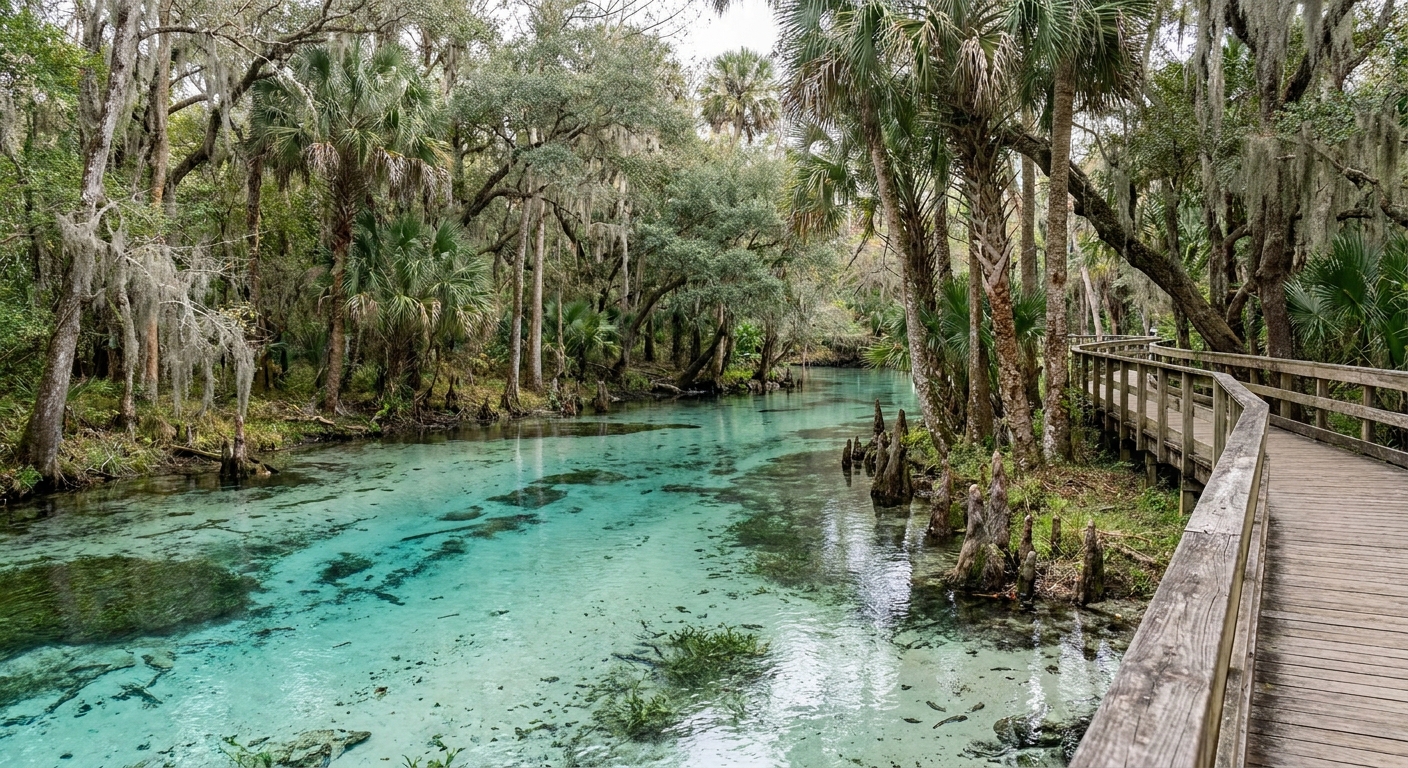
The water at Blue Spring makes you inhale before you swim. The USGS gauge in the run read 74.3 °F (23.5 °C) on September 11, 2026, cool enough to catch your breath on a Florida afternoon and never cold enough to send you back to the towel. Below you the bottom stays in focus: gray limestone, a sunken log, a fish holding still against the current.
That visibility comes from volume. The same gauge measured 168 cubic feet per second leaving the vent, so the water in front of your mask is replaced faster than it can cloud. The state counts one designated swimming area here, which means the whole park funnels toward a single stretch of blue, and the swim is short, current-assisted and worth doing twice.
THE SPRING AT A GLANCE · BLUE SPRING
Come for a swim in water the gauge put at 74.3 °F (23.5 °C), arrive early enough to be one of 187 cars, and call the park for the fee, the hours and the winter status of the swim area, because none of the three could be read at the source.
USGS GAUGE 02235500 · 1 SWIM AREA · 187 PARKING SPACES · 3,050 FEET OF BOARDWALK
Go for: a swim you can see through, 3,050 feet of boardwalk over the run, and one launch that takes canoes, kayaks and tubes.
Think twice before: a summer Saturday arrival after breakfast, or any winter plan that assumes the swim area is open: the park’s own status page returned nothing we could quote.
Water: USGS station 02235500 · Facilities: Florida DEP inventory 2024 · Legal class: Florida Statutes 373.802(5) · full sources at the end
On this page
- How cold the water is74.3 °F on the gauge, most days of the year
- Whether you can swim at Blue SpringOne designated swimming area
- What to do besides swim3,050 feet of boardwalk, 3 platforms, 6 cabins
- Parking and summer weekends187 spaces, then a closed gate
- Is the drive worth itThe verdict, and what the statute protects
- Manatees in winterWhere swimming near manatees is legal in Florida
- Other Florida springsThe springs overview
The entrance fee, the opening hour and the winter status of the swim area are not here, because we could not read them at the source: floridastateparks.org answered our automated reads with a 403 error on September 11, 2026, and the FWC manatee page builds itself in the browser. Call the park for those, and see how this one sits among its neighbors in the Florida springs overview.
How cold is Blue Spring?
A spring does not have seasons; the air above it does. The 74.3 °F (23.5 °C) the gauge reported on September 11, 2026 is close to what it reports on any other date, so what changes between two visits is the weather you brought with you. In August that same water is the cold plunge everyone yelps about on entry. In January, with the St. Johns River outside the run far colder, it is the reason manatees move up into the spring, and the reason the manatee-viewing season belongs to the boardwalk rather than the swimsuit.
Can you swim at Blue Spring?
Swimming happens in one place. The state’s facility inventory lists a single designated swimming area, reached from the boardwalk along the water, and at 168 cubic feet per second the current does most of the work: people walk up the run, drift down it, then walk up again. A mask is worth more here than fins.
Whether that one area is open on your date is not something we could verify. The park publishes its own status, and our reads of the state park site came back with a 403 error, so the honest move is a phone call the day before you drive. If manatees are the reason you are coming, start with the rules for swimming near them in Florida, since they differ site by site.
What is there to do at Blue Spring?
| What the state counts | How many | What you do with it |
|---|---|---|
| Designated swimming area | 1 | The entire swim, in one stretch of run |
| Canoe, kayak and tube launch | 1 | Boats and tubes go in at the same spot |
| Boardwalk | 3,050 feet | Walk the run end to end without getting wet |
| Observation platforms | 3 | Standing room above the water, looking down |
| Cabins | 6 | Roofed beds, per the 2024 inventory |
3,050 feet of boardwalk is a little over half a mile of walking with the spring on one side, and the three observation platforms are where that walking stops. They sit above the water, so the view goes down through it instead of across it. On a winter morning the platforms are the main event for visitors who never open a bag.
One launch takes canoes, kayaks and tubes, which keeps the put-in simple and the line singular on a warm weekend. From there the run carries you toward the St. Johns River, and the return leg is the part first-time paddlers underestimate: everything that pushed you along on the way out is still pushing on the way back.
Six cabins is the whole roofed count in the state’s 2024 inventory, so the calendar is the constraint rather than the rate. Nightly prices and booking windows sit outside that inventory and we are not borrowing them from another park. Families weighing a cabin here against a coastal base will find the trade-offs in Florida with kids.
How busy does Blue Spring get?
187 parking spaces decide a summer Saturday at Blue Spring, not an opening hour. The state counts them in its facility inventory, and when the lot fills, the gate closes to arriving cars until other cars leave.
So the arrival is the plan. Since the opening time is one of the figures we could not verify, that means calling ahead or reading the park’s own posted hours before you commit to the drive. And if the lot is already full, nothing gets you in except somebody else pulling out, so a second car traveling with you should not leave an hour behind the first.
Winter changes who occupies the park rather than how many. Fewer bodies go in the water and more line the rails, because the steady 74.3 °F is exactly what draws manatees up the run when the river outside turns cold. We carry no manatee count for Blue Spring: the FWC page that would supply one rendered client-side and gave us nothing to quote on September 11, 2026. The seasonal picture for the state is in when to visit Florida.
A weekday in the shoulder months takes the parking question off the table, and the single swim area is why it matters at all: one blue stretch cannot absorb a crowd the way a long beach can. If the spring is one stop on a longer loop, the driving side sits in getting around Florida, and the road trip guide shows where a stop like this fits between coasts.
Is Blue Spring worth visiting?
Sources & data for this guide
- Water temperature and discharge, 74.3 °F (23.5 °C) and 168 cubic feet per second · U.S. Geological Survey, National Water Information System, station 02235500 Blue Spring · instantaneous reading, September 11, 2026 · checked Sep 13, 2026
- Parking spaces, swimming area, boardwalk length, cabins and observation platforms · Florida Department of Environmental Protection, Recreational Facilities Inventory, 2024 annual report (PDF, 374 pages) · checked Sep 13, 2026
- Definition of Outstanding Florida Springs · Florida Statutes 373.802(5), leg.state.fl.us · checked Sep 13, 2026
- Entrance fee, opening hours and manatee numbers: not quoted here. floridastateparks.org returned a 403 error to our automated reads and the FWC manatee page renders client-side, so neither could be read · checked Sep 13, 2026
- Editorial note: a single gauge reading is a moment, not an average, and spring magnitude classification belongs to the Florida Geological Survey · we publish the flow and the legal definition separately for that reason.
Yes, with one phone call first. Clear water at 74.3 °F (23.5 °C) is the whole draw, and the boardwalk means the visit still works for anyone who has no intention of getting in. Two hours covers the swim and the walk; a cabin night turns it into a morning with the run to yourself before the lot starts filling.
Florida law has a category for water like this. Florida Statutes 373.802(5) defines Outstanding Florida Springs as every historic first-magnitude spring, as the Florida Geological Survey determines them, plus six springs named by hand in the statute. The language is dry and the consequence is not: it is the state saying which springs it intends to keep.
One reading is not a classification. The 168 cubic feet per second measured on September 11, 2026 describes an afternoon, and the Geological Survey works from long records when it assigns magnitude. We give the flow and the statutory definition separately, and leave the label to the agency that owns it.
The entrance fee, the opening hour and the number of manatees stay off this page for the same reason. Florida fees vary by park and by season, so a price copied from another spring would be a guess wearing a number’s clothes, and the park’s desk is the source for all three.
The gauge itself is the page worth a look before you go: station 02235500 posts Blue Spring’s temperature and flow whether or not the park’s site answers, and it will be near that 74.3 °F on your date too. Check it the morning you leave, and call about hours while the coffee brews. Then swim up the run once, drift back, and repeat until the boardwalk crowd arrives.