
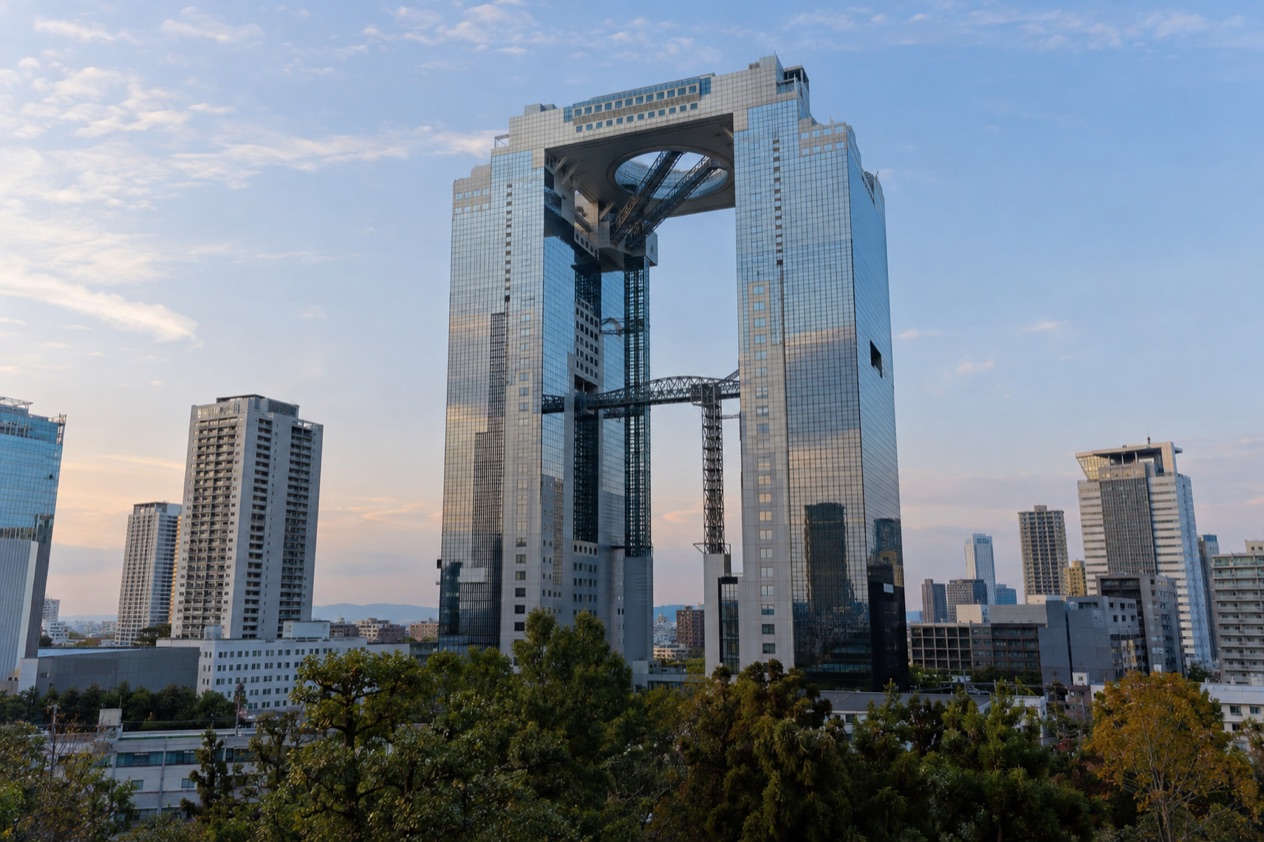
Two glass-and-steel towers rise above the rail tracks and office blocks of northern Osaka, and at the very top a ring-shaped platform seems to hover between them. Step into the open atrium at the foot of the towers and you look up through a gap in the sky, with escalators crossing it in a glass tube. The Umeda Sky Building is a visit for anyone who wants Osaka laid out below them, and a good stop for a traveler staying near Osaka Station.
Is visiting the Umeda Sky Building worth it?
Yes, if you like architecture that is meant to be experienced and not only photographed, and if you want a rooftop view of Osaka to go with a stop for coffee and a stroll in a garden. It suits couples, solo travelers who enjoy a skyline, and families who want a break from shopping streets. It is less of a fit for anyone hoping to tick off a temple or a castle, because this is a modern landmark, and its pleasures are in the structure itself.
What sets it apart from other high places in the city is its shape. Instead of one tower with a deck on top, two towers are joined at their highest floors, so the way up is itself part of the show: glass bridges, escalators and elevators crossing an open space with nothing but air around them. Add the rooftop Floating Garden Observatory, a cafe on the upper floors, gardens at ground level and a market that recreates old Osaka underground, and the building becomes a small outing in its own right.
It also sits where travelers already pass through. The towers stand near Osaka Station and Umeda Station, so a visit fits between a train connection and dinner without a detour across town. Osaka is known for its food, entertainment and nightlife, and the building gives the city a calmer counterpoint, a place to look at it all from a distance before heading back into the crowds.
What to see at the Umeda Sky Building
The building has the look of a gate: two tall slabs joined high above the ground. Completed on March 25, 1993, it holds offices and public spaces in a single mixed-use complex, and each part of the visit reveals a different side of it.
The Floating Garden Observatory
The rooftop Kuchu Teien Observatory, called the Floating Garden Observatory in English, is the reason people come. The name describes the idea: a garden in the air, a ring where you walk around and look out over Osaka instead of standing at one window. The towers reach 557.74 feet at the roof, and with the spires the building rises to 623.4 feet, so the horizon is wide.
The observatory spans two floors, which gives you more than one level to explore. Look for the rail lines fanning out from the stations, the grid of office towers and the way the city thickens into blocks in every direction. The Fence of Vows is also here, a spot where visitors leave words of devotion, and it gives the platform a human touch among the steel and glass.
Café Sky 40
Within the two-floor observatory sits Café Sky 40, named for the floor count of the towers, which rise 40 floors above ground. It turns the visit from a quick look into a pause: a table, a drink and the view of the city carrying on far below. It is a natural place to sit after circling the rooftop, especially if you are traveling with someone who tires of standing.
Take the time to notice the structure around you while you sit. The two towers frame the open space between them, and the bridges that link the top floors cut across it like lines drawn through the sky.
Glass bridges and escalators across the atrium
The part that draws the most photographs is the crossing between the towers. At the two uppermost stories, glass bridges hold escalators and elevators that run across an open atrium. You travel through empty space with a transparent shell around you, and the towers rise on either side.
The ride is brief, but it is a highlight even for travelers who do not usually care for heights. Look up from the atrium floor before you go and again when you come back down. The same crossing looks like a thin line from below and a hallway in the sky from inside.
The gardens at the base
At the foot of the towers, the Island Garden and the Vegetable Garden give the complex a green floor. Walking trails and water features run through them, so you can follow a path after the height and glass of the upper floors and see the towers from beneath their own shadow.
The contrast is part of the design, a dense urban site given a patch of planting and moving water. The Vegetable Garden is a small surprise in a district of offices and stations, and a reminder that Osaka likes to mix its work and its meals.
The underground market
Below the building, a market tries to recreate the atmosphere of Osaka in the early 20th century. It is the kind of place that rewards slow wandering: lanterns, old-style shopfronts and the feel of a street from another era, set under a modern tower. Osaka’s love of food shows here in the idea of the market itself, with places to eat and browse in a setting built to evoke the past.
The market is on one of the two floors below ground, so it sits at the opposite end of the building from the rooftop. Visiting both gives the full range, from the lowest level of the tower to the open air at the top.
Hours, tickets and rules
The building is not one attraction with a single gate but a set of parts, and each has its own character. The rooftop Floating Garden Observatory, the two-floor viewing level with Café Sky 40, the Island Garden and Vegetable Garden at the base and the underground market all sit within the same complex, and a visit can pick any of them or all of them.
Think of the day as a vertical route. At the bottom you have the market under the ground floor and the gardens with their walking trails and water features. In the middle are the towers, with offices in the shaft of the building. At the top you reach the observatory and the glass bridges across the atrium, with a cafe to sit in.
Because this is a working mixed-use skyscraper, most of the tower is not open to visitors, and the public experience concentrates at the top and the base. You will notice the difference between the offices below and the observation levels above as soon as you arrive at the lobby.
How to get to the Umeda Sky Building
The towers stand near Osaka Station and Umeda Station, so the starting point for almost every trip is one of those two stations. Both sit in the northern part of the city’s rail network, and from either you head for the towers on foot, with the building visible above the surrounding blocks.
If you are arriving from Tokyo, the Tokaido-Sanyo shinkansen runs to Shin-Osaka Station, and the journey takes about two and a half hours. From Shin-Osaka, a JR local line goes to Osaka Station, which puts you near the building. That is the standard chain for a traveler coming in by bullet train, with one change after the long leg.
From the same two stations you can reach other parts of Osaka. The Midosuji Line runs from Osaka or Umeda Station to Shinsaibashi, the shopping and nightlife district, and if you stay on until Namba Station you reach Dotonbori, with its canal and neon signs. That makes the building an easy anchor for a day that ends in the food streets of the south.
Osaka Bay is also reachable from Osaka or Umeda stations, via the JR Loop Line and the Chuo subway line.
When to visit the Umeda Sky Building
The best months are the ones when you want to be outdoors on a rooftop, and in Osaka that points to spring and autumn, with October and April offering mild air and a good share of sunshine. Summer is hot and humid, and January is cold enough that a rooftop walk calls for a coat. Each season changes what the platform feels like.
| Month | Average high (°F) | Average low (°F) | Days with rain | Sunshine (hours) |
|---|---|---|---|---|
| January | 49.5 | 37.4 | 5.6 | 146 |
| April | 67.8 | 51.6 | 9.2 | 193 |
| July | 89.2 | 76.3 | 10.0 | 184 |
| October | 74.7 | 60.8 | 8.3 | 166 |
In April the days are comfortable for a walk around the ring, and the sunshine is the most generous of the four months in the table. Rain comes on about a third of the days, in showers that pass, so a gray day is likely to be followed by a clear one. October is a little warmer, with the air still pleasant after the summer heat has gone.
July brings heat and humidity, with highs close to 90 degrees and showers on a third of the days. It is a month when the cafe and the indoor floors of the observatory matter more than the open rooftop. January is dry by comparison but cold, and snow or sleet falls on a handful of days in an average winter, so the view can come with a sharp wind.
Choose the season by how you like to look at a city: crisp and bright in the cooler months, hazy and warm in summer.
Tips for your visit
Bring a layer, because a rooftop is exposed and temperatures at the top feel different from the street. In the cooler months a coat makes the platform comfortable, and in July a hat and a bottle of water matter more. In rain, the indoor floors, the cafe, the atrium and the underground market keep the visit going.
Plan to see the building from the outside first. The two towers with their linked top are best understood from the atrium and the gardens, and the walking trails and water features around the base give you a place to look up. Then go up to the observatory with that shape in mind, so the glass bridges make sense when you cross them.
The location lets you combine it with the rest of Osaka. From Umeda Station the Midosuji Line reaches Shinsaibashi and Dotonbori, so you can finish the day among the shops and the canal.
For families, the gardens at the base give children something to explore outside the observatory, with trails and water features and a vegetable garden to look at. The escalators across the atrium are an event in themselves for younger visitors, though anyone uneasy about heights may want to treat the crossing as an optional part of the trip and enjoy the gardens and the market instead.
Good to know before you go
Osaka is a city that rewards an unhurried approach, known for its food, entertainment and nightlife with some history and culture to discover, and the building fits that rhythm as a pause between the busier stops. Carry the usual essentials for a day in the city and keep a layer or an umbrella handy, since showers pass through in many months of the year. The rainy and warm months bring humidity, so lighter clothing helps in summer, and a coat is the better choice in winter.
Sources
- Wikipedia, Umeda Sky Building (https://en.wikipedia.org/wiki/Umeda_Sky_Building), checked October 11, 2026
- Japan National Tourism Organization, Osaka (https://www.japan.travel/en/destinations/kansai/osaka/), checked October 11, 2026
- Japan Meteorological Agency (JMA), Normal values 1991-2020, monthly (https://www.data.jma.go.jp/stats/etrn/view/nml_sfc_ym.php?prec_no=62&block_no=47772), station Osaka, elevation 23 m, checked October 11, 2026
To plan your stay
- Best Time to Visit Japan: Cherry Blossoms, Autumn Colors, Weather and Festivals
- Where to Stay in Japan: Ryokan, Temple Stays, Capsule Hotels and the Best Cities to Base In
- Sending Luggage from the Airport in Japan: Hands-Free Travel, Hotel Delivery and Coin Lockers
- Know Before You Go to Japan: Entry, Money, Etiquette and Getting Around