
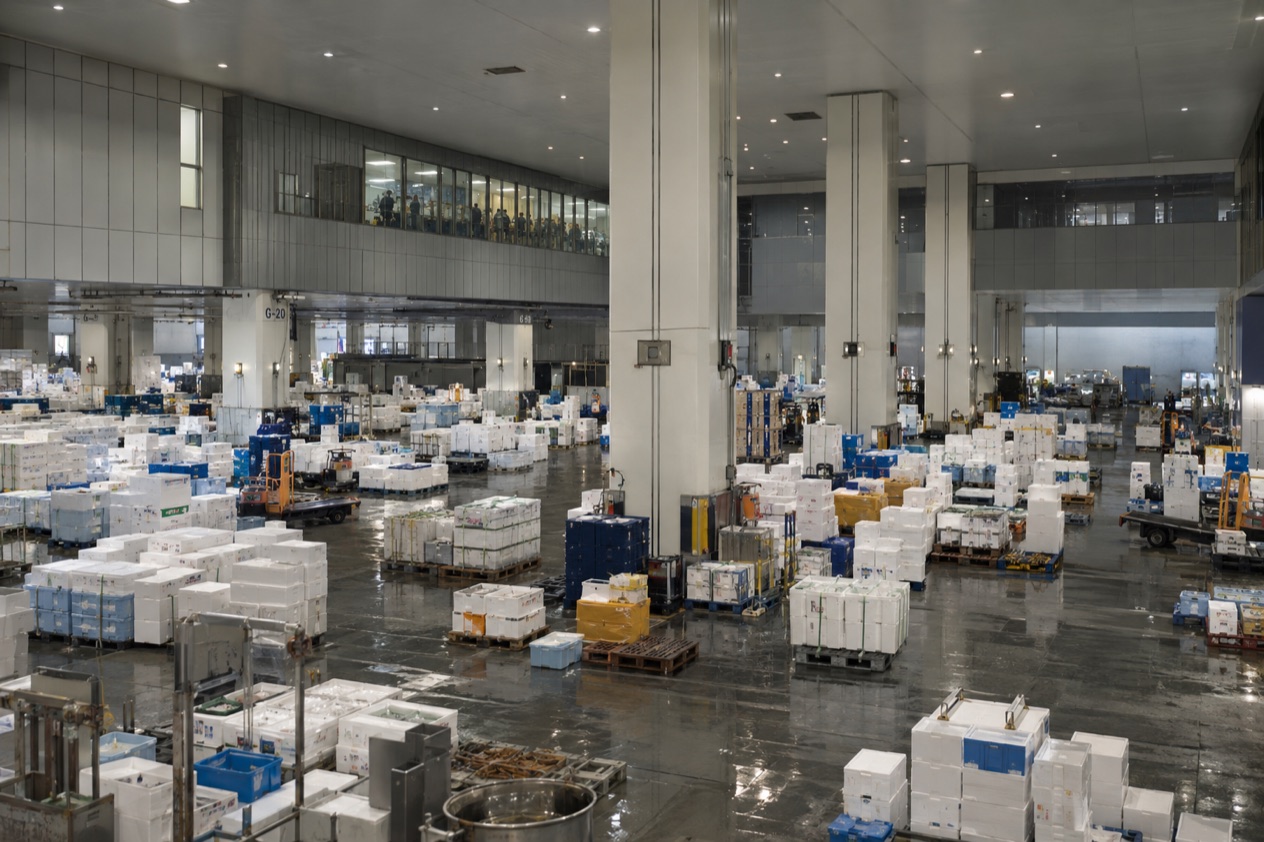
Inside the wholesale buildings at Toyosu, the day is organized around fish. Crates of seafood move past on small carts, buyers study what has come in, and above it all a glass-fronted walkway lets visitors look down on the work. Toyosu Market sits in the Toyosu area of Tokyo’s Kōtō ward, and a visit here is part working-market tour, part seafood meal, part stroll on a rooftop with a view of the skyline.
Is visiting Toyosu Market worth it?
Yes, if you like food and want to see where a great deal of Tokyo’s seafood arrives, because Toyosu lets you watch a real wholesale operation and then eat what it sells. It suits curious eaters, travelers who enjoy seeing how a city feeds itself, and anyone who wants a seafood meal built around the market itself. It is less rewarding if you expect to wander among the stalls and pick things up, since the working floor is kept separate from visitors.
What sets Toyosu apart from the older fish markets people may have read about is the layout. It is a modern, purpose-built complex with three markets, each in its own building, and visitors move through it on elevated routes and viewing areas rather than through the middle of the action.
It opened to the general public in October 2018, and it became the largest wholesale fish market in the world when it opened. The restaurants and the shops called uogashi yokocho give you the tasting side of the experience, while the viewing deck gives you the watching side.
The rooftop adds something a traditional market never had: a landscaped terrace with lawns and panoramic views over parts of Tokyo’s skyline. After the smell of the sea inside, stepping out onto green grass with the city laid out beyond is a pleasant change of pace, and it gives the visit a second act. Together, the viewing, the eating and the terrace make a satisfying outing that stands on its own.
What to see at Toyosu Market
The complex is divided by purpose, and the best way to enjoy it is to treat each building and level as a different chapter. Some parts are about watching, some about eating, and one is about fresh air.
The auction viewing deck
Tourists can observe the auction market from a second floor viewing deck. You look down on the floor where buyers and sellers do their business, so you see the scene as an onlooker rather than a participant. Visitors cannot attend the auction at floor level among the buyers.
There is also a second way to watch. Upon registration, visitors can view from a room at the same level as the floor, separated from it by a window. Either way, look at how the fish are laid out, how buyers inspect them, and how the whole floor keeps moving. It is a view of work in progress, so what you see depends on the moment you arrive.
Restaurants and food stalls
Toyosu has restaurants serving fresh seafood and produce from the market, and about 40 food stalls in the wholesale fish buildings, most of them located above the market and accessible to visitors. This is where the visit turns delicious. Picture sushi counters, bowls of rice topped with sliced fish, and the kind of simple seafood plates that depend entirely on the quality of what came in that day.
Browse before you commit. Walking the length of the eating areas shows you the range, from quick bites to sit-down meals, and lets you choose what looks best. Seafood is the star, but the produce side of the market feeds into the menus too, so vegetables and fruit appear alongside the fish.
Uogashi yokocho shops
The shops called uogashi yokocho are the market’s browsing street, where you can look over food products and sundries tied to the market’s trade. The name suggests a little alley of fish-related shops, and that is the spirit of it: small stalls, specialty goods and the pleasure of poking around.
It is a good place to slow down between the viewing deck and a meal, or to pick up something edible to take away. Look at what is on display, notice the variety, and let your appetite decide what comes next.
The rooftop terrace
The rooftop is reached by elevator and includes a large terrace with landscaping, lawns and panoramic views of parts of Tokyo’s skyline. It is the open-air counterpart to the busy buildings below. Eating and drinking are not allowed on the roof, so finish your meal first and come up to walk and look.
The terrace works well as a pause. After the viewing deck and the food stalls, the lawns and the city views give you room to breathe before heading on.
Hours, tickets and rules
Toyosu Market is open to the public, and its address is 6 Chome-3 Toyosu, Kōtō ward, Tokyo 135-0061. The market opened to the general public in October 2018. The viewing deck, the restaurants and the rooftop are the parts visitors use, while the working floors stay with the buyers and sellers.
| Site | Open | Admission |
|---|
Visitors cannot attend the auction at floor level among buyers. They can watch from the second floor viewing deck or, upon registration, from a room at the same level separated by a window. Eating or drinking are not allowed on the roof, which is accessible by elevator.
When to visit Toyosu Market
Toyosu is a place where the calendar matters less than the weather on the day, because most of the visit happens indoors, with the rooftop as the one outdoor stop. That makes it a flexible choice in any month, and a useful one when the forecast is uncertain.
Tokyo’s seasons shape the rooftop part of the visit. April brings highs in the mid-60s, a comfortable temperature for lingering on the lawns.
July is hot and humid, with highs in the mid-80s and humidity in the mid-70s percent, so the terrace is best taken in small doses and the indoor buildings offer the relief. Showers are typical, so a day here can fit around them, with the roof as a bonus when it clears.
A visit at any time of year follows the same rhythm: watch from the deck, eat, browse the shops, then go up to the roof if the sky allows. The meal is the constant, and that is the real reason to come.
| Month | Average high (°F) | Average low (°F) | Rain days |
|---|---|---|---|
| January | 49.6 | 34.2 | 4.5 |
| April | 66.9 | 49.6 | 9.5 |
| July | 85.8 | 72.3 | 10.5 |
| October | 71.6 | 58.6 | 10.5 |
Tips for your visit
Start on the viewing deck to see the auction market, move to the restaurants and food stalls for a meal built on fresh seafood, then browse the uogashi yokocho shops. Finish on the roof, where eating and drinking are not allowed, so that is the natural last stop once you have eaten.
If you want a closer look at the auction, the registered viewing room at the same level, behind a window, is an option. Remember that visitors cannot stand on the floor among the buyers, so expect to watch rather than take part.
The rooftop is reached by elevator, which helps anyone who prefers not to climb stairs. Bring a light layer in the cooler months, since the terrace is open to the air, and in summer bring something for the heat and humidity.
Tokyo has other districts worth pairing with a market morning. Ginza is an upscale downtown area with high-end restaurants and luxury shops, and Nihonbashi is known for its rich heritage and as the main financial district of Japan. Both are in Tokyo and give a very different flavor from the market.
Roppongi and Akasaka are further options in the city, with Roppongi Station served by the Tokyo Metro Hibiya Line and Toei Oedo Line. Tokyo is on Tokyo Bay, and its nearest airports are Haneda Airport and Narita Airport, which is useful to know when planning a trip around a market visit.
Good to know before you go
Toyosu is a working wholesale market that welcomes visitors, so treat the floors and the people working on them with the same courtesy you would any place of business. Rain in Tokyo is common in October, and the indoor layout makes the market an easy fit for a showery day. Come hungry, since the seafood is the heart of the experience.
Sources
- Wikipedia, Toyosu Market (https://en.wikipedia.org/wiki/Toyosu_Market), checked October 11, 2026
- Japan National Tourism Organization, Tokyo (https://www.japan.travel/en/destinations/kanto/tokyo/), checked October 11, 2026
- Japan Meteorological Agency (JMA), Normal values 1991-2020, monthly (https://www.data.jma.go.jp/stats/etrn/view/nml_sfc_ym.php?prec_no=44&block_no=47662), station Tokyo, elevation 25 m, checked October 11, 2026
To plan your stay
- Best Time to Visit Japan: Cherry Blossoms, Autumn Colors, Weather and Festivals
- Where to Stay in Japan: Ryokan, Temple Stays, Capsule Hotels and the Best Cities to Base In
- Sending Luggage from the Airport in Japan: Hands-Free Travel, Hotel Delivery and Coin Lockers
- Know Before You Go to Japan: Entry, Money, Etiquette and Getting Around