
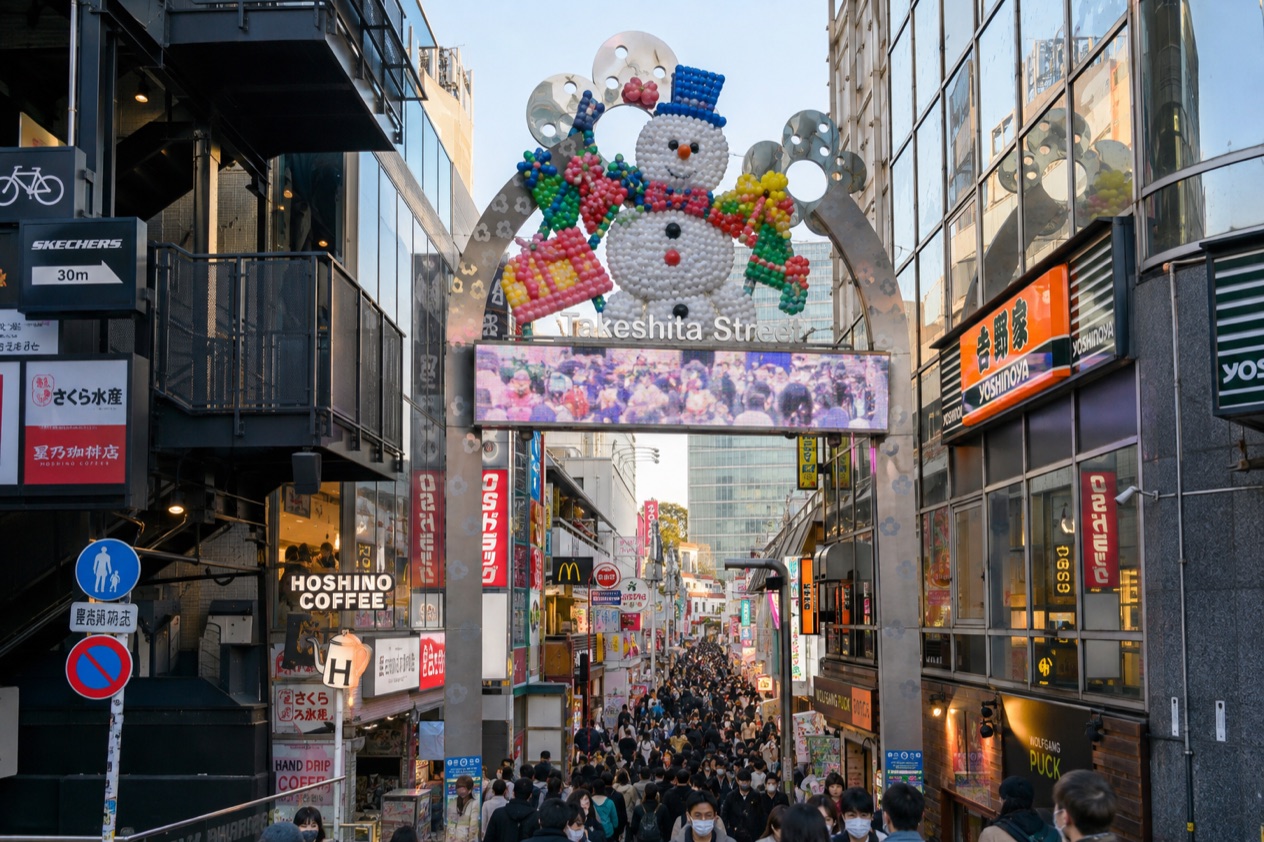
Coming out of Harajuku Station, you step into a stream of teenagers, tourists and shopping bags, and the narrow street ahead is already packed with pastel signs, crepe stands and racks of loud, playful clothes. Music leaks from every doorway and the sweet smell of fried dough and sugar hangs in the air. Takeshita Street is a stroll through Tokyo youth fashion, small and busy, and it suits anyone who likes to people-watch with a snack in hand.
Is visiting Takeshita Street worth it?
Yes, if you enjoy street fashion, snacks you eat while walking and the energy of a place built around young people. It is less rewarding if you are looking for temples, gardens or quiet corners, because the street is all about shopping, browsing and watching the crowd go by.
Takeshita Street is known as a center of Japanese youth culture and fashion, and that reputation shapes everything you see. The shops are many, small and youth-oriented, independent boutiques and cafés side by side, so a walk here feels like flipping through a magazine of trends rather than visiting a mall. Even if you buy nothing, the window displays, the costumes and the sheer inventiveness of the signage are entertainment enough.
What sets it apart from the other fashion districts of Tokyo is its scale and its focus. Ginza, for example, is an upscale downtown area with high-end restaurants and luxury shops, a very different mood from the playful, teen-oriented stalls here.
Takeshita Street is a single lane of small storefronts, and its sights are close together, which makes it easy to pair with a visit to Meiji Shrine, the large Shinto shrine nearby. Together they give you two sides of Harajuku in one outing: the shrine for its wooded calm, the street for its color and noise.
There is history behind the spectacle, too. The area from Harajuku Station to the streets around Takeshita Street was once called Takeshita-cho, and in the 1980s the street became known for teenage street dancing groups called takenoko-zoku. That tradition of young people turning a public street into a stage still hangs over the place today.
What to see at Takeshita Street
The street rewards slow walking and frequent detours. Rather than a list of monuments, you meet a sequence of small scenes, each one a few doors from the last.
The boutiques and fashion stalls
Clothes are the reason the street exists. The many small boutiques sell youth-oriented styles, from frilly and pastel looks to dark, layered outfits and secondhand finds, and the independent shops tend to have a strong personality of their own. Racks spill onto the pavement, and staff often call out greetings over the music.
Look at the accessories as much as the clothes: hair clips, socks, bags and novelty items fill the shelves and make easy souvenirs. Step inside even a shop that looks tiny, since many of them stretch back farther than the front suggests. It is a good place to watch what young Tokyo is wearing, and the passersby are often as inventive as the stock.
Cafés and snack stands
Among the shops are the independent cafés that give the street its second identity. Crepes rolled around whipped cream and fruit are the snack most associated with Harajuku, and you will see people carrying them in paper cones along the whole length of the lane. Sweets in bright colors, cotton candy and fluffy desserts compete for attention.
If you want to sit down, a café in a side room gives you a break from the crowd and a view of the street. Eating while walking is part of the local style here, so a cone in hand is simply how the street is enjoyed. Savor it near the stand, then move on to keep the flow going.
The street’s youth-culture story
The takenoko-zoku of the 1980s were teenagers who danced in matching, colorful outfits on the street, and their name, which refers to bamboo shoots, stuck to the whole scene. They helped fix the idea of Takeshita Street as a place where young people show who they are. Today the dancing is not the draw, but the spirit of self-presentation carries on in the clothes and the crowd.
Knowing this history makes the walk richer. When you see someone in an elaborate outfit posing for a friend’s camera, you are watching a long habit of the place, not a performance staged for visitors. Former Takeshita-cho is still a stage for the young.
Meiji Shrine next door
Takeshita Street is located near Meiji Shrine, a large Shinto shrine in Harajuku, and the contrast between the two is the best argument for seeing them together. The shrine is a wooded grounds with wide gravel paths and large torii gates, the opposite of the street’s tight, bright commerce.
Walking from the noise of the street to the shrine grounds, you notice how quickly the mood changes. It gives the day a shape: color and sugar first, then a slower walk beneath the trees.
How to get to Takeshita Street
Two stations put you at the doorstep of Takeshita Street, and both are in Harajuku. Which one you use depends mostly on where you are staying and which line is closest to your hotel.
By JR Yamanote Line to Harajuku Station
Harajuku Station on the JR East Yamanote Line serves as a gateway to Takeshita Street. This is the station people associate with the street, since the lane begins close to its exit. If your hotel sits near another stop on the Yamanote loop, this is the most direct way to reach the street.
From the station you simply follow the crowd. The street is the obvious draw, and the flow of shoppers and sightseers leaves little doubt about the direction. The shrine is in the same neighborhood, so the station also serves a visit to Meiji Shrine.
By Tokyo Metro to Meiji-jingumae Station
Meiji-jingumae ‘Harajuku’ Station, on the Tokyo Metro Chiyoda Line and the Tokyo Metro Fukutoshin Line, provides access to the Harajuku area including Takeshita Street. It is the alternative if your base is better connected to the subway than to the JR network.
Using this station can also suit a route that continues to other districts on those two Metro lines. As the station name carries Harajuku in quotation marks, you will see both names on signs, so look for either one.
From the airports and the wider city
Tokyo is served by Haneda Airport, officially Tokyo International Airport, and by Narita Airport, Japan’s largest international airport. From either one you continue into the city to reach Harajuku, then use one of the two stations above for the final stretch.
Tokyo sits on Tokyo Bay, in the Kanto region on Honshu. Harajuku is one district among many, so visitors arrive from another part of the city by train and treat the street as one stop in a longer day of sightseeing.
When to visit Takeshita Street
The street works in any month, since it is a place for walking and browsing, but the weather changes how pleasant the stroll feels. Spring and autumn bring the mildest conditions for a long wander, while midsummer asks for more patience.
Seasons on the street
In April, afternoons are mild, with highs in the upper 60s, and the rain comes on fewer days than in the summer months. That makes it comfortable for a day that mixes the street with the shrine grounds. October is similar in temperature, with highs in the low 70s, though the month brings more rainfall, so a light rain layer is useful.
July is hot and humid, with highs in the mid-80s and a damp feel to the air. On such days the many cafés and their cold drinks and desserts become more than a treat. January is cold, with highs near 50 and occasional snow or sleet, and a street lined with warm snacks has its own appeal then. Bundle up for the walk between stops.
| Month | Average high (°F) | Average low (°F) | Rain days | Precipitation (in) |
|---|---|---|---|---|
| January | 49.6 | 34.2 | 4.5 | 2.35 |
| April | 66.9 | 49.6 | 9.5 | 5.26 |
| July | 85.8 | 72.3 | 10.5 | 6.15 |
| October | 71.6 | 58.6 | 10.5 | 9.24 |
Time of day and the crowd
Takeshita Street is a lane of small shops and stands, so it feels busy whenever people are walking it, and its mood is that of a lively promenade rather than a place with a fixed opening time. Plan to visit when you have the energy to move slowly through a crowd, and be ready to step into a shop or café whenever you want a pause.
A day that starts with the street and ends at Meiji Shrine lets the pace slow down as you go. Because the shrine is a large wooded area, it gives you a place to walk freely after the tight lane.
Tips for your visit
Go with comfortable shoes and an empty stomach. The street is a place for wandering, and most of the pleasure comes from stopping at whatever catches your eye, whether a boutique, a crepe stand or a café with an inviting window.
What to bring and how to pace the visit
Bring a bag that closes easily, since the lane is narrow and you will be carrying purchases and snacks. A small cloth bag for souvenirs helps. In wet months, a compact umbrella is useful, though in a crowd it takes up room, so a light rain jacket can be the better choice.
Browse, eat, take photos, then move on to something calmer. The mix of independent boutiques and cafés rewards those who step off the main flow and look at what the smaller shops are doing.
What to combine it with
Meiji Shrine is the natural partner for the street, a wooded Shinto site in the same neighborhood. If you want a very different kind of Tokyo afterward, Ginza is an upscale downtown area with high-end restaurants and luxury shops, the polar opposite of Takeshita Street in tone.
Roppongi and Akasaka can be reached from Shibuya Station in about 10 minutes by train, which gives you another district to add for the evening. Roppongi Station is served by the Tokyo Metro Hibiya Line and the Toei Oedo Line.
Families and mobility
Young visitors and teenagers tend to enjoy the street for its colors, sweets and shops, which suits a family with older children who like to shop. With strollers or limited mobility, the narrow lane and the press of people deserve some thought, so consider how you will move through it and where you can stop to rest in a café. Pick a few shops or stands you want to see rather than trying to cover the whole lane, and keep your group together, since it is easy to lose each other among the crowd.
Good to know before you go
Takeshita Street is a pedestrian lane where the crowd is part of the experience, so keep your belongings close and your group in sight as you walk. Tokyo’s rainy stretches, with showers across the damper months, are worth keeping in mind when you plan an outdoor stroll, and a day that includes both the street and Meiji Shrine is best planned around a dry spell.
Sources
- Wikipedia, Takeshita Street (https://en.wikipedia.org/wiki/Takeshita_Street), checked October 11, 2026
- Japan National Tourism Organization, Tokyo (https://www.japan.travel/en/destinations/kanto/tokyo/), checked October 11, 2026
- Japan Meteorological Agency (JMA), Normal values 1991-2020, monthly (https://www.data.jma.go.jp/stats/etrn/view/nml_sfc_ym.php?prec_no=44&block_no=47662), station Tokyo, elevation 25 m, checked October 11, 2026
To plan your stay
- Best Time to Visit Japan: Cherry Blossoms, Autumn Colors, Weather and Festivals
- Where to Stay in Japan: Ryokan, Temple Stays, Capsule Hotels and the Best Cities to Base In
- Sending Luggage from the Airport in Japan: Hands-Free Travel, Hotel Delivery and Coin Lockers
- Know Before You Go to Japan: Entry, Money, Etiquette and Getting Around