
On the last Saturday of July, the riverbanks near Asakusa fill with people in cotton yukata, fans in hand, staking out a patch of ground long before the first shell rises. When the sky finally breaks open, the crowd answers with shouts of “tamaya!” that roll along the water. It is a summer night built around sound and light, and a very Tokyo way to spend one.
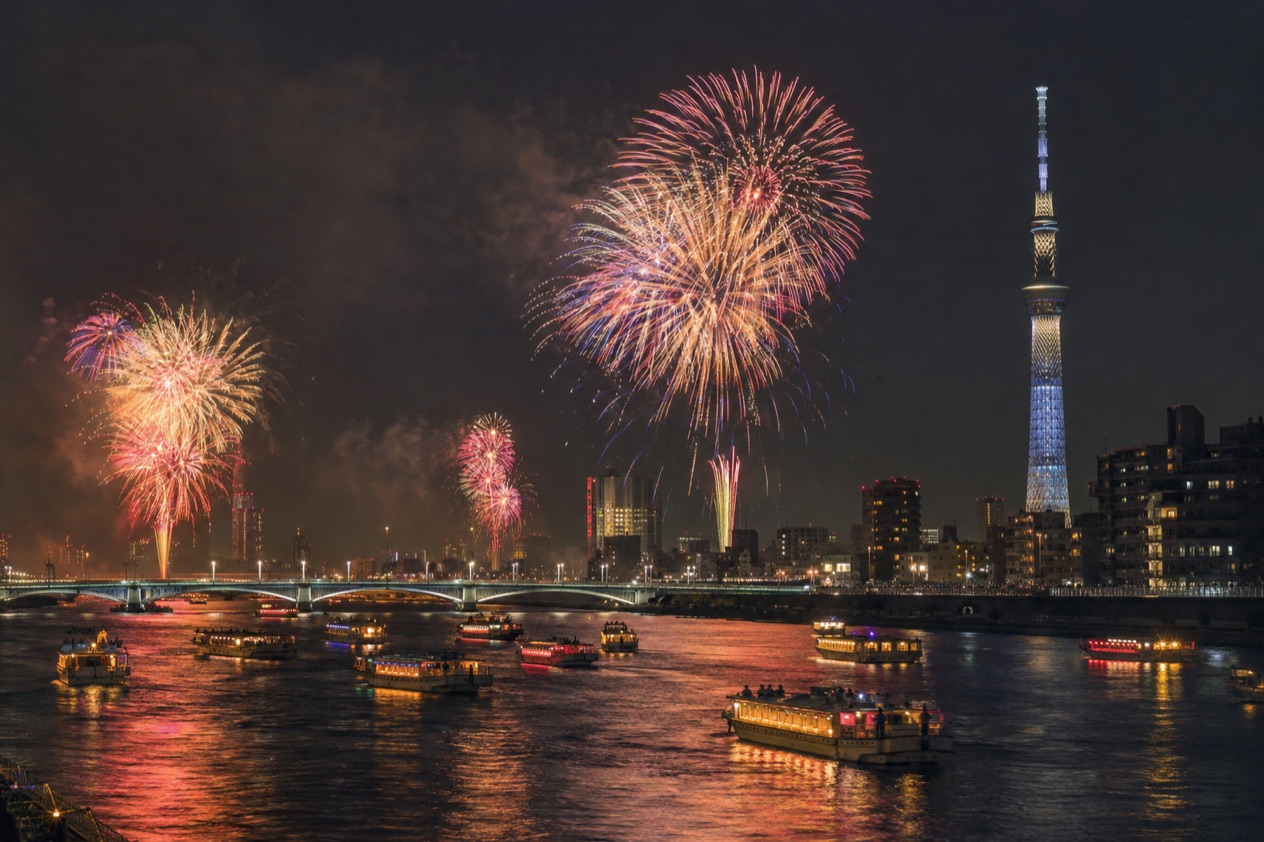
Is visiting the Sumida River Fireworks Festival worth it?
Yes, if you want to see Tokyo gather outdoors for one of its oldest summer rituals rather than simply watch a show, and it suits travelers who enjoy a crowd with a sense of occasion. The festival is held every year on the last Saturday in July over the Sumidagawa River near Asakusa, and it draws close to a million celebrants. That is a figure worth keeping in mind: you are joining a city-wide evening, not a quiet viewing.
What sets it apart from other fireworks displays you might find around Tokyo is its lineage. The tradition goes back to the Kyōhō famine in 1732, when fireworks were launched as part of festivals for the dead, and the event was first known as Ryōgoku Kawabiraki. Behind the sparkle lies a memorial impulse, a way of answering hardship with light over the water.
It is also a contest. Following the Japanese tradition, the festival is a competition between rival pyrotechnic groups, so the display feels less like a single choreographed performance and more like teams trying to outdo one another. Add the custom of calling out the names of the old rival guilds as shells burst, and you have something participatory that a modern show set to music cannot copy.
The setting helps as well. Asakusa, with its temple streets and old-Tokyo atmosphere, is a fitting neighborhood for a festival with roots this deep. You can spend the day wandering the district, then let the evening carry you to the river with everyone else. If your idea of a good trip includes a shared night out, a summer scent of food stalls and a sky full of color, this is among the most rewarding single evenings you can plan in the city.
It is less suited to anyone who dislikes crowds or heavy summer air. July in Tokyo is warm and humid, and the festival asks you to stay outdoors for a good while. Travelers who enjoy people-watching, festival food and a little theater will feel repaid. Those who prefer calm evenings may find the energy too much.
What to see at the Sumida River Fireworks Festival
The fireworks over the Sumidagawa River
The main event is the display itself, launched over the Sumidagawa River near Asakusa. Because the festival is a competition between rival pyrotechnic groups, the shells arrive as a series of showpieces, each team presenting its own style. Watch for the differences in color, shape and rhythm as one group gives way to the next, and notice how the crowd reacts to the ones it likes.
The river matters as much as the sky. Shells burst above the water, and the glow spreads across the surface and along the banks, lighting up faces in the crowd. Hearing the booms echo between the buildings is part of the experience, and it is a very different feel from a fireworks show in an open field.
The Tamaya and Kagiya shouts
Tamaya and Kagiya were the two major rival guilds of pyrotechnicians in the festival’s history. Over time it became part of Japanese culture to yell “tamaya!” and “kagiya!” while watching fireworks, and you will hear both at the Sumidagawa display. The calls work like a cheer at a ballgame, a way for the audience to praise a particularly fine burst.
Join in if you like. A good time to shout is just as a big shell opens, when the whole sky lights up and people around you let out a cry. It is one of the simplest ways to feel part of the evening, and nobody will mind an accent.
Asakusa and the crowds on the banks
The festival takes place near Asakusa, and much of the pleasure is in the scene around the display: families, couples and groups of friends settling in, many dressed in yukata, the light summer robe worn at matsuri, or festivals. Food stalls and the general buzz of a summer festival belong to the mood even if you never get close to the water’s edge.
With close to a million celebrants, the banks are a spectacle in their own right. Take time to look at the people as well as the sky. The mix of generations, the paper fans and the patient, good-humored waiting say a lot about how Tokyo celebrates.
When to visit the Sumida River Fireworks Festival
The festival is held on the last Saturday in July, so the month is set by the calendar. In 2027 it takes place on July 31, and in 2028 on July 29. Build your trip around that Saturday, and plan to be in Asakusa for the evening, since the display is the point of the visit.
July in Tokyo is warm and humid, with highs in the mid-80s and nights that stay in the low 70s. Humidity runs high, and rain falls on about ten days of the month, usually in showers rather than whole washed-out weeks. Expect a sticky evening where light clothing is the sensible choice, which is why so people wear yukata and carry fans.
| Month in Tokyo | Average high (°F) | Average low (°F) | Precipitation (inches) | Days with 1 mm or more | Humidity (%) |
|---|---|---|---|---|---|
| July | 85.8 | 72.3 | 6.15 | 10.5 | 76 |
Mornings and afternoons are well suited to wandering Asakusa before the evening gathers pace. With sunshine totals lower in July than in spring, expect a mix of bright and cloudy hours.
One more piece of history shows how much the event matters to the city. The 2011 festival was postponed until August 27 in the wake of the 2011 Tōhoku earthquake and tsunami. That is a reminder that the date is a firm tradition, and that it is worth confirming the year’s plans as your trip approaches.
Tips for your visit
Dress for heat and humidity. Light, breathable clothing suits a July evening in Tokyo, and a hand fan or a small towel is useful. A yukata, if you happen to have one, fits the occasion, and you will see plenty around you.
Plan to spend the whole evening. With close to a million celebrants, the festival is as much about the atmosphere as the display, so treat it as an outing rather than a quick look. Bring something to drink and a little patience for the crowd, and keep the plans around it loose.
Pair the evening with Asakusa during the day. The district is the natural base for a day built around the festival, and you can enjoy its streets before the night begins. Tokyo has two nearby airports, Haneda and Narita, which are the usual gateways for a trip that includes the city.
If you are staying elsewhere in the city, other districts offer a contrast to the festival crowds. Ginza is an upscale downtown area with high-end restaurants and luxury shops, and Nihonbashi is known for its rich heritage and is the main financial district of Japan. Roppongi and Akasaka are further districts in Tokyo, and Roppongi Station is served by the Tokyo Metro Hibiya Line and Toei Oedo Line.
For families, expect a long, busy evening outdoors in warm, humid weather, and plan accordingly with water, snacks and rest breaks. For travelers who find crowds tiring, an early start in Asakusa and a clear plan for the evening make the day easier to enjoy.
Good to know before you go
The festival is a yearly summer event, and July is a warm, humid month in Tokyo with showers on about ten days. Keep the evening flexible in case weather shifts the mood. Carry what you need for a long night outdoors, and keep an eye on your belongings in a crowd of this size, as you would at any large gathering.
Bring cash and cards for food and drinks, and keep a small bag for the evening. After the last shell, the whole crowd leaves at once, so a relaxed pace and a little patience make the walk out part of the experience.
Sources
- Wikipedia, Sumidagawa Fireworks Festival (https://en.wikipedia.org/wiki/Sumidagawa_Fireworks_Festival), checked October 11, 2026
- Japan National Tourism Organization, Tokyo (https://www.japan.travel/en/destinations/kanto/tokyo/), checked October 11, 2026
- Japan Meteorological Agency (JMA), Normal values 1991-2020, monthly (https://www.data.jma.go.jp/stats/etrn/view/nml_sfc_ym.php?prec_no=44&block_no=47662), station Tokyo, elevation 25 m, checked October 11, 2026
To plan your stay
- Best Time to Visit Japan: Cherry Blossoms, Autumn Colors, Weather and Festivals
- Where to Stay in Japan: Ryokan, Temple Stays, Capsule Hotels and the Best Cities to Base In
- Sending Luggage from the Airport in Japan: Hands-Free Travel, Hotel Delivery and Coin Lockers
- Know Before You Go to Japan: Entry, Money, Etiquette and Getting Around