
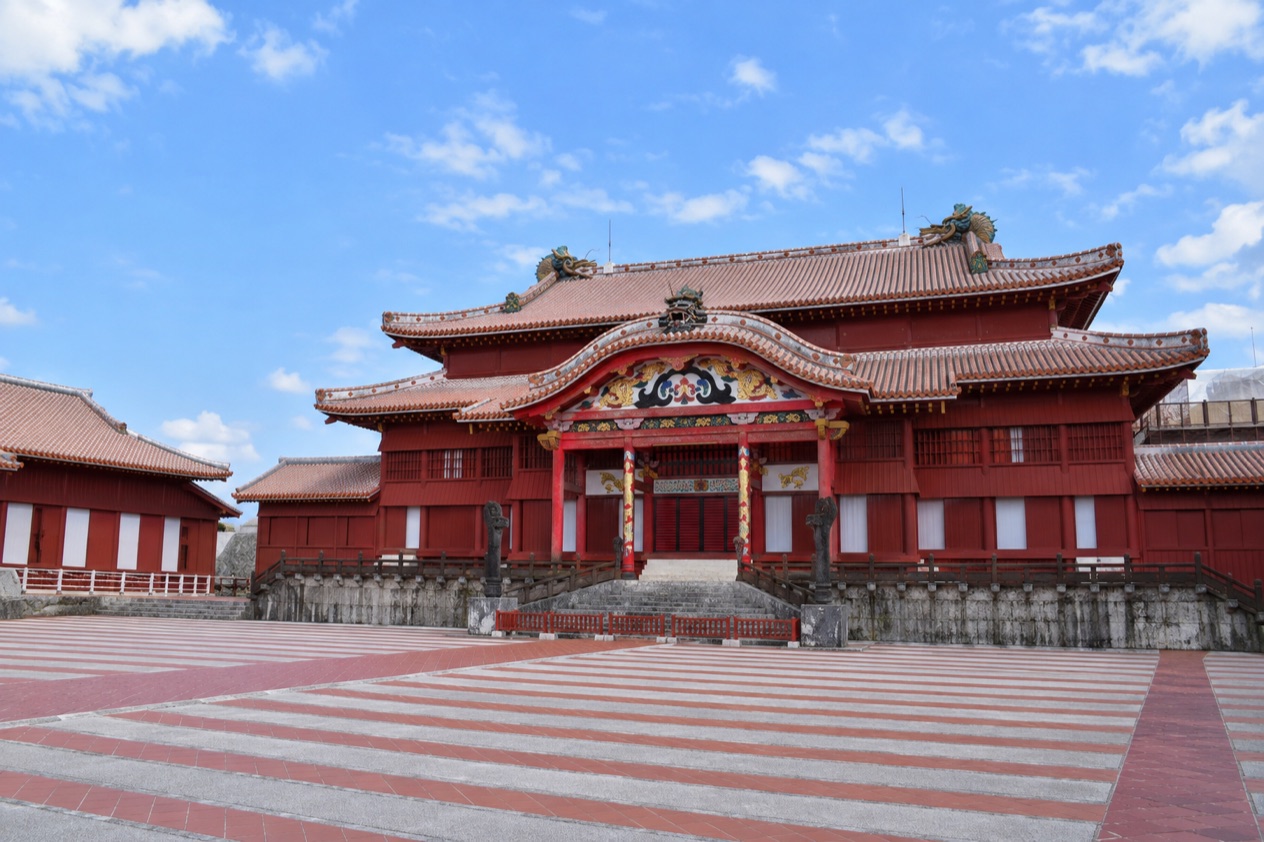
Red lacquer is the first thing the eye catches at Shuri Castle, glowing against the green of the hill and the gray limestone of the curving walls. Okinawa’s royal seat looks unlike the white-walled, dark-roofed castles of the Japanese mainland, closer in spirit to a Chinese palace with its own island accent. The visit today is a partial one, and it is as much about the story of a vanished kingdom as about the buildings.
Is visiting Shuri Castle worth it?
Yes, if you are curious about the Ryukyu Kingdom and want to understand why Okinawa feels so different from the rest of Japan, and no, if you only want to walk through a finished palace. Shuri Castle is partly open to the public, but the main castle is closed because of the fire. That shapes the visit: you come for the setting, the walls, the history and the sense of a place still in the middle of its own recovery.
What sets it apart from the other places people tick off in Japan is its origin. Castles in Kyoto, Osaka or Himeji belong to the story of samurai and shoguns.
Shuri belonged to the kings of the Ryukyu islands, a trading kingdom connected to China, Japan and Southeast Asia, with distinctive court music, dance, textiles and cooking, court music, dance, textiles and cooking. The vermilion color, the dragon motifs and the layout all say so before any sign does.
It also fits naturally into a stay in Naha, the largest city in Okinawa, which is home to about 21% of the main island’s residents. A morning at the castle pairs well with the rest of a city day, and the story you hear here gives context to what you taste and hear elsewhere on the island, from the island’s own noodles to the sound of the sanshin, the three-stringed instrument of Okinawan folk music.
What to see at Shuri Castle
The castle sits on a hill and was built as a set of courtyards, gates and halls climbing toward the seat of the king. Even with the main castle closed, the site tells that story through its stonework and its setting, and the parts open to visitors let you read the layout of the royal compound.
The main hall and the red palace
The main hall, the Seiden, is the building people picture when they think of Shuri. Its red walls, stacked roofs and carved dragons made it the symbol of Okinawa, and it was the stage for royal ceremonies and state business. Because the main castle is closed after the fire, this is the part of the story you take in from what remains around it and from images and explanations rather than by stepping inside.
The architecture is worth studying while you are there. The color and ornament show the strong link with Chinese court style, while the roof tiles and proportions reflect Japanese influence. Together they make a fusion that belonged to the Ryukyu Kingdom alone, and it explains why the palace looks so different from mainland castles.
Stone walls and gates
Instead of the straight, angular lines of mainland fortresses, the limestone blocks follow the shape of the hill in long, flowing arcs, fitted together with remarkable precision. The pale stone softens to gray with age and picks up green where moss and plants have found a hold.
Gateways punctuate the climb, and the Shureimon, with its red wooden frame and tiled roof, is the one that stands in the imagination of most Okinawans. It carries a phrase about the land of courtesy, a reminder that the kingdom saw itself as a place of ceremony and diplomacy. Look at the way the stone and timber meet, and at how each gate frames the next stretch of the route.
The story of the Ryukyu court
Behind the architecture is the kingdom itself. The Ryukyu court received envoys from China, sent ships across the seas and cultivated arts that still live on in Okinawa today, among them court dance, lacquerware and the red-and-indigo patterns of bingata cloth. Seeing the castle with those threads in mind gives the walk more weight than a simple look at buildings.
Later chapters of the island’s history, including the loss of much of the castle in wartime and its rebuilding afterward, add another layer. That is part of why the fire felt so painful in Okinawa: the castle had already been rebuilt once as an act of cultural memory, and its people watched it burn again.
Hours, tickets and rules
Shuri Castle is partly open to the public, but the main castle is closed due to the fire in 2019. That one sentence is the most important thing to know about a visit, because it decides what you can walk through and what you can only look at from outside or learn about through displays.
Opening hours and admission amounts are not something to guess at, and the arrangements for the open areas can change as work on the site continues.
The practical consequence is a matter of expectations. Plan the visit as a walk around a historic site in recovery, with the walls, gates and surroundings as the substance of the outing, rather than as a tour of a complete palace. Seen that way, the partial opening is not a disappointment but a different kind of visit, one in which the story of the loss and the effort to bring the castle back is part of what you see.
When to visit Shuri Castle
The air in January is mild and the sun appears for fewer hours, April is pleasantly warm, July is hot and bright, and October stays summery with rain that comes and goes.
| Month in Naha | Average high (°F) | Average low (°F) | Precipitation (inches) | Days with rain | Sunshine (hours) |
|---|---|---|---|---|---|
| January | 67.6 | 58.8 | 4.00 | 10.2 | 93 |
| April | 75.7 | 66.4 | 6.34 | 10.3 | 121 |
| July | 89.4 | 80.6 | 7.41 | 9.4 | 227 |
| October | 82.6 | 74.3 | 7.06 | 8.8 | 163 |
January suits a walk on a hill in comfortable air. You will want a light layer, since the air feels cooler with the damp, and the gray spells can be frequent. It is a month when the stone walls look their most somber and the red of the gates stands out against softer light.
April brings warmth without the full weight of summer, though it is also a rainy month, so showers are part of the picture. July is the sunniest of the four and the hottest, and a castle hill with stone steps and open courtyards means a good deal of time under the sun. A hat, water and a slow pace go a long way.
October is still summery, with warm days, humid air and occasional rain. It is a good month for an unhurried outing if you carry something for the rain.
Tips for your visit
Comfortable shoes matter more than anything else you bring, because a castle hill means slopes, steps and stone underfoot. Add a hat and sunscreen for the warmer months, and a compact umbrella or light rain jacket for the showers that come in every season in Naha. In summer, bring water and plan to pause in shade.
Give the visit unhurried time rather than squeezing it between other stops. Much of its interest lies in reading the walls, the gates and the setting, and in thinking about what stood here, which rewards a slow pace. and let that set the pace and the focus of your photos.
Pairing it with the rest of Naha
Naha has the only public rail network in Okinawa, the Okinawa Urban Monorail, known as Yui Rail, and it is the city’s own way of getting around on rails. The city around the castle is where you can taste Okinawan cooking, such as goya champuru (a stir-fry with bitter melon), Okinawa soba and rafute, braised pork belly, and where the island’s pottery and textiles are sold.
Naha Airport is the gateway to all of Okinawa’s islands, served by flights from dozens of cities across Japan, including low-cost carriers. That makes Shuri an easy thing to slot into a stay in Okinawa whether Naha is your whole trip or the first night before you move on to another island.
Beyond the castle on Okinawa Island
If you have more days on the main island, Okinawa Churaumi Aquarium is one of the big draws, and it recently welcomed a new female Japanese sawshark in an effort to breed the species. The aquarium also cautions visitors about bite-wound injuries from white-banded triggerfish during their breeding season, .
The island also has several beaches, including Manza Beach, Emerald Beach, Okuma Beach, Zanpa Beach, Moon Beach and Sunset Beach in Chatan. , a reminder that the island has green hills as well as coast. A day at the castle and a day by the water make two very different faces of Okinawa.
Good to know before you go
Okinawa’s air is humid all year, with showers that can appear in any month, so a light rain layer belongs in the bag. Because the castle is a partial visit, it is worth treating it as one chapter of a day in Naha, with a meal of local dishes, a stroll and time to absorb what you have seen. Bring a little patience for the weather and curiosity about a kingdom that shaped the island.
Sources
- Wikipedia, Shuri Castle (https://en.wikipedia.org/wiki/Shuri_Castle), checked October 11, 2026
- Japan National Tourism Organization, Okinawa (https://www.japan.travel/en/destinations/okinawa/okinawa/naha-and-the-main-island/), checked October 11, 2026
- Okinawa Churaumi Aquarium (https://churaumi.okinawa/en/), checked October 11, 2026
- Wikipedia, Okinawa Island (https://en.wikipedia.org/wiki/Okinawa_Island), checked October 11, 2026
- Japan Meteorological Agency (JMA), Normal values 1991-2020, monthly (https://www.data.jma.go.jp/stats/etrn/view/nml_sfc_ym.php?prec_no=91&block_no=47936), station Naha, elevation 28 m, checked October 11, 2026
To plan your stay
- Best Time to Visit Japan: Cherry Blossoms, Autumn Colors, Weather and Festivals
- Where to Stay in Japan: Ryokan, Temple Stays, Capsule Hotels and the Best Cities to Base In
- Sending Luggage from the Airport in Japan: Hands-Free Travel, Hotel Delivery and Coin Lockers
- Know Before You Go to Japan: Entry, Money, Etiquette and Getting Around