
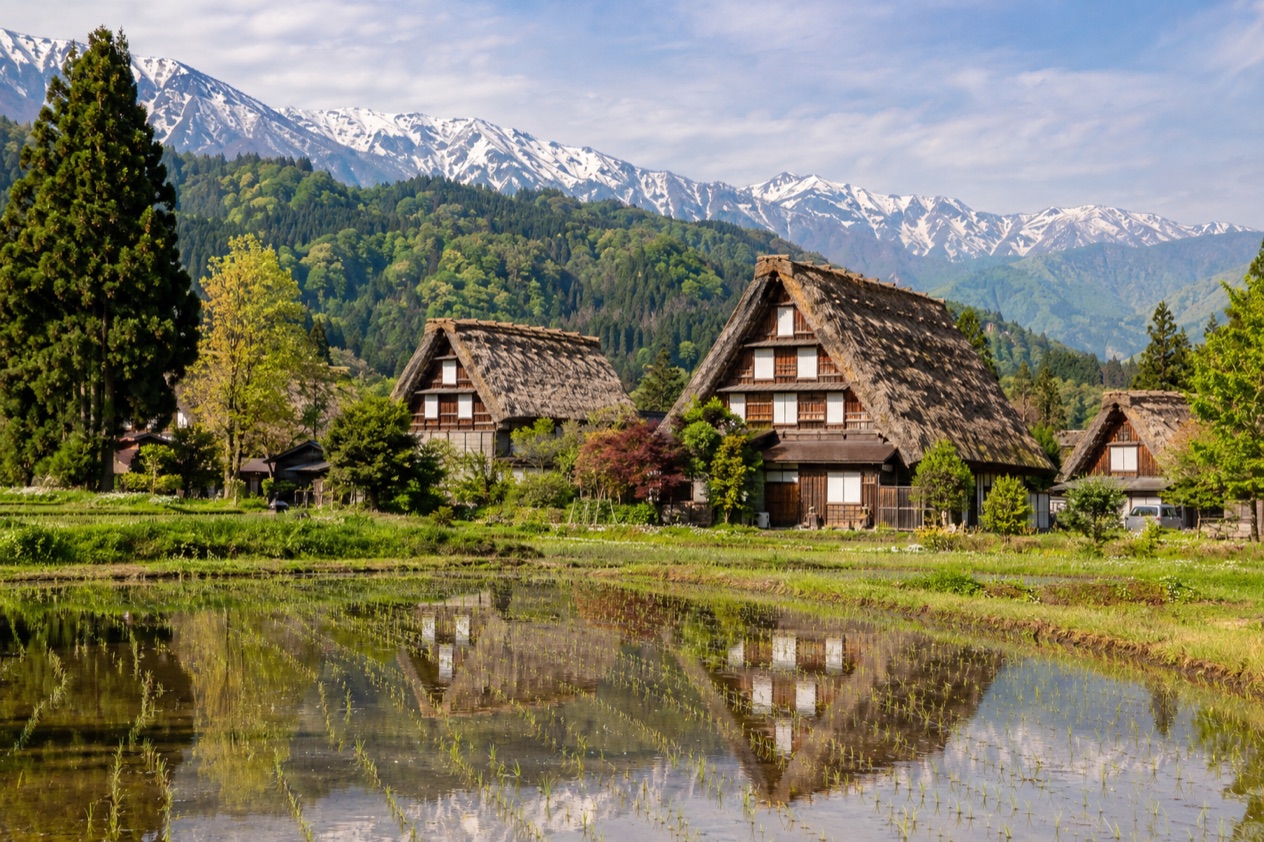
The bus lets you off at the terminal, and within a few steps the valley opens up: steep thatched roofs rising like folded hands above rice paddies, wooden walls darkened by weather, and mountains close on every side. Shirakawa-go is a farming village in the mountains of Gifu that has become a World Heritage Site, and it makes a day trip for anyone curious about how people lived under very deep snow.
Is visiting Shirakawa-go worth it?
Yes, if you like places where architecture explains the climate, and it suits travelers who enjoy walking slowly through a village more than ticking off big sights. Photographers, history lovers and anyone building a route between Takayama, Kanazawa and the Toyama side of the mountains will find a clear reason to stop here.
What sets it apart from other old-town stops in the region is that the buildings are not a stage set copied from another era. The gassho houses grew out of necessity, shaped by winters that count among the snowiest in Japan.
Roofs this steep and this thick only make sense where snow piles up for months, and walking among them you read the landscape in the carpentry. Many of the houses still belong to local families, and the village keeps working as a community around its visitors. Nearby Gokayama, in Nanto, Toyama, shares the same World Heritage listing, so the two places read as parts of one story about mountain farming.
The village does not have a train station, which shapes the visit. You arrive by road, you walk, and you leave again by road. For some travelers that is a drawback, and for others it is part of why the place feels set apart from the rail-linked cities around it.
What to see at Shirakawa-go
The visit centers on the gassho-zukuri houses, Shirakawa Hachiman Shrine, the village lanes and the hilltop viewpoint over Ogimachi. Expect a visit built around looking closely rather than a list of ticketed attractions.
The gassho-zukuri farmhouses
Gassho means hands together, as in prayer, and the name comes from roofs so steep that they resemble two palms pressed into a point. The angle is practical. Snow slides off instead of loading the frame, and the thick thatch sheds meltwater down to the ground. The houses were created as an answer to the village’s heavy snowfall, which averages more than 390 inches a year.
Look at the timber frames, the deep eaves and the large attic spaces under the thatch. Families in the region traditionally used those upper floors for work such as raising silkworms, which is one reason the buildings are so tall. Notice also how the houses stand in the fields, their ridges lined up in the same direction, a sign of how carefully the village was planned around wind and sun.
Wadake Home
Wadake Home is the largest gassho-zukuri in the Shirakawa area, and its size makes it a useful place to understand what these houses held. A single building like this sheltered an extended family, its tools, its stores for winter and its work through the cold months. Seen from the lane, the huge roof dominates the scene, and the thatch has the layered, shaggy look of a surface renewed by many hands over time.
If you want a sense of scale, stand beside it and compare it with the smaller farmhouses nearby. The difference shows how much wealth and labor a household could command, and why such houses were the center of village life.
Shirakawa Hachiman Shrine
The village shrine is the setting for the Doburoku Festival, held every October 14 and 15. Doburoku is a cloudy, unfiltered sake, and the festival is famous for its Nigorizake, the milky rice wine that gives the celebration its character. Even outside the festival days, the shrine is worth a look for its wooded grounds and the way it ties the village to the seasons of the rice harvest.
A Shinto shrine like this is where a farming community gives thanks for the year’s crop. The festival grows from that same idea, with offerings, village processions and shared drinking that mark the end of the harvest.
Hours, tickets and rules
The lanes, rice fields and shrine grounds are part of a place where people work and live, and 70% of the residents earn their living from tourism. That tells you the village is built to receive visitors, with its houses, shops and meals as part of the day.
Individual farmhouses, museums and viewpoints each follow their own arrangements, so the experience of the village changes from one building to the next. The shrine and its festival follow a fixed rhythm, with the Doburoku Festival on October 14 and 15 each year.
Treat the houses as what they are: homes, workplaces and heritage, often within the same walls. Walking the lanes and looking at the buildings from the outside is the heart of the visit, and moving through the village at a gentle pace fits the setting. The thatched roofs and the fields around them are the reason the place was listed as a World Heritage Site, together with Gokayama in Toyama, on December 9, 1995.
How to get to Shirakawa-go
You reach Shirakawa-go by road, since the village has no passenger railway service. Highway buses serve Shirakawa-go from Takayama, Kanazawa, Toyama and Nagoya.
From Takayama in Gifu, the trip takes within 50 minutes since the Hida Tunnel opened, compared with the earlier drive of three hours.
From the Toyama side, a World Heritage Site Bus is run by Kaetsuno Bus from Takaoka Station in Toyama, via Shin-Takaoka Station, to the Shirakawa-go Bus Terminal. Travelers coming through Takaoka or Shin-Takaoka can use it to arrive at the village without changing to another mode of transport on the way.
Whichever route you choose, the bus terminal is where the visit starts. From there you step into the village, with the houses and fields laid out in front of you. Because there is no station, the buses are the village’s link to the rest of the country, and they shape how visitors arrive and leave.
When to visit Shirakawa-go
The date that gives the village its liveliest moment is the Doburoku Festival at Shirakawa Hachiman Shrine, every October 14 and 15. If you are in the region in mid-October, it is the clearest reason to plan the day around the calendar, and it adds sake, ritual and village life to the architecture.
Winter is the season that explains the houses. This is among the snowiest places in Japan, and snow on the steep thatch shows the purpose of the design in a way no other season can. Anyone drawn to the image of a village under deep snow should think of the cold months, with the understanding that snow shapes travel as much as it shapes the scenery.
Outside winter, the village shows another face. In the warmer months the rice paddies and vegetable plots around the houses give the thatched roofs a green frame, and in autumn the hillsides turn color behind them. Each season changes the mood of the same lanes, so the right month depends on whether you want snow, fields or festival.
Because visitors come for the day, the village has a rhythm of its own. Staying beyond the day-trip crowd is a choice some travelers make for a different feel, though the choice is yours to weigh against your route through Takayama, Kanazawa or Toyama.
Tips for your visit
Plan Shirakawa-go as a day trip, as 95% of visitors do, with a base in Takayama, Kanazawa, Toyama or Nagoya. The average spending per person is only a few thousand yen, which tells you the visit is about walking and looking, with a meal or a small purchase along the way.
Bring shoes you are happy to wear on village lanes and fields, and dress for the weather of the day, since this is a mountain valley that gets heavy snow in winter. A camera suits the place, and the gassho roofs reward a slow look from different angles, whether you stand among the rice fields or by the farmhouse walls.
Pair the village with its neighbors. Takayama, within 50 minutes by the road described above, makes a natural companion, and the Gokayama villages in Nanto, Toyama, share the World Heritage listing and tell the same story from a different valley. Combining them lets you compare how two communities built and kept their thatched farmhouses.
If you travel with family, let children look for the details that make the houses different: the angle of the roof, the thickness of the thatch, the size of Wadake Home beside its neighbors. Give yourself time to follow the lanes without a fixed list, since the village is a place to wander. Because the village is also a home to its residents, keep a respectful distance from private houses and fields, as you would in any working community.
Good to know before you go
Spending in the village is small and simple, a meal, a snack or a souvenir, and the visit is built around the buildings and the setting. The mountain climate is the main thing to plan around, since snowfall in this part of Gifu is heavy and shapes how the whole valley looks and feels from season to season.
The village has a sister city in Alberobello, in Apulia, Italy, another place known for its distinctive traditional houses, and the link gives a nice note of context if you are fond of vernacular architecture. Beyond that, the best preparation is to arrive curious, walk slowly and let the roofs, the fields and the mountains do the talking.
Sources
- Wikipedia, Shirakawa-gō (https://en.wikipedia.org/wiki/Shirakawa-g%C5%8D), checked October 11, 2026
- Wikivoyage, Shirakawa-go (https://en.wikivoyage.org/wiki/Shirakawa-go), checked October 11, 2026