
In a Kagawa noodle shop the broth steams, the udon is thick and springy, and at the next table a pilgrim in a white jacket and sedge hat leans a wooden staff against the wall. That pairing says a lot about Shikoku, the island south of Honshu where temples, hot springs, mountain gorges and island art museums are spread between the Seto Inland Sea and the Pacific. It suits travelers who like to move slowly through a place with its own rhythm, and who are happy to leave the Shinkansen behind.
Where is Shikoku and what is it like?
Shikoku is the smallest of Japan’s four main islands, lying south of Honshu and northeast of Kyushu, with the Seto Inland Sea along its northern side and the Pacific Ocean on its southern coast. It is about 140 miles long. At its widest it is roughly 95 miles across, and in places it narrows to about 30 miles. Four prefectures share it: Kagawa, Tokushima, Ehime and Kochi.
The island is divided by mountains. Mount Ishizuchi in Ehime, the highest peak on Shikoku, rises to 6,503 feet, and the interior is a tangle of forested ridges and deep river valleys, the Iya Valley among them. Towns and cities cluster along the coasts.
Takamatsu faces the Inland Sea in Kagawa, Matsuyama is the capital of Ehime and the largest city on the island, and Kochi sits on the Pacific side. Each has a different feel, and the contrast between the calm northern shore and the open Pacific coast is part of the pleasure of traveling here.
Shikoku has no Shinkansen line, and that shapes the experience. Trains and buses link the main cities, but the island rewards a loose plan, a few well-chosen bases and time to wander.
Travelers who love food, onsen towns, gardens and country roads will feel at home. Those who want to tick off a long list of headline sights in a few days may find the distances between places, and the pace of getting around, work against them.
Shikoku also carries a strong sense of tradition. The pilgrimage that circles the island gives it a spiritual thread, and you meet the pilgrims everywhere, at temple gates, in train stations and in small-town cafés. Even if you never walk a step of the route, the habit of welcoming walkers colors the whole island, and it is a good reason to come with curiosity rather than a checklist.
What is there to do in Shikoku?
The big reasons to come are the pilgrimage temples, the food, the hot springs and the island’s landscapes, from mountain gorges to the art islands of the Inland Sea. What sets Shikoku apart from its neighbors is that these things are woven into ordinary life rather than gathered into one famous district. Even in a short stay, you pass from a temple to a noodle counter to a garden without leaving the same town.
The Shikoku 88 Temple Pilgrimage
The pilgrimage links 88 Buddhist temples associated with Kobo Daishi, the monk also known as Kukai, in a loop around the whole island. It starts at Ryozenji in Tokushima, the first temple, and the standard walking course is about 750 miles long. Walkers take anywhere from 30 to 60 days, and the route is described as grueling.
You do not have to walk it all to feel it. Visiting a single temple, you see pilgrims in white pausing at the gate to bow, lighting incense and candles, and reciting sutras in front of the main hall. Visitors who are not on the route are simply watching a living tradition, so it helps to follow what the pilgrims do and keep your voice low in the temple grounds.
Udon in Kagawa and food across the island
Kagawa Prefecture is famous for its udon noodles, and the noodle shops of Takamatsu and the towns around it are a reason in themselves to come. The noodles are thick and chewy, served hot in broth or cold with a dipping sauce, and often topped with something as simple as grated radish, scallion or a soft egg. People eat more than one bowl in a day.
Elsewhere the menu follows the sea. In Kochi, on the Pacific, seared bonito, known as katsuo no tataki, is served with garlic and citrus, and the city’s evening market stalls and izakaya (casual pubs) are where it tastes best. Ehime is known for its citrus, and mandarin oranges appear in juices, sweets and snacks. Eating your way around Shikoku makes a natural thread for a trip.
Dogo Onsen and the garden and castle towns
In Matsuyama, the thermal waters of Dogo Onsen inspired Studio Ghibli, the studio behind the famous anime. The old bathhouse, with its wooden bathhouse architecture and tiled roof, is the heart of a district of ryokan, shops selling local sweets and towels, and cafés where you can rest after a soak. A bath here is a pleasure that is both Japanese and unmistakably Shikoku.
Other towns offer gardens and fortifications. Ritsurin Garden in Takamatsu is a Japanese garden designated as a Special Place of Scenic Beauty by the Japanese government, spectacular with cherry blossoms in spring and vivid colors in autumn. In Kochi, Kochi Castle is one of the island’s seasonal attractions. Walking through these places, you see how each season is staged on purpose, with pines, ponds, bridges and teahouses placed to be viewed.
The Iya Valley, the Inland Sea and Naoshima
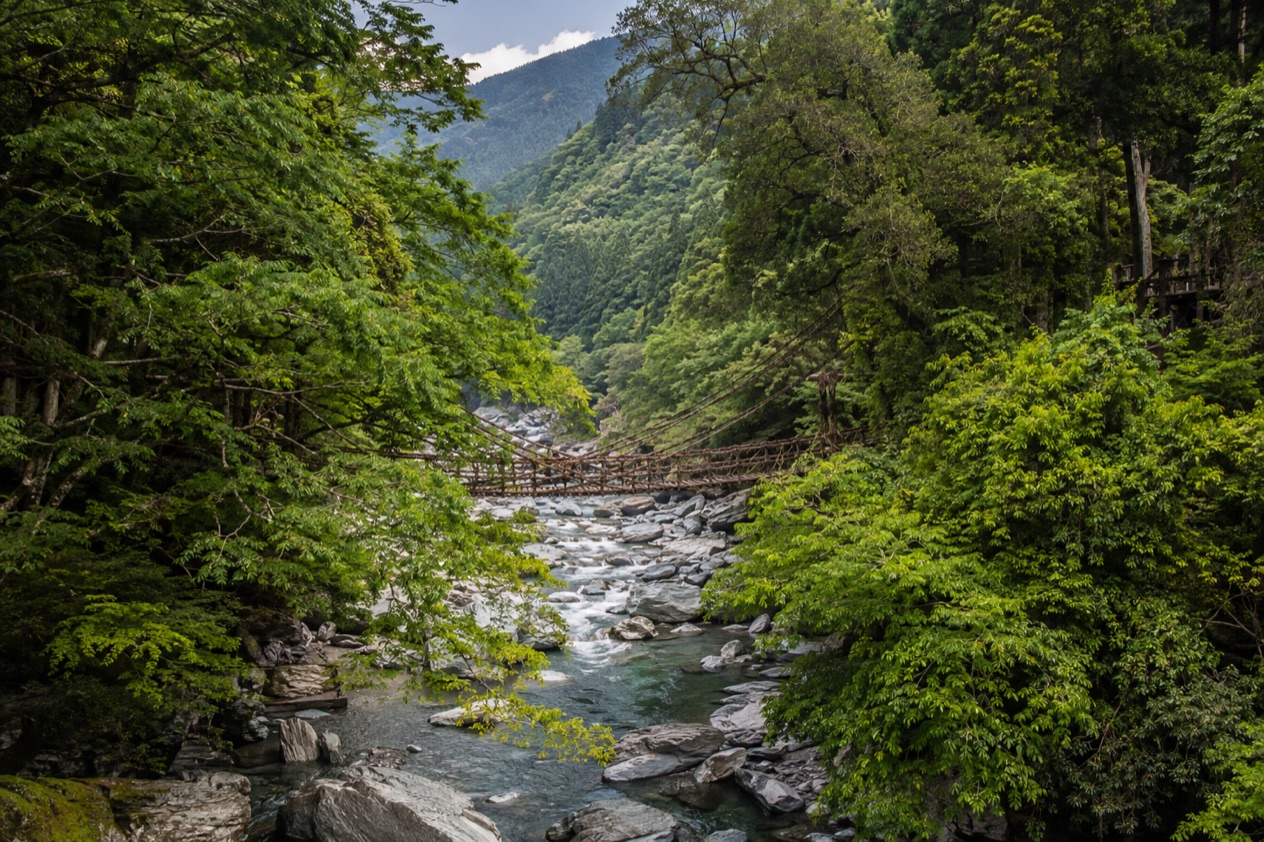
The Iya Valley in Tokushima is a scenic area of mountain valleys, thatched-roof farmhouses and historic vine bridges. The Oku-Iya Double Vine Bridge is one of Shikoku’s seasonal attractions, and crossing a bridge woven of vines above a river gorge is the sort of experience that stays with you. The valley is a place for slow driving, for looking at old houses set into steep slopes and for time outdoors.
On the other side of the island, the Seto Inland Sea offers coastline views and a chain of thousands of islands with a mild climate and clean beaches, which makes them a draw for short getaways from Takamatsu, Okayama, Hiroshima and Kobe. Naoshima, part of Kagawa Prefecture, is best known for its contemporary art installations and museums, and it works as a day out or an overnight. The Shimanami Kaido, a very popular cycling trail, hops across bridges from Onomichi on Honshu to Imabari on Shikoku.
How many days do you need in Shikoku?
A long weekend gives you a taste of one corner of the island, and a week lets you link two or three of its prefectures. Shikoku is not a destination to rush, because the mountains between cities and the pace of the trains and buses make every transfer part of the trip. Choosing a base and exploring around it works better than trying to cover the whole island.
With three or four days, you could stay around Takamatsu and Kagawa. That means udon, a walk through Ritsurin Garden, and a day on Naoshima for its art museums and installations. Another short-stay pairing is Matsuyama and Dogo Onsen, where a hot-spring soak and a stroll through the old bathhouse district fill an evening.
With a week, you can add Kochi, with its castle, its Pacific coastline and its food, and Tokushima, with the first temple of the pilgrimage and the gateway to the Iya Valley. The Oku-Iya Double Vine Bridge and the thatched farmhouses of the valley call for a day of their own, away from the cities. A week also allows time for a few temples along the pilgrimage route, without the commitment of walking all of it.
For cyclists, the Shimanami Kaido can anchor a trip that begins at Onomichi on Honshu and ends at Imabari on Shikoku, continuing to Matsuyama. Travelers with more time sometimes take on sections of the pilgrimage on foot, since the full walk is a matter of weeks. Whatever the length of your stay, leave a gap or two in the schedule, because the best moments here, a conversation at a temple gate or a noodle shop you stumble into, are rarely planned.
Where to stay in Shikoku
The main places to stay are the island’s four prefectural cities and a few smaller bases, each with its own flavor. Takamatsu, the capital of Kagawa in northern Shikoku, suits travelers who want udon, Ritsurin Garden and a jumping-off point for Naoshima and the Inland Sea islands. It is also the city where the frequent connections from Okayama on Honshu arrive, which makes it a gentle first stop.
Matsuyama, the largest city on Shikoku, is a good base for visitors who care about hot springs. Kochi, a city on the Pacific Ocean, appeals to those who want its castle, its food and a feel closer to the open ocean than to the Inland Sea.
Tokushima is the natural choice for pilgrims, since Ryozenji, the first temple of the route, is located there, and for travelers heading into the Iya Valley. In the valley itself, staying in a farmhouse-style inn among the mountains is a way to experience the thatched-roof houses and vine bridges for more than a day trip. Naoshima and the other Setouchi islands offer overnight options for those who prefer to linger among the art museums.
Ryokan, Japanese inns with tatami rooms and often a bath of their own, can be found in hot-spring towns like Dogo Onsen, and many include a multi-course dinner in the evening. Pilgrims have long relied on temple lodgings along the route, and the tradition of welcoming walkers shapes the hospitality of many small towns. Whichever area you choose, base yourself where the next day’s plans begin, since moving across the island takes time.
How do you get to Shikoku and get around?
You reach Shikoku by train, bus or plane, and most routes begin on Honshu. Shikoku is 60 minutes from Hiroshima and 100 minutes from Osaka, which puts it within reach of the main cities of western Japan. By air, a flight from Haneda Airport in Tokyo to Matsuyama Airport takes about 1 hour 30 minutes.
By train and bus from Honshu
Shikoku is not connected to the Shinkansen network, so most rail journeys use the Tokaido-Sanyo Shinkansen as far as Okayama. From there, trains cross the Seto Ohashi Bridge, which connects Okayama Prefecture to Kagawa Prefecture, and there are frequent connections from Okayama to Takamatsu and onward through the island. The limited express Shiokaze runs between Okayama and Matsuyama roughly every hour during the day.
For Kochi, the route goes through Okayama too, with the JR Shikoku bus leaving from the west side of Okayama Station. The bridge crossing gives a view of the Seto Inland Sea, and it is a pleasant way to arrive on the island. Cyclists have another route in, the Shimanami Kaido, which hops across bridges from Onomichi on Honshu to Imabari on Shikoku.
Getting around the island
Once on Shikoku, trains and express buses link the main cities. The Shikoku Highway Bus Free Pass allows unlimited rides on express buses within Shikoku and comes as a 2-day, 3-day or 5-day pass. Boarding dates can be set to any days within the validity period, and there is no limit to the number of rides, so the pass can follow a loose itinerary.
Places like Ritsurin Garden, the old bathhouse at Dogo Onsen and Kochi Castle are in cities, where you can see them on foot between meals. The Iya Valley, the Setouchi islands and the pilgrimage temples are more spread out, and getting to them takes more planning. Because the island is long and narrow, with mountains in the middle, think of travel between prefectures as a part of the day rather than a gap to fill.
When is the best time to visit Shikoku?
Spring and autumn are the seasons the island shows off best, and the clearest case is Ritsurin Garden in Takamatsu, which is spectacular in spring during cherry blossom season and in autumn with its vivid colors. Gardens, castles and mountain landscapes all take on a different character as the seasons turn, and Shikoku has attractions meant to be seen in particular seasons, from the Uzu-no-Michi Walkway in Tokushima to Kochi Castle and the platform at JR Shimonada Station in Ehime.
The seasonal list goes further. The Oku-Iya Double Vine Bridge in Tokushima, Sanuki Manno National Park in Kagawa and Naoshima are also counted among the island’s seasonal destinations, so a trip planned around the time of year gives you a different set of views from one visit to the next. If you are drawn to blossoms, pick spring. If you want the garden colors, aim for autumn.
It draws large numbers, so expect the city to be busy at that time. For pilgrims, the season decides the experience of the walk itself, and anyone planning to walk should think about weather and daylight along the way.
Good to know before you go
Shikoku rewards unhurried planning. The island’s long, narrow shape and its mountain interior mean travel between prefectures is part of the day, so choose a couple of bases rather than a long list of stops.
Local food, from udon to bonito, is an easy way into daily life, and respecting temple customs, such as bowing at the gate and keeping your voice low, goes a long way when you meet pilgrims on the route. Pack for the season you choose, since the coast, the valleys and the mountains each have their own weather.
Sources
- Japan National Tourism Organization, Shikoku (https://www.japan.travel/en/destinations/shikoku/), checked October 11, 2026
- Tourism Shikoku (https://shikoku-tourism.com/en/), checked October 11, 2026
- Wikipedia, Regions of Japan (https://en.wikipedia.org/wiki/Regions_of_Japan), checked October 11, 2026
- Wikipedia, Shikoku (https://en.wikipedia.org/wiki/Shikoku), checked October 11, 2026
- Wikivoyage, Shikoku (https://en.wikivoyage.org/wiki/Shikoku), checked October 11, 2026
- Wikipedia, Iya Valley (https://en.wikipedia.org/wiki/Iya_Valley), checked October 11, 2026
- Japan National Tourism Organization, Matsuyama (https://www.japan.travel/en/destinations/shikoku/ehime/matsuyama-and-around/), checked October 11, 2026
- Wikipedia, Matsuyama, Ehime (https://en.wikipedia.org/wiki/Matsuyama,_Ehime), checked October 11, 2026
- Japan National Tourism Organization, Takamatsu (https://www.japan.travel/en/destinations/shikoku/kagawa/takamatsu-area/), checked October 11, 2026
- Wikipedia, Takamatsu, Kagawa (https://en.wikipedia.org/wiki/Takamatsu,_Kagawa), checked October 11, 2026
- Japan National Tourism Organization, Kochi (https://www.japan.travel/en/destinations/shikoku/kochi/kochi-and-around/), checked October 11, 2026
- Wikipedia, Kōchi, Kōchi (https://en.wikipedia.org/wiki/K%C5%8Dchi,_K%C5%8Dchi), checked October 11, 2026
- Japan National Tourism Organization, Naoshima (https://www.japan.travel/en/destinations/shikoku/kagawa/setouchi-islands/), checked October 11, 2026
- Wikipedia, Naoshima (https://en.wikipedia.org/wiki/Naoshima), checked October 11, 2026