
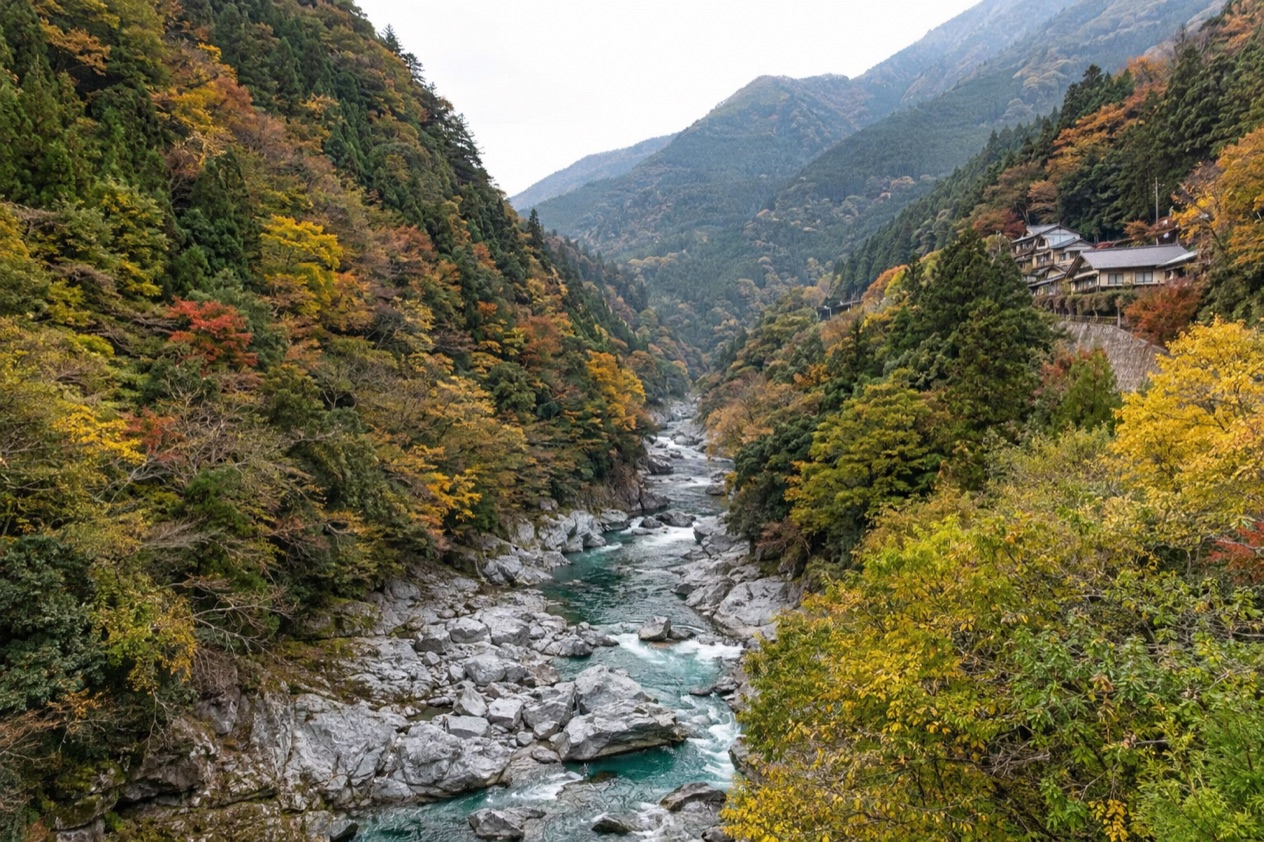
The road narrows, the mountainsides close in, and far below the river runs green and fast through a gorge of steep forest. Then a bridge woven from vines appears, swaying over the water, and the valley starts to feel like a place apart. The Iya Valley, in Tokushima Prefecture on the island of Shikoku, is a visit of slow roads, thatched roofs and hot spring baths, for travelers who like their landscapes with some history in them.
Is visiting the Iya Valley worth it?
Yes, if you like mountain scenery, old rural architecture and a journey that is part of the destination, and much less so if you want a long list of attractions to tick off. The Iya Valley rewards people who enjoy looking, walking a little and lingering over a view.
What sets it apart from the other places you might pair with it on Shikoku is its character as a deep mountain valley. The rest of the island offers coastlines along the Seto Inland Sea and the noodle shops of Kagawa Prefecture, famous for its udon. Here, the pleasures are vine bridges, thatched farmhouses and gorge views. Only three vine bridges remain in the whole valley, which gives each one real weight.
The valley also splits into two moods. The western part, Nishi-Iya, has good road access and tourist accommodations, plus hot spring baths at its large hotels. The eastern part, Higashi-Iya or Oku-Iya, is reached by lesser routes and feels more remote.
Most visitors do not go deeper, mainly because a one lane road keeps most tour buses out. If you are willing to drive on, or to spend a night, you see a quieter side of the valley.
What to see at the Iya Valley
The Iya-no-Kazurabashi in Nishi-Iya
The main vine bridge is the image most people have of the Iya Valley. It crosses the river in Nishi-Iya, a lattice of thick vines hung between two banks, with gaps in the walkway that let you see the water below. It is about 148 feet long and is classified as an important Tangible Folk Culture Property.
Bridges like this are part of the valley’s lore. A familiar story says that people who sought refuge in these mountains built crossings from vines so that they could be cut down behind them if pursuers came.
Whatever the truth of the tale, the bridge is a craft of the valley, and its vines are replaced every 3 years. Steel cables now reinforce it for safety, so the bridge keeps its look while standing up to modern visitors.
Look at how the vines are twisted and lashed, how the planks sit between them, and how the whole structure moves a little underfoot.
The Oku-Iya Double Vine Bridges
In Higashi-Iya, near the base of Mount Tsurugi, the Oku-Iya Double Vine Bridges are the other two of the valley’s three remaining vine bridges. They stand as a pair, which makes them different from the single span in Nishi-Iya, and the setting is wilder and farther from the hotels and the main road.
Getting here means committing to the quieter eastern side of the valley, where access routes are lesser and the one lane road shapes the journey. The reward is the sense of being deep in the mountains, with forest on all sides and the sound of the river below. Seeing both sets of bridges gives a fuller picture of how people once crossed this valley.
Thatched farmhouses and the mountain slopes
The valley is known for its thatched roof farmhouses, set on slopes so steep that the houses seem to cling to the mountainside. Thick straw roofs, small terraced fields and narrow paths between buildings make up the picture of old Iya life.
Take the time to look at the way the houses are placed: on hillsides above the river, facing across the gorge, with fields cut into whatever flat ground exists. In the mist that often settles in mountain valleys, these roofs look quiet and weathered. You do not need an agenda here.
The old cliffside road and the Peeing Boy statue
The old road through the Iya Gorge runs about 12 miles along a cliff face. About halfway along stands the Peeing Boy Statue, erected in honor of the young boys who, as the story goes, relieved themselves from the high precipice to prove their courage.
The statue is small and a little comic, but it tells you something about the height of the drop. It makes a good pause on the way through, and a reminder that this road was once the main link through the gorge. A modern tunnel now connects the central Iya Valley to Oboke, so the old road is more a piece of the valley’s history than a necessity.
Hours, tickets and rules
The valley is not one gated site but a landscape of bridges, roads, farmhouses and villages, so there is no single opening time to plan around. You travel through it, stopping where something catches your eye, and the bridges are the places where you slow down and look.
What matters about the bridges is how they are kept. The main bridge in Nishi-Iya is classified as an important Tangible Folk Culture Property, its vines are renewed every 3 years, and steel cables reinforce it for safety. That upkeep is why the bridge looks as it does today and why it remains part of the visit.
The valley’s biggest festivals are open to anyone. They are summer festivals held in Nishi-Iya and Higashi-Iya at middle school grounds, on the weekends before and after the national Obon Holiday of August 15. If your trip falls at that moment, you can join in with the people who live here.
How to get to the Iya Valley
The Iya Valley lies in Tokushima Prefecture on Shikoku, so the journey begins with reaching the island. Shikoku is the smallest of Japan’s four main islands, southwest of Honshu across the Seto Inland Sea, and it is made up of four prefectures: Tokushima, Kagawa, Ehime and Kochi.
By train, Shikoku is reached from Honshu over the Seto Ohashi Bridge, which connects Okayama Prefecture to Kagawa Prefecture. , which places the island within reach of two major cities of western Japan.
Once on Shikoku, express buses link the island, and the Shikoku Highway Bus Free Pass allows unlimited rides on them. It comes as a 2-day, 3-day or 5-day pass, boarding dates can be set to any days within the validity period, and there is no limit to the number of rides.
Inside the valley, the western part, Nishi-Iya, has good road access. The eastern part has lesser routes, and a one lane road limits tour buses there. A modern tunnel now connects the central Iya Valley to Oboke, giving faster and easier access to the main areas of the valley. The old cliffside road through the gorge, about 12 miles long, is the older way through.
When to visit the Iya Valley
The one date the valley itself marks is the Obon Holiday on August 15. The largest festivals of the Iya Valley take place in Nishi-Iya and Higashi-Iya on the weekends before and after it, on the grounds of the middle schools, and anyone may attend. The festivals are held at middle school grounds and are open to anyone.
Outside that moment, the valley is a place of forest, river and mist, and what you see depends on the day. Mountain valleys, thatched-roof farmhouses and historic vine bridges define the Iya Valley. The hot spring baths at the large hotels in Nishi-Iya add a reason to stay overnight and let the valley unfold at a slower pace.
If you plan to visit the Oku-Iya Double Vine Bridges near the base of Mount Tsurugi, give yourself room in the day. The roads into Higashi-Iya are narrower, and the valley rewards a trip that is not squeezed between other plans. Pairing the festival weekends with a night in Nishi-Iya is one way to see both the traditions and the landscape.
Tips for your visit
Think of the valley as a two-part trip. Nishi-Iya has the main vine bridge, hotels with hot spring baths and the better road, while Higashi-Iya has the Double Vine Bridges and a more remote feel. Seeing only Nishi-Iya is a complete visit. Going on to Higashi-Iya turns it into an exploration.
Bring shoes you are comfortable walking in, since the bridges and the paths beside them are part of the experience, and bring something to take in the quiet. The valley is not a place for racing through. The one lane road beyond Nishi-Iya is the reason most tour buses stop short, so allow more time for the deeper parts than a map might suggest.
Shikoku makes a good pairing with the valley. Kagawa Prefecture is famous for its udon noodles, and the coastline of the Seto Inland Sea offers views of a different kind from the gorge. A trip across the island can mix mountain and sea, noodle bowls and vine bridges.
Families and travelers who prefer a gentler pace can stay in Nishi-Iya, where the access is better and where the hot spring baths of the large hotels offer an evening after a day on the roads. Take a moment at the Peeing Boy Statue on the old cliffside road, where the drop below explains the legend.
Good to know before you go
Take your time on the old cliffside road, where the drop is steep, and treat the vine bridges with the care that their long upkeep deserves.
Sources
- Wikipedia, Iya Valley (https://en.wikipedia.org/wiki/Iya_Valley), checked October 11, 2026
- Japan National Tourism Organization, Shikoku (https://www.japan.travel/en/destinations/shikoku/), checked October 11, 2026
- Tourism Shikoku (https://shikoku-tourism.com/en/), checked October 11, 2026
To plan your stay
- Best Time to Visit Japan: Cherry Blossoms, Autumn Colors, Weather and Festivals
- Where to Stay in Japan: Ryokan, Temple Stays, Capsule Hotels and the Best Cities to Base In
- Sending Luggage from the Airport in Japan: Hands-Free Travel, Hotel Delivery and Coin Lockers
- Know Before You Go to Japan: Entry, Money, Etiquette and Getting Around