
On a November afternoon in a Japanese garden, people stop on a bridge and look up, phones raised, at a maple that has gone from green to a deep, glowing red. Locals call this momiji, the maple leaves of autumn, and the habit of going out to see them is as much a part of the season as the cold air. For a traveler, the question is where the color arrives and when, and the answer moves down the country from late autumn into early winter.
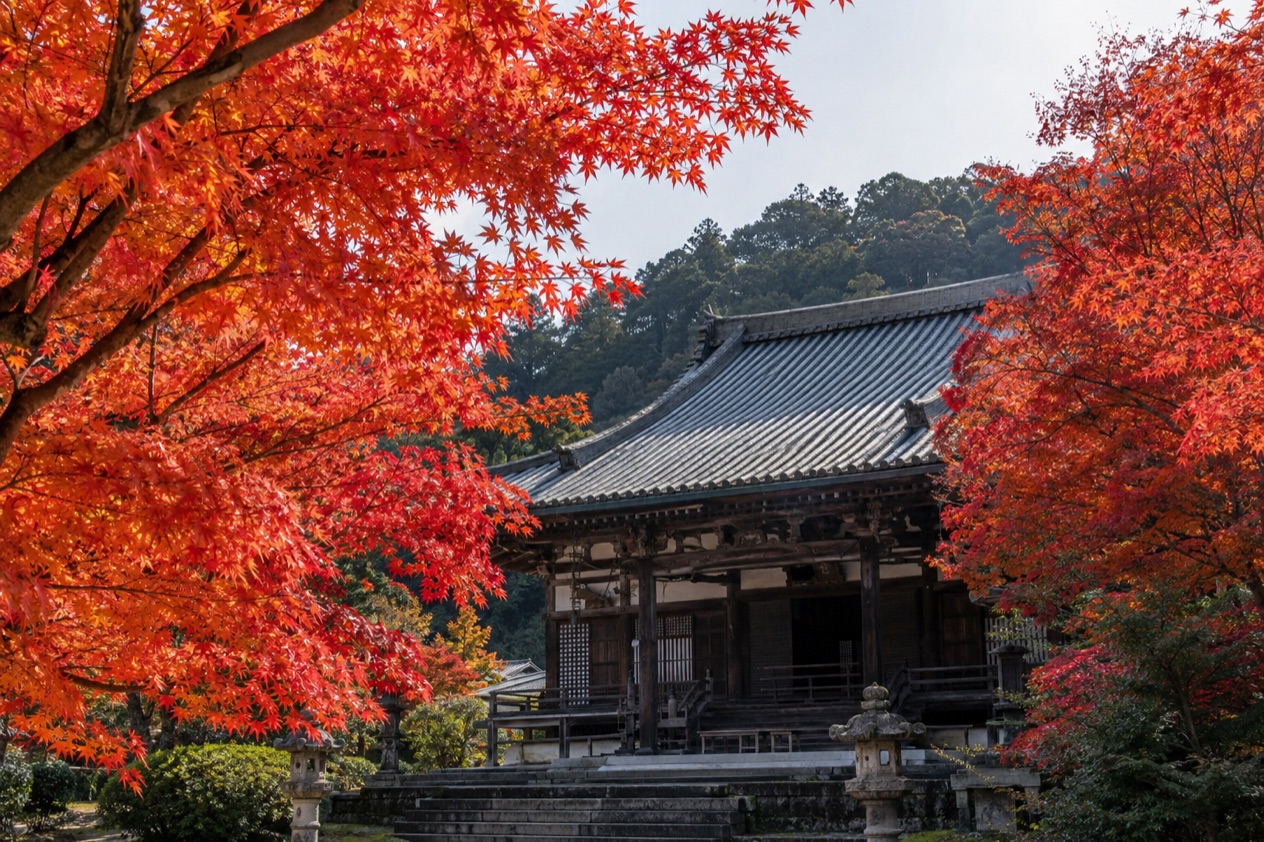
What is momiji?
Momiji is the Japanese word for the red and golden leaves of autumn, and by extension the season of going out to look at them. The word is tied to maples in particular, the trees whose leaves turn the brightest reds, and the same word is used for the leaves, the trees and the outing itself. The leaf-viewing outing is often called momiji-gari, literally a hunt for red leaves, and it sits beside hanami, the cherry blossom picnic of spring, as one of the two great seasonal viewings of the year.
The seasonal viewing has its own look. People walk garden paths slowly, stand at the edge of temple ponds where the red leaves reflect in the water, and sit in tea houses with a bowl of matcha and a sweet shaped like a maple leaf. Shops and bakeries fill with momiji-themed treats, and the maple leaf appears on cookies, cakes and boxes of sweets across the country.
How the national weather agency counts the color change
Japan’s national weather agency tracks the season with a precise yardstick. Its maple color-change day, called kaede koyo, is the first day on which most of the leaves of a sample tree, looked at as a whole, have turned red. It is a measure of a specific tree in a specific city, so it marks the moment the color takes hold rather than the last day to see it.
That is worth keeping in mind when you read the dates. A city’s color-change day is the start of its good weeks, and the leaves then continue to deepen and spread across the other trees. The agency reports the date for each city with a reference tree, which is why the same city gives a firm date from one year to the next while the actual color on the hills around it comes in stages.
A season that travels down the country
Color does not arrive everywhere at once. According to the agency, it starts in mid-October in eastern Hokkaido, then reaches the Tohoku region and eastern Hokuriku around November 20. The Kanto, Hokuriku, Tokai, Chugoku, Shikoku and northern Kyushu areas follow around November 30.
The Pacific coasts of Kanto and Tokai, the Kinki region and southern Kyushu come last, from early to mid December. For a traveler this means autumn color can be followed across a whole trip. A route that starts in the north and ends in the southwest can stretch the season over many weeks, with the leaves reaching their red in each place in turn.
What a momiji day looks like
A day built around the leaves is usually slow. You wander a garden with a pond and a bridge, pass under a tunnel of maples, stop at a temple with a view across a valley, and break for a bowl of noodles or a plate of grilled rice cakes. Many gardens in Japan are designed around the maple, with a tree placed at the corner of a pond or beside a stone lantern so that the red falls into the water.
Local food follows the season too. Chestnuts and sweet potatoes show up in cafes, persimmons hang from eaves, and mushrooms and grilled fish appear on set menus. In Hiroshima, momiji manju, a soft cake shaped like a maple leaf and filled with sweet bean paste, is a familiar sweet for the season.
Where are the best-known spots?
The cities with a measured color-change date run from Hakodate and Aomori in the north to Fukuoka and Kagoshima in the southwest, and each gives a different kind of autumn. Together they cover a long arc of the country, so you can pick the region that fits your route and then match it to the dates.
Hakodate and Aomori in the north
Hakodate, on the southern tip of Hokkaido, and Aomori, at the northern end of Honshu, are where the season comes first among the cities with a date. Their autumns mix port-town scenery with hills and parks. In Hakodate, the slopes above the harbor and the city’s parks are where the leaves are watched, with the water always in the background.
Aomori offers a cooler, more northern feel, and apples are a local pride, so autumn here tastes of fruit as well as looking red. A trip to the north suits a traveler who wants the season in its early weeks, when much of the rest of the country is still green.
Kanazawa on the Sea of Japan side
Kanazawa is home to Kenrokuen, a garden that is one of the places people think of first when they picture a Japanese garden in autumn. Maples, pines, ponds and stone lanterns are arranged for a walk with changing views, and the color adds a new layer to the landscape. The old samurai and teahouse districts nearby give the same season a different setting, with narrow lanes, wooden facades and traditional sweets.
Kanazawa also sits in the Hokuriku region, which the national agency places in the group that gets color around the end of November. Seafood from the nearby coast is a draw at the table in the same weeks, and the city’s gold leaf craft appears in sweets, shops and souvenirs.
Kobe, Hiroshima and the west
Kobe, in the Kinki region, and Hiroshima, in the Chugoku region, come later in the season. In Hiroshima, the maple leaf is part of the city’s culinary identity through momiji manju, and the nearby island of Miyajima is associated with maples and the red torii of Itsukushima Shrine. Kobe pairs its hillside walks with a port, a harbor and a café culture that makes a slow autumn afternoon easy to fill.
A trip through these cities fits a traveler who prefers the season in its later stretch, when the north has already turned brown and the southwest is just reaching red.
Fukuoka and Kagoshima in Kyushu
Fukuoka and Kagoshima are the two Kyushu cities with a date, and both come late. Fukuoka is a city of food stalls, ramen and noodles, so the leaves can be paired with a bowl of hot soup after a walk in a park. Kagoshima, with its volcano across the bay, offers a different backdrop for the season, where autumn color meets a smoking mountain. For a traveler arriving in December who thinks the leaves are over, these two cities are a reason to go southwest and find the red still arriving.
When is the best time?
The dates below are the usual day the color change is declared and the date it was recorded in 2025, so you can see both the typical timing and one real year.
| City | Usual date of color change | Observed in 2025 |
|---|---|---|
| Hakodate | November 2 | November 6 |
| Aomori | November 13 | November 10 |
| Hiroshima | November 22 | November 27 |
| Kanazawa | November 24 | November 25 |
| Fukuoka | December 1 | December 1 |
| Kobe | December 1 | November 26 |
| Kagoshima | December 15 | December 2 |
Reading the dates
The usual date is a middle point and the observed date shows how far a year can move from it. Kagoshima’s observed date came well before its usual one, while Hakodate’s came after.
That spread is the practical lesson. Treat the usual date as a landmark, not a promise, and leave room on both sides of it. A trip planned around the color-change day will often catch good leaves in the days and weeks after it, as the color deepens and spreads across the trees.
Building a route around the season
Because the northern cities come first and the southwestern ones last, a trip that moves from north to southwest can follow the red for a long stretch. Hakodate and Aomori open the season in early to mid November. Hiroshima and Kanazawa follow in the last third of the month, and Kobe and Fukuoka arrive at the start of December, with Kagoshima later still.
A traveler with a single week can simply choose one region and match it to the table. Someone going to Kanazawa will find the leaves arriving in the last week of November, while a visitor heading to Fukuoka should look to the beginning of December. Either way, the country offers weeks of color rather than a single weekend.
If you arrive too early or too late
If you arrive before a city’s date, the trees are often partly green and partly turning, which has its own appeal because the mix of green, yellow and orange gives a garden several colors at once. If you arrive after, the leaves may already be falling, and a carpet of red on the ground and in the ponds is a sight of its own that visitors enjoy.
Either case is a reason to be flexible rather than to give up. A garden with a pond reflects the maples whether the tree is half turned or past its peak, and a temple path covered in fallen leaves keeps the season in view.
Good to know before you go
The dates in this season shift from one year to the next, so plan with a margin of days rather than one fixed afternoon. Keep the leaf-viewing relaxed, since gardens and temple grounds are places for strolling, and the day often works best when built around a meal or a tea stop as much as around the trees. If the weather turns gray, the red of a wet maple against dark wood and stone remains worth seeing, and a hot drink in a tea house is a fitting reason to linger.
Sources
- Japan Meteorological Agency, maple color-change dates 2025-2026 with difference from the 1991-2020 normal (https://www.data.jma.go.jp/sakura/data/phn_014.html), checked October 11, 2026
- Japan Meteorological Agency, kaede2020.pdf (https://www.data.jma.go.jp/sakura/data/kaede2020.pdf), checked October 11, 2026
To plan your stay
- Japan Rainy Season (Tsuyu): Dates, Regions and How to Plan Your Trip
- Seasons in Japan: Blossoms, Fall Color, Snow Festivals and Summer Matsuri
- Typhoon Season in Japan: When It Hits, Which Regions Take the Brunt and How the Warning Alerts Work
- Autumn Leaves Dates by City: Usual Maple Dates, 2025 Results and How Much They Shift