
At midnight on December 31, the deep note of a temple bell rolls out over a neighborhood, then another, and a bowl of buckwheat noodles is already cooling on the table at home. New Year is the most important family holiday of the Japanese calendar, a season of food, bells, postcards and quiet visits to shrines. For a traveler, it is a time when the country slows down in the most visible way, and knowing what to expect makes it a memorable moment to be there.
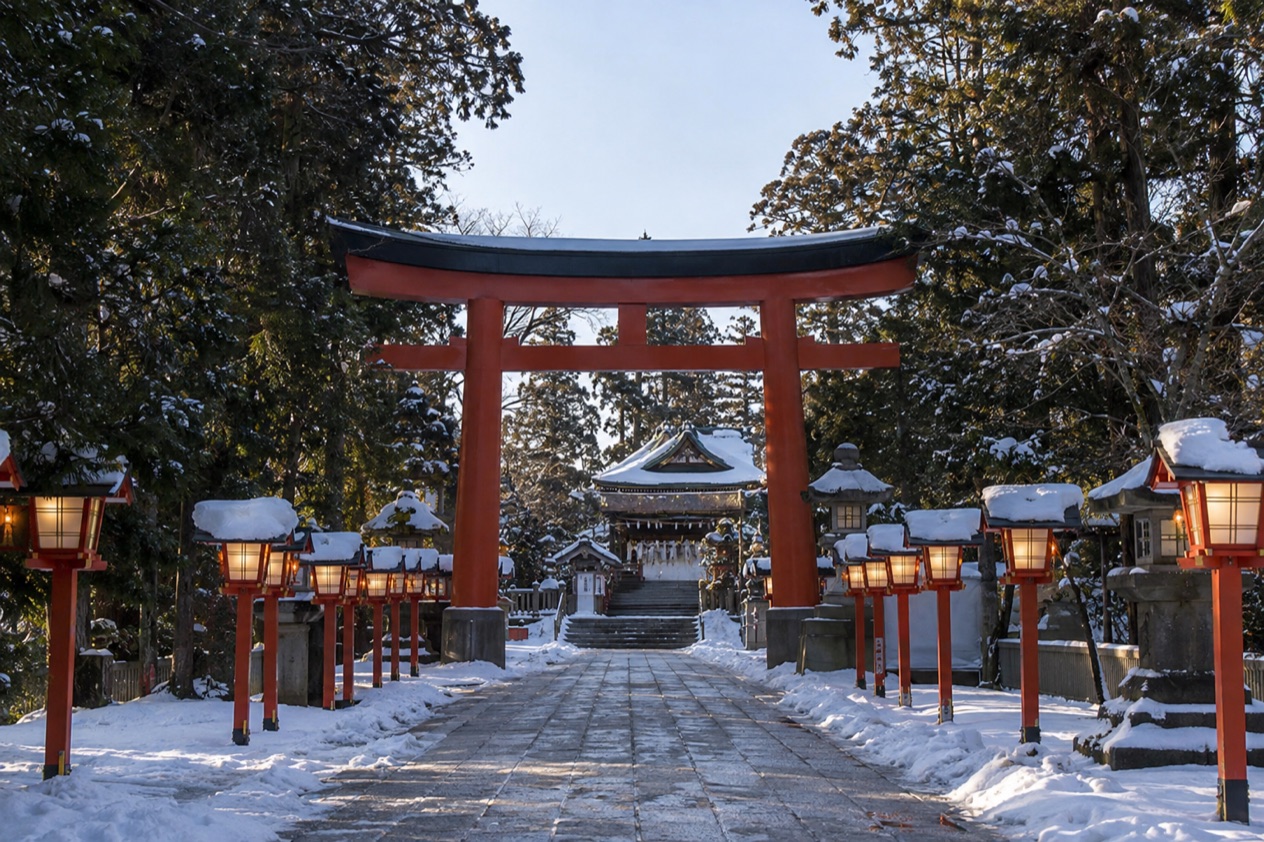
How does Japan celebrate New Year?
Japan celebrates New Year as a family season built around a few set rituals: noodles on the last night, temple bells at midnight, special dishes on the first days and a visit to a shrine or temple. The official New Year has followed the Gregorian calendar since 1873, so it falls on January 1 each year. New Year’s Day, called Ganjitsu, is a national holiday, and the wider Shōgatsu season generally refers to the first one, three or seven days of the year.
The season begins before the date itself. In the weeks leading up to it, households prepare for the turn of the year, and the last day of December has its own name, ōmisoka. Everything that follows is shaped by the idea of starting the year fresh, with the old one seen off properly.
New Year’s Eve: soba, bells and television
On ōmisoka it is very common to eat toshikoshi soba, buckwheat noodles eaten to close out the year. The bowl is simple, often a hot broth with a few toppings, and it is the kind of meal you may notice on menus and in shop displays as the day goes on. It is a custom shared across households rather than a restaurant specialty, so the mood is more domestic than festive.
At midnight, Buddhist temples all over Japan ring their bells 108 times, a ritual called Joya no Kane. The number stands for the 108 earthly temptations in Buddhist belief, and each strike is meant to carry one of them away. Hearing the bell from a temple precinct, with the sound spreading slowly across the night, is one of the most atmospheric moments of the season.
At home, many families spend the evening in front of the television. For many decades it has been customary to watch Kōhaku Uta Gassen, the music show aired on NHK on New Year’s Eve. Concert halls have their own tradition too: Beethoven’s Ninth Symphony, with chorus, is traditionally performed throughout Japan during the New Year season, and in one December alone there were 55 performances by major orchestras and choirs.
Osechi, postcards and the first days
The signature food of the first days is osechi-ryōri, usually shortened to osechi, a selection of dishes eaten during the New Year celebration. It arrives as a set of small foods, each with its own meaning for the year ahead, and it is traditionally a meal shared with family at home. Travelers are more likely to see it in department store food halls and in the hands of people carrying boxes home than at a restaurant table.
Another thread of the season is the nengajō, the New Year’s postcard. The post office guarantees delivery on January 1 for cards marked with the word nengajō and mailed between mid-December and a few days before the end of the year. It is customary to skip these cards when there has been a death in the family, and a relative instead sends a mourning postcard, called mochū hagaki, to let friends and relatives know.
Sports and regional variations
On New Year’s Day, the final of the Emperor’s Cup, the national football elimination tournament, has been played since 1969 and is usually aired on NHK. It gives the day a sporting rhythm for many households, alongside the food and the visits.
Not every region has followed the same calendar. Okinawa Prefecture and the Amami Islands in Kagoshima Prefecture used to celebrate Lunar New Year on the first day of the lunar calendar, a reminder that the January 1 date is a relatively modern standard laid over older local habits.
What closes?
Many shops across Japan close for several days during the New Year period, from late December to early January. That changes the normal rhythm, in which urban shops are generally open from 10:00 a.m. to 8:00 p.m. every day. Offices follow their usual weekday pattern of 9:00 a.m. to 5:00 p.m., and they are closed on weekends, which adds to the sense of a country on pause once the holiday begins.
Shops and everyday services
The shop closures are the part of the season that most affects a visitor’s day. A street that normally has its shutters up from mid-morning to evening can be dark for several days, and rural areas, where shops often close earlier than usual, sometimes as early as 6:00 p.m., are no exception. If you are used to wandering into a shop whenever you feel like it, the New Year period asks for a different habit: eating, shopping and picking up what you need before the closures begin.
Convenience stores are the exception that matters most. Many of them, such as 7-Eleven, FamilyMart and Lawson, are open 24 hours a day, even on national holidays. They become the practical backbone of the season for a traveler, a place for a hot drink, a snack or the basics when almost everything else is shut.
Trains and getting around
Most trains in Japan run from about 5:00 a.m. to midnight. That is a useful frame on New Year’s Eve, when the bells ring at the stroke of midnight, since it shapes how you plan an evening out. The usual weekday rush hours, from about 7:30 a.m. to 9:00 a.m. and from 5:30 p.m. to 7:00 p.m., are tied to the working week, so they do not describe the holiday days themselves.
Shrines, temples and the holiday rules
Shrines and temples are the places that do not shut for the season. They are generally open all year and often accessible from early morning until late afternoon, which is exactly why the New Year is such a natural time to visit them. Because the holiday is about being out among them, the usual closing of shops and offices does not touch the sites themselves.
Japan also has rules that extend a holiday when the calendar lines up in a certain way. When a national holiday falls on a Sunday, the next working day becomes a public holiday, known as furikae kyūjitsu.
Any day that falls between two other national holidays also becomes a holiday, called kokumin no kyūjitsu. Coming of Age Day, held on the second Monday of January, follows soon after New Year and is another day off for many workers.
| Holiday | Date |
|---|---|
| New Year’s Day (Ganjitsu) | January 1 |
| Coming of Age Day | Second Monday of January |
| National Foundation Day | February 11 |
| Emperor’s Birthday | February 23 |
| Vernal Equinox Day | Around March 20 |
What can travelers do?
Travelers can join the season by listening to temple bells, eating the foods of the holiday, visiting shrines and temples, and using the convenience stores and trains that keep running. The days are quieter in the shopping streets but full of ritual elsewhere, so the best approach is to plan around what is open rather than around what is closed.
Ring in the year at a temple
The most direct way to feel the turn of the year is to be near a Buddhist temple at midnight on December 31, when the bells are rung 108 times in the Joya no Kane ritual. Temples across the country take part, so it can be done in whatever city you are staying in. The experience is mostly about sound and atmosphere: a slow count, a cold night and the sense of a whole country marking the same moment.
Since most trains run until about midnight, think about how you will return to your lodging after the bells. Shrines and temples are generally open all year, but the hours people keep around them vary, so it helps to treat the night as a special outing rather than an ordinary evening stroll.
Eat the season
Food is an easy way in. On ōmisoka, a bowl of toshikoshi soba is the dish of the night, and on the first days of the year osechi-ryōri is the meal people associate with the holiday. You may not always find them in a restaurant, since both are largely home traditions, but they shape what you see in food shops and on tables across the country.
With many shops closed for several days, convenience stores that stay open around the clock, even on national holidays, are the reliable stop for a quick meal or a hot drink. Treat them as the fallback that keeps the days running smoothly.
Watch, listen and send a card
If you are in a hotel with a television, Kōhaku Uta Gassen on NHK is the long-running New Year’s Eve music show, and the Emperor’s Cup final is usually aired on NHK on January 1. For a night out, look for one of the concerts of Beethoven’s Ninth that orchestras and choirs perform around the country at the turn of the year.
A smaller pleasure is the postcard. Cards marked nengajō and mailed between mid-December and a few days before the end of the year are guaranteed delivery on January 1, so a card sent from Japan to a friend can arrive right on the holiday. It is a way to take part in a custom that Japanese households keep up every year.
Good to know before you go
The practical rhythm of the New Year is simple: the season begins in late December, with many shops shut for several days, and January 1 is a national holiday. Shrines and temples stay open, convenience stores keep their lights on, and trains generally run from about 5:00 a.m. to midnight. Plan your meals and any purchases around the closures, and keep the late-night bell ringing in mind when you think about getting back to your room.
Sources
- Japan National Tourism Organization, shop and attraction hours, national holidays (https://www.japan.travel/en/plan/business-hours-and-holidays/), checked October 11, 2026
- Wikipedia, Japanese New Year (https://en.wikipedia.org/wiki/Japanese_New_Year), checked October 11, 2026
- Wikipedia, Public holidays in Japan (https://en.wikipedia.org/wiki/Public_holidays_in_Japan), checked October 11, 2026
To plan your stay
- Japan Rainy Season (Tsuyu): Dates, Regions and How to Plan Your Trip
- Seasons in Japan: Blossoms, Fall Color, Snow Festivals and Summer Matsuri
- Typhoon Season in Japan: When It Hits, Which Regions Take the Brunt and How the Warning Alerts Work
- Autumn Leaves Dates by City: Usual Maple Dates, 2025 Results and How Much They Shift