
A temple garden in early summer fills with round clusters of blue, violet and pink, and visitors slow down to look at them leaf by leaf. These are ajisai, the hydrangeas that Japan has long tied to the turn from spring into summer. They are a reason to plan a trip around a flower other than the cherry blossom, and they suit anyone who likes gardens, temples and a softer pace.
When do the hydrangeas bloom in Japan?
Hydrangeas bloom in early summer, when they reach full bloom in the tranquil atmosphere of temple gardens. That puts them after the cherry blossoms, the wisteria and the tulips of spring, and before the sunflowers and lavender of high summer. A spring trip will find the garden still green and waiting, and a trip in autumn will find only leaves.
No single date applies to the whole country, and the flowers do not open on a schedule you can pin to a calendar day. Plan around the season as a whole, early summer, and let the plants set the exact week. A visit that falls a little early will often show buds and the first colored clusters, while a late one shows the older flowers fading to papery tones.
How the season fits into the Japanese flower year
Japan’s flower calendar moves like a relay. The cherry blossom, the most famous flower in the country and a harbinger of spring, opens the year. Peach trees follow in Toyota, in Aichi Prefecture, and tulips and wisteria fill the gardens soon after. Hydrangeas take the baton as spring ends.
After the hydrangeas come the big summer fields. Tomita Farm in Hokkaido is at its peak in July, with lavender, poppies, ferns and white birch trees together. The Hokuryu Sunflower Village, also in Hokkaido, has two million sunflowers. Then autumn brings cosmos, and between early and mid-October the Tonami Yumenotaira cosmos field in Toyama shows one million of them in different colors.
What you are looking at
Hydrangeas are native to Japan, and eastern Asia, notably China, Korea and Japan, holds the greatest diversity of species. That explains why the plants look at home in old gardens here. Some bear the familiar round mophead, while others carry flatter, lacier clusters with a ring of showy petals around a fine center.
Color is part of the pleasure. A single garden can hold blue, purple, pink and white flowers side by side, and a bush can shift shade from one cluster to the next. Gardeners often say the soil influences the blues and pinks, which is why neighboring plants sometimes look like different species. Walking slowly and looking at the shifts is half the point of the visit.
A hydrangea that won in London
Japan’s hydrangeas also travel. A hybrid called Runaway Bride Snow White, bred in Japan, won Plant of the Year at the 2018 RHS Chelsea Flower Show. It is a good reminder that the flower you admire in a temple garden belongs to a breeding tradition that gardeners abroad now follow closely.
Where can you see them?
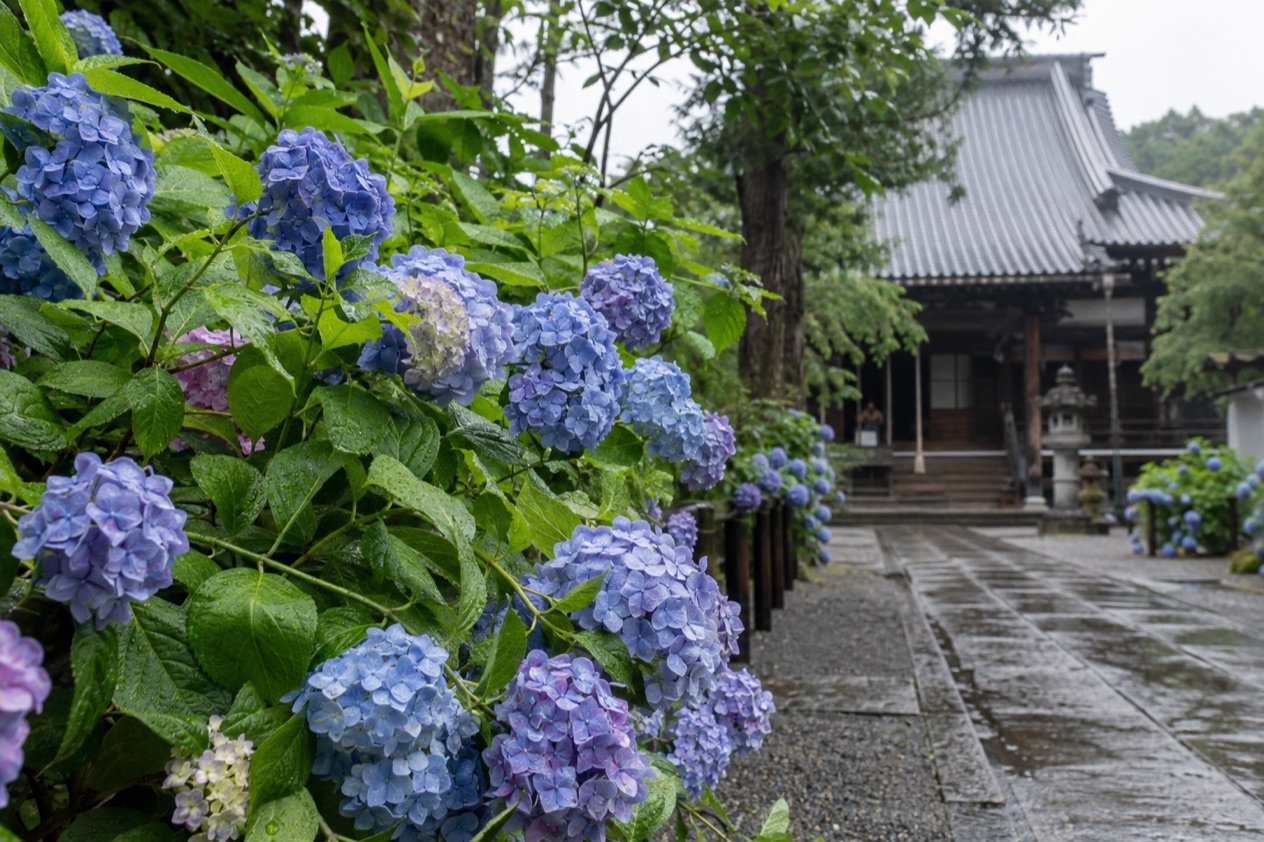
Temple gardens are where Japan shows its hydrangeas, and Hasedera Temple in Kanagawa is one of the prime spots to view them in early summer. The pairing makes sense. A temple gives the flowers old wood, stone, moss and tiled roofs to grow against, and the blooms soften all of it.
Hasedera Temple in Kanagawa
Hasedera is the name to hold onto when you plan a hydrangea visit. It is described as one of the prime places to see ajisai in early summer, and it is the single hydrangea site named for this trip. The experience is that of a temple visit with flowers added: you move between sacred buildings and garden, and the clusters line the walk.
Think of it as a morning or afternoon built around looking rather than ticking off sights. Bring patience for stopping often, and a camera for close-ups of single clusters, where the layered petals and raindrops make the best pictures. Opening hours and admission are not set out here, so confirm them with the temple before you go.
Temple gardens more broadly
The JNTO frames hydrangea viewing as a temple-garden experience, so a wider search for the flower can begin with temples and their grounds wherever your route passes. A garden visit sits comfortably beside the other things temples offer, such as incense, prayer halls, small shrines and tea. The flowers are an added layer, not the entire reason to walk through the gate.
Because the guidance names only Hasedera as a prime place, treat any other hydrangea garden you hear about as something to confirm locally rather than assume. Each place has its own pace of bloom, and a garden that is full in one week can be bare in another.
If you are traveling outside early summer
Visiting in October, as travelers do, means the hydrangeas are done for the year. The flowers on offer now are different. The Tonami Yumenotaira cosmos field in Toyama shows its one million blooms between early and mid-October, and it gives you a full field of color to walk through while you wait for the next hydrangea season.
For other months the JNTO points to other flowers. Spring brings the tulips at Tonami Tulip Park in Toyama, with its three million bulbs, and the 200,000 tulips at the Grinpa amusement park with Mount Fuji behind them. Kawachi Fujien Wisteria Garden has tunnels of purple, blue and white wisteria that run for over 100 meters, and Hitachi Seaside Park is praised for blue nemophila set against sea and sky.
What should you know before you go?
The main thing to know is that hydrangea season is a matter of timing, and the flower rewards a flexible plan. Early summer is the window, temple gardens are the setting, and a few cultural details make the visit richer than the flowers alone.
Leave room for the weather and the calendar
A bloom is a living thing, and it does not keep to the same week from one year to the next. Build in a few spare days if the flowers are the point of your trip, and keep your sightseeing list loose enough to move. If a garden is not yet at its fullest, the temple buildings, grounds and surroundings still give you a day worth having.
Early summer in Japan is also a damp, greener time of year in the popular imagination, and hydrangeas are the flower people link to it. Treat that as a mood rather than a forecast. Soft light, wet leaves and glossy petals are part of why the flowers photograph so well, and a gray day can flatter them more than a bright one.
Ama-cha, the sweet tea made from hydrangea leaves
Hydrangeas in Japan are more than ornamental. Ama-cha, meaning sweet tea, is an herbal tea made from Hydrangea serrata, whose leaves contain phyllodulcin, a compound that develops a sweet taste. For the fullest flavor, fresh leaves are crumpled, steamed and dried, which gives dark brown tea leaves.
The tea has a ceremonial role. It is mainly used for kan-butsu-e, the Buddha bathing ceremony, held on April 8 every year, the day thought to be Buddha’s birthday in Japan. During the ceremony, ama-cha is poured over a statue of Buddha and served to the people in attendance. That date falls in spring, well before the flowers, so the tea belongs to a different moment from the bloom.
Matching your visit to the garden
A hydrangea garden asks for a different kind of attention than a cherry blossom park. There is no single spectacle to stand in front of. The reward comes from lingering over a cluster, noticing how the color changes, and looking at how a bush sits against a wall, a roof or a stone lantern.
If you travel with companions who are not flower enthusiasts, the temple setting carries the day. Buildings, grounds and the habits of a temple visit give everyone something to look at, and the hydrangeas become the bonus.
Good to know before you go
Hydrangea viewing costs little beyond the temple visit itself, so the planning is mostly about timing. Carry some yen for small purchases around a temple, since sweets, tea and souvenirs often sit near the gate.
Temples are places of worship as well as gardens, so voices drop and shoes come off where the entrance asks for it. Early summer can bring rain, and a wet day suits the flowers well even if it asks for a flexible schedule.
Sources
- Japan National Tourism Organization, flowers by season: cherry blossom, plum, wisteria, hydrangea, where and when (https://www.japan.travel/en/see-and-do/flowers/), checked October 11, 2026
- Wikipedia, Hydrangea (https://en.wikipedia.org/wiki/Hydrangea), checked October 11, 2026
To plan your stay
- Japan Rainy Season (Tsuyu): Dates, Regions and How to Plan Your Trip
- Seasons in Japan: Blossoms, Fall Color, Snow Festivals and Summer Matsuri
- Typhoon Season in Japan: When It Hits, Which Regions Take the Brunt and How the Warning Alerts Work
- Autumn Leaves Dates by City: Usual Maple Dates, 2025 Results and How Much They Shift