
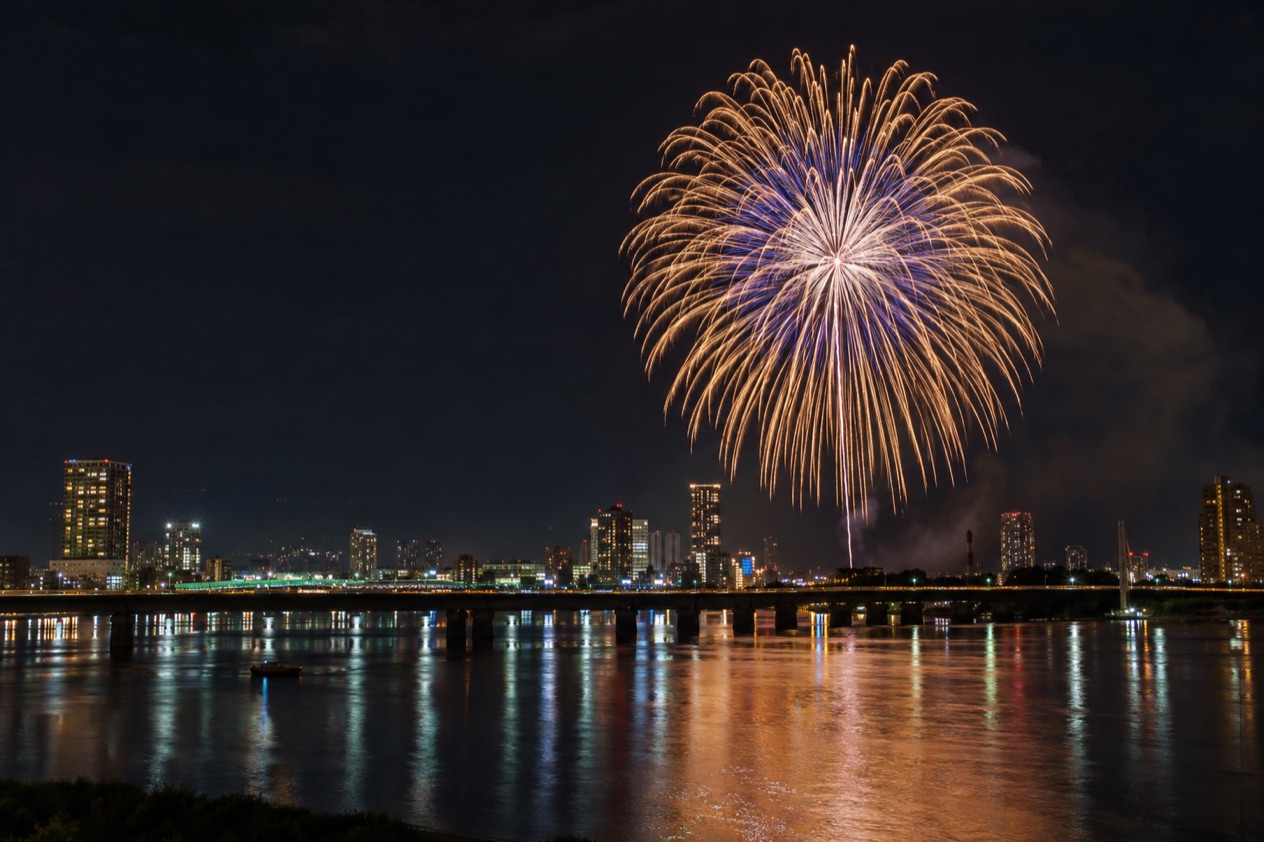
On a hot summer evening in Japan, people drift toward a riverbank in cotton yukata, carrying paper fans and plastic bags of fried noodles, and then the first shell opens over the water with a thud you feel in your chest. Fireworks, called hanabi, are woven into the summer festival calendar, sometimes as a whole evening in their own right and sometimes as the last act of a larger matsuri. The short answer for a traveler is that summer is the season, and the first week of August holds two of the most striking nights.
When are fireworks festivals held in Japan?
Fireworks festivals belong to summer, and the first week of August is when two of the best-documented displays take place. Nagaoka Matsuri in Niigata Prefecture falls in that week, and the Nebuta Matsuri in Aomori ends on August 7 with a fireworks display. Plan around those dates if you want to see a display with a festival around it, not only a burst of light overhead.
Summer on the islands of Honshu and Kyushu is very humid, hot and sultry, and that shapes the whole experience. A fireworks night is as much about sitting outside in warm, heavy air with a cold drink as it is about the show itself. The word hanabi is written with the characters for flower and fire (花火), and the name fits the way a shell blooms and fades over the dark.
Dates for the two festivals with fireworks
The table gathers the two festivals where fireworks are part of the program. Use it as a skeleton for a summer route, then fill in the days around each one with other festivals and sights.
| Festival | Place | When | Fireworks |
|---|---|---|---|
| Nagaoka Matsuri | Niigata Prefecture | First week of August | About 20,000 in a typical year |
| Nebuta Matsuri | Aomori | August 2 to August 7 | Display on August 7, the last day |
Fireworks as the last act of a festival
In Japan fireworks often close a festival instead of standing alone. The Nebuta Matsuri is the clearest example here, because its six days run toward a fireworks display on the final evening. That means a trip to Aomori gives you parades and lantern floats first, and the sky finale as a reward at the end.
This shape suits travelers who like a story with an ending. You can spend the earlier days in the streets with the festival, then keep the last night for the display. Nagaoka Matsuri is built around the fireworks themselves, so the two festivals give you two different rhythms of the same summer tradition.
Summer festivals that share the calendar
Fireworks are not the only reason to be in Japan in summer. The Gion Festival in central Kyoto has been held since 869, and the Tenjin Matsuri in Osaka is considered one of Japan’s three greatest festivals, alongside Tokyo’s Kanda Matsuri and Kyoto’s Gion Matsuri. For Gion, it is recommended to book accommodation several months in advance.
Further into the season, the Gujo Odori Festival in Gifu runs from July to September and offers ten dances to learn, which makes it a participatory evening for anyone who would rather join in than watch. Pairing one of these festivals with a fireworks night gives a summer trip a good deal of variety.
Which are best known?
One is a festival whose fireworks are the main event, and the other ends a parade of illuminated floats with a burst of color. Either makes a good anchor for a trip built around summer.
Nagaoka Matsuri in Niigata
Nagaoka Matsuri is held during the first week of August and features about 20,000 fireworks in a typical year. That is a very large number of shells for one festival, and it tells you what kind of evening to expect: a long show with many chapters, rather than a few minutes of spectacle.
A festival of this scale in Niigata Prefecture suits travelers who want fireworks as the reason for the trip. It fits well into a route that heads toward the Sea of Japan side of Honshu, where you can build the days around the festival and spend the rest of your time exploring the prefecture. The summer heat and humidity are part of the night, so a light outfit and a fan are the sensible companions.
The Nebuta Matsuri finale in Aomori
The Nebuta Matsuri begins on August 2 and ends on August 7 with a fireworks display. The festival is known for its great lantern floats, and the last night turns the attention from the street to the sky. For a traveler, this gives a clear plan: spend the earlier days at the parades, then be in Aomori on the closing evening for the fireworks.
Because the display comes at the end of the festival, there is a feeling of release to it. After days of drums, chanting and glowing paper figures, the quiet gap before the first shell is part of the pleasure. It is a good choice for people who prefer a festival with a full arc over a single evening.
Other festivals to set beside them
Beyond fireworks, Japan has a long list of festivals to weave into the same trip. The Hakata Dontaku Festival usually has 30,000 participants and attracts over two million visitors each year, which gives a sense of how seriously cities take their celebrations. The Sanja Festival in Asakusa, Tokyo, features lively parades with mikoshi, portable shrines carried through the streets.
In Kanazawa, the Hyakumangoku Festival brings samurai re-enactments, drum performances and a spectacular parade. At the Nagasaki Kunchi you can eat hashimaki, which is okonomiyaki wrapped around chopsticks. None of these is a fireworks festival as such, but each shows how food, music and processions fill the Japanese festival calendar around the displays.
How do you watch one?
You watch a fireworks festival the way people in Japan do, outdoors and unhurried, with food in hand and a spot on the ground. It is a social evening more than a spectator event, and the pleasure is in the atmosphere as much as in the show. Dress for heat and humidity, because summer on Honshu and Kyushu is hot and sultry.
What the evening looks like
People wear yukata, the light cotton kimono of summer, and carry a paper or folding fan. Families and friends sit together on picnic sheets, passing around snacks from festival stalls. The food stalls are part of the show: grilled skewers, fried noodles, shaved ice and candied fruit all belong to the genre.
When the shells go up, a common reaction is a collective sound, a low murmur and then applause or shouts of delight after a particularly good burst. Listen for the shout of approval that rises from the crowd, an old habit of the audience. The mood is cheerful and relaxed, and nobody expects you to know the customs in advance.
Building a trip around a display
If Aomori appeals, the festival runs from August 2 to August 7 and the fireworks come on the last evening. If Niigata Prefecture appeals, the first week of August is the window for Nagaoka Matsuri.
If you are heading to a bigger festival such as the Gion Festival, the advice to book accommodation several months in advance is worth following. The same sense of planning ahead applies to any trip that centers on a summer date. Around the festival, fill the days with whatever the region offers, from temples and food markets to mountain scenery.
Other summer pleasures nearby
A summer in Japan can include more than festival nights. Mount Fuji’s climbing season typically runs from the beginning of July to about the first week of September. In Yamanashi Prefecture, visitors can try kayaking and rafting in the mountains, and in Kanagawa Prefecture windsurfing is possible on the beaches near Tokyo.
These make good daytime companions to an evening of fireworks, giving the trip a balance between water, mountains and festival lights.
Good to know before you go
Summer fireworks nights are warm and humid, so a small towel, a fan and a light outfit are the habits of the season. Festival stalls are where the food is, and a festival evening is a good time to try street snacks you may not have met before. Dates and programs for individual festivals can shift from one summer to the next, so treat the early August window for Nagaoka and the August 2 to 7 run of the Nebuta Matsuri as the shape of the plan.
Sources
- Japan National Tourism Organization, summer in Japan (https://www.japan.travel/en/guide/summer-guide/), checked October 11, 2026
- Japan National Tourism Organization, festivals and events (https://www.japan.travel/en/see-and-do/festivals-and-events/), checked October 11, 2026
- Wikipedia, Hanabi (https://en.wikipedia.org/wiki/Hanabi), checked October 11, 2026
To plan your stay
- Japan Rainy Season (Tsuyu): Dates, Regions and How to Plan Your Trip
- Seasons in Japan: Blossoms, Fall Color, Snow Festivals and Summer Matsuri
- Typhoon Season in Japan: When It Hits, Which Regions Take the Brunt and How the Warning Alerts Work
- Autumn Leaves Dates by City: Usual Maple Dates, 2025 Results and How Much They Shift