
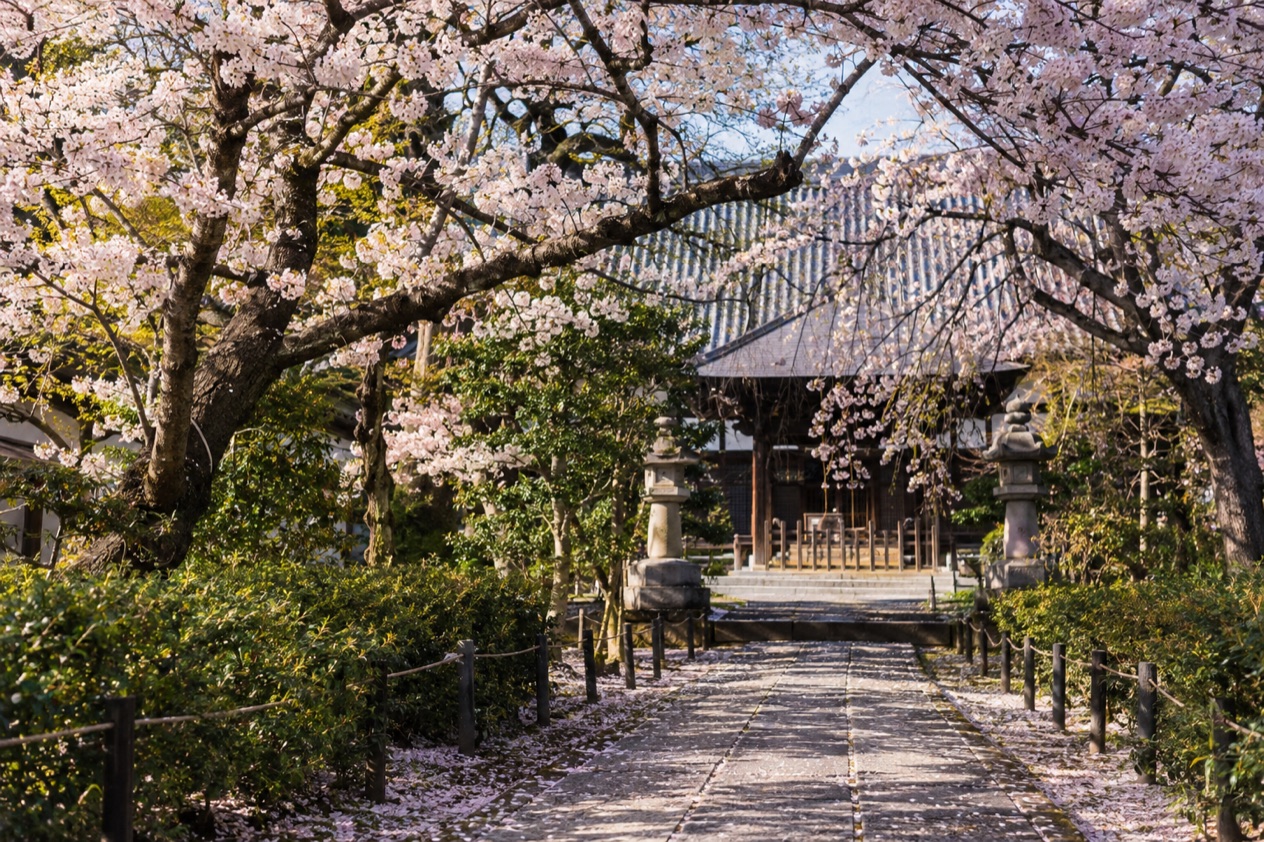
In early spring the streets around Zenko-ji fill with people looking up, phones raised toward branches that have just turned pale pink against a still-bare mountain backdrop. Nagano is a highland city, and its blossoms arrive a little later than those of the big cities on the coast. The answer in short: the cherry trees here usually open in the first half of April, and the city makes a pleasant base for the days that follow.
When do the cherry blossoms bloom in Nagano?
That timing suits travelers who would rather meet spring after the first rush of Tokyo and Kyoto, and who like the idea of petals set against a mountain town rather than a skyline.
The dates below are those recorded for the city of Nagano. They are usual dates, not a forecast, and spring can move them earlier or later from one year to the next. Recent springs have in fact tended to start a little ahead of the long-term pattern, so a trip planned around the usual date can land on trees that are already fully open or already shedding.
| Stage | Usual date | Recent range (2021-2026) |
|---|---|---|
| First bloom (kaika) | April 11 | March 28 to April 9 |
| Full bloom (mankai) | April 16 | April 1 to April 13 |
What first bloom and full bloom mean
Kaika is the day the first blossoms open on the reference trees, and mankai is the day most of the flowers are open. In practice, the days around full bloom are the ones people plan picnics and hanami (flower-viewing parties) around, spreading blankets under the trees and sharing bento and drinks.
After full bloom the petals begin to fall, and a windy or rainy day can bring them down quickly. That drift of petals on paths and water has its own charm, and many Japanese travelers treat it as part of the season rather than the end of it.
Planning around a moving date
Because recent years have ranged over about two weeks, the safest approach is to treat the first half of April as the window and stay flexible within it.
Spring in a highland city can still feel cool, especially in the evening, so a layer you can add or remove is a sensible habit when walking under the trees at dusk. Nagano is also a city where autumn color arrives on its own schedule, with the maple leaves usually turning in mid-November, which makes it a place with two distinct seasons for looking at trees.
Where can you see them in Nagano?
The easiest place to start is Nagano city itself, where the blossoms bloom around the temple district and the streets leading up to Zenko-ji. The temple is a National Treasure established at its present location in 642, and the approach to it is a street of shops and lodgings that gives the spring walk a sense of place beyond the flowers.
Zenko-ji and the old approach
Walking toward Zenko-ji is the natural way to combine blossoms with culture. The road rises gently through a neighborhood of temple lodgings, small shops selling local sweets and snacks, and quiet side lanes where a single cherry tree can fill a view.
Take your time at the temple grounds, then wander back down the approach with a snack in hand. The mix of old wooden buildings and pale petals is what people come to Nagano for in spring, and it works whether you have an hour or an afternoon.
Olympic facilities and the city’s open spaces
Nagano hosted the 1998 Winter Olympic Games, and many of the facilities, such as the M-Wave speedskating arena and the Aqua-Wing arena, remain open. They are a different kind of stop from a temple, and they give the city a modern counterpoint if you want to balance a day of shrines with something from recent history.
Parks and riverbanks in a city of this kind are where residents tend to gather for hanami, so open green areas away from the main sights are worth a look when the trees are in flower. Wandering without a fixed route often turns up a street lined with blossoms that no guidebook mentions.
Reaching the city
From Tokyo, Nagano city is 1 hour 20 minutes away without stopping on the Hokuriku Shinkansen. From Osaka or Kyoto, the route is the high-speed train to Nagoya, then the JR Wide View Shinano express train to Nagano.
Nagano is the capital of its prefecture and its northernmost transportation hub, so it is a natural point to arrive and settle in before heading out to see the trees. The city sits at an altitude of about 1,219 feet, the highest of any prefectural capital in Japan, which helps explain why spring comes at a measured pace here.
What should you know before you go?
The main thing to know is that the blossom window is short and shifts from year to year, so flexibility matters more than any single date. First bloom has fallen anywhere from late March to early April in recent springs, and full bloom has followed within roughly a week.
Building a flexible trip
If your dates are fixed, aim for the first half of April and expect to see the trees somewhere between early bloom and the first falling petals. If your dates are open, watch the spring reports as the season approaches and shift your arrival to match what the trees are doing.
Because Nagano is reached by Shinkansen from Tokyo, it also works as a stop added to a longer route rather than a trip of its own. Travelers coming from Osaka or Kyoto can fit it into a wider loop through central Honshu, making the blossoms one chapter among several.
What to expect from the weather and the mood
Early April in a highland city feels like the first real warmth after winter, with mornings and evenings that can still be crisp. Rain is possible in any spring, and wet petals on dark pavement make their own kind of photograph, so a gray day is not a lost one.
The atmosphere during blossom season is cheerful and unhurried. Families, office groups and couples spread out under the trees, and the city has a festive feel without the intensity of Japan’s largest destinations. Bring a taste for slow afternoons and good food, and the season will reward you.
Pairing blossoms with the rest of the city
A day built around Zenko-ji, a walk through the old approach, and an hour at one of the Olympic venues gives a rounded picture of Nagano.
Late in the year the same city offers a second show, when the maple leaves change color, usually in mid-November. Anyone who loves the spring trees may enjoy knowing that Nagano rewards a return visit in autumn.
Good to know before you go
Spring in Nagano is a season for light layers, comfortable walking shoes and a flexible plan. Carry some yen for small shops along the temple approach, keep an eye on the weather, and give yourself a few days around the usual date so the trees, not the calendar, set the pace of your visit.
Sources
- Japan Meteorological Agency, cherry blossom first-bloom dates 2021-2026 and 1991-2020 normal (https://www.data.jma.go.jp/sakura/data/sakura003_07.html), checked October 11, 2026
- Japan Meteorological Agency, cherry blossom full-bloom dates 2021-2026 and 1991-2020 normal (https://www.data.jma.go.jp/sakura/data/sakura004_07.html), checked October 11, 2026
- Japan National Tourism Organization, Nagano (https://www.japan.travel/en/destinations/hokuriku-shinetsu/nagano/nagano-and-around/), checked October 11, 2026
- Wikipedia, Nagano (city) (https://en.wikipedia.org/wiki/Nagano_(city)), checked October 11, 2026
- Wikivoyage, Nagano (https://en.wikivoyage.org/wiki/Nagano), checked October 11, 2026
- Japan Meteorological Agency, maple color-change dates 2025-2026 with difference from the 1991-2020 normal (https://www.data.jma.go.jp/sakura/data/phn_014.html), checked October 11, 2026
To plan your stay
- Japan Rainy Season (Tsuyu): Dates, Regions and How to Plan Your Trip
- Seasons in Japan: Blossoms, Fall Color, Snow Festivals and Summer Matsuri
- Typhoon Season in Japan: When It Hits, Which Regions Take the Brunt and How the Warning Alerts Work
- Autumn Leaves Dates by City: Usual Maple Dates, 2025 Results and How Much They Shift