
In spring, the black walls of Matsumoto Castle gain a pale pink frame, and people spread tarps under the trees with bento boxes and cans of tea while the Japan Alps stand behind the keep. The question of timing comes up as soon as you plan a trip around the blossoms, because the bloom shifts from one spring to the next. Matsumoto, in Nagano Prefecture, is a city where the castle, the old streets and the mountains make the cherry season worth a stop.
When do the cherry blossoms bloom in Matsumoto?
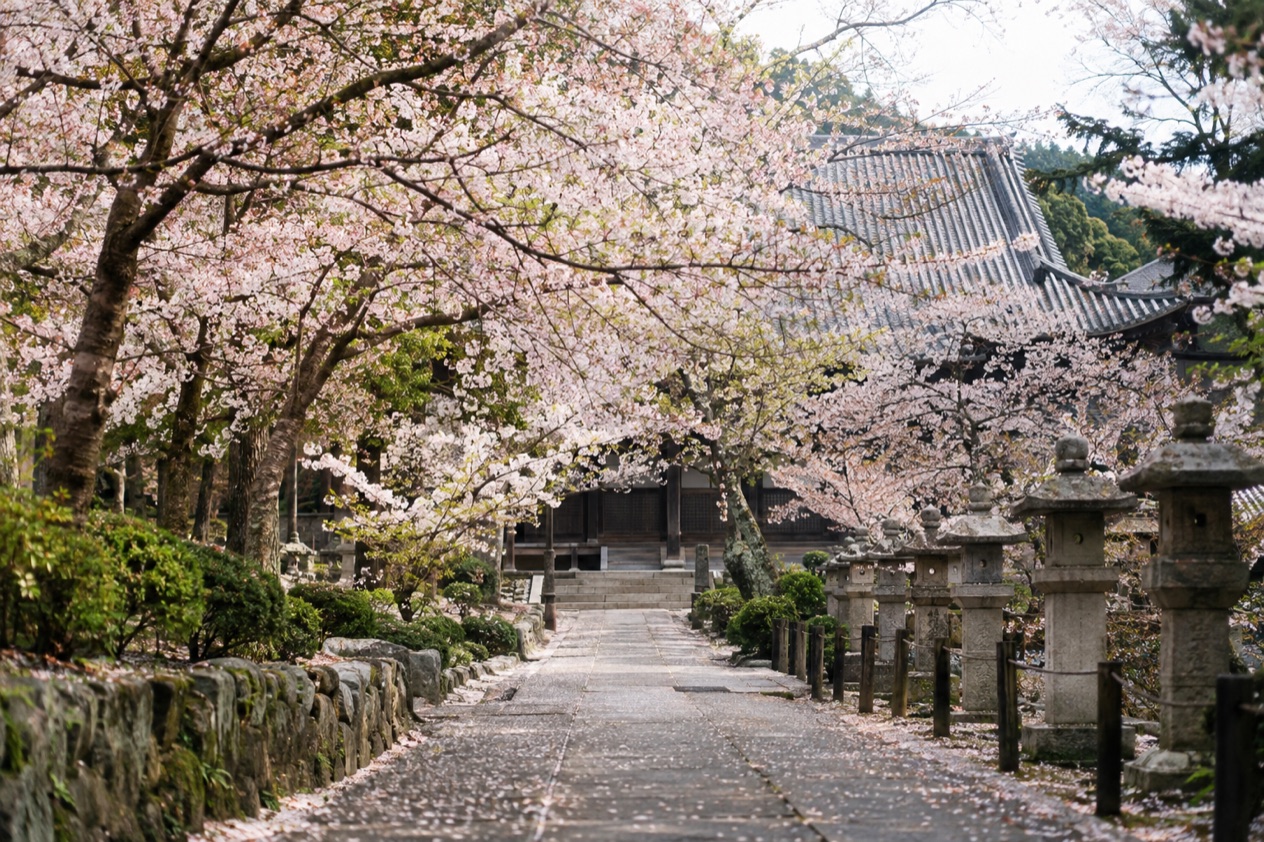
The cherry blossoms bloom in spring, and the exact week changes from year to year with how the winter and early spring have run. Matsumoto sits in the mountains of Nagano Prefecture, at the eastern end of the Japan Alps, so the season follows the pace of an inland highland town rather than a city on the coast. Trees open over a stretch of days, not all at once, and the whole spell from the first open flowers to the petals falling is brief.
There is no fixed calendar date to circle. That habit suits you too: pick a window in spring, keep your days flexible, and let the trees decide which morning is the one for the castle walk.
What the bloom looks like in stages
First come the buds, tight and darker than you expect, then the first flowers on the most exposed branches. Full bloom is when the crowns turn white and pink and whole branches are covered.
After that the petals begin to fall, and the water of the castle moat and the ground under the trees fill with drifting pink. Many Japanese people love this last stage as much as the peak, and the word hanafubuki, a blizzard of petals, describes it.
Because the stages move quickly, a stay of several days gives you the best chance of catching at least one of them. A single day trip can land on bare branches or on petals already on the ground, and both have their charm with the keep in the background.
If you are here in October instead
Autumn does not bring blossoms, but it does bring light to the castle. Matsumoto Castle is illuminated in October on a Thursday and a Friday, October 15 and 16, and the black keep and its moat are lit through the evening. It is a gentle consolation for anyone who arrives out of season, and a reminder that this castle is made for being looked at after dark as well as in daylight.
| Event | Dates | Hours |
|---|---|---|
| Matsumoto Castle illumination | October 15 (Thu) and 16 (Fri) | 5:00 PM to 10:00 PM |
Where can you see them in Matsumoto?
The place to start is Matsumoto Castle, which is one of Japan’s 12 original castles and is designated a National Treasure of Japan. Its dark walls make a strong contrast against pale petals, and the moat doubles the view when the water is still. The castle is sometimes called Crow Castle, but the official site states that this nickname is incorrect, so you will hear it more from other visitors than from the castle itself.
The castle grounds and the moat
A walk around the outer edge of the moat gives you the keep from changing angles, with branches reaching over the water in the foreground. The red bridge near the main enclosure is a favorite spot for photographs when the trees are in flower. Inside the grounds there is room to stroll between trees, and the mountains behind the castle give the scene a depth that low-lying castle towns cannot match.
If you want to go inside, visitors can climb the precarious stairways to the top of the keep. They are steep and narrow, which is part of the experience of a castle built for defense and not for sightseeing. From the upper floors you look out over the roofs of the city and, on a clear day, toward the mountains.
Tea in the castle setting
A tea ceremony is held at Matsumoto Castle, and it pairs well with a blossom visit because the ritual of whisked green tea and a small sweet sits well with the season. Two ticket types exist, a five-seat ticket for advance purchase and a single-seat ticket for one school that is sold the same day only.
| Tea ceremony ticket | Price |
|---|---|
| Five seats (advance only) | 3,000 yen |
| Single seat, one school (same day only) | 700 yen |
The folkcraft museum and the old town
Away from the castle, the Matsumoto Folkcraft Museum is a good place to slow down between viewings. It shows the everyday objects and handcrafts of the region, and it makes a quiet counterpoint to the pink crowds at the castle. Admission is ¥300 for adults, and school children enter free.
The streets around the castle are good for wandering with no plan. Old storehouse-style buildings, small cafés and craft shops fill the lanes, and the mountain view appears at the end of many of them. A spring afternoon here can be a slow loop of coffee, a sweet, a shop and a look back at the castle from a new corner.
What should you know before you go?
Matsumoto is reached by train from several cities, and once you arrive you can get around by bus or by bicycle. From Shinjuku Station in Tokyo the train takes 2 hours and 40 minutes, from Nagoya Station it takes 2 hours, and from Nagano Station it takes 50 minutes. Matsumoto is approximately 47 miles south of Nagano City.
Arriving by train or by air
Matsumoto Airport (MMJ) also has commercial flights, but only from Osaka, Sapporo and Fukuoka. Downtown is about 20 minutes from the airport.
Getting around town
The Town Sneaker Bus is the city’s local bus service. Japanese IC cards do not work on buses in Matsumoto, but contactless payment with major credit cards other than Mastercard is possible. That detail matters if you are used to tapping a Suica or ICOCA card in other cities, so carry coins or a suitable credit card.
Bicycles are another way to get around. JR Eki Rent-A-Car, beside Matsumoto Station, rents them by the day. Cycling lets you loop around the castle, the old streets and the museum at your own pace, and stop wherever a tree catches your eye.
Mountain trips from Matsumoto
Matsumoto is also a gateway to the mountain areas of Norikura and Shirahone. A combined train and bus return ticket is sold for each, and the tickets are listed here so you can weigh a mountain day against a day in town.
| Destination | Combined train/bus return ticket |
|---|---|
| Norikura | ¥3,300 |
| Shirahone | ¥3,500 |
Good to know before you go
Spring in a mountain city can swing from bright sun to a cool breeze within a day, so a layer in your bag is a sensible habit for time spent outdoors under the trees. Cash in coins is handy for local buses, as described above. Beyond that, the blossom season is a time to go slowly, keep a flexible schedule, and let the trees set the rhythm of your days.
Sources
- Matsumoto Castle official site (https://www.matsumoto-castle.jp/), checked October 11, 2026
- Wikivoyage, Matsumoto (https://en.wikivoyage.org/wiki/Matsumoto), checked October 11, 2026
- Japan National Tourism Organization, Matsumoto (https://www.japan.travel/en/destinations/hokuriku-shinetsu/nagano/matsumoto-and-around/), checked October 11, 2026
- Wikipedia, Matsumoto, Nagano (https://en.wikipedia.org/wiki/Matsumoto,_Nagano), checked October 11, 2026
- Japan Meteorological Agency, biological season observations (https://www.data.jma.go.jp/sakura/data/index.html)
To plan your stay
- Japan Rainy Season (Tsuyu): Dates, Regions and How to Plan Your Trip
- Seasons in Japan: Blossoms, Fall Color, Snow Festivals and Summer Matsuri
- Typhoon Season in Japan: When It Hits, Which Regions Take the Brunt and How the Warning Alerts Work
- Autumn Leaves Dates by City: Usual Maple Dates, 2025 Results and How Much They Shift