
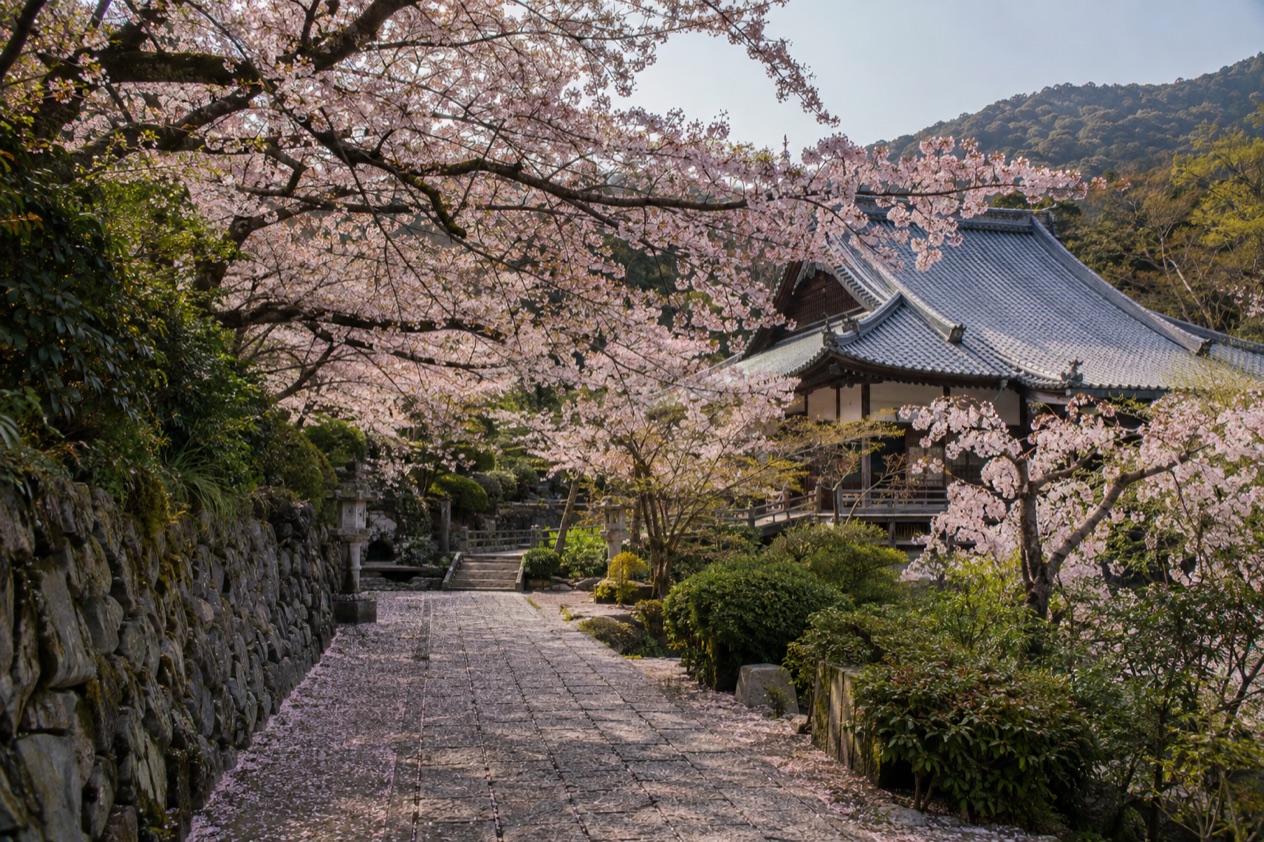
In early spring, the old temple town of Kamakura starts to pale at the edges, as pink petals gather on stone steps and drift over the paths between shrines. Travelers who plan a Japan trip around the blossoms often wonder whether this former shogunate capital belongs on the list. Late March into early April is the time to aim for, and the town gives the season a setting of temples, wooded hills and narrow lanes.
When do the cherry blossoms bloom in Kamakura?
The blossoms usually open in the last days of March, and full bloom tends to arrive around the first days of April. Japan’s weather agency has no station in Kamakura itself, so the dates below are those of its Yokohama station, the reference point for the same stretch of Kanagawa Prefecture. They are a guide to the rhythm of the season here, not a forecast for any single tree in Kamakura.
| Stage | Usual date at Yokohama | Range in recent years |
|---|---|---|
| First bloom (kaika) | March 25 | March 15 to April 1 |
| Full bloom (mankai) | April 1 | March 25 to April 7 |
What the dates mean for your trip
First bloom is the day the first flowers open on the reference trees. Full bloom comes about a week later in the usual calendar, when most of the blossoms on a tree are open. For a visitor, that means the petals look their fullest around the turn from March to April, and the trees are already dressed in pink some days before that.
The range in recent years is wide. First bloom has fallen as early as mid-March and as late as the very start of April, and full bloom has moved by almost two weeks from one spring to the next. A trip planned for the last days of March and the first week of April sits inside that window in most years, but the exact week shifts, and the trees do not follow a calendar.
Before and after full bloom
Cherry season is a slow wave rather than a single day. Before full bloom, branches show a mix of buds and open flowers, with a lighter, more scattered pink. After it, petals begin to fall, and paths and temple courtyards end up carpeted in white and pale pink, a scene Japanese travelers call hanafubuki, the blossom snowstorm.
Both ends of the season have their charm in a town like Kamakura, where the backdrop of wooden halls, moss and stone lanterns changes the look of a tree.
After the blossoms: the other color season
Autumn brings the second great color show of the temple calendar. The reference date for maple leaves turning at Yokohama is December 14, so Kamakura’s red leaves belong to the very end of the year, far from the pink of spring. If you are choosing between the two, the blossoms belong to the turn of March into April and the maples to mid-December.
Where can you see them in Kamakura?
Cherry trees grow all across Kamakura, along temple approaches, shrine paths, hillside lanes and streets in the old town, so the season is something you walk into rather than a single spot you travel to. The town sits in the Kanto region on the island of Honshu, and its setting of hills and old religious sites gives the blossoms a frame that few modern cities can offer.
Temple and shrine grounds
Kamakura was the political capital of Japan during the Kamakura shogunate, from 1185 to 1333, and the temples and shrines that grew up in that era still shape the town. Blossoms against old wooden gates, stone steps and tiled roofs make for the classic photograph of a Japanese spring. Walking from one temple to the next, you pass under branches that lean over walls and spill into the lanes.
Take your time inside the grounds. Cherry trees often stand beside a bell, a pond or a small hall, and the best views tend to come when you pause rather than hurry between sights. Temple halls, gardens and ponds all frame the flowers differently, so the same tree can look quite different from one corner to another.
Streets and quiet lanes
Away from the main religious sites, the residential lanes of the old town hide their own cherry trees, leaning from gardens and over low walls. These are good for an unplanned stroll with a coffee in hand, stopping where a branch catches the light. Petals gather in gutters and on the edges of small bridges, and a slow wander often rewards you more than a fixed route.
With a town of roughly 172,929 people, Kamakura has the everyday life of a real place behind its sights. Bakeries, small shops and tea stops line the lanes, so a blossom walk can include a sweet bean treat or a bowl of noodles between temples.
Seeing the blossoms from the train
The Enoden line is the small private railway that runs through the town, and its cars pass through a landscape of houses and gardens. When the cherry trees are in flower, the ride itself becomes part of the season, with branches brushing close to the windows in places. It is a pleasant way to move between neighborhoods while looking out at the pink.
What should you know before you go?
The main thing to know is how to reach Kamakura from Tokyo and how to match your dates to the blossom calendar. There is more than one way to come from Shinjuku, and one of them is built around a combined ticket.
Getting there from Shinjuku
One alternative from Shinjuku is to take the private Odakyu line to Fujisawa and then change onto the Enoden line to Kamakura. The travel time for this route is about 90 minutes. The change at Fujisawa puts you on the small Enoden railway, which means the last part of the trip already carries the feel of the town.
The Enoshima-Kamakura Free Pass offers a roundtrip from Shinjuku and unlimited use of the Enoden line for one day. It does not include fares on local buses, so any bus ride within town is paid separately. For a day built around moving along the Enoden line, the pass fits the plan.
Timing your visit
Because the blossom dates shift from one spring to the next, it helps to plan flexibly. The usual full bloom falls around the first days of April, but in recent years it has landed anywhere from late March to the first week of April. Building a few spare days into your Japan itinerary lets you adjust as the season unfolds.
Kamakura also suits a pairing with other cherry sights in the Tokyo area, since the reference dates here are those of Yokohama and the same spring pattern runs through the region.
A day among the petals
A good blossom day in Kamakura is unhurried. Start with a temple, follow a lane to the next, stop for a snack, and let the path decide where you end up. Ride the Enoden when your feet need a rest, and watch the pink pass by the window.
Spring light, wooden gates and falling petals combine into the kind of scenery people cross the ocean to see. Even if the trees are a few days ahead or behind your dates, the town itself, with its old religious sites and hillside lanes, makes the walk worthwhile.
Good to know before you go
Spring in Kamakura is a season of changing weather, so a layer for cooler hours and something for a passing shower fit easily in a day bag. Bus fares in town are paid separately from the Enoden pass, and it helps to carry a little cash for small shops, snacks and temple stops. Treat the dates here as the usual rhythm of the region rather than a promise, and let the trees set the final schedule.
Sources
- Japan Meteorological Agency, cherry blossom first-bloom dates 2021-2026 and 1991-2020 normal (https://www.data.jma.go.jp/sakura/data/sakura003_07.html), checked October 11, 2026
- Japan Meteorological Agency, cherry blossom full-bloom dates 2021-2026 and 1991-2020 normal (https://www.data.jma.go.jp/sakura/data/sakura004_07.html), checked October 11, 2026
- Wikipedia, Kamakura (https://en.wikipedia.org/wiki/Kamakura), checked October 11, 2026
- Wikivoyage, Kamakura (https://en.wikivoyage.org/wiki/Kamakura), checked October 11, 2026
- Japan Meteorological Agency, maple color-change dates 2025-2026 with difference from the 1991-2020 normal (https://www.data.jma.go.jp/sakura/data/phn_014.html), checked October 11, 2026
- Japan Meteorological Agency, biological season observations (https://www.data.jma.go.jp/sakura/data/index.html)
To plan your stay
- Japan Rainy Season (Tsuyu): Dates, Regions and How to Plan Your Trip
- Seasons in Japan: Blossoms, Fall Color, Snow Festivals and Summer Matsuri
- Typhoon Season in Japan: When It Hits, Which Regions Take the Brunt and How the Warning Alerts Work
- Autumn Leaves Dates by City: Usual Maple Dates, 2025 Results and How Much They Shift