
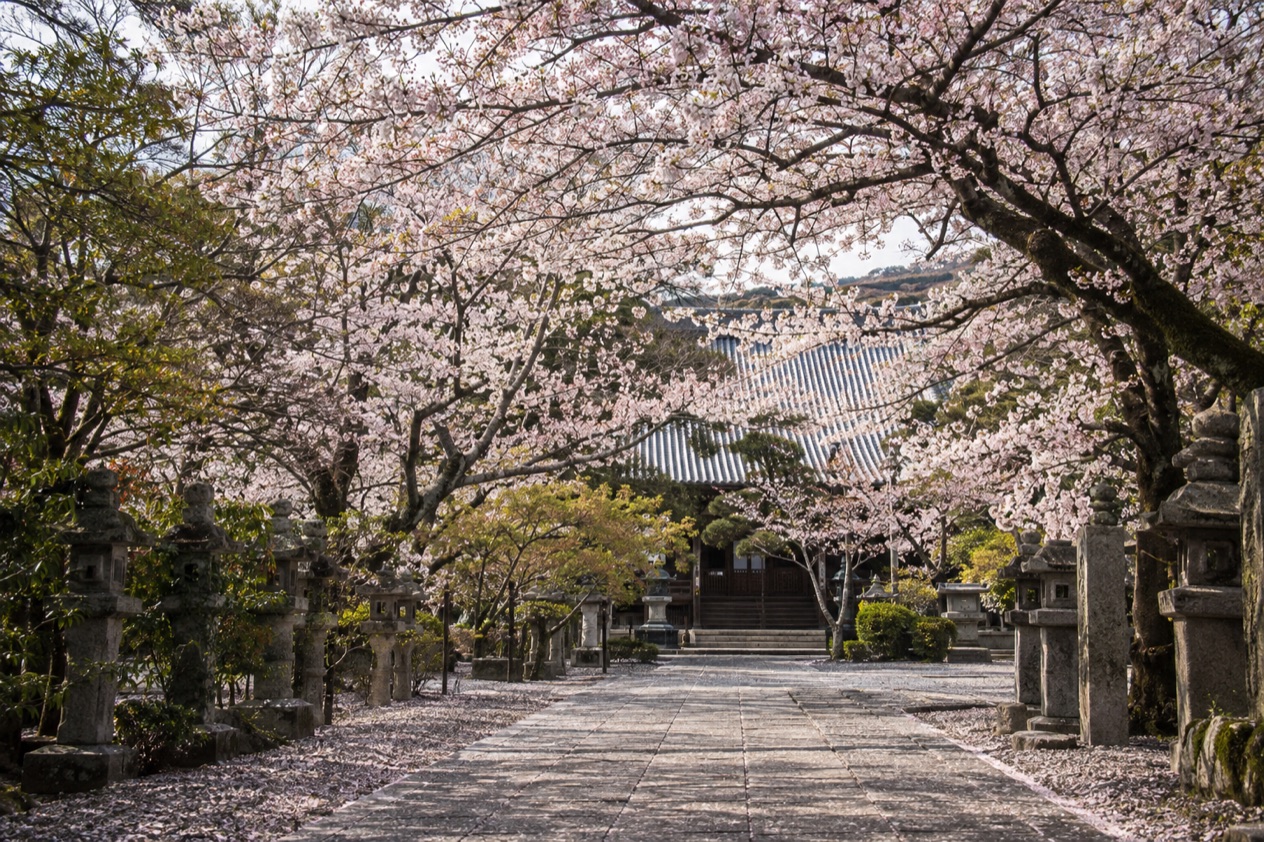
A petal drifts down onto the surface of a castle moat, joins a thousand others, and the water turns pale pink from bank to bank. That is the picture travelers carry when they ask about cherry blossom in Hirosaki, a castle town in western Aomori Prefecture. The blossoms here open in April, later than in Tokyo or Kyoto, and the town is built around the castle grounds where the trees stand.
When do the cherry blossoms bloom in Hirosaki?
Japan’s weather agency has no station in Hirosaki, so the dates below are those of its station at Aomori, the nearest one measured. They are a guide to the season in the same prefecture, not a calendar for the castle trees themselves.
| Stage | Usual date at Aomori | Recent springs |
|---|---|---|
| First bloom (kaika) | April 22 | April 7 to April 17 |
| Full bloom (mankai) | April 26 | April 11 to April 22 |
The usual dates sit in the last third of April. In recent years, though, the flowers have often come earlier than that, and the spread from one spring to the next is wide.
What the two dates mean on the ground
First bloom is the day the first few flowers open on the reference trees. Full bloom is when most of the blossoms are open, and it is the moment people mean when they say the cherry blossoms are at their peak. The gap between the two is short, so a trip planned around the second date has the better chance of catching trees in flower.
After full bloom comes the stage that Japanese writers love as much as the bloom itself. Petals fall in drifts, cover the paths and float on the water. A visit a little after the peak can still be a pink one, only the color has moved from the branches to the ground and the moat.
Why Hirosaki runs later than the big southern cities
Hirosaki sits in the northern Tohoku region of Honshu, and the blossom front reaches it after it has crossed the rest of the main island. Travelers who have already seen the trees in Tokyo or Kyoto in late March can meet them again here weeks later. For anyone who missed the southern bloom, northern Honshu in April offers a second chance.
It also makes Hirosaki a good fit for a longer trip that follows spring northward. The blossoms move through the country like a slow wave, and this town lies near the far end of the main island, so it often comes near the end of the season on Honshu.
Planning around a moving target
Flowers that open early or late are part of the experience, and a cold spell can hold the buds shut for days. The honest approach is to treat the dates above as the middle of a range and keep the schedule flexible.
Locals follow the progress of the blossoms through the daily forecasts, as people do all over Japan, and the talk of the town in April is whether the trees are ahead or behind. That small ritual of watching and waiting is part of why the season feels like an event and not just a view.
Where can you see them in Hirosaki?
The place to see them is the castle grounds, because Hirosaki grew up as a castle town for the Hirosaki Domain, ruled by the Tsugaru clan, and the park around the castle is where the town gathers under the trees. The domain was rated at 100,000 koku, a measure of rice that told you how large a lord’s holding was, and the castle still anchors the town’s image.
Hirosaki Castle and its moats
The castle is surrounded by water, and the cherry trees lean over the moats and the old earthen embankments. Walking the paths beside the water, you see the blossoms from below and reflected beside you. When the petals fall they cover the surface, so the moat becomes a long pink band, and visitors stop on the bridges to look at it.
The grounds are a place for walking slowly and looking in all directions: up at the branches, across at the keep and its stone walls, down at the water. Photographers often come with long lenses and tripods, but a phone is enough to catch the contrast of white castle, dark wood and pale flowers. Plan to spend a good part of the day here, since the park rewards wandering with no fixed route.
Picnics, food stalls and the festival mood
Hanami, the custom of sitting under blooming trees, is at the heart of the season. Groups spread tarps, share bento boxes and drink tea or sake, while stalls sell the usual festival snacks such as grilled skewers, fried dough and sweets on sticks. The mood is relaxed and a little noisy, and it is part of the experience as much as the flowers.
In the evening the park is often lit with lanterns during the blossom season, which turns the same paths into something different. The trees glow against the dark sky and the moat doubles every light. If you want to see both versions of the park, plan a walk by day and a second one after dark.
Apple country around the castle
Hirosaki is the largest producer of apples in Japan, and the orchards are part of the town’s identity. In the cafés and shops you find apple pie, apple juice, cider and sweets made from the local fruit, and they make a good snack between walks in the park. It is a simple pleasure: a slice of pie and a hot drink after an hour under the trees.
The apples themselves are an autumn matter, but the shops that sell their products are open when the blossoms are out, and they make good gifts to take home.
What should you know before you go?
The main thing to know is that Hirosaki is far to the north, so the trip needs a plan for getting to the top of Honshu, and the bloom dates need a flexible schedule. The town lies in western Aomori Prefecture, and the prefecture itself sits at the northernmost tip of the main island.
Getting to the region
From Tokyo, the JR Tohoku Shinkansen runs regular trips to Shin-Aomori, which is the rail route into the prefecture. A second option is the bus: the company Konan runs several day and night buses between Ueno Station in Tokyo and Aomori Station. Both options end at Aomori, so a traveler continues from there toward Hirosaki.
By air, the closest airport to Hirosaki is Aomori Airport, whose code is AOJ. Anyone coming from another part of Japan by plane will land there. The airport, the stations and the town all belong to the same prefecture, so a trip can be built around Aomori as a base for several days.
Reading the dates the right way
The trees in the castle park can open a little before or after the reference trees, so the dates are a starting point. A traveler who follows the news as the season approaches will have a better idea of where things stand than any average can give.
A wise plan is to choose the days around the usual full-bloom date, stay in the area for a few nights and let the flowers decide which day is best for the park. Extra nights also leave room for the evening walk under the lanterns and a slow afternoon in the town’s cafés.
A small town with a long history
Hirosaki is a castle town, so besides the blossoms it offers the pleasures of such towns: old streets, quiet shrines, craft shops and food tied to the region. The Tsugaru clan left its mark on local crafts and customs, and a day spent on those subjects makes a good complement to the hours in the park.
Travelers who arrive with only the blossoms in mind often leave with the apples, the castle and the town’s pace as their favorite memories. A slower trip, with time for the cafés and the side streets, suits a place of this kind.
Good to know before you go
Spring in northern Honshu is a season of changing weather, and the blossoms depend on it, so the schedule should stay loose. The custom of hanami means that the park is also a place to eat and drink outdoors, and it is good manners to take your rubbish with you when you leave. In the end, the trip is about the trees, the moat and a slow afternoon in a castle town, and it can be adjusted day by day as the flowers open.
Sources
- Japan Meteorological Agency, cherry blossom first-bloom dates 2021-2026 and 1991-2020 normal (https://www.data.jma.go.jp/sakura/data/sakura003_07.html), checked October 11, 2026
- Japan Meteorological Agency, cherry blossom full-bloom dates 2021-2026 and 1991-2020 normal (https://www.data.jma.go.jp/sakura/data/sakura004_07.html), checked October 11, 2026
- Japan National Tourism Organization, Aomori (https://www.japan.travel/en/destinations/tohoku/aomori/aomori-city-and-around/), checked October 11, 2026
- Wikipedia, Hirosaki (https://en.wikipedia.org/wiki/Hirosaki), checked October 11, 2026
- Wikivoyage, Hirosaki (https://en.wikivoyage.org/wiki/Hirosaki), checked October 11, 2026
- Japan Meteorological Agency, maple color-change dates 2025-2026 with difference from the 1991-2020 normal (https://www.data.jma.go.jp/sakura/data/phn_014.html), checked October 11, 2026
- Japan Meteorological Agency, biological season observations (https://www.data.jma.go.jp/sakura/data/index.html)
To plan your stay
- Japan Rainy Season (Tsuyu): Dates, Regions and How to Plan Your Trip
- Seasons in Japan: Blossoms, Fall Color, Snow Festivals and Summer Matsuri
- Typhoon Season in Japan: When It Hits, Which Regions Take the Brunt and How the Warning Alerts Work
- Autumn Leaves Dates by City: Usual Maple Dates, 2025 Results and How Much They Shift