
Under the white walls of Himeji Castle, petals drift onto the moat and picnic sheets are spread across the grass, while visitors tip their heads back to look at the keep through the branches. Himeji’s blossom season runs from late March into early April, though it shifts from one spring to the next. The castle is the setting everyone has in mind, and the blooms give its pale roofs a pink frame for a week or two.
When do the cherry blossoms bloom in Himeji?
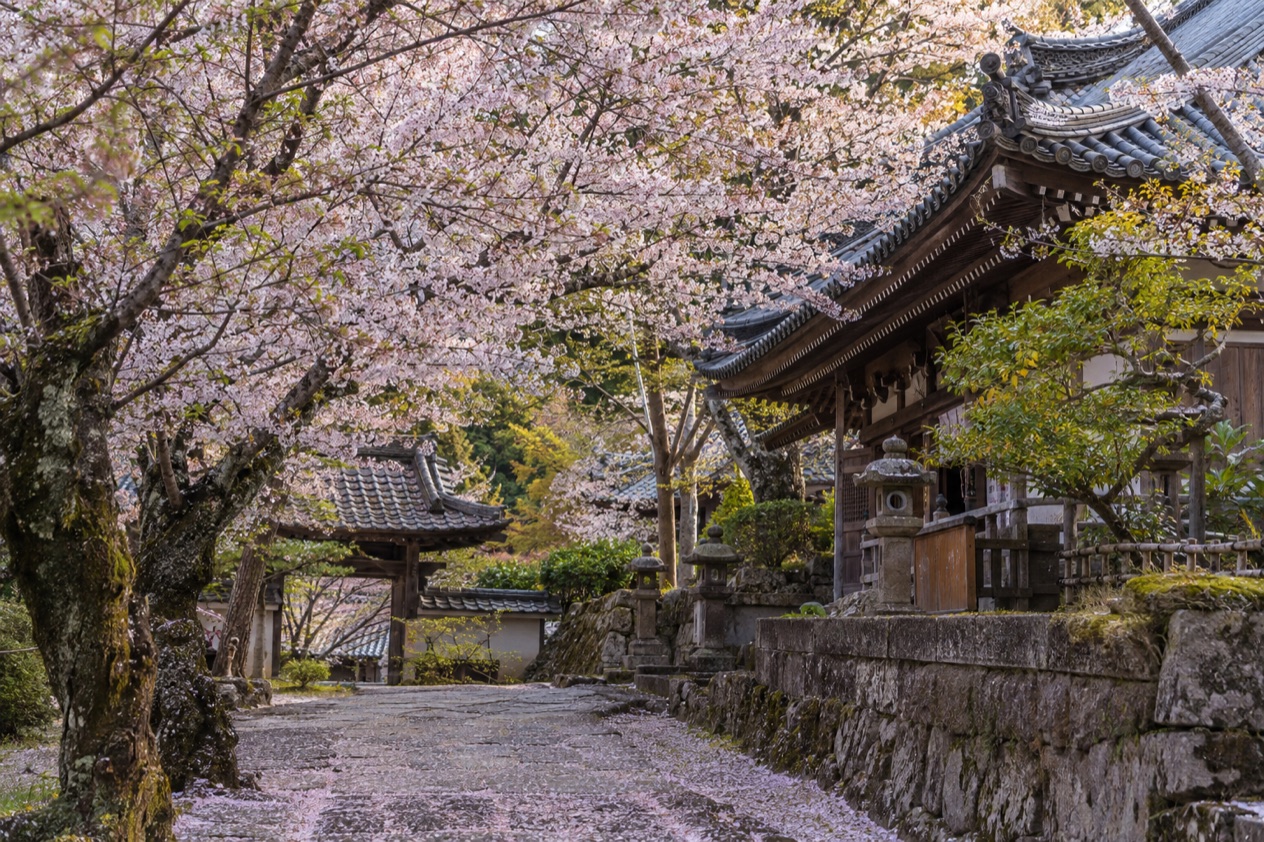
Cherry blossoms in Himeji usually open from late March into early April, with full bloom arriving in the first days of April.
| Stage | Usual date at Kobe | Range in recent years |
|---|---|---|
| First bloom (kaika) | March 27 | March 24 to April 1 |
| Full bloom (mankai) | April 5 | March 30 to April 7 |
What first bloom and full bloom mean
Kaika is the day the first flowers open on the reference trees, and it is the moment the Japanese press starts running blossom maps. Mankai, full bloom, comes when the branches are covered. For a visitor the gap between the two is the stretch when the trees change from a few scattered flowers to a pink cloud, and photographs taken on either side of it look like two different seasons.
After full bloom the petals begin to fall. The Japanese have a word for the moment when a breeze sends them off the branches in drifts, hanafubuki, a blossom blizzard. Petals collect on the water of the castle moat and on the paths, and people find this phase as beautiful as the peak itself.
Why the dates move from year to year
The range in recent years shows how much the season can slide. A warm late winter pulls the flowers forward, and a cold snap in March holds them back. Between the earliest first bloom and the latest full bloom in that range lies about two weeks, so a trip planned around a single date is a bet.
Travelers who want to catch the trees in flower tend to plan a window instead of a day. Staying in the area across the turn from March to April gives the best odds, and the local news and the agency’s bloom updates, which Japanese media repeat each spring, tell you where the season stands once you arrive.
What the weeks around the bloom feel like
Spring in the Kansai region is a season of lengthening light and changeable days, and the blossom weeks are when the whole country seems to move outdoors. Offices and families stake out spots under the trees for hanami, the flower-viewing party built around bento boxes, snacks and drinks. Food stalls and seasonal sweets appear, and pink sakura flavors turn up on shop shelves, from rice cakes wrapped in a salted cherry leaf to seasonal drinks.
Because the castle sits at the center of the city, a blossom day in Himeji becomes a city-wide mood more than a single outing. The trees along the approach streets and around the moat are part of an ordinary spring walk, and even a coffee stop can come with a view of the keep.
Where can you see them in Himeji?
The castle is both a Japanese national treasure and a UNESCO World Heritage site, and its pale walls and layered roofs give the blossoms a backdrop that few places in Japan can match.
The castle grounds
Himeji Castle dates back more than 400 years and is one of the 12 original castles in Japan. It has been spared for four centuries from war, earthquakes and fires, and that survival is part of the sight: you are looking at a keep that has stood through all of it. Its white plaster has earned it the nickname Shirasagi-jo, the White Heron Castle, and in spring the pink of the trees sits against that whiteness.
Walk the grounds slowly and the view keeps changing. Branches frame the keep from the broad open ground at the foot of the castle, from the paths that climb between the gates, and from the stone walls above the water. The castle layout is a maze of gates and turns, so the keep disappears and reappears behind the blossoms as you move.
Around the moat and the approach streets
Outside the walls, the moat gives a second way to see the trees, with branches hanging over the water and petals collecting on its surface once the flowers begin to fall. Walking the outer edge shows the castle at a distance, with the keep rising behind the blossoms, a different picture from the close-up views inside the gates.
The streets that lead toward the castle from the station make up the third viewing area. They are an ordinary part of the city, with shops, cafés and traffic, and in the blossom weeks the castle sits at the end of the street like a destination announced from far away. It is a good way to arrive, with the keep growing larger as you walk.
Gardens and picnic spots near the castle
Himeji’s castle area includes gardens in the Japanese style, with ponds, stone lanterns and clipped pines, and in spring they offer a quieter way to take in the season than the main grounds. A garden is a place to linger, with the keep appearing over a hedge or across a pond as part of a composed view.
Open grass around the castle suits the hanami habit of sitting under the trees with food. People lay out sheets, unpack bento and watch the petals fall. If you prefer to eat and drink in the Japanese way, a convenience store or station shop will have seasonal sweets and rice balls to carry with you.
What should you know before you go?
Before you go, know that Himeji lies about 1.5 hours west of Osaka by train, that the castle keeps set hours, and that entry to its main keep is capped each day. Those three points shape a blossom visit more than anything else.
Castle hours and closing days
| Site | Open | Last admission |
|---|---|---|
| Himeji Castle (September to April) | Daily, 09:00 to 17:00 | 16:00 |
| Himeji Castle (May to August) | Daily, 09:00 to 18:00 | 17:00 |
| Himeji Castle closing days | December 29 to 31 | None |
Blossom season falls within the first row of that table, which means the castle closes its gates in the late afternoon and the last admission comes a full hour earlier. A walk through the grounds therefore fits best into the middle of the day, with enough slack to reach the keep before admission ends.
The limit on the main keep
Himeji Castle limits entry to the main keep to the first 15,000 visitors each day. Blossom weeks are when people want to come, so it is worth knowing that the keep itself, the tall white tower at the center of the complex, is not guaranteed to every visitor who walks through the gate.
If the keep matters to you, plan the castle for a time when you can reach it comfortably. The grounds, the moat and the surrounding views are there to enjoy in any case, and the blossoms do not depend on entering the tower.
Getting to Himeji from Osaka
Himeji is about 1.5 hours west of Osaka by train, which puts it within reach of a day away from a base in the Kansai region. That makes it a natural pairing with a stay in Osaka or Kyoto, with the castle and the blossoms as the destination of the day.
Because the bloom shifts from year to year, a flexible plan works well here. If the trees in Osaka or Kyoto are already open or just ahead of Kobe’s dates, that is a hint about where the season stands, and a visit to Himeji can be set for the days when the flowers look right.
A city beyond the castle
Himeji is a full city, spread over a wide area, and the castle is only one part of it. The streets near the station have shops and places to eat, and a blossom day can be built around a walk to the castle, time in the grounds and a meal in town afterward.
Local cooking is part of the visit, and a meal in the arcades near the station fills the gap between the castle and the train home. Seasonal spring sweets, often flavored with cherry blossom, are an easy way to take the season with you.
Good to know before you go
A blossom trip to Himeji works best held loosely: the trees follow their own calendar, and a day or two of slack around the turn from March to April lets you see them at their fullest. Cards and cash both matter in Japan, and a few coins make small purchases at stalls and shops simpler.
Sources
- Japan Meteorological Agency, cherry blossom first-bloom dates 2021-2026 and 1991-2020 normal (https://www.data.jma.go.jp/sakura/data/sakura003_07.html), checked October 11, 2026
- Japan Meteorological Agency, cherry blossom full-bloom dates 2021-2026 and 1991-2020 normal (https://www.data.jma.go.jp/sakura/data/sakura004_07.html), checked October 11, 2026
- Japan National Tourism Organization, Himeji (https://www.japan.travel/en/destinations/kansai/hyogo/himeji-and-around/), checked October 11, 2026
- Wikipedia, Himeji (https://en.wikipedia.org/wiki/Himeji), checked October 11, 2026
- Wikivoyage, Himeji (https://en.wikivoyage.org/wiki/Himeji), checked October 11, 2026
- Japan Meteorological Agency, maple color-change dates 2025-2026 with difference from the 1991-2020 normal (https://www.data.jma.go.jp/sakura/data/phn_014.html), checked October 11, 2026
- Japan Meteorological Agency, biological season observations (https://www.data.jma.go.jp/sakura/data/index.html)
To plan your stay
- Japan Rainy Season (Tsuyu): Dates, Regions and How to Plan Your Trip
- Seasons in Japan: Blossoms, Fall Color, Snow Festivals and Summer Matsuri
- Typhoon Season in Japan: When It Hits, Which Regions Take the Brunt and How the Warning Alerts Work
- Autumn Leaves Dates by City: Usual Maple Dates, 2025 Results and How Much They Shift