
Spread a blue tarp under a tree, pass around the bento and the canned tea, and look up: that is hanami, and in Fukuoka it begins when the first pink buds crack open along the park paths. The city on Kyushu’s north coast sees its blossoms arrive in late March, a little before the season reaches much of the country. For a traveler fitting a spring trip around the flowers, the date to aim for is the very end of March, with room on either side.
When do the cherry blossoms bloom in Fukuoka?
Cherry blossoms in Fukuoka usually open in the second half of March, and the trees are in full bloom around the turn from March to April.
| Stage | Usual date | Dates in recent years |
|---|---|---|
| First bloom (kaika) | March 22 | March 12 to March 27 |
| Full bloom (mankai) | March 31 | March 22 to April 3 |
First bloom and full bloom, in plain terms
Kaika, the first bloom, is the day the first blossoms open on the reference tree. It is a quiet start: a few branches show pink while the rest of the tree still looks bare. Mankai, full bloom, comes about nine days later by the usual dates, when most of the blossoms are open and the branches look heavy and pale.
Japanese spring conversation runs on these two words. Television weather segments, newspapers and park noticeboards all talk about whether the trees have reached kaika or mankai, and the same vocabulary will help you read local updates once you arrive.
Why the dates move from one spring to the next
The usual dates are an average, and the real bloom wanders around them. In recent years the first flowers have appeared well before the middle of the usual window in some springs and nearly at the end of March in others. Full bloom has stretched from the last third of March into the first days of April.
The practical meaning is simple. A trip in the final week of March sits close to the center of the likely full bloom, while a trip in the first days of April may catch the trees at their fullest in a late year or already shedding petals in an early one. Trips in mid-March can find only the first flowers, or nothing yet.
What the petals do after full bloom
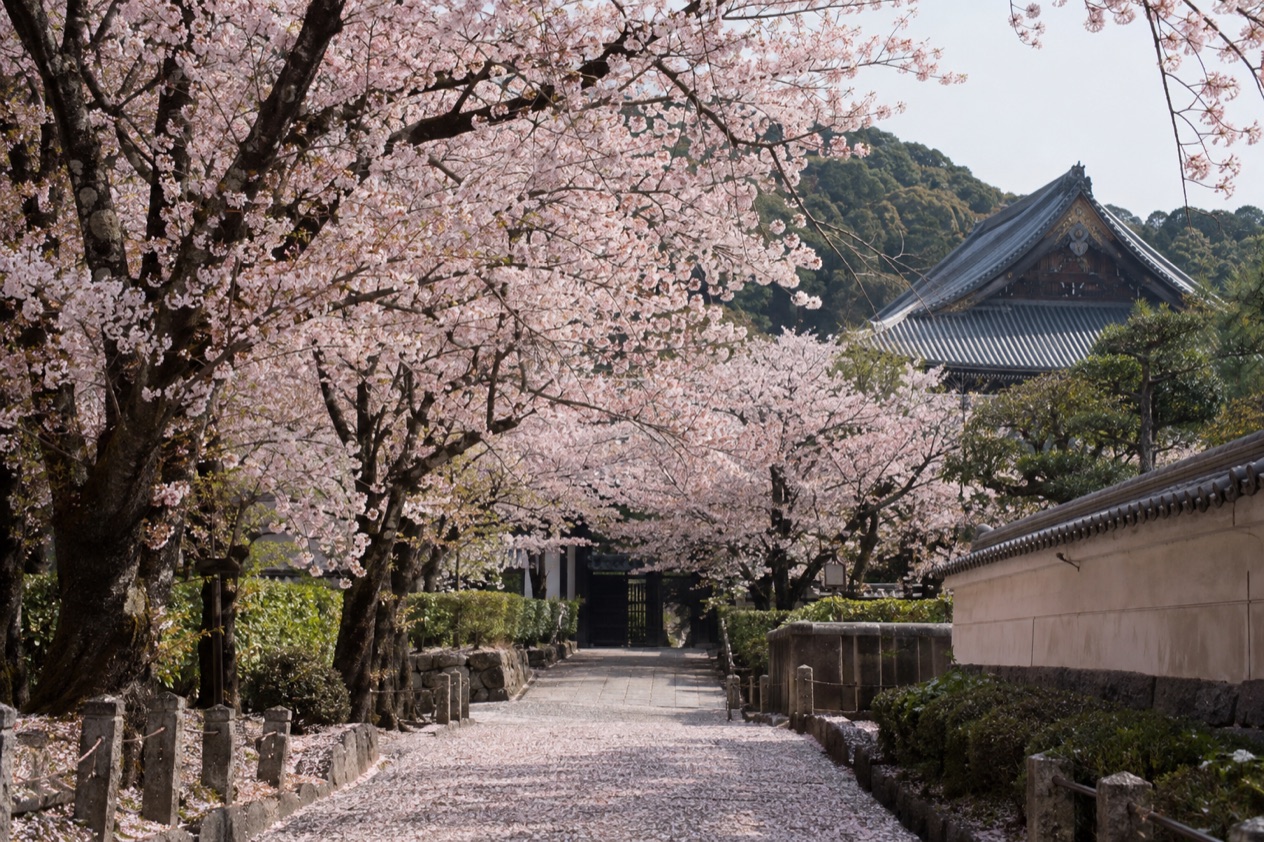
Once full bloom passes, the blossoms do not vanish overnight. Petals begin to loosen and drift down with every gust of wind, a scene the Japanese call hanafubuki, a blossom blizzard. Paths turn pink, the surface of a pond fills with floating petals, and people find this stage as moving as the peak itself.
Fresh green leaves then start to push through the thinning flowers. If your dates fall a few days after the usual full bloom, you are likely to see this softer, scattering stage rather than a tree at its fullest.
Where can you see them in Fukuoka?
Fukuoka’s blossom viewing happens mostly in its city parks, and Ohori Park, built around a large pond, is the one to put at the top of the list.
Ohori Park
Ohori Park is organized around its pond, and the walk around the water is where the trees do their work. Branches lean over the path and the reflections double the pink in the pond, so you can see the blossoms from the path, from the water’s edge and from the small bridges that cross it.
The art gallery in the park gives you a place to step in between walks, which suits a day when the sky turns gray. Pair a loop of the pond with a coffee or a snack from a nearby stand, and let the weather decide how long you stay outside. Cherry trees in a park of this kind tend to be spread along the shore rather than gathered in one grove, so the best view is often the one you find by walking on.
Other parks for a blossom picnic
Beyond Ohori Park, Fukuoka’s other large parks, among them Maizuru Park, set around the remains of a castle, and Nishi Park, on a hill, are the kinds of places where residents lay out their tarps in spring. Neither is covered by a fact on our list, so treat them as names to look up on the day, once the local bloom reports tell you how far the trees have opened.
What you find in such parks follows a familiar pattern: groups of coworkers and friends sitting on plastic sheets, food and drinks spread out between them, and trees overhead. Some people come for a lunch, others stay on into the evening. Joining in is a matter of finding a free corner and enjoying the same view.
Blossoms and the city’s food culture
Fukuoka is a city that people visit for what they eat. It was selected in the Food category of Lonely Planet’s Best In Travel, and the yatai, the open-air food stalls of Hakata, were chosen for The New York Times’ list of places to go. A blossom day in Fukuoka fits naturally with a meal built around them.
After a day beneath the trees, the stalls are a natural place to continue. A spring day can end up with both.
What should you know before you go?
The main thing to know is that the blossoms keep their own schedule, so the best preparation is a flexible plan built around the end of March. Fukuoka is a port city on the north coast of Kyushu, the third largest island of Japan, and it works well as a base for a trip that has the blossoms as one goal among several.
Plan around a window, not a day
Because first bloom has fallen anywhere from mid-March to the end of the month in recent years, a trip is best built around a window of several days on either side of the usual full bloom. That gives you the best chance of seeing open flowers, and it leaves room to move your outdoor time to the sunniest day.
If you are watching the calendar, it helps to keep an eye on local bloom reports in the weeks before you leave. Japanese media report the opening of each city’s trees as it happens, and Fukuoka’s observation point is among those that get named. Treat the usual dates as a guide, and the reports as the confirmation.
Where Fukuoka sits on a Japan itinerary
Fukuoka lies 684 miles from Tokyo, so it is a destination in its own right and not a side trip. It is also the Japanese city near the Asian mainland: Busan in South Korea is the nearest overseas region, 112 miles away, and the city has exchanged culture with the continent throughout its history. That shows in its food, its port and its outward-looking character.
The city has also been described as the fastest-growing in Japan in terms of population, which gives it a lively, youthful feel on a spring evening, when people spill out of offices and into the parks and streets.
Hanami habits
Blossom viewing comes with a few habits worth knowing. People sit on a sheet spread on the ground, shoes come off before stepping on it, and food and drink are shared among the group. People bring their own rubbish bags and take everything away with them afterward, leaving the grass as they found it.
Branches are for looking at, not for pulling down or shaking for photographs, and the trees are not for climbing.
Good to know before you go
Spring days in a blossom season can shift between sun and cloud, so plan the park hours loosely and keep the museum and the food stalls as the alternatives. The blossoms last only a short time, which is part of why they matter so much to people in Japan. When the petals begin to fall, the last day of a trip is often better spent in a park than anywhere else, taking in the scattered pink on the ground and on the water.
Sources
- Japan Meteorological Agency, cherry blossom first-bloom dates 2021-2026 and 1991-2020 normal (https://www.data.jma.go.jp/sakura/data/sakura003_07.html), checked October 11, 2026
- Japan Meteorological Agency, cherry blossom full-bloom dates 2021-2026 and 1991-2020 normal (https://www.data.jma.go.jp/sakura/data/sakura004_07.html), checked October 11, 2026
- Japan National Tourism Organization, Fukuoka (https://www.japan.travel/en/destinations/kyushu/fukuoka/fukuoka-city/), checked October 11, 2026
- Fukuoka City official tourist guide (https://yokanavi.com/en/), checked October 11, 2026
- Wikipedia, Fukuoka (https://en.wikipedia.org/wiki/Fukuoka), checked October 11, 2026
- Japan Meteorological Agency, maple color-change dates 2025-2026 with difference from the 1991-2020 normal (https://www.data.jma.go.jp/sakura/data/phn_014.html), checked October 11, 2026
To plan your stay
- Japan Rainy Season (Tsuyu): Dates, Regions and How to Plan Your Trip
- Seasons in Japan: Blossoms, Fall Color, Snow Festivals and Summer Matsuri
- Typhoon Season in Japan: When It Hits, Which Regions Take the Brunt and How the Warning Alerts Work
- Autumn Leaves Dates by City: Usual Maple Dates, 2025 Results and How Much They Shift