
Somewhere in the weeks before a spring trip, someone opens a calendar, looks at a flight to Tokyo and wonders whether the trees will be in flower when the plane lands. Japan’s cherry blossoms do not open everywhere at once. They move across the country over many weeks, so the date depends on the city, and the average dates below give you a place to start.
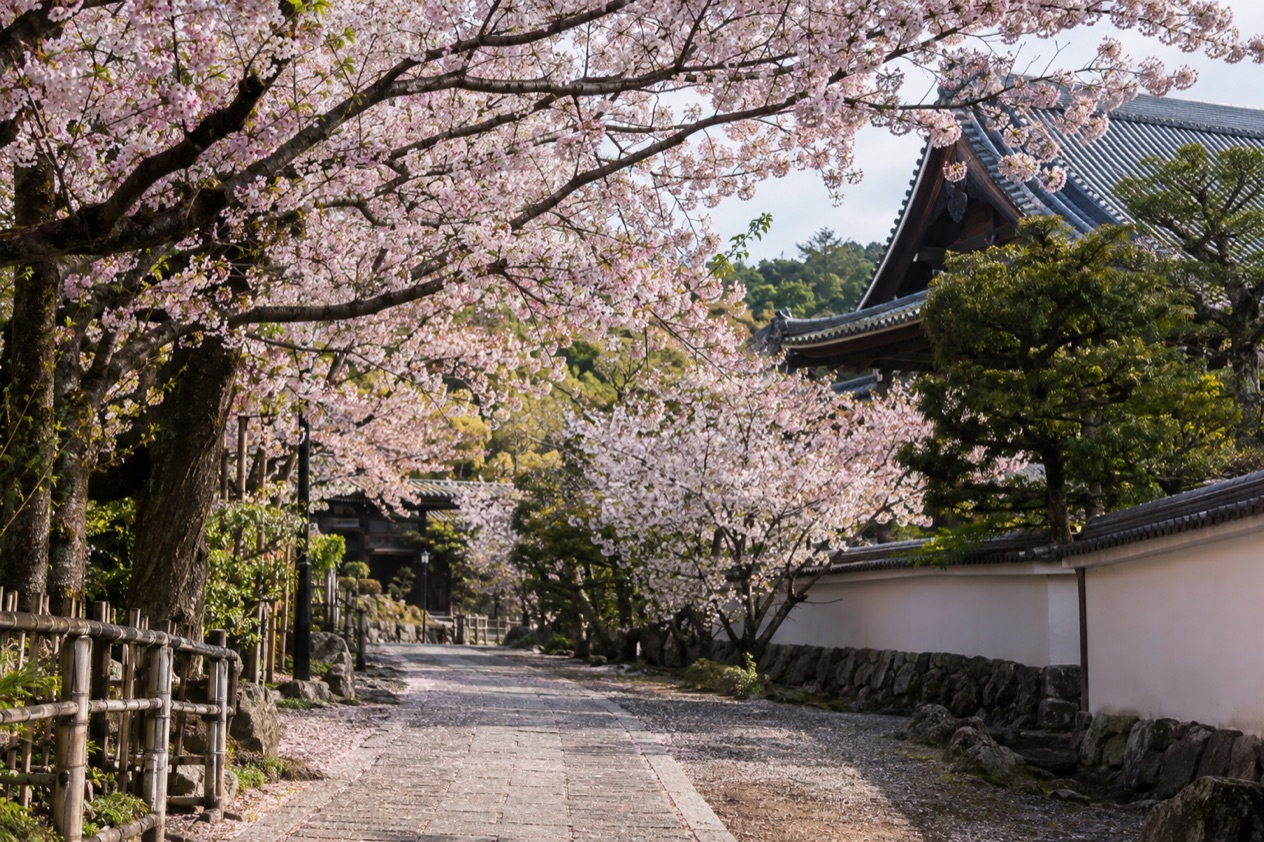
When do cherry blossoms bloom in each Japanese city?
Cherry blossoms bloom first in the south and then work their way up the country, so each city has its own moment, from late March in the big cities of the main island to early May in Hokkaido.
Two moments are tracked. The first is kaika, first bloom, the day on which five or six or more flowers are open on a sample tree. The second is mankai, full bloom, the first day on which about 80 percent or more of the buds are open.
The tree observed is mainly the Somei-Yoshino, the pale pink variety that most people picture. Where it does not grow, the agency watches the Hikan-zakura in Okinawa and Amami and the Ezo-yamazakura in Hokkaido.
Kyushu, western Honshu and the Kansai cities
Fukuoka, Hiroshima and Kagoshima open in the last third of March, with full bloom arriving in the final days of March or the first week of April. Kyoto, Osaka, Nara and Kobe follow almost together. In all four, first bloom comes in the last days of March and full bloom lands in the first days of April.
That closeness is useful if you are building a trip around the Kansai region. The trees in Kyoto, Osaka, Nara and Kobe peak within a day or two of each other on average, so a single stretch of days can take in the temple lanes, the castle grounds and the riverbanks while the petals are still on the branches. Hiroshima sits a little ahead of them, and Kagoshima a little behind its own first bloom, with full bloom in the first week of April.
Tokyo, Yokohama and Nagoya
Tokyo is among the earliest of the big cities. First bloom comes in the last week of March and full bloom follows about a week later, at the very end of the month. Yokohama is a day or so behind Tokyo, and Nagoya reaches full bloom in the first days of April.
In practice this is the stretch when parks fill with people sitting on tarps under the trees, a custom called hanami, flower viewing. Evenings bring yozakura, night blossom viewing, with lanterns and lights strung beside the water. Rivers, moats and castle grounds all become places to sit, snack and look up.
Kanazawa, Nagano and Sendai
Moving inland and up the main island, the blossoms arrive later. The Somei-Yoshino reach Hokuriku and the southern Tohoku region around April 10 on average. Kanazawa opens in the first days of April, and full bloom comes about five days after that. Sendai and Nagano follow in the second week of April, with full bloom in the middle of the month.
A trip that starts in Tokyo at the end of March and ends in one of these cities in mid-April can see the blossoms twice. That works because the season keeps moving north rather than ending.
Aomori, Hakodate and Sapporo
Northern Tohoku and Hokkaido bloom at the end of the line. Aomori opens in the second half of April. Hakodate comes a few days later, and Sapporo arrives in early May, with full bloom in the first week of that month. Across the north, the trees reach northern and eastern Hokkaido in mid-May.
In Hokkaido the species is the Ezo-yamazakura where the Somei-Yoshino does not grow, so the blossoms are a little different from those farther south. Travelers who arrive in Japan too late for the main island can still find cherry trees in flower in these northern cities in the weeks that follow.
Okinawa and Amami
The calendar starts far earlier in Okinawa and Amami. The Hikan-zakura begin to bloom there around mid-January, with deeper pink flowers than the Somei-Yoshino. That is a different event from the spring wave of the main islands, and it comes while the rest of the country is still in winter.
What are the average dates?
The average dates fall between late March and early May, with the big cities of the main island clustered around the turn of March into April. The table lists each city by its date of full bloom, from the earliest to the latest.
| City | Average first bloom | Average full bloom |
|---|---|---|
| Fukuoka | March 22 | March 31 |
| Tokyo | March 24 | March 31 |
| Yokohama | March 25 | April 1 |
| Nagoya | March 24 | April 2 |
| Hiroshima | March 25 | April 3 |
| Kyoto | March 26 | April 4 |
| Osaka | March 27 | April 4 |
| Nara | March 28 | April 4 |
| Kagoshima | March 26 | April 5 |
| Kobe | March 27 | April 5 |
| Kanazawa | April 3 | April 8 |
| Sendai | April 8 | April 13 |
| Nagano | April 11 | April 16 |
| Aomori | April 22 | April 26 |
| Hakodate | April 28 | May 2 |
| Sapporo | May 1 | May 6 |
Full bloom follows first bloom by a few days to about a week in most of these cities. Tokyo and Fukuoka share the same date for full bloom, even though Fukuoka opens first.
How to use the dates
Pick the city you care about most and look at its full bloom date, since that is when the trees are at their fullest. The first bloom date tells you when the first flowers appear, and the days between the two are when the blossoms are still filling in. Petals do not hold forever, so the days that follow full bloom are the ones when the ground may turn pink with fallen petals, a sight the Japanese call hanafubuki, a blizzard of blossoms.
If your route covers several cities, the table lets you sequence them. A path that begins in Fukuoka or Hiroshima, passes through Kyoto and Osaka and ends in Tokyo or Kanazawa stays within a few weeks of blossom, since the later cities open as the earlier ones fade. The date for Sendai and beyond only makes sense for a trip that runs into mid-April or later.
Cities with no date in the records
Places not in the table, such as small towns, mountain villages and individual parks, get no date here. Elevation and local conditions change the timing, and a famous viewing spot can bloom days away from the city it belongs to. For these places, use the date of the nearest city in the table as a rough guide and expect some difference.
How much do they vary?
They vary quite a bit from one spring to the next, often by two or three weeks for first bloom in a single city, so an average date is a center point and not a schedule.
| City | First bloom in recent years | Full bloom in recent years |
|---|---|---|
| Fukuoka | March 12 to March 27 | March 22 to April 3 |
| Tokyo | March 14 to March 29 | March 22 to April 4 |
| Yokohama | March 15 to April 1 | March 25 to April 7 |
| Nagoya | March 17 to March 28 | March 27 to April 7 |
| Hiroshima | March 11 to March 26 | March 25 to April 5 |
| Kyoto | March 16 to March 29 | March 24 to April 5 |
| Osaka | March 19 to March 30 | March 27 to April 6 |
| Nara | March 20 to March 31 | March 27 to April 8 |
| Kagoshima | March 17 to March 29 | March 30 to April 12 |
| Kobe | March 24 to April 1 | March 30 to April 7 |
| Kanazawa | March 23 to April 1 | March 29 to April 8 |
| Sendai | March 26 to April 8 | March 31 to April 11 |
| Nagano | March 28 to April 9 | April 1 to April 13 |
| Aomori | April 7 to April 17 | April 11 to April 22 |
| Hakodate | April 14 to April 23 | April 20 to April 28 |
| Sapporo | April 15 to April 23 | April 21 to April 27 |
The pattern is that recent springs have often opened ahead of the average dates. In Aomori, Hakodate and Sapporo the earliest recent blooms came well before the averages in the earlier table. Springs also run late in some years, so the range goes both ways, and Kobe and Kagoshima show later ends than the average would suggest.
Why the dates move
Cherry trees respond to the weather of the weeks before they flower, so a warm late winter pulls the dates forward and a cold snap holds the buds back. That is why first bloom in a city such as Tokyo can land in the middle of March in one spring and at the end of the month in the next. The length of the bloom is also affected by wind and rain, which bring the petals down sooner.
The gap between first bloom and full bloom also changes. In some years the trees go from first flowers to full bloom within a few days, while in others they open slowly over more than a week. A trip with a fixed date cannot control any of this, which is why a range is more honest than a single day.
Planning around the range
If the dates of your trip are fixed, look at the range for the cities you will visit and see how much of it your days cover. A visit to Kyoto or Osaka in the first days of April sits inside the range for full bloom in both. A visit in the middle of March sits before the range, and a visit late in April falls after it, though the northern cities are then in season.
If you have room to choose, a route that moves from one region to the next gives you more than one chance. Because the wave travels north over several weeks, a city that is early in one spring can be matched by the next city on the line.
Good to know before you go
From December to June the Japan Meteorological Agency updates the current year’s flowering and full bloom status three times a day, so the average dates here can be checked against what the trees are doing in the weeks before departure. Sample trees are designated for each city, and many of the observations are carried out with citizen surveyors, which is why the dates refer to specific trees and not to every tree in town.
Sources
- Japan Meteorological Agency, cherry blossom first-bloom dates 2021-2026 and 1991-2020 normal (https://www.data.jma.go.jp/sakura/data/sakura003_07.html), checked October 11, 2026
- Japan Meteorological Agency, cherry blossom full-bloom dates 2021-2026 and 1991-2020 normal (https://www.data.jma.go.jp/sakura/data/sakura004_07.html), checked October 11, 2026
- Japan Meteorological Agency, sakura2020.pdf (https://www.data.jma.go.jp/sakura/data/sakura2020.pdf), checked October 11, 2026
- Japan Meteorological Agency, biological season observations (cherry blossom and autumn leaves) (https://www.data.jma.go.jp/sakura/data/index.html), checked October 11, 2026
To plan your stay
- Japan Rainy Season (Tsuyu): Dates, Regions and How to Plan Your Trip
- Seasons in Japan: Blossoms, Fall Color, Snow Festivals and Summer Matsuri
- Typhoon Season in Japan: When It Hits, Which Regions Take the Brunt and How the Warning Alerts Work
- Autumn Leaves Dates by City: Usual Maple Dates, 2025 Results and How Much They Shift