
On a late-autumn afternoon in Tokyo, ginkgo leaves drift onto the pavement in drifts of yellow, and a garden pond holds the reflection of a maple gone deep red. Office workers stop mid-stride to photograph a single branch. The leaves here come late, around the end of November, and the city rewards anyone who plans a few slow walks in parks, shrine grounds and old strolling gardens around that time.
When do the leaves change color in Tokyo?
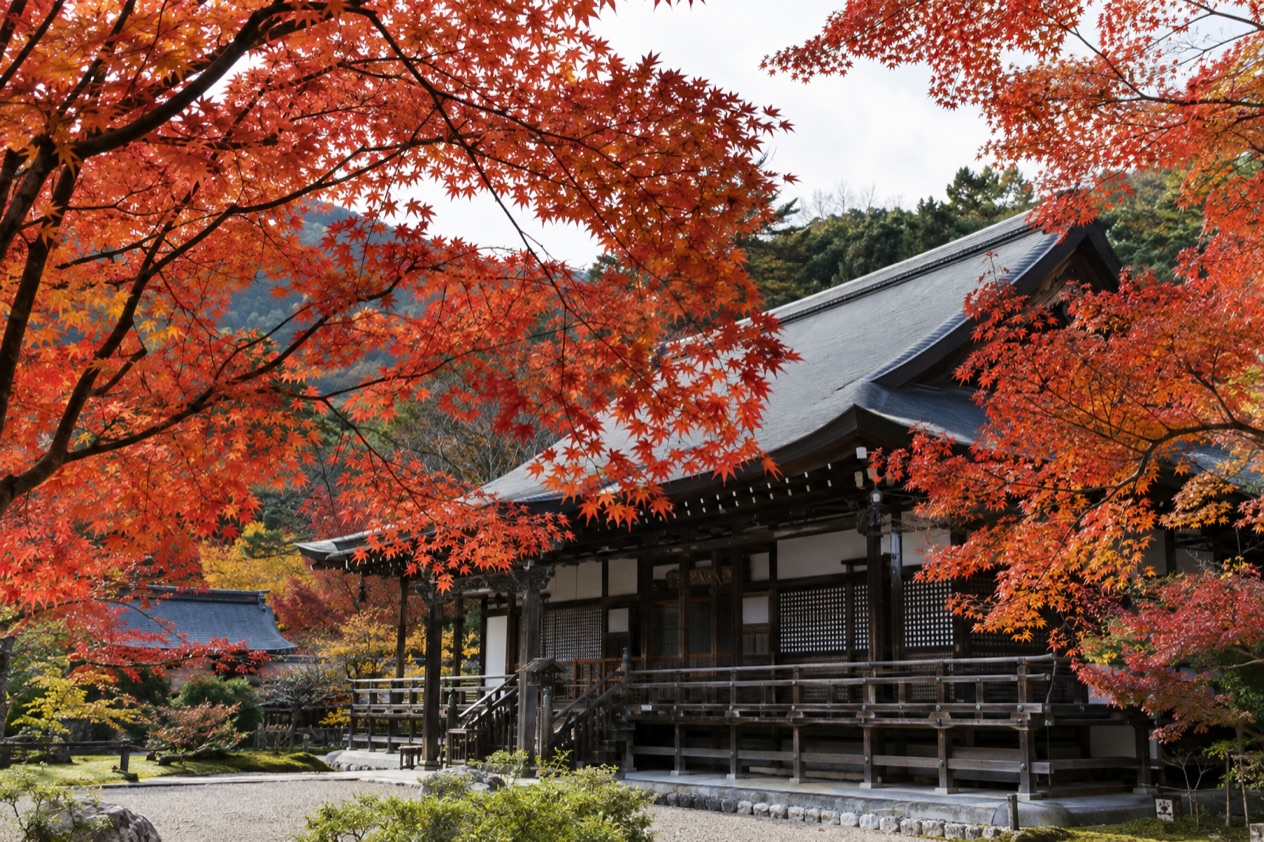
Tokyo’s maples usually change color around the end of November, later than travelers expect from a city this far south on Honshu. The Japanese term is kaede kōyō, literally the reddening of maple leaves, and the Japan Meteorological Agency tracks it at its Tokyo station by recording the day the leaves are judged to have turned.
| Maple color change in Tokyo | Date |
|---|---|
| Usual date | November 28 |
| Observed in 2025 | November 23 |
The usual date is a point of reference, not a promise. Plan around the last week of November and treat the days on either side as part of the same window.
What the date actually marks
The color change date is the moment the first maples show their autumn color, so it is the start of the show rather than the peak. In the days after it, more trees follow, and the red deepens branch by branch. That is why a walk in the first days of December can still feel like the heart of the season in a garden full of maples.
Maples are not the only trees that count. Each species keeps its own rhythm, so the city is a patchwork of colors rather than a single moment.
How to plan around the dates
Think in terms of a stretch of days rather than a single date. If your trip falls in the final days of November or the first days of December, you are in the range where Tokyo’s maples are most likely to be in color. Earlier in November you may find green and early yellow, and the best you can hope for is a few trees ahead of the rest.
Because the season is close to the usual date from one year to the next but never identical, it helps to stay flexible. Keep a couple of free half days in the schedule so that you can shift a garden visit toward the day the trees look their fullest rather than locking it to a single slot.
Why Tokyo’s autumn comes late
Tokyo sits on Tokyo Bay in the Kanto region, and the city’s built-up streets hold on to warmth. The result is a color season that lands at the very end of November, when a traveler arriving from the mountains or from farther north may already have seen leaves fall. In Tokyo the red arrives as the year turns toward winter, and the evening light is already low by the time the garden gates close.
This lateness has a pleasant side effect. Seasonal food is at its height as the leaves turn: roasted chestnuts, sweet potatoes baked in stones, persimmons stacked in shop windows and wagashi, the delicate sweets shaped like maple leaves, appear in department store food halls and traditional confectioners across the city.
Where can you see them in Tokyo?
You can see autumn leaves in Tokyo’s landscape gardens, its large city parks, its shrine grounds and along its ginkgo-lined avenues, and the choice depends on whether you want maples around a pond or a tunnel of yellow overhead. Each of these places looks different, and a good plan mixes two of them rather than repeating the same kind of scene.
Landscape gardens
Tokyo’s old strolling gardens were designed with seasons in mind, and autumn is one of the moments they were built for. Rikugien and Koishikawa Korakuen are laid out around ponds, with paths that wind past islands, stone lanterns and arched bridges. Maples are planted so that their color doubles in the water, and the paths are made for walking slowly and stopping at each turn.
Hamarikyu Gardens, beside Tokyo Bay, adds a different note, with tidal ponds and a tea house over the water. In every one of these gardens, the pleasure is in the composition: a red maple against a dark pine, fallen leaves floating on the surface, a moss-covered bank dotted with orange.
Big parks and shrine grounds
Shinjuku Gyoen is a wide park of lawns, a Japanese garden and tree-lined paths, and in autumn its different sections show different leaves, from maples to plane trees. Ueno Park, with its temples, shrines and museums, has avenues where leaves fall in thick layers beside the paths, and Meiji Jingu, the forested shrine, gives a different mood, with leaves turning inside a deep woodland setting.
These places suit a day with no fixed plan. Walk, sit on a bench, buy a warm drink and let the leaves be the destination. A shrine visit pairs naturally with the season, since the buildings are often framed by maples, and the contrast between vermilion woodwork and red leaves is part of the scene.
Ginkgo avenues and city streets
The ginkgo avenue at Meiji Jingu Gaien is the classic yellow tunnel of Tokyo autumn, with rows of trees forming a golden canopy and a carpet of fan-shaped leaves underfoot. Ginkgo trees line many other streets across the city, so even a walk between shops can turn into a leaf-viewing moment.
In districts such as Ginza, an upscale area of luxury shops and high-end restaurants, and Nihonbashi, known for its heritage and its role as Japan’s main financial district, autumn shows up in seasonal window displays and menus as much as in trees. Roppongi and Akasaka are further city districts where a stroll between meals can include a few colored branches.
What should you know before you go?
The most useful thing to know is that Tokyo’s color season is short and centers on the end of November, so your dates matter more than any other choice. Beyond timing, a few habits make the days smoother: how to base yourself, how to combine garden visits with meals, and how to get to the city.
Arriving and choosing a base
Tokyo is served by two airports, Haneda, officially Tokyo International Airport, and Narita, Japan’s largest international airport. Either one puts you within reach of the city’s parks and gardens once you are in town. Tokyo is the capital of Japan and the most populous metropolitan area in the world, so the city rewards choosing a base close to where you plan to spend most of your time.
Roppongi and Akasaka make a practical base for a leaf-viewing trip, since Roppongi Station is served by the Tokyo Metro Hibiya Line and the Toei Oedo Line, Nogizaka Station by the Chiyoda Line, and Roppongi-Itchome Station by the Namboku Line. From Shibuya Station, the districts can be reached in about 10 minutes by train.
Building a day around the leaves
A good leaf-viewing day in Tokyo pairs one garden with one meal and one wander. Start with a strolling garden, then break for a bowl of noodles or a set lunch, and finish in a district with shops and cafés. The mix keeps the day varied and lets the leaves be the thread rather than the whole program.
If you want a longer outing, look beyond the city center to hills on the edge of the metropolitan area, where hiking trails climb through autumn forest. Wherever you go, a camera or phone is part of the kit, because the light on wet leaves and the reflections in ponds are a large part of the pleasure.
Autumn with food and warm drinks
Autumn in Tokyo is a season for eating. Look for kuri (chestnut) in sweets and rice dishes, satsumaimo (sweet potato) baked or turned into cakes, kaki (persimmon) sold by the piece and matsutake mushrooms in refined restaurant menus. Teahouses in garden settings serve matcha with seasonal sweets, and the combination of warm tea and falling leaves is one of the quiet rituals of the season.
Izakaya, the casual Japanese pubs, bring out seasonal specialties too, including grilled fish and hot pots. A late afternoon in a garden followed by an evening in a lantern-lit izakaya is a combination that fits the end of November.
Good to know before you go
Since the color season sits so close to the end of November, flexibility is worth more than any other precaution. Leave a few open half days, keep indoor options such as museums and department store food halls in your back pocket for gray days, and let the leaves shape your route rather than the other way around. Tokyo rewards walking, so comfortable shoes and a willingness to wander into a side street are the best companions in this season.
Sources
- Japan Meteorological Agency, maple color-change dates 2025-2026 with difference from the 1991-2020 normal (https://www.data.jma.go.jp/sakura/data/phn_014.html), checked October 11, 2026
- Japan National Tourism Organization, Tokyo (https://www.japan.travel/en/destinations/kanto/tokyo/), checked October 11, 2026
- Japan Meteorological Agency, cherry blossom first-bloom dates 2021-2026 and 1991-2020 normal (https://www.data.jma.go.jp/sakura/data/sakura003_07.html), checked October 11, 2026
- Japan Meteorological Agency, cherry blossom full-bloom dates 2021-2026 and 1991-2020 normal (https://www.data.jma.go.jp/sakura/data/sakura004_07.html), checked October 11, 2026
To plan your stay
- Japan Rainy Season (Tsuyu): Dates, Regions and How to Plan Your Trip
- Seasons in Japan: Blossoms, Fall Color, Snow Festivals and Summer Matsuri
- Typhoon Season in Japan: When It Hits, Which Regions Take the Brunt and How the Warning Alerts Work
- Autumn Leaves Dates by City: Usual Maple Dates, 2025 Results and How Much They Shift