
Late in the year, a traveler flipping through a Japan itinerary reaches the stretch between Tokyo and the mountains and wonders whether Nagano will be red or still green when the train pulls in. In Japan the turning of the maples has its own name, kaede kōyō, and its own small ritual of checking, comparing and planning around it. For Nagano city, the color usually arrives in the middle of November, a little later than many visitors expect.
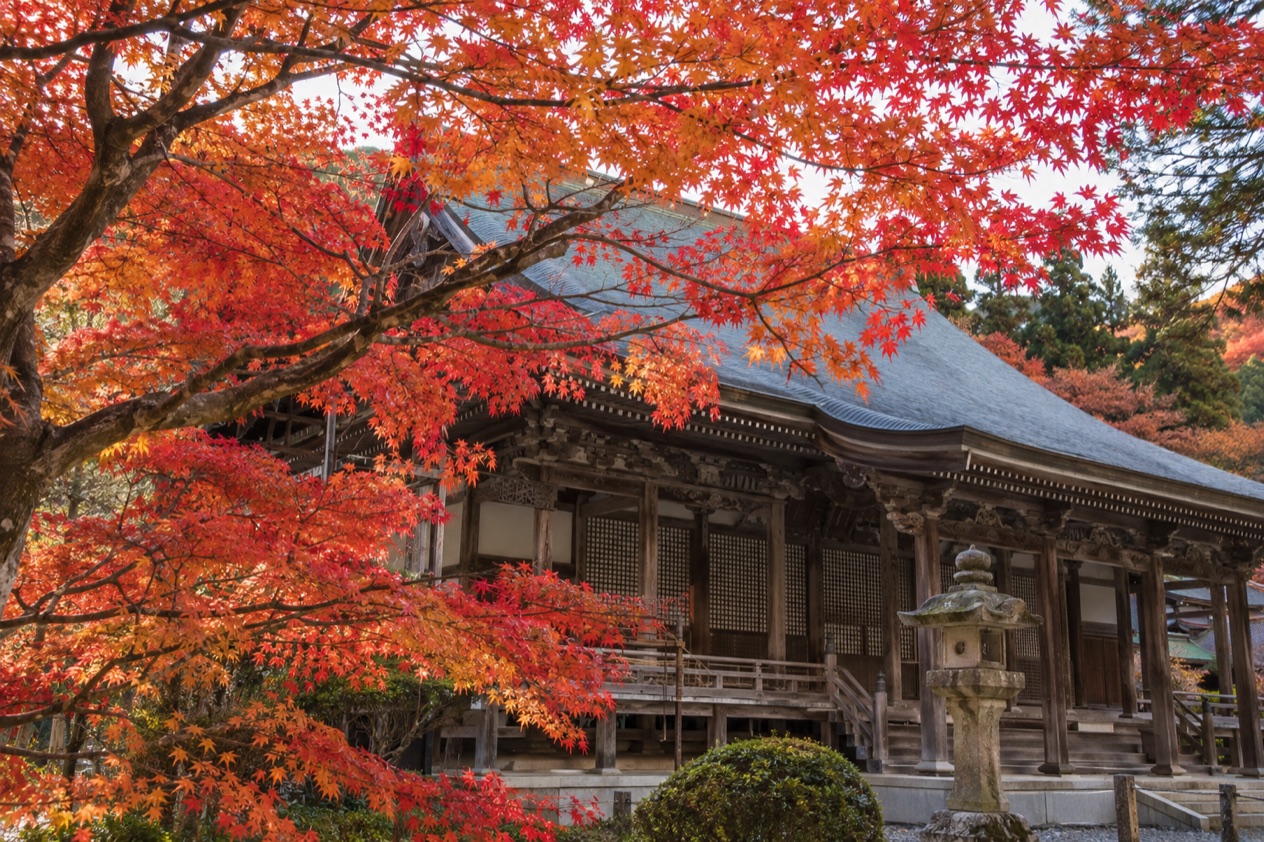
When do the leaves change color in Nagano?
In Nagano city the maples usually change color around November 12, which puts the turn firmly in the second week of the month rather than in October. That date comes from the Japan Meteorological Agency’s observation point in the city, where the change in the maple leaves is recorded each autumn as kaede kōyō.
A usual date is a landmark and not a promise. In 2025 the change was observed on November 19, about a week later than the usual date.
Autumn color moves from one year to the next with the warmth of the season, so the sensible way to use the date is to build a window around it rather than a single day. A trip that spans the middle of November and the days after it gives the leaves room to arrive.
| Maple leaf color change in Nagano city | Date |
|---|---|
| Usual date | November 12 |
| Observed in 2025 | November 19 |
What the date means when you are on the ground
The observation is made on the maples of the city itself, so it describes Nagano city and not every valley or hillside in the prefecture. Treat it as the moment the city’s own trees turn, and as a reference point for the days around it. Walking the streets in the days that follow, you tend to see color building from tree to tree rather than all at once, with some branches still green while others have deepened.
Mid-November is also a time when the light is lower and the air has an edge. Evenings call for an extra layer, and a fall day in a mountain-ringed city often feels crisper than the calendar suggests. Pack for changeable autumn weather and plan outdoor hours for daylight, since the days are shortening.
Why the middle of November, and not earlier
Many travelers arrive in Japan in October with the idea that autumn color belongs to that month everywhere. For Nagano city the usual date says otherwise, and that is useful: an October visit would more likely find green or just-turning trees, while the second half of November is when the maples are most likely to be in color.
This is also why a rushed itinerary can miss the moment. If your dates are fixed in early November, you are arriving before the usual change, and if they run into late November you are catching it after the date and in the weeks that follow. Knowing that the observed date can slip by a week, as it did in 2025, helps you choose a stay of more than a night or two when the color is the point of the trip.
Where can you see them in Nagano?
The place to start is Nagano city itself, the capital of Nagano Prefecture and its northernmost transportation hub, since that is where the leaf change is recorded and where the date above applies. It is the largest city of the prefecture, set in the central Chūbu region, and it sits at 1,219 feet, which makes it the highest prefectural capital in Japan.
Zenkō-ji and the old center
Zenkō-ji is the temple that anchors the city. It is a Buddhist temple listed as a National Treasure, established at its present location in 642 AD, and a visit there gives a clear sense of why Nagano has long drawn travelers. Japanese temples and their grounds are traditional places to spend an autumn day, and a walk through the precincts in mid-November is a fair way to see how the city’s trees are coming along.
Approach it as a slow walk. Temple grounds invite you to look up at the trees, pause at the gate, and let the pace of the place set your own. Pair the visit with a stroll through the streets around it, where small shops and cafés give you somewhere to warm up after time outdoors.
The Olympic venues
Nagano hosted the Winter Olympic Games in 1998, and many of the facilities remain open, among them the M-Wave speedskating arena and the Aqua-Wing arena. They are not leaf-viewing spots in themselves, but they give a second kind of outing for the same trip, a way to fill a day when the weather turns gray or the trees are not yet in color.
Combining a temple morning with an afternoon at a venue gives a day with two different moods, one rooted in centuries of pilgrimage and the other in a recent chapter of the city’s story. Both fit a November itinerary built around the maples.
Beyond the city
Nagano Prefecture is much larger than its capital, and color in other towns and valleys will not follow the city’s date. For those places, look to local reports closer to your trip rather than to a date borrowed from the capital. What the city’s date offers is a firm reference point for the one place where it is measured.
What should you know before you go?
The main thing to know is how you reach the city and when to time it. From Tokyo, Nagano city is 1 hour 20 minutes away on the Hokuriku Shinkansen without stopping, which is what makes a trip from the capital workable in a single day of travel with time left to see the trees.
Coming from Tokyo
The Hokuriku Shinkansen is the train in question, and the nonstop run is the one that takes 1 hour 20 minutes. A traveler basing themselves in Tokyo for the first part of a trip can plan the Nagano portion around the middle of November and then continue onward once the leaves have been seen. Since the usual color change falls in the second week of November and may arrive later, giving yourself a few nights in or near Nagano is a better fit for the subject than a single rushed visit.
Coming from Osaka or Kyoto
From Osaka or Kyoto, the route is the high-speed train to Nagoya, then the JR Wide View Shinano express train to Nagano. It is a two-train journey with a change at Nagoya, so it suits travelers who are already working their way across central Japan and want Nagano as one stop among several. Because the change of trains is part of the plan, it helps to think of the trip as a day of travel and to keep the first hours in Nagano light.
Eating and warming up in the city
The prefecture is known for soba, buckwheat noodles served cold on a bamboo tray or hot in broth, and for apples, which are in season in the fall. A bowl of noodles after a cool afternoon among the trees is a natural way to end the day, and a hot drink from a café does the same job on days when the wind picks up.
Good to know before you go
Carry some yen for small purchases and bring a light jacket for evenings, since mid-November in a mountain-ringed city can turn cool once the sun drops. Plan your outdoor hours for daylight, and keep one indoor stop in reserve, such as a museum or a café, for the days when the sky is gray. Because the color may arrive a week later than the usual date, leave a little slack in the schedule.
Sources
- Japan Meteorological Agency, maple color-change dates 2025-2026 with difference from the 1991-2020 normal (https://www.data.jma.go.jp/sakura/data/phn_014.html), checked October 11, 2026
- Japan National Tourism Organization, Nagano (https://www.japan.travel/en/destinations/hokuriku-shinetsu/nagano/nagano-and-around/), checked October 11, 2026
- Wikipedia, Nagano (city) (https://en.wikipedia.org/wiki/Nagano_(city)), checked October 11, 2026
- Wikivoyage, Nagano (https://en.wikivoyage.org/wiki/Nagano), checked October 11, 2026
- Japan Meteorological Agency, cherry blossom first-bloom dates 2021-2026 and 1991-2020 normal (https://www.data.jma.go.jp/sakura/data/sakura003_07.html), checked October 11, 2026
- Japan Meteorological Agency, cherry blossom full-bloom dates 2021-2026 and 1991-2020 normal (https://www.data.jma.go.jp/sakura/data/sakura004_07.html), checked October 11, 2026
To plan your stay
- Japan Rainy Season (Tsuyu): Dates, Regions and How to Plan Your Trip
- Seasons in Japan: Blossoms, Fall Color, Snow Festivals and Summer Matsuri
- Typhoon Season in Japan: When It Hits, Which Regions Take the Brunt and How the Warning Alerts Work
- Autumn Leaves Dates by City: Usual Maple Dates, 2025 Results and How Much They Shift