
Late in the year, the talk around Mount Fuji turns from the summit to the trees at its feet, as maples go from green to orange and deep red and the first persimmons hang bare-branched in village yards. Travelers start asking when the color actually arrives. The short answer is that it comes late, usually around the end of November and into early December, well after the climbing season has closed.
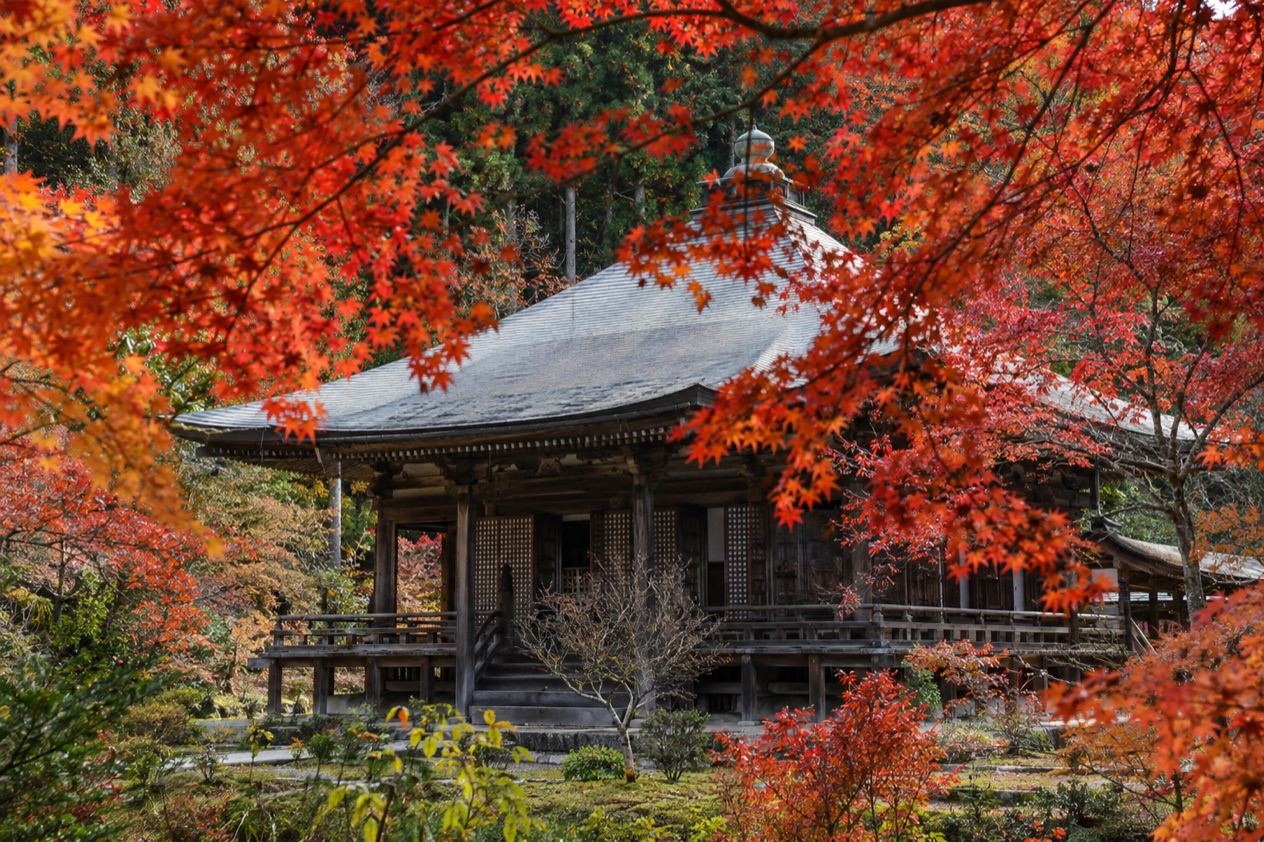
When do the leaves change color in Mount Fuji?
The maples around Mount Fuji usually turn in late November, and in some autumns the color slips into early December. That is later than many first-time visitors expect, and it means the leaf season belongs to the cold, clear weeks of late autumn rather than to the warm days of early fall.
The Japan Meteorological Agency keeps no station on Mount Fuji or at Lake Kawaguchi, so the leaf dates come from its station at Kofu, the nearest place where the change of maple leaves (kaede kōyō) is recorded. Read them as a guide to the timing of the season in this region, not as the exact date on the mountain’s own slopes, where color can arrive earlier or later depending on the spot.
The dates recorded at Kofu
| Event at the Kofu station | Usual date | Observed in 2025 |
|---|---|---|
| Maple leaf color change (kaede kōyō) | November 29 | December 5 |
The usual date is the average over many autumns, and 2025 came about a week behind it. That gap is the useful lesson. Leaf color shifts from one autumn to the next, so the date works as a landmark in the calendar rather than a promise. A warm stretch pushes the color later, a cold snap can bring it forward.
Maples (kaede) are the trees this record follows, and they are the ones that give the deep reds. Other trees turn at their own pace, so you may see yellow and gold in one place while the maples nearby are still catching up.
How the season sits next to the climbing season
The official climbing season on Mount Fuji ends on September 10th. By the time the maples turn, the summit trails belong to a different part of the year, and leaf viewing is a matter of the lower country, the towns and the lakes, with the mountain as the backdrop rather than the destination.
That changes what a trip looks like. Autumn leaves here mean strolling under trees, stopping for a hot meal and watching the color against the mountain’s shape, not hiking to the top. Anyone who still wants to know the state of the trails can look at the official climbing website, which the Japan National Tourism Organization points visitors to for the latest information.
Where can you see them in Mount Fuji?
You see them at the foot of the mountain, in the lowland towns and around the lakes, where maples and other trees frame Mount Fuji itself, the highest mountain in Japan and a UNESCO World Heritage site. The mountain is the reason to come, and the leaves give it a different look from the one it wears in summer.
The trails that climb the mountain are a separate matter. In winter, the Yoshida, Subashiri and Gotemba trails are closed from the 5th station to the summit, and the Fujinomiya Trail is closed from the 6th station to the summit. Leaf viewing therefore happens below those points, in the country around the mountain, with the closed upper slopes as part of what you look at.
| Trail | Closed in winter from | Closed to |
|---|---|---|
| Yoshida Trail | 5th station | Summit |
| Subashiri Trail | 5th station | Summit |
| Gotemba Trail | 5th station | Summit |
| Fujinomiya Trail | 6th station | Summit |
Lake Kawaguchi and the lakeside towns
Lake Kawaguchi is where visitors base themselves for a look at Fuji with trees in the foreground. Around a lake in late autumn you can expect the mix that makes the season: maples in red, trees of yellow and brown, and the mountain rising behind. A walk along the water, a stop in a café and another look at the view once the light changes is the natural rhythm of a day here.
The leaf dates on record come from Kofu, not from the lakeshore, so treat the weeks around the end of November as a starting point and let what you see on arrival set the plan. If the trees by the water are still green, the color may be a little further along elsewhere in the region, and if it has already dropped, evergreens and bare branches still give the mountain a stark frame.
Shrines, gardens and village streets
Maples are planted in shrine grounds and gardens across Japan for a reason. A torii gate or a stone lantern against red leaves is one of the standard pictures of the season, and the habit of going out to look at autumn color is called momijigari, literally maple hunting. In the Fuji region you can pair that tradition with the mountain itself, which turns even a small shrine yard into a composition.
Village streets have their own autumn details. Persimmons are hung out to dry under eaves, chrysanthemums appear in gardens and woodsmoke can drift over the lanes on colder evenings. None of this needs a ticket or a schedule. It is the texture of the season, and it is as much a reason to wander as the leaves are.
What to eat after a day among the trees
Yamanashi, the prefecture on this side of the mountain, is known for hōtō, wide flat wheat noodles simmered in a miso broth with pumpkin and vegetables. It is a thick, warming dish that suits the weeks when the leaves turn and the air has an edge. Travelers plan a bowl as the end of a day of walking.
Autumn also brings chestnuts, sweet potatoes and mushrooms to menus across Japan, and tea shops serve seasonal sweets shaped like maple leaves. Even a small stop for green tea and a leaf-shaped confection gives you a taste of the season that matches what you see out the window.
What should you know before you go?
The main thing to know is that autumn color near Mount Fuji arrives late and varies from one year to the next, so the usual date is a guide and not a guarantee. The record from Kofu shows the pattern: color in late November in an average autumn, and in 2025 it came in early December.
Build your plans around that range. A trip in the last days of November and the first days of December lines up with both dates, and it gives you more than one chance to catch the maples at their color. Arriving much earlier risks finding mostly green trees, while arriving much later risks leaves already on the ground.
Do not plan around the summit
Leaf viewing is a lower-slope pastime, and the summit is not part of it. If climbing is a question for you, the Official Website for Mt. Fuji Climbing is the place the tourism organization tells visitors to check, and it provides information for all climbers to ensure a safe climb and return.
For a leaf trip, the better question is what you want in front of the mountain. A lake, a shrine garden, a village lane and a bowl of noodles can fill a day without any reference to the trails, and the mountain keeps its place in the view throughout.
Read the dates as a range
Two figures exist for the leaf season: the usual date at Kofu and what was observed in 2025. They sit about a week apart, which is a fair picture of how much the season can move. Treat the usual date as the middle of the range and allow time on either side.
Because the dates belong to Kofu, they are one step removed from the mountain and its lakes. The sensible approach is to use them as a signal for the region and to confirm what you see when you arrive. If one spot has passed its color or has not yet reached it, the trees at another point around the mountain may be in a different stage.
What a late-autumn day looks like
A good leaf day here is slow. You walk under maples, stop where the view of Fuji opens, step into a shrine yard and pause for tea. Then you eat a hot meal. The trip is built from small stops, and the mountain gives each of them its backdrop.
Because this is the cool end of the year, think of the day as an outdoor one with a warm meal at the end. The pace matters more than the number of places, and the leaves are best enjoyed by lingering, not racing between viewpoints.
Good to know before you go
Mount Fuji is a UNESCO World Heritage site, and the region around it is a destination of its own in late autumn, long after the climbers have gone home. Plan for a season that moves from one year to the next, keep the end of November and the start of December in mind, and let the trees on the day set the pace. For anything about the mountain’s trails, the official climbing website is the reference the tourism organization names.
Sources
- Japan Meteorological Agency, maple color-change dates 2025-2026 with difference from the 1991-2020 normal (https://www.data.jma.go.jp/sakura/data/phn_014.html), checked October 11, 2026
- Japan National Tourism Organization, Mount Fuji guide (https://www.japan.travel/en/fuji-guide/), checked October 11, 2026
- Official website for Mt. Fuji climbing, about the climb (https://www.fujisan-climb.jp/en/about/), checked October 11, 2026
- Japan Meteorological Agency, cherry blossom first-bloom dates 2021-2026 and 1991-2020 normal (https://www.data.jma.go.jp/sakura/data/sakura003_07.html), checked October 11, 2026
- Japan Meteorological Agency, cherry blossom full-bloom dates 2021-2026 and 1991-2020 normal (https://www.data.jma.go.jp/sakura/data/sakura004_07.html), checked October 11, 2026
- Japan Meteorological Agency, biological season observations (https://www.data.jma.go.jp/sakura/data/index.html)
To plan your stay
- Japan Rainy Season (Tsuyu): Dates, Regions and How to Plan Your Trip
- Seasons in Japan: Blossoms, Fall Color, Snow Festivals and Summer Matsuri
- Typhoon Season in Japan: When It Hits, Which Regions Take the Brunt and How the Warning Alerts Work
- Autumn Leaves Dates by City: Usual Maple Dates, 2025 Results and How Much They Shift