
The ferry from the mainland slides toward an island where deer wait by the pier and a vermilion gate stands in the water, and in November the hills behind it start to burn red and orange. Travelers usually ask the same thing on the crossing: have the maples turned yet? On Miyajima the color arrives in the second half of November, following the rhythm of nearby Hiroshima, and it lights up the shrine, the temples and the wooded valley behind them.
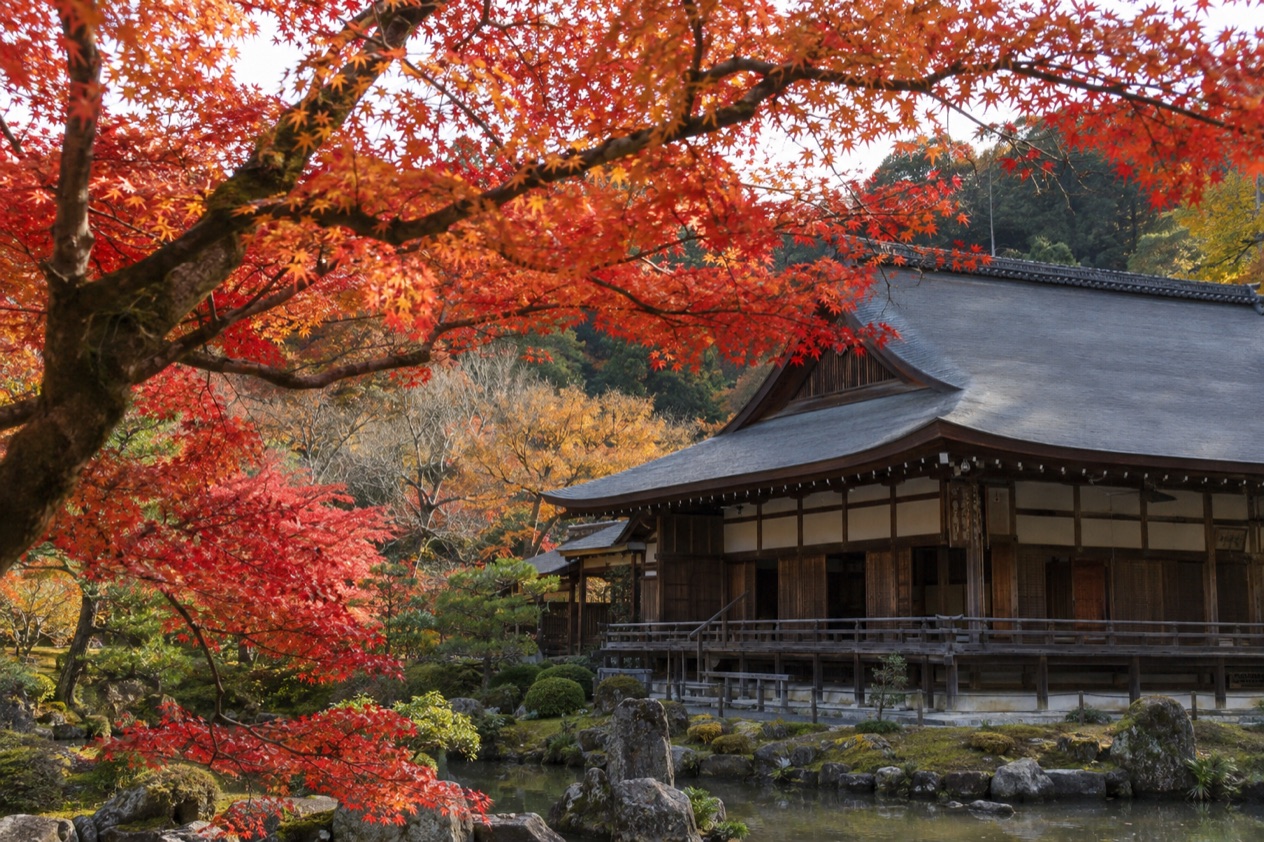
When do the leaves change color in Miyajima?
Maples on Miyajima turn in the second half of November, and the nearest reliable benchmark is the city of Hiroshima, across the water. The island has no weather record of its own, so the dates below are those of the Hiroshima station, a guide for planning rather than a promise about any single tree on the island.
| Maple color change at Hiroshima | Date |
|---|---|
| Usual date | November 22 |
| Observed in 2025 | November 27 |
The date to plan around
In Hiroshima, the color change of maple leaves (kaede koyo in Japanese) usually falls in the last third of November. That is later than in people’s mental picture of an October-to-early-November autumn, so a trip built around leaves belongs at the very end of the month, with the first days of December as a margin.
The word to watch is koyo, the turning of the leaves, which Japanese forecasters and newspapers track city by city every autumn. A first blush of color on a few branches is not the same as a hillside in full color, so a visit on the usual date often finds a mix of green, yellow and deep red rather than a single tone. Travelers find that mix more interesting than a uniform wall of red.
How the dates move from one year to the next
The color change does not arrive on the same day each year. In 2025 it was observed in Hiroshima after the usual date, a reminder that a warm autumn pushes the show later and a cool one can bring it forward.
If your dates are fixed, think of the window as a stretch rather than a day. Late November at Hiroshima is the heart of it, and the island’s trees, planted among evergreens on the slopes, tend to show their color in layers. Some leaves will already have fallen while others are just turning, which makes for a carpet of red under the branches as well as above them.
Reading the island’s trees once you arrive
Miyajima’s name in daily use means Shrine Island, while its older name is Itsukushima, and the whole place is treated as sacred ground. The forest on the hills has long been looked after as part of the shrine’s setting, which is why the maples sit so close to red-lacquered halls and stone lanterns.
Look for the difference between the maples along the stream, which often turn first and brightest, and the slopes higher up, where evergreens hold the green and the red appears in patches. Fallen leaves on the paths and on the shrine’s wooden corridors are part of the scene, not a sign that the season is over.
Where can you see them in Miyajima?
The best places are the maple valley of Momijidani, the grounds around Itsukushima Shrine, the temples on the slope above the village and the forested flank of Mount Misen. All of them lie within the same stretch of the island, so a single day on foot can cover several of them.
Momijidani, the maple valley
Momijidani means Maple Valley, and the name is honest. A stream runs down a wooded ravine, small bridges cross it, and the maples lean in from both sides so that the water carries red leaves in November. It sits behind the village, a little away from the shopping street, and the sound changes as you walk in: fewer voices, more water.
It suits a slow walk with a camera and no particular plan. Stop on one of the bridges and look both up and down the valley, because the color sits at different heights. Deer sometimes wander through the park as well, and a stag standing under a red canopy is one of those pictures visitors tend to remember long after the details of the day have faded.
Itsukushima Shrine and the great torii
The shrine is built over the water on pilings, its corridors and halls painted vermilion, with the big torii gate standing out in the bay. In autumn, the wooded hill behind the buildings supplies the backdrop, so red lacquer, dark roof tiles and red maples all sit in one frame. When the tide is high the buildings seem to float, and when it is low the sand around the gate is exposed. Opening hours shorten as autumn deepens, which matters if you are planning to linger.
| Site | Period | Open |
|---|---|---|
| Itsukushima Shrine | March to October | 06:30 to 18:00 |
| Itsukushima Shrine | November | 06:30 to 17:30 |
| Itsukushima Shrine | December | 06:30 to 17:00 |
| Itsukushima Shrine | January to February | 06:30 to 17:30 |
Temples and pagodas on the slope
Above the shrine, a hillside of temple buildings gives the island its second set of autumn pictures. The five-story pagoda and the large wooden hall called Senjokaku stand close together near the shrine, and the pagoda’s red frame against turning leaves is a favorite subject for photographers. Further along, Daisho-in is a temple climbing the slope in stages, with stairways, lanterns and statues set among maples.
These places reward wandering more than a checklist. Take the stairways, look back at the bay between the trunks, and notice how the temple roofs, moss and fallen leaves create small compositions of their own. Temples keep their own hours and customs, so it is worth looking at the notices at each gate.
Mount Misen and the forested hills
Mount Misen rises behind the village and is the island’s highest peak, wrapped in forest that holds both evergreens and broadleaf trees. Seen from the shrine or the water, its flanks show the autumn color in broad bands. Paths lead up through the woods, and in November the leaves along them change from one stretch to the next.
Because conditions on a mountain differ from those at the pier, dress for a change in the weather and decide on the spot how far to go.
What should you know before you go?
The practical essentials are the ferry crossing from the mainland, the shorter shrine hours in late autumn, and a menu of seasonal food that is part of the day. The island belongs to Hatsukaichi in Hiroshima Prefecture, and it lies off the coast of Hiroshima, so it combines easily with a stay in that city.
Reaching the island by ferry
Ferries connect Miyajimaguchi, on the mainland, with the island, and the crossing takes about ten minutes. Two services run the route, the JR West ferry (the JR Miyajima ferry) and the Miyajima Matsudai Tourist Ship, and both sail frequently.
There is also an express passenger ferry between Itsukushima and Hiroshima harbour, which runs hourly. That makes it possible to arrive by one route and leave by the other, for example crossing from Miyajimaguchi in the morning and returning by water to Hiroshima at the end of the day. On the crossing, keep an eye on the torii as it comes into view, since the gate looks different from the water than it does from the shore.
Planning around shrine hours
Since the shrine closes earlier in November than in the months before it, a plan that treats the day as running to dusk can leave you outside the gates. Build the day so that the shrine comes while it is open, and let the temple slope, the valley or the shopping street fill the time after. Even with the gates shut, the torii and the exterior of the shrine can still be seen from the waterfront.
Late November days are short, and the cooler air means you will want layers for the ferry, which has open sections, and for the walk between sights. A jacket that packs small and comfortable shoes with grip for stairs, damp stone and leaf-covered paths will do more for your day than any other item.
What to eat while the leaves turn
The island has its own food habits, and autumn suits them. Momiji manju, small cakes shaped like maple leaves and filled with sweet red bean paste, are the island’s signature sweet, sold fresh and warm along the shopping street, and in some shops they come deep-fried on a stick. Grilled oysters, a specialty of the Hiroshima area, appear on charcoal grills in front of restaurants, and the smell drifts along the lanes.
Other things to look for are anago, the sea eel served over rice, and a bowl of oysters in other forms, fried or in a hot pot. Eating on the street is part of the visit, but deer are bold and will inspect a paper bag, so keep food close and hands tidy. Paper maps and snack wrappers draw their curiosity too.
Good to know before you go
Late November is the cool, changeable end of autumn, so a rain layer is more useful than an umbrella that catches on stairways and crowded lanes. Paying in cash alongside a transit card is a common habit in small shops and stalls, though the sights themselves are the part to plan around. Keep an eye on the clock as the shrine’s closing time gets earlier, and leave the last stretch of the day for the waterfront, where the torii stays in view and the maple leaves still catch what light remains.
Sources
- Japan Meteorological Agency, maple color-change dates 2025-2026 with difference from the 1991-2020 normal (https://www.data.jma.go.jp/sakura/data/phn_014.html), checked October 11, 2026
- Wikipedia, Itsukushima (https://en.wikipedia.org/wiki/Itsukushima), checked October 11, 2026
- Wikivoyage, Miyajima (https://en.wikivoyage.org/wiki/Miyajima), checked October 11, 2026
- Japan Meteorological Agency, cherry blossom first-bloom dates 2021-2026 and 1991-2020 normal (https://www.data.jma.go.jp/sakura/data/sakura003_07.html), checked October 11, 2026
- Japan Meteorological Agency, cherry blossom full-bloom dates 2021-2026 and 1991-2020 normal (https://www.data.jma.go.jp/sakura/data/sakura004_07.html), checked October 11, 2026
- Japan Meteorological Agency, biological season observations (https://www.data.jma.go.jp/sakura/data/index.html)
To plan your stay
- Japan Rainy Season (Tsuyu): Dates, Regions and How to Plan Your Trip
- Seasons in Japan: Blossoms, Fall Color, Snow Festivals and Summer Matsuri
- Typhoon Season in Japan: When It Hits, Which Regions Take the Brunt and How the Warning Alerts Work
- Autumn Leaves Dates by City: Usual Maple Dates, 2025 Results and How Much They Shift