
In Kanazawa, a gardener on a ladder ties a rope to the crown of a pine while maple leaves drift onto the water of a pond below. The city sits on a strip of land between mountains and the Sea of Japan, and autumn arrives there slowly, tree by tree. The maples usually turn in the last days of November, so the season falls late in the year and runs close to the first winter preparations in the gardens.
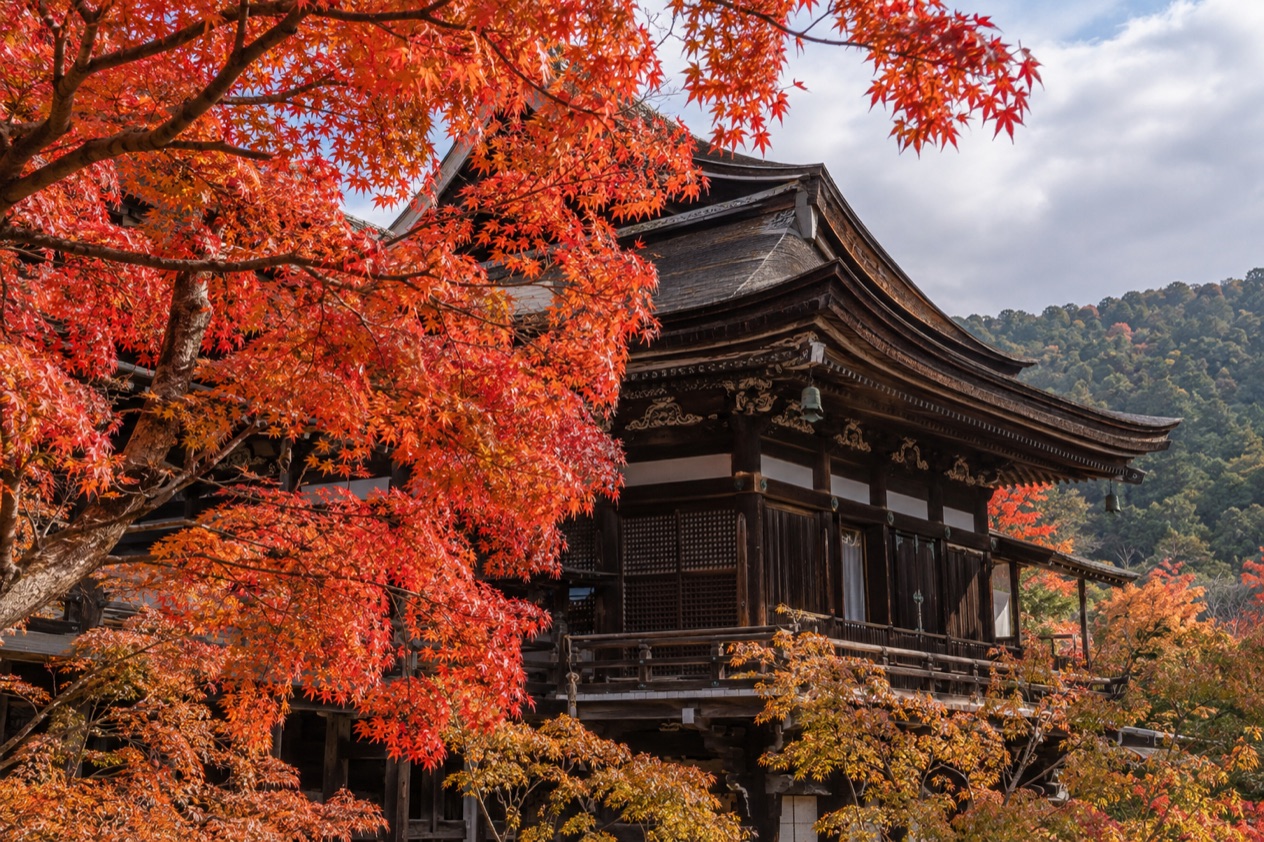
When do the leaves change color in Kanazawa?
The maples of Kanazawa usually change color in the last week of November, which makes this a late-autumn city rather than an early-October one. The Japan Meteorological Agency tracks the color change of maple leaves (kaede kōyō in Japanese) at its Kanazawa station and puts the usual date at November 24. In 2025 the change was observed on November 25, one day later.
| Event | Date at the Kanazawa station |
|---|---|
| Usual date of maple color change | November 24 |
| Observed in 2025 | November 25 |
Read those dates as a landmark, not a promise. The color change is the moment the agency records when the leaves of the reference maples have turned, and the trees around the city keep turning for some time on either side of it. From one autumn to the next the date shifts, so a trip planned around the end of November is aimed at the season, not at a single day.
What the date means on the ground
A recorded color-change date is the start of the show. Gingko and cherry trees, which turn on their own schedule, often add yellow and bronze to the same scene.
Because Kanazawa is a city and not a mountain valley, the color shows up in pockets: a temple courtyard, a canal bank, a garden pond.
Why late November suits Kanazawa
Kanazawa was one of the most important cultural and artistic centers in Japan during the Edo period, and the color season gives that heritage a seasonal frame. Gold leaf workshops, tea houses and samurai-era lanes all look different with red maples overhead. Autumn here is also a food season, with the seafood of the Sea of Japan and the local Kaga cuisine on the menu in the cooler months.
The leaves pair well with the city’s museums, which give you somewhere to go between garden visits. A day can run from a garden in the morning to a gallery or a market in the afternoon, then back to a lit-up park after dark.
Cherry blossoms and maples are separate seasons
Kanazawa has two color seasons, one in spring and one in autumn, and they should not be mixed up when planning. The maple date above has nothing to do with the cherry blossom calendar, which belongs to the spring months. A traveler who wants red leaves is looking at the end of November, and a trip much earlier in the autumn may meet trees that are still mostly green.
If the leaves are not yet at their color when you arrive, the gardens, castle grounds and old districts still give a full day, and you can plan a return walk through the same places at the end of your stay.
Where can you see them in Kanazawa?
The leaves are best looked for in Kenrokuen Garden and Kanazawa Castle Park, and in the old districts that surround them. The Japan National Tourism Organization calls Kenrokuen one of Japan’s most iconic landscape gardens, and the garden is the center of any leaf trip to the city.
Kenrokuen Garden
Kenrokuen is a landscape garden built around ponds, streams, bridges, teahouses and carefully shaped trees. In the color season the maples frame the water, and the reflections double the reds. Stone lanterns and old pines give the same scene dark shapes against the leaves. You walk the paths slowly, stopping at each turn where the view changes.
Free admission is offered to Kenrokuen Garden. The tourism guide promotes nighttime illuminations at Kenrokuen, but check the current schedule before planning an evening visit.
Kanazawa Castle Park
Kanazawa Castle Park lies beside the garden and is lit at night together with Kenrokuen, according to the Kanazawa Tourist Information Guide. The grounds are wide lawns, stone walls and gates, with trees that change color at their own pace. Plain white walls and tiled roofs make a strong backdrop for red and gold.
The park is a natural pairing with the garden, since both can be seen in the same outing and both carry an evening illumination. You can wander the lawns, look up at the tiled roofs through the leaves, and move on to the garden when you want the more detailed scenery.
The old districts around the center
Beyond the two big green spaces, Kanazawa’s older districts add a few trees to the scene. Higashi Chaya, the old tea-house district, has wooden facades and narrow lanes. Nagamachi, the former samurai quarter, has earthen walls and small canals. A maple behind a wall or a ginkgo over a lane gives these areas their own autumn look.
These districts work as a change of pace after the gardens. You can drink tea or eat sweets in a tea house, look at gold leaf crafts, or just walk with the leaves overhead. Omicho Market, the city’s food market, makes a good stop for seafood of the season.
A day that follows the leaves
One way to arrange a day is to begin at Kenrokuen, walk from there to the castle grounds, and then drop into one of the old districts for lunch. The afternoon can go to a museum, for art and culture lovers are well served here, and the evening can return to the lit garden or castle park.
If rain comes, the museums and tea houses keep the day going, and wet leaves often look deeper in color than dry ones. A second day can repeat the garden loop at a different pace, or head to the markets and crafts for a break from the trees.
What should you know before you go?
The main thing to know is that the leaf date moves a little each year, so the plan should leave room around the end of November. Kanazawa is the capital of Ishikawa Prefecture, on a narrow strip of land along the Sea of Japan on Honshu, Japan’s main island, and the city covers 180.94 square miles. That is a lot of ground, but the leaf spots cluster around the garden and castle.
Getting to Kanazawa
Since March 14, 2015, the Hokuriku Shinkansen has served Kanazawa, shortening the trip from Tokyo to around two and a half hours. That makes the city a stop on a rail route that begins in the capital. The Shinkansen is the bullet train network, and arriving by it puts you in the city without a transfer to a local line.
The nearest airport to Kanazawa is Komatsu Airport, in the city of Komatsu. Travelers who fly in arrive there and continue to the city from that airport.
Planning around the color date
With the usual date at the end of November and the 2025 date one day later, a stay that straddles the last week of the month gives the best overlap with the season. A couple of nights, with the garden on more than one day, lets you see the trees in different light and change plans if the weather turns.
Treat a gray day as part of the trip. Raindrops on maple leaves, wet stone paths and steaming cups of tea are part of how Kanazawa looks in the late season.
Evenings, food and a slower pace
The illumination of the castle park and Kenrokuen turns the evening into a second visit. You can eat first, then walk to the lit grounds, so the day has a natural arc from daylight leaves to lamplit ones.
The cooler months bring seafood from the Sea of Japan, and Kanazawa is known for its Kaga cuisine, a style of regional cooking built around local ingredients. Sweets, tea and gold leaf treats round out the city’s table. Eating is as much a reason to come as the trees, and the two fit together well on a slow trip.
Good to know before you go
Late November is the moment to arrive for the maples, and the city rewards a slower schedule with room for tea houses, museums and an evening walk under the lights. The leaves are a seasonal thread, and the rest of Kanazawa, from its craft workshops to its markets, fills the days around them. Carry yen for small purchases at stalls and tea houses, and keep an umbrella within reach on a coast where gray skies come and go.
Sources
- Japan Meteorological Agency, maple color-change dates 2025-2026 with difference from the 1991-2020 normal (https://www.data.jma.go.jp/sakura/data/phn_014.html), checked October 11, 2026
- Japan National Tourism Organization, Kanazawa (https://www.japan.travel/en/destinations/hokuriku-shinetsu/ishikawa/kanazawa-and-around/), checked October 11, 2026
- Kanazawa Tourist Information Guide (https://www.kanazawa-tourism.com/), checked October 11, 2026
- Wikipedia, Kanazawa, Ishikawa (https://en.wikipedia.org/wiki/Kanazawa,_Ishikawa), checked October 11, 2026
- Japan Meteorological Agency, cherry blossom first-bloom dates 2021-2026 and 1991-2020 normal (https://www.data.jma.go.jp/sakura/data/sakura003_07.html), checked October 11, 2026
- Japan Meteorological Agency, cherry blossom full-bloom dates 2021-2026 and 1991-2020 normal (https://www.data.jma.go.jp/sakura/data/sakura004_07.html), checked October 11, 2026
To plan your stay
- Japan Rainy Season (Tsuyu): Dates, Regions and How to Plan Your Trip
- Seasons in Japan: Blossoms, Fall Color, Snow Festivals and Summer Matsuri
- Typhoon Season in Japan: When It Hits, Which Regions Take the Brunt and How the Warning Alerts Work
- Autumn Leaves Dates by City: Usual Maple Dates, 2025 Results and How Much They Shift