
In Kamakura the maples turn late, after most of Japan has already put away its autumn photographs. Red and orange leaves hang over temple gates and moss-covered stairs while the cooler air smells of incense and wet stone. The answer to when to come is the final weeks of the year, and the temples of the old shogun capital are where the color gathers.
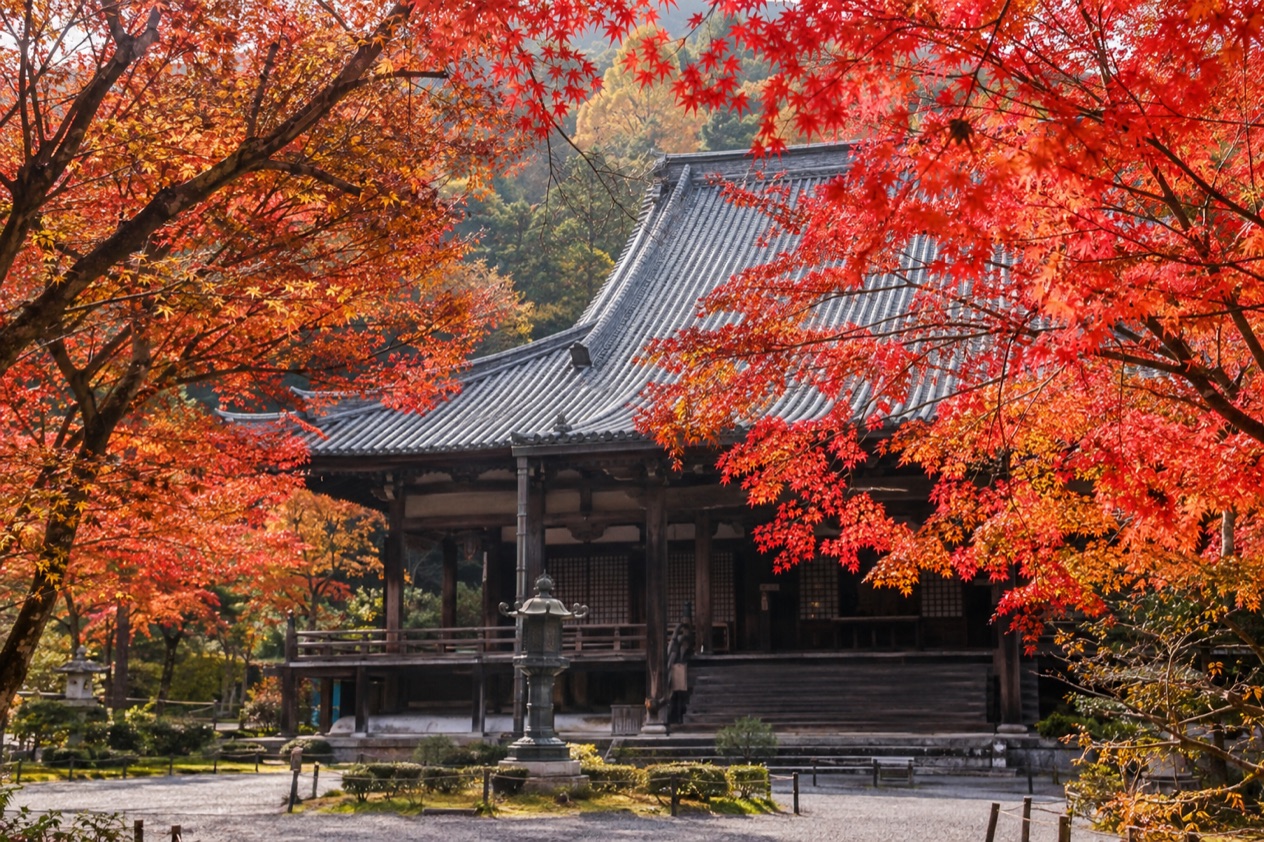
When do the leaves change color in Kamakura?
The maples around Kamakura usually turn in December, which is later than travelers expect from a place so close to Tokyo.
Treat them as a landmark for the season rather than a promise for a given week.
From one autumn to the next the date moves a little. In 2025 the change was observed on December 15, a day after the usual date. That is a small gap, and it suggests the season does not swing wildly. Leaves in a hillside temple garden and leaves along a city street can still turn on different schedules, so a walk that links several places gives you more chances to catch the color at its height.
This late timing shapes the whole trip. A visit in October or early November is a visit to green maples, with the first tints perhaps starting in the shadier valleys. Waiting until the final weeks of the year puts you in the middle of the color, with cool air, bare branches next to the red ones, and ginkgo leaves lying yellow on the paths.
How autumn compares with the cherry season
Kamakura is also a spring city, and the same Yokohama observations help you see how the two seasons relate. Cherry trees open first around the end of March and reach full bloom around the beginning of April. In recent springs the first bloom has landed anywhere from mid-March to the first day of April, so spring shifts more than the late December maples do.
Both seasons use the same landscape of temple roofs, stone lanterns and wooded hills behind the town. In spring the pink sits against the new green. In autumn the red and gold sit against the dark cedar and the gray of old wood. If you have seen Kamakura in spring, December shows you a different city entirely.
| Seasonal event | Usual date at Yokohama |
|---|---|
| Maple leaf color change (kaede koyo) | December 14 |
| Cherry blossom first bloom (kaika) | March 25 |
| Cherry blossom full bloom (mankai) | April 1 |
Reading the season while you travel
Japanese travelers follow the color the way Americans follow fall foliage, and the words you will hear are momiji (the maple leaves themselves) and koyo (the turning of the leaves). In Kamakura you read the season on the ground as much as in the trees. Fallen maple leaves collect on stone steps, ginkgo drops its fan-shaped yellow leaves beside temple halls, and garden keepers sweep the paths in a rhythm of their own.
If you arrive and the trees are still half green, that is not a wasted day. Half-turned maples, with green, orange and red on the same branch, are often the most interesting to look at. The temples themselves, with their thatched gates, mossy courtyards and wooden halls, are worth the walk in any state of leaf.
Where can you see them in Kamakura?
You see them in the temple and shrine grounds that lie among the wooded hills around the old center, because Kamakura’s color lives in its gardens and courtyards more than on its streets. This was the political capital of Japan during the Kamakura shogunate, from 1185 to 1333, and the religious sites that grew up then still shape the town. Each has its own mix of maple, ginkgo, stone and water.
Kencho-ji and Engaku-ji
Two of Kamakura’s great Zen temples, Kencho-ji and Engaku-ji, are large compounds with big wooden gates, long approaches and halls set back among tall trees. Zen gardens depend on restraint, so the effect of autumn is of a few strong colors against dark timber and raked gravel, not a blaze across the whole hillside.
Walking through either one is a matter of following the axis from the main gate toward the halls at the back, with side paths leading off among the trees. Engaku-ji sits close to a railway line, and you will hear trains now and then, which is part of Kamakura’s mix of the old and the everyday. Pair the two temples in one outing and you see how different Zen compounds can feel from one another.
Tsurugaoka Hachimangu
Tsurugaoka Hachimangu is the shrine that anchors the town, reached by a long tree-lined approach that runs up from the direction of the sea. Ginkgo and other trees line the way, and the shrine’s main hall stands at the top of a broad flight of stone steps, with a view back down the avenue.
A shrine, unlike a temple, is Shinto, and the difference shows in the details: a torii gate at the entrance, a purification fountain where visitors rinse their hands, and vermilion woodwork. In late autumn that vermilion against yellow ginkgo leaves is one of the most striking color pairings in the town.
Hase-dera, Meigetsu-in and other hillside temples
Smaller hillside temples such as Hase-dera, Meigetsu-in, Zuisen-ji and Hokoku-ji give a more intimate kind of autumn. Their gardens are set into slopes, with ponds, stone lanterns, small statues and maples that frame a doorway or hang over water. Meigetsu-in is known for its round window that frames the garden, and Hokoku-ji for a bamboo grove inside its grounds.
Hase-dera looks over the town and the bay from its terraces, with gardens and a hall of Kannon, the bodhisattva of compassion, among the trees. Because these temples are on slopes, expect steps and uneven paths, and plan on moving between them by train or bus rather than trying to link them all on foot in one go.
The Great Buddha at Kotoku-in
Kotoku-in is the temple of Kamakura’s Great Buddha, a bronze figure seated in the open air. It is not a maple garden, but trees stand around the grounds, and autumn light on the dark bronze gives the figure a different mood from the green of summer.
Travelers add it to a day of temple-hopping because it is among the best-known sights of the town and sits well beside the hillside temples. Treat it as a pause between color-hunting stops rather than the reason for the day.
What should you know before you go?
The main thing to know is how to reach Kamakura and how to move around it, because the temples are spread across hills and valleys rather than gathered in one square. Kamakura is a city of Kanagawa Prefecture, in the Kanto region on the island of Honshu, and the Odakyu route described here starts from Shinjuku in Tokyo.
Getting there from Shinjuku
One way to reach Kamakura from Shinjuku is to take the private Odakyu line to Fujisawa and then change onto the Enoden line to Kamakura. The travel time by this route is about 90 minutes. The Enoden is a small, old-style line that runs through neighborhoods and close to the coast, and the ride itself is part of the outing.
Starting from Shinjuku means you are crossing Tokyo’s west side before the day has really begun. Plan the temples you most want to see first, and let the others fill whatever time and daylight remain. In December, the days are short and the temples have their own closing times, so build the day around two or three places rather than six.
The Enoshima-Kamakura Free Pass
The Enoshima-Kamakura Free Pass is a ticket that includes a roundtrip from Shinjuku and unlimited use of the Enoden line for one day. It does not include fares on local buses, which matters in Kamakura because some of the hillside temples are reached by bus.
The Enoden line stops near several of the places mentioned here, so a ticket covering that line suits a day that follows it. If your plan includes a temple served only by bus, count those rides separately.
Matching the trip to the leaves
Because the color usually peaks around mid-December at the Yokohama reference point, a trip aimed at the leaves belongs in the second half of the year’s final month, not in the weeks when most of Japan is at its reddest. A trip earlier in the autumn is still a temple trip, with green maples and the first color.
Kamakura’s history gives the day a second layer. Seven centuries ago this was the seat of the warrior government, and the Zen temples, shrines and hillside paths you walk are part of that story. Even when the leaves are not at their height, the setting rewards the visit.
Good to know before you go
Carry some cash for small temple gardens and stalls, and expect to take your shoes off at the entrance of some halls. The leaves follow the weather, so a late or early turn is part of the trip, and a gray day still shows the moss, the stone and the quiet shapes of the old garden walls.
Sources
- Japan Meteorological Agency, maple color-change dates 2025-2026 with difference from the 1991-2020 normal (https://www.data.jma.go.jp/sakura/data/phn_014.html), checked October 11, 2026
- Wikipedia, Kamakura (https://en.wikipedia.org/wiki/Kamakura), checked October 11, 2026
- Wikivoyage, Kamakura (https://en.wikivoyage.org/wiki/Kamakura), checked October 11, 2026
- Japan Meteorological Agency, cherry blossom first-bloom dates 2021-2026 and 1991-2020 normal (https://www.data.jma.go.jp/sakura/data/sakura003_07.html), checked October 11, 2026
- Japan Meteorological Agency, cherry blossom full-bloom dates 2021-2026 and 1991-2020 normal (https://www.data.jma.go.jp/sakura/data/sakura004_07.html), checked October 11, 2026
- Japan Meteorological Agency, biological season observations (https://www.data.jma.go.jp/sakura/data/index.html)
To plan your stay
- Japan Rainy Season (Tsuyu): Dates, Regions and How to Plan Your Trip
- Seasons in Japan: Blossoms, Fall Color, Snow Festivals and Summer Matsuri
- Typhoon Season in Japan: When It Hits, Which Regions Take the Brunt and How the Warning Alerts Work
- Autumn Leaves Dates by City: Usual Maple Dates, 2025 Results and How Much They Shift