
As October wears on, travelers with a Japan trip half planned start asking the same question over breakfast: when exactly will the maples turn? Japan answers with a slow wave of red that begins in the northern mountains and takes weeks to travel south. It reaches the big cities of Honshu and the far west in late November and December, so the answer is never one date for the country, only one for each city.
What is the autumn leaves forecast for Japan?
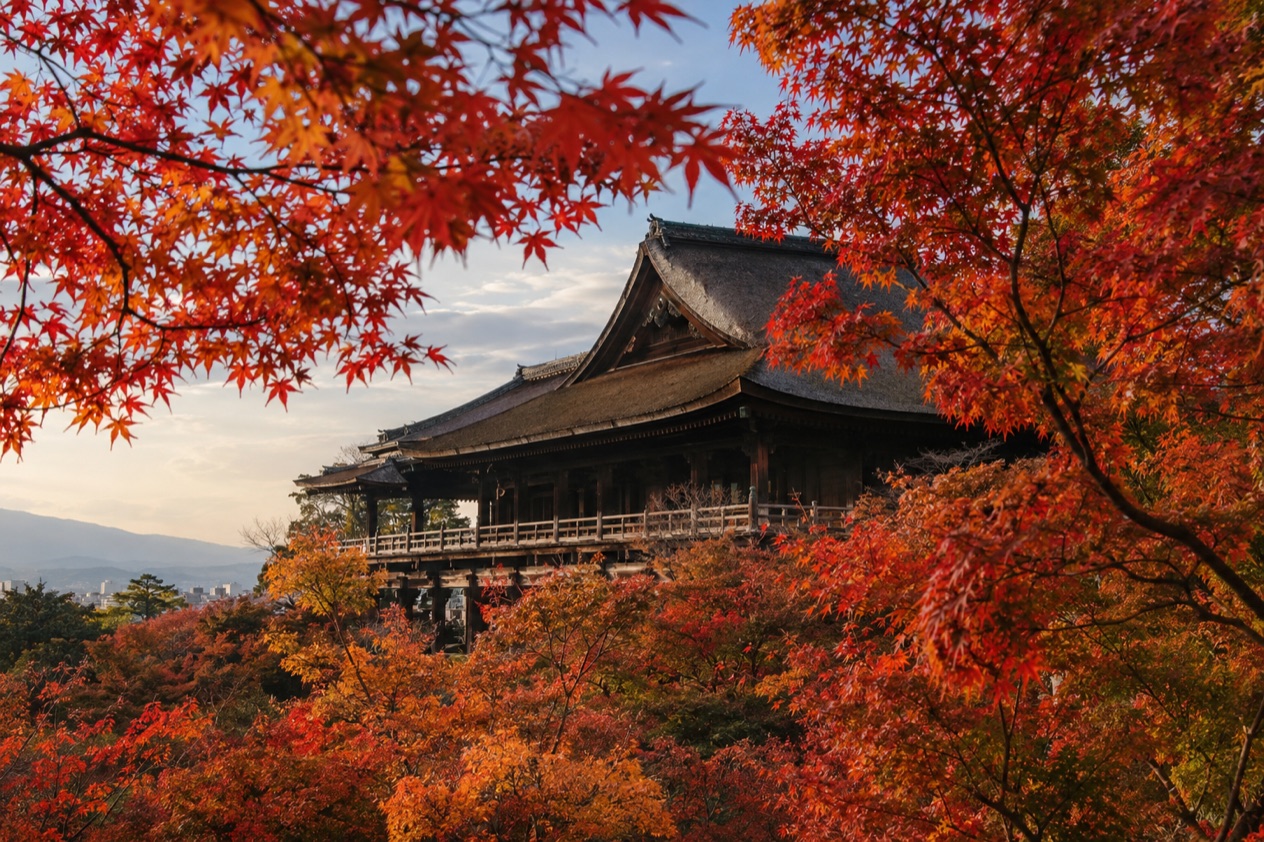
The forecast is a north-to-south wave: the maples turn first in the cool north and last on the warm Pacific coasts and in the southwest. The Japan Meteorological Agency defines the moment that matters as the first day on which most leaves on a sample maple tree have turned red. It calls this kaede koyo, and the color change in Japanese is usually spoken of as momiji, the maple leaf and the red of autumn itself.
Across the country the wave starts in mid-October in eastern Hokkaido. It reaches the Tohoku region and eastern Hokuriku around November 20, then the Kanto, Hokuriku, Tokai, Chugoku, Shikoku and northern Kyushu around November 30.
The Pacific coasts of Kanto and Tokai, the Kinki region and southern Kyushu come last, from early to mid December. The table gives the date for sixteen cities, from the earliest to the latest, next to what was actually observed in 2025.
| City | Usual date of color change | Observed in 2025 |
|---|---|---|
| Sapporo | October 28 | November 6 |
| Hakodate | November 2 | November 6 |
| Nagano | November 12 | November 19 |
| Aomori | November 13 | November 10 |
| Nara | November 21 | November 14 |
| Sendai | November 21 | November 20 |
| Hiroshima | November 22 | November 27 |
| Kanazawa | November 24 | November 25 |
| Tokyo | November 28 | November 23 |
| Nagoya | November 28 | November 25 |
| Fukuoka | December 1 | December 1 |
| Kobe | December 1 | November 26 |
| Osaka | December 1 | December 4 |
| Kyoto | December 5 | December 10 |
| Yokohama | December 14 | December 15 |
| Kagoshima | December 15 | December 2 |
Hokkaido and the north
Hokkaido is where the season opens, and the island’s cities turn early. Sapporo and Hakodate both reached the color change before the middle of November in 2025, and their usual dates sit at the very end of October and the start of November. A trip here suits travelers who want to see the leaves while much of Honshu is still green.
Farther south on Honshu, Aomori and Sendai belong to the Tohoku group. Aomori’s usual date falls in the middle of November, and Sendai’s comes about a week later. Both are cities where the red arrives well before it does in Tokyo, which makes the north a natural place to start a route that follows the leaves southward.
Central Honshu and the Japan Sea side
Nagano turns earlier than most of the cities in this group, with a usual date in the middle of November. In 2025 Tokyo and Nagoya both came in a little ahead of that, while Kanazawa landed within a day.
For a first trip, this is the stretch where the calendar feels most generous. A traveler who lands in Tokyo at the very end of November is looking at the usual week for the city’s maples to be red, and the timing lines up for several other cities in the same group.
Kansai, the west and Kyushu
The west turns last, and the order is not strictly north to south. Nara and Hiroshima arrive in the third week of November, earlier than Kobe and Osaka, which wait until the first day of December. Kyoto is later still, in the first week of December, a point worth knowing for anyone who pictures the old capital in red by early November.
Fukuoka matches Osaka and Kobe on the first of December, while Yokohama and Kagoshima close the list in the middle of the month. These are Pacific coast and southern Kyushu cities, and they are the places where the JMA’s own description of early to mid December applies most clearly.
Where do forecasts come from?
They rest on the Japan Meteorological Agency’s observation of sample maple trees, one set for each city it watches. A forecast for a given autumn is a guess about when that observed moment will arrive, and the usual dates in the table are the anchor that any such guess starts from.
The definition is narrow on purpose. The agency looks at the whole of a sample tree and counts the first day on which most of its leaves have turned red.
A branch that has gone crimson while the rest of the tree stays green does not count, and neither does a single bright maple in a park that happens to turn early. That is why the dates read as precise, even though the leaves themselves change over many days.
What a sample tree tells you
A sample tree is a reference point, not a map of every garden in the city. The date it gives is the day on which red becomes the dominant color of that tree, and it says the leaf season in the city has well and truly begun. Temples, gardens and hillsides around the city will not all match it exactly, because shade, elevation and the kind of maple all shift the timing.
For a traveler, the useful reading is the order of the cities. When the date for Nara comes before the date for Osaka, the maples around Nara turn first, and a plan that puts the two in the right sequence gives a better chance of catching both in color. Aomori sits at the other end, with a date in the middle of November that tells you the north is already done by the time the west begins.
Usual dates and what actually happened
The usual date for each city is a long-run reference, and the 2025 column shows how one real season compared with it. Reading the two together is the honest way to use a forecast. The usual date tells you where to aim, and the 2025 date tells you how far a single autumn can land from that aim.
Some cities hit the mark almost exactly. Fukuoka turned on the usual day, and Sendai, Kanazawa and Yokohama all came within a day of theirs.
How leaf viewing is spoken of
In Japan the pastime has its own word, momijigari, literally the hunt for red leaves, and it sits alongside cherry blossom viewing as a seasonal habit. People go out to temple gardens, wooded valleys and city parks to see the maples, and the season has its own foods, among them momiji manju, small cakes shaped like a maple leaf.
Because the trees do not all turn together, the habit is to follow the color instead of waiting for it. A traveler who is flexible about the city can chase the wave, and one who is fixed to a city looks at its usual date and plans around it.
How reliable are they?
They are good guides to the order of the season and loose guides to the exact day, because a single autumn can land well before or after the usual date. The 2025 observations show it plainly, and the swings run in both directions.
Cities that came early in 2025
Kagoshima turned nearly two weeks ahead of its usual date, the biggest early move among the cities listed. If you had planned a Tokyo trip around its usual date, the red would already have been there for several days by the time you arrived.
Nagoya and Sendai were early by a small margin too, so the pattern was not confined to one region. An early year does not mean a short season for the traveler, only that the window opens sooner, and the cities that turned early are the ones where a late-arriving visitor is most likely to miss the peak.
Cities that came late in 2025
Sapporo ran about nine days behind its usual date, the largest late shift in the group. Nagano was about a week behind, and Kyoto lagged by roughly five days.
Kyoto is worth a second look. Its usual date already falls in the first week of December, and in 2025 it slipped into the second week. A visitor who counts on early December for Kyoto may find the city on the late side of that window, so the date is better read as a general sign than a target.
How to use a date without trusting it too hard
The practical reading is to treat the usual date as the middle of a window rather than a deadline. Two cities that look close on paper, like Tokyo and Nagoya, can end up a few days apart in a given year, and a city can move by a week or more in either direction. A plan that allows a few days of slack on both sides holds up better than one built on a single day.
It also helps to remember what the date measures. It marks the day most of a sample tree’s leaves have turned red, so the days just after it are typically when color is well established around the city, and the maples in nearby gardens may be a little ahead or behind. A route through several cities spreads that risk, since an early year in one place is often a late one in another.
Good to know before you go
The one habit that pays off is to plan around the order of the cities and not a single date for the country. Color begins in the north, reaches Tokyo and central Honshu in the last week of November, and arrives in Kyoto, Osaka and the Pacific coasts in December. A trip that moves from north to south follows the leaves, while a trip that stays in one city leans on that city’s own date and a little patience for the year it turns up.
Sources
- Japan Meteorological Agency, maple color-change dates 2025-2026 with difference from the 1991-2020 normal (https://www.data.jma.go.jp/sakura/data/phn_014.html), checked October 11, 2026
- Japan Meteorological Agency, kaede2020.pdf (https://www.data.jma.go.jp/sakura/data/kaede2020.pdf), checked October 11, 2026
To plan your stay
- Japan Rainy Season (Tsuyu): Dates, Regions and How to Plan Your Trip
- Seasons in Japan: Blossoms, Fall Color, Snow Festivals and Summer Matsuri
- Typhoon Season in Japan: When It Hits, Which Regions Take the Brunt and How the Warning Alerts Work
- Autumn Leaves Dates by City: Usual Maple Dates, 2025 Results and How Much They Shift