
ST. AUGUSTINE · FLORIDA · THINGS TO DO
You have already picked St. Augustine. What is left is the schedule: which door opens at nine, which ticket lasts a week, which ferry costs nothing, and which tower turns a child away at the base. The old town rewards a day built around two federal properties and one working lighthouse, and all three publish their hours.
The city holds two of Florida’s eleven National Park Service units, the Castillo de San Marcos and Fort Matanzas, set along the same river and the same Spanish defensive logic. One charges $15 and gives you seven consecutive days. The other charges nothing at all, ferry included, provided you collect the pass in the right building.
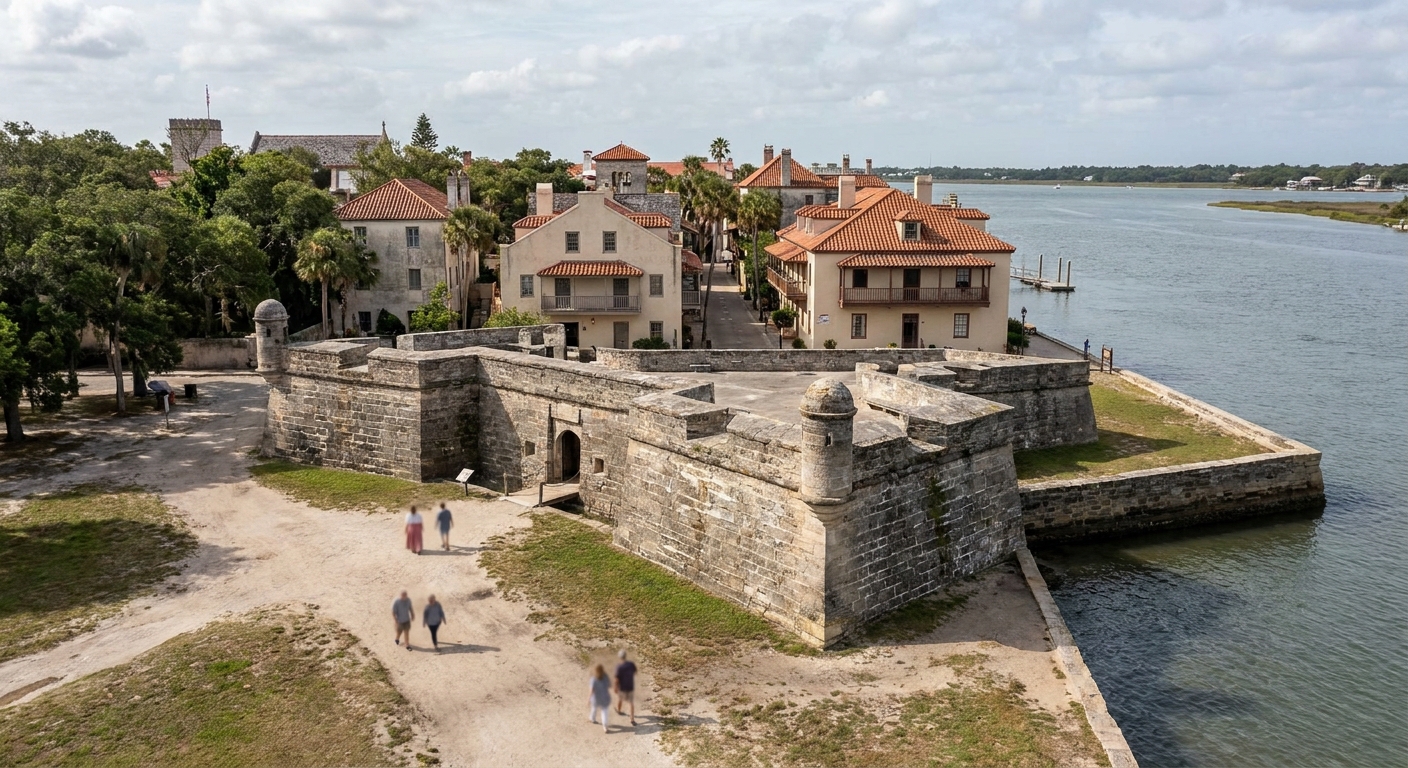
THE VISIT AT A GLANCE · ST. AUGUSTINE
Two federal forts anchor the day: $15 buys a week at the Castillo, Fort Matanzas costs nothing including its ferry, and the lighthouse tower enforces a height rule we can quote long before a price we could not.
TWO NPS UNITS · CASTILLO $15 FOR 7 DAYS · FORT MATANZAS FREE · EASTERN TIME
Go for: two coquina forts you can walk into, a free boat ride across the Matanzas River, and an 1874 tower whose stairs come with a 44-inch rule.
Think twice before: driving south to Fort Matanzas without stopping at its own visitor center, where the free boarding passes are issued, one for every family member of any age.
Forts: National Park Service · Tower hours: St. Augustine Lighthouse & Maritime Museum · Beach flags: Florida Statutes s. 380.276 · full sources at the end
On this page
- Castillo de San Marcos tickets and hours$15 for seven days, 9:00 a.m. to 5:15 p.m.
- What the forts are built fromCoquina, the only local stone
- A free fort with a free ferryFort Matanzas and its boarding pass
- St. Augustine Lighthouse hours and the climbing ruleLast ticket times and 44 inches
- Beach flag colors and where you can walkFive flags and the high-water line
- Is St. Augustine the oldest city in the United States?What 1565 covers, and what it does not
- Weather and crowds by monthSt. Augustine month by month
St. Augustine keeps Eastern time, since it sits east of the Apalachicola River (49 CFR 71.5). The nearest large airport is Jacksonville, which boarded 3,749,791 passengers in 2024 against Orlando’s 27,859,783, per the FAA. Two of Florida’s eleven National Park Service units stand here, and neither is a National Park: in Florida that title belongs to Biscayne, Dry Tortugas and the Everglades. Rooms carry St. Johns County’s 5% transient rental tax on top of 6% state sales tax (trip costs).
Castillo de San Marcos: tickets, hours and what it is
The National Park Service calls the Castillo de San Marcos the oldest masonry fortification in the continental United States, built by the Spanish at St. Augustine to defend Florida and the Atlantic trade route. Keep the word continental: it is the Park Service’s own qualifier, and it exists because older fortifications stand in Puerto Rico. What you are visiting is a working piece of imperial infrastructure, not a reconstruction.
Admission for anyone aged 16 and above is $15.00, and the ticket is valid for seven consecutive days. That validity changes how you use the place. Walk the gun deck on a clear morning, come back for the cool of the casemates when an afternoon shower parks over the bay, and the second visit costs nothing extra.
Children aged 15 and under enter free of charge, with one condition attached by the Park Service: they must be accompanied by an adult. Families traveling with teenagers should count carefully, because the line falls at 16, not at 18. Our Florida with kids notes apply to the rest of the day.
Hours are tight at the end. First admission is 9:00 a.m., last admission 5:00 p.m., and the fort closes with everyone out by 5:15 p.m.. Fifteen minutes is not a visit, so a 4:45 arrival buys you a glance rather than the ramparts. The Castillo opens seven days a week except Thanksgiving Day and Christmas Day.
What is coquina, and why the Spanish built with it
The Park Service puts it in one line on the Castillo’s Stories page: The Castillo is constructed from a unique stone called coquina. The Spanish built with it because it was the only local stone. Not a preference, then, and not an aesthetic choice. It was what the coast offered, a shell rock quarried nearby and stacked into walls thick enough to hold artillery.
You will hear that coquina swallowed cannonballs instead of shattering. It is repeated everywhere in town, and we could not read it on any Park Service page we opened, so we do not print it as fact. What is documented is the reach of the material: the watchtower downriver at Fort Matanzas is coquina too, completed in 1742.
Fort Matanzas: free entry and the ferry
Every area of Fort Matanzas National Monument is free of charge, and that includes the ferry that carries you across the river to the tower itself. No entry fee, no boat fare, no add-on. In a town that sells tickets to a great many doorways, this is the cheapest hour of history on offer.
The trap is the paperwork. The free boarding pass is issued at the Fort Matanzas Visitor Center, not at the St. Augustine city visitor center in the old town, and every family member of every age needs a pass of their own. Collect them when you arrive at the monument, before you settle on a bench with a view of the boat.
What waits on the far bank is a fortified coquina watchtower, completed in 1742, built to defend the southern approach to the Spanish military settlement of St. Augustine. It is small, and that is the point: a garrison of a handful of men watching an inlet that an enemy fleet could have used as a back door.
One number is missing here on purpose. The Fort Ferry Service runs October 1 to September 30, but we could not read the daily departure times at the source, so we prints none. Ask at the visitor center desk as you pick up the passes, and confirm the last crossing of the day first, since that is the one people miss.
The name carries the darkest story in the county. The Park Service ties it to the killing of the French Huguenots, the incident that led to the naming of the river, Matanzas, the Spanish word for slaughters, and adds the strategic reason anyone bothered: whoever controlled Florida controlled the rich shipping lanes coming from the Spanish Caribbean.
St. Augustine Lighthouse: hours and the height rule
The lighthouse runs two seasons. From October 1 to February 28 it opens 9:00 a.m. to 6:00 p.m. daily, with the last ticket sold at 5:30 p.m. From March 1 to September 30 it opens 9:00 a.m. to 6:30 p.m., last ticket at 6:00 p.m. Both windows close the register half an hour before the gate, which is the detail that strands late arrivals.
Two restrictions apply on the stairs. Children under 44 inches are not permitted up the tower, and neither are animals. Anyone taller than 44 inches has to climb under their own power, so carrying a tired six-year-old up is not an option. The tower dates from 1874, and general admission includes the climb.
We cannot give you the price. The general admission rate was not readable at the source when we checked, and the only figure published was a special Lens Room Tour at $500 per person, which is emphatically not the ordinary ticket. Check the museum’s own site or the window before you build a budget around it.
Beaches in St. Augustine: flags and access
Florida’s beach warning flags run five colors. Double red means the water is closed. Red is high hazard, yellow medium, and green low hazard with a reminder to exercise caution anyway. Purple flies alongside another flag and warns of dangerous marine life. The limit of the system: no law compels a beach to fly any of them, so a bare pole is not a green light.
Access has a legal line, and it is drawn at the tide. Florida Statutes s. 163.035(2) prevents a local government from adopting or keeping a customary-use rule for any beach above the mean high-water line without a judicial declaration. Wet sand below that line is public. Dry sand above it can be private property, whatever the towels suggest. Water conditions themselves sit in our Florida safety guide.
Is St. Augustine the oldest city in the United States?
A few claims circulate here so widely that they sound sourced. The age of the St. George Street shopfronts, the Fountain of Youth’s pitch, the founding narratives sold at the doors of several private museums: we hold no verified figure, price or opening time for any of them, so we leave them out. Same for lodging. No hotel name, room rate or restaurant in this town has been verified by us.
The superlative itself deserves the same treatment. St. Augustine is routinely called the oldest continuously occupied city in the United States, and that phrase appears on none of the National Park Service pages we read. Treat it as a local claim rather than a documented fact, and notice that the town’s best material does not need it.
What the Park Service does date without hedging is the beginning: the first conflict goes back to 1565, the year of the founding of St. Augustine. Carry three numbers around town instead of a slogan. 1565 for the settlement, 1742 for the finished watchtower downriver, 1874 for the tower with the height rule. Then pick your month with the month-by-month page, where the weather and the crowds are counted.
Sources & data for this guide
- Oldest masonry fortification in the continental United States · NPS Castillo de San Marcos · checked Sep 13, 2026
- $15 adult ticket valid 7 consecutive days, ages 15 and under free with an adult · NPS Castillo de San Marcos, Fees · checked Sep 13, 2026
- First admission 9:00 a.m., last admission 5:00 p.m., exit 5:15 p.m., closed Thanksgiving and Christmas · NPS Castillo de San Marcos, Hours · checked Sep 13, 2026
- Coquina as the only local stone · NPS Castillo de San Marcos, Stories · checked Sep 13, 2026 · absent from the index, learn and FAQ pages, which is why we opened Stories
- Free entry and free ferry, boarding pass issued at the Fort Matanzas Visitor Center, one per person of any age · NPS Fort Matanzas, Fees · checked Sep 13, 2026
- Coquina watchtower completed 1742, origin of the name Matanzas, 1565 founding date · NPS Fort Matanzas, History & Culture · checked Sep 13, 2026
- Ferry service season, October 1 to September 30 · NPS Fort Matanzas · checked Sep 13, 2026 · daily departure times could not be read at the source and are not printed
- Seasonal hours, last ticket times, 44-inch rule, 1874 tower · St. Augustine Lighthouse & Maritime Museum · checked Sep 13, 2026 · general admission price not readable, only a $500 Lens Room Tour was listed
- Beach warning flag colors · Florida Statutes s. 380.276 and Volusia County Beach Safety · checked Sep 13, 2026
- Customary use above the mean high-water line · Florida Statutes s. 163.035 · checked Sep 13, 2026
- St. Johns County 5% transient rental tax with 6% state sales tax · Florida Department of Revenue, form DR-15TDT · checked Sep 13, 2026
- Passenger boardings at JAX and MCO, CY2024 · Federal Aviation Administration · checked Sep 13, 2026
- Eastern time boundary at the Apalachicola River · 49 CFR 71.5(f) · checked Sep 13, 2026
- Nothing about St. George Street, the Fountain of Youth, private museums, hotels or restaurants was verified in time for this edition, so none of it is quoted above · hours and tickets change, confirm with operators when you book.