
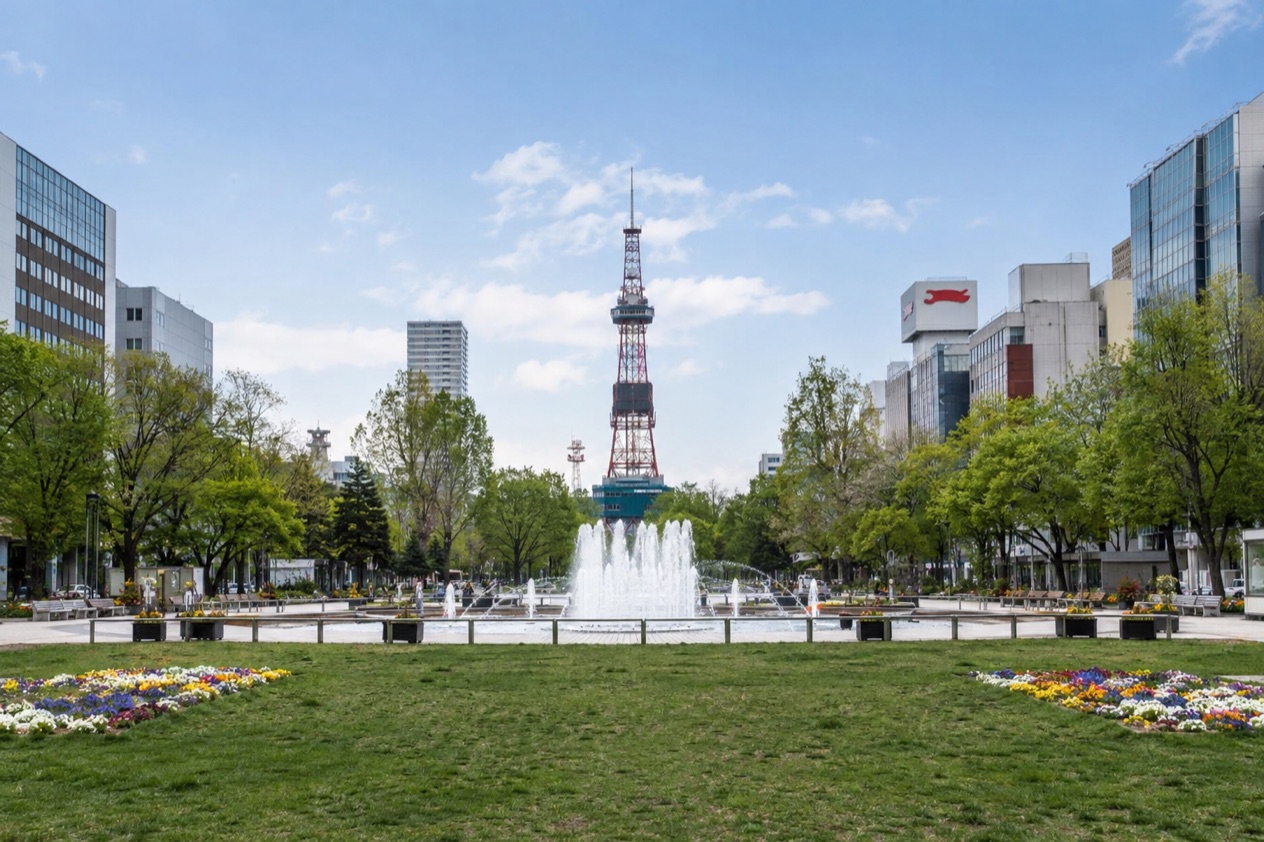
Odori Park runs through the middle of Sapporo as a long green ribbon, with benches, fountains and wide lawns where office workers eat lunch and families wander between the flower beds. Depending on the month, the same strip of grass turns into a field of snow statues, a lilac grove, a dance stage or a giant open-air beer hall. It is an easy kind of visit to fold into a day in the city, and the calendar decides what you find.
Is visiting Odori Park worth it?
Yes, if you like cities that hand you a public space to enjoy rather than a ticket to buy, and it suits couples, families, food lovers and anyone who wants to see how Sapporo spends its seasons. Odori Park is a stretch of lawn and trees in the middle of the city, so you do not come for a single monument. You come to see what is happening on it.
What sets it apart from a typical city park is how much of Sapporo’s year is staged right here. The Sapporo Snow Festival fills it with snow statues every February. In spring the lilacs take over, in early summer a huge dance festival arrives, and through the warm months the breweries set up their own gardens. Few parks in Japan act so clearly as the city’s living room.
The park is also a useful way to read the layout of Sapporo. It is long and narrow, and the blocks along it are counted in a numbered system (Nishi 1 chome, Nishi 8 chome and so on), so you always know roughly where you stand. Walk a few blocks and you pass fountains, sculptures and shaded benches, with office towers framing the view on both sides.
Hokkaido is the northernmost island of Japan, and Sapporo is the place where its outdoor culture meets city life. Sapporo hosted the first Winter Olympic Games in Asia in 1972, and that winter identity still shows in the way the city celebrates snow.
If you are looking for a quiet, contemplative garden, this is not that. If you want to feel the rhythm of the city, with food stalls, music and people out on the grass, it fits well.
Combine it with the other parts of the city and it makes a natural anchor for a day, because it connects the TV Tower at one end to the neighborhoods around it.
What to see at Odori Park
The park stretches about one and a half kilometers through the center of Sapporo and covers roughly 79,000 square meters of lawns, flower beds and paths. Walking its length gives you a series of different scenes, from the tower end to the blocks where summer’s beer gardens appear.
Sapporo TV Tower
The tower stands in the eastern half of the Nishi 1 chome block, at the end of the park, and it gives the whole strip a landmark you can see from far along the lawns. Its observation deck lets you look over all of Odori Park and across Sapporo, so you see the long green line cutting through the grid of the city.
It helps to look up at the tower from the park first, then decide whether to go up. On a clear day the view makes the layout of the city easy to read. In winter, the same view shows the park under snow, with festival structures taking shape along it.
The lilacs in spring
About 400 lilac trees grow in Odori Park, and every May they are the reason for the Lilac Festival, which lasts about ten days. The scent drifts along the paths, and the festival brings stalls and events to the lawns, so locals come out in numbers to sit under the blossoms.
Walk slowly and look at the trees one by one, because the colors range through white, pale purple and deeper violet. It is a gentle moment in a city that is still shaking off winter, and a good reason to bring a camera and a picnic.
The summer beer gardens
In summer, Odori Park changes into a large beer garden. From Nishi 5 chome to Nishi 8 chome, major Japanese breweries, including Sapporo Breweries Limited, set up their own beer gardens. Tables fill the lawn, and the smell of grilled food mixes with the sound of conversation under the trees.
It is a very social scene, with groups of friends and coworkers sharing plates and pitchers. Even if you do not drink, the atmosphere is worth a walk through, and you can sample the kind of grilled dishes that suit Hokkaido’s beer culture.
Festivals on the lawns
The Yosakoi Soran Festival arrives every June as a huge dance festival, with teams in bright costumes moving through the park to music. In September the Autumn Fest settles in for about three weeks, with food stalls from restaurants around the city and beyond, which makes it a good time to eat your way along the lawn.
Late August brings the Hokkaido Marathon, which starts from the park. And in February the Sapporo Snow Festival fills Odori Park with snow statues and several events, turning the long lawns into a winter gallery.
When to visit Odori Park
Spring and summer give you flowers, dance and beer, early autumn gives you food stalls, and winter gives you the snow festival. Between those events, the park is still a pleasant place for a walk, but quieter.
Winter: snow statues and cold days
February is the month of the Sapporo Snow Festival, and it is the reason people come to the city in winter. Expect real cold. In an average January, highs reach only the low 30s Fahrenheit and snow falls on most days, so the park is a white landscape.
Dress for standing outside and walking slowly along the statues. A warm drink from a stall is part of the experience, and the TV Tower gives you a way to look down on the scene from above.
Spring: lilacs and thawing lawns
April is still cool, with highs around the low 50s and a little snow possible, and sunshine returns steadily. By May the lilacs are in bloom and the Lilac Festival fills about ten days with events. It is a gentle time to walk the park with a coat and a camera.
Summer: dance, beer and long evenings
June brings the Yosakoi Soran Festival, and July has the warmest weather of the year, with highs in the upper 70s and fewer rainy days than winter or autumn. The beer gardens sit on the lawns in summer, and the park fills in the evenings with people at tables. Late August adds the Hokkaido Marathon.
Autumn: Autumn Fest and cooler days
September is the time of the Autumn Fest, about three weeks of food stalls on the lawns. By October the air has turned cool, with highs in the low 60s and lows in the mid-40s, and rain falls on roughly a third of the days, so a light waterproof jacket is useful. Snow is rare but a trace can appear late in the month.
| Month | Average high (°F) | Average low (°F) | Precipitation (in) | Rain days |
|---|---|---|---|---|
| January | 31.3 | 20.5 | 4.27 | 18.3 |
| April | 53.1 | 38.1 | 2.15 | 9.6 |
| July | 77.7 | 64.2 | 3.57 | 7.7 |
| October | 61.5 | 46.4 | 4.33 | 11.6 |
Tips for your visit
Plan to treat Odori Park as a place to stroll rather than a sight to tick off. The park is long, so walking from one end to the other with stops for a drink or a snack fills a relaxed afternoon, and the paths let you decide how far to go.
What you bring depends on the season. In winter, warm layers, gloves and sturdy shoes for snow are the sensible choices. In summer, light clothes and a sun hat suit the open lawns, and in autumn a waterproof layer helps, since October has rain on a good share of its days.
Pairing the park with nearby sights
The Sapporo TV Tower sits at the park’s end, so it fits naturally into the same outing, and its observation deck lets you see the whole park and the city. If you enjoy beer, the Sapporo Beer Museum and its pub, the Sapporo Beer Garden, let you enjoy a beer and lamb barbecue, a good follow-up to the summer gardens in the park.
Sapporo also works as a base for the wider island. Hokkaido offers seasonal views, skiing and trekking, Ainu and Jomon culture, gourmet food and hot springs, and the park is a pleasant way to get a feel for the city before heading out.
Families and slower walkers
Lawns, benches and fountains give families places to pause, and the festivals add food and entertainment that can keep children occupied. Because the park is a long strip, you can choose a section and stay there rather than walking the whole length.
During big events, stalls and stages change the layout of the lawns, so take your time moving through them. In winter, the snow on the paths changes the pace of a walk, so allow extra time.
Good to know before you go
Odori Park is a public space in the city center, and the festivals that fill it each have their own stalls and food, so bring a little cash or a card for snacks and drinks. The weather changes sharply from season to season, from deep winter snow to warm summer evenings, so check what the month brings before choosing your clothes. Rain and a little snow are possible in October, while January is cold and snowy throughout.
Sources
- Wikipedia, Ōdōri Park (https://en.wikipedia.org/wiki/%C5%8Cd%C5%8Dri_Park), checked October 11, 2026
- Japan National Tourism Organization, Sapporo (https://www.japan.travel/en/destinations/hokkaido/hokkaido/sapporo-and-around/), checked October 11, 2026
- Hokkaido Love, the official Hokkaido tourism site (https://www.visit-hokkaido.jp/en/), checked October 11, 2026
- Hokkaido Love, what to see and do (https://www.visit-hokkaido.jp/en/spot/), checked October 11, 2026
- Japan Meteorological Agency (JMA), Normal values 1991-2020, monthly (https://www.data.jma.go.jp/stats/etrn/view/nml_sfc_ym.php?prec_no=14&block_no=47412), station Sapporo, elevation 17 m, checked October 11, 2026
To plan your stay
- Best Time to Visit Japan: Cherry Blossoms, Autumn Colors, Weather and Festivals
- Where to Stay in Japan: Ryokan, Temple Stays, Capsule Hotels and the Best Cities to Base In
- Sending Luggage from the Airport in Japan: Hands-Free Travel, Hotel Delivery and Coin Lockers
- Know Before You Go to Japan: Entry, Money, Etiquette and Getting Around