
You come to Odaiba by crossing water, either on the driverless Yurikamome gliding over Rainbow Bridge or on a ferry that slides down the Sumida River. The first things you see are the odd ones: a replica of the Statue of Liberty facing the skyline, and a television headquarters built like a giant steel frame. This is Tokyo’s bay-front playground, a man-made island district for wandering with the city laid out across the water.
Is visiting Odaiba worth it?
Yes, if you like your sightseeing with open sky, water views and a few unusual landmarks rather than temples and old lanes, and it suits families, science fans and anyone who wants a break from the dense center of Tokyo.
What sets it apart from the other districts you will visit is the setting. Odaiba sits on Tokyo Bay, so the skyline is something you look at rather than something you stand inside.
Ginza, a few stops away, is an upscale downtown of luxury shops and high-end restaurants, and Nihonbashi is the country’s main financial district. Odaiba offers the opposite mood: wide promenades, a museum devoted to emerging science, a convention center and a beach where swimming is prohibited but strolling is the point.
It also has some sporting history. Odaiba was one of the venues for the 2020 Summer Olympics, with temporary arenas at Shiokaze Park for beach volleyball and at Odaiba Marine Park for triathlon and marathon swimming. Walking those same waterfront parks gives the place a little extra meaning if you followed the Games.
What to see at Odaiba
Rainbow Bridge and the waterfront
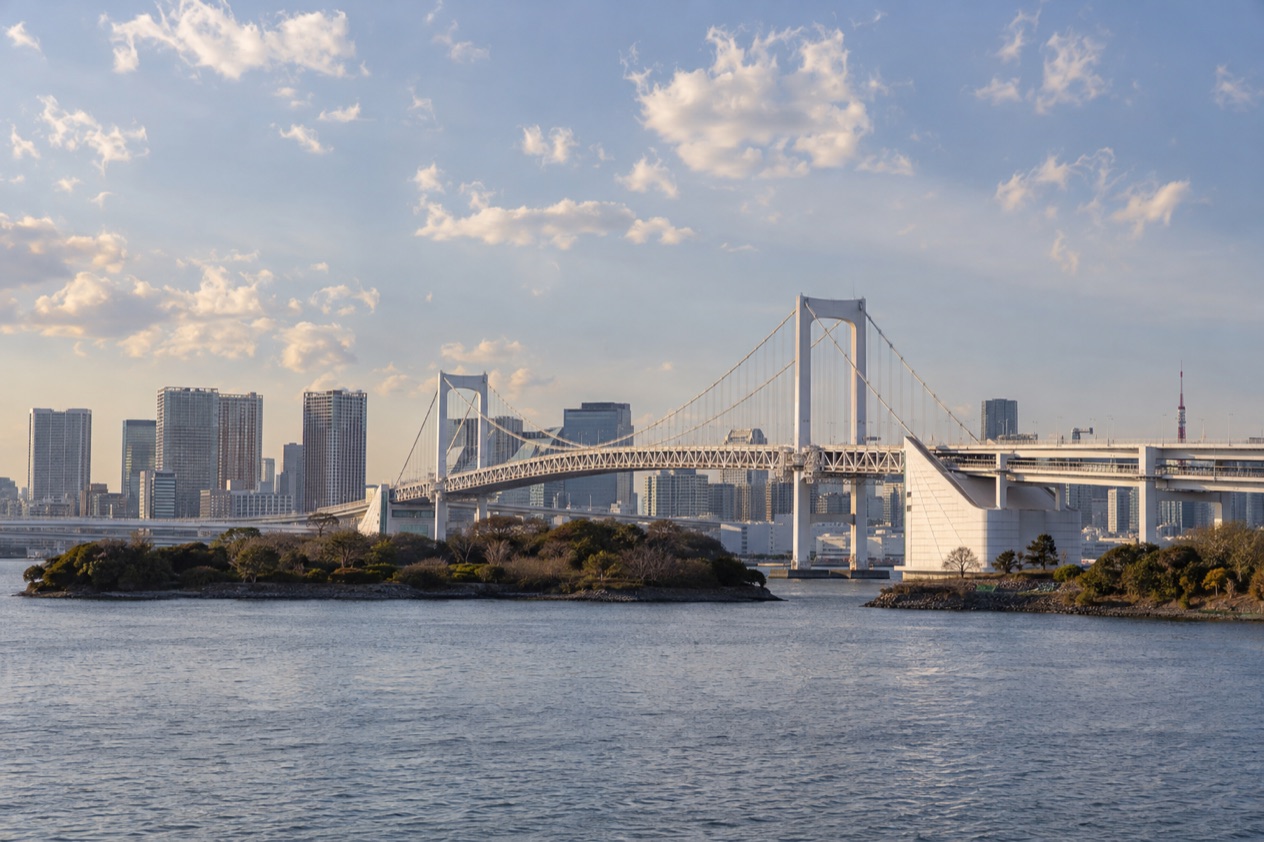
Rainbow Bridge connects Odaiba to the heart of Tokyo, and it is the picture people carry home. The suspension bridge spans the bay in a long arc, and from the island’s shore you see it framed against the city’s towers. After dark it is lit, and the glow on the water draws couples and photographers along the promenade.
The beach is part of the same stroll. It is one of two beaches in urban Tokyo, and swimming is prohibited there. People come to walk the sand, sit and look across the bay, and the Olympic parks of Shiokaze and Odaiba Marine Park lie along the same shoreline.
The Statue of Liberty replica
A replica of the Statue of Liberty stands on the waterfront, a small echo of the New York original that Americans tend to smile at when they come around a corner and find it. Behind her, the bridge and the skyline make an unexpected backdrop.
It works well as a pause between bigger stops. Visitors take photos with the span of Rainbow Bridge behind, and the spot is simple to fold into a walk along the shore.
Miraikan, the science museum
Miraikan is Japan’s National Museum of Emerging Science and Innovation, and it sits in Odaiba. The subject is the present and near future: technology, robotics, the planet and how people live with both. It is the stop for curious travelers and for families who want something hands-on.
Plan to let the exhibits set your pace. Pair it with a walk along the water afterward, which makes a good counterweight to the indoor hours.
Fuji Television and Tokyo Big Sight
The Fuji Television headquarters has a distinctive building designed by Kenzo Tange, and you spot it from far along the shore. Its bold, gridded form is among the most recognizable shapes on the island, and architecture fans like to circle it for the photographs.
Tokyo Big Sight, the Tokyo International Exhibition Center, is also here. It hosts trade shows and large events, so what you find inside depends on the day, while the building itself is a striking sight from outside.
How to get to Odaiba
Odaiba is reached by rail, bus or ferry, and each gives a different first impression. The automated Yurikamome transit system runs to the island from Shimbashi and from Toyosu. It is the route visitors picture, since the elevated line carries you over the bay with the skyline outside the window.
The privately operated Rinkai Line is the other rail option. It runs between Shin-kiba and Osaki, and many trains connect directly to Shibuya, Shinjuku and Ikebukuro. If your hotel is near one of those hubs, you can reach Odaiba without changing to another system at all.
City buses provide cheaper if slower access. They suit travelers who do not mind trading time for a lower fare and a look at the streets along the way.
By water, ferries connect Odaiba with Asakusa, running along the Sumida River, and with Kasai Rinkai Park in eastern Tokyo. Arriving by boat turns the trip into part of the outing, with the bridges and the city sliding past before you step ashore.
Travelers flying in land at Haneda Airport (officially Tokyo International Airport) or at Narita Airport, Japan’s largest international airport, and continue into Tokyo from there. Tokyo itself sits on Tokyo Bay, in the Kanto region on Honshu, which is why Odaiba feels so tied to the water.
When to visit Odaiba
Odaiba is an outdoor place, so the weather shapes the day more than the calendar does. October brings highs in the low 70s and lows in the upper 50s, comfortable for hours on the promenade, though it is also one of the wetter months, with showers on about ten days and gray skies more common than blue. Keep an indoor stop such as Miraikan in reserve.
Spring is gentler on the days that count. April warms into the mid-60s, with rain on roughly nine or ten days, and a stroll along the bay feels fresh rather than tiring. In January the air is cold, in the upper 40s by day, but skies are often bright, and a walk beside the water can be crisp and clear.
July is the heavy month. Highs reach the mid-80s, humidity is high, and the open promenades offer little shade, so the waterfront asks for a slower pace. In that season, aim for indoor stops in the heat of the day and leave the shoreline for later.
| Month | Average high (°F) | Average low (°F) | Precipitation (inches) | Days with rain |
|---|---|---|---|---|
| January | 49.6 | 34.2 | 2.35 | 4.5 |
| April | 66.9 | 49.6 | 5.26 | 9.5 |
| July | 85.8 | 72.3 | 6.15 | 10.5 |
| October | 71.6 | 58.6 | 9.24 | 10.5 |
Tips for your visit
Build the day around walking. The sights are spread along the shore, so comfortable shoes matter more than anything else you pack, and in warmer months a hat and water make the open stretches easier. Because swimming is prohibited at the beach, leave the swimsuit at the hotel.
A good order runs from the museum to the water. Start with Miraikan while you are fresh, walk to the Statue of Liberty replica and the Rainbow Bridge view, and look at the Fuji Television building on the way. Tokyo Big Sight is worth checking for events, since what is on varies.
Families will find the museum and the open shoreline a good pairing, with room for children to move between stops. For a return trip with a different feel, take the ferry one way and the Yurikamome the other, which gives you the bay from the water and from above.
If you want more of the city in the same day, Odaiba pairs with Ginza, where luxury shops and high-end restaurants offer a dressed-up contrast to the waterfront. Roppongi and Akasaka are also reached by train from Shibuya, for an evening in a different part of Tokyo.
Good to know before you go
Odaiba is a district of Tokyo, so the habits of the city apply: keep voices low on trains, carry your trash until you find a bin, and expect most of the day to be spent outdoors. Rain comes on about ten days in the wetter months, so a compact umbrella is useful, and the typhoon season belongs in your thinking when you plan an autumn outing around open waterfront.
Sources
- Wikipedia, Odaiba (https://en.wikipedia.org/wiki/Odaiba), checked October 11, 2026
- Japan National Tourism Organization, Tokyo (https://www.japan.travel/en/destinations/kanto/tokyo/), checked October 11, 2026
- Japan Meteorological Agency (JMA), Normal values 1991-2020, monthly (https://www.data.jma.go.jp/stats/etrn/view/nml_sfc_ym.php?prec_no=44&block_no=47662), station Tokyo, elevation 25 m, checked October 11, 2026
To plan your stay
- Best Time to Visit Japan: Cherry Blossoms, Autumn Colors, Weather and Festivals
- Where to Stay in Japan: Ryokan, Temple Stays, Capsule Hotels and the Best Cities to Base In
- Sending Luggage from the Airport in Japan: Hands-Free Travel, Hotel Delivery and Coin Lockers
- Know Before You Go to Japan: Entry, Money, Etiquette and Getting Around