
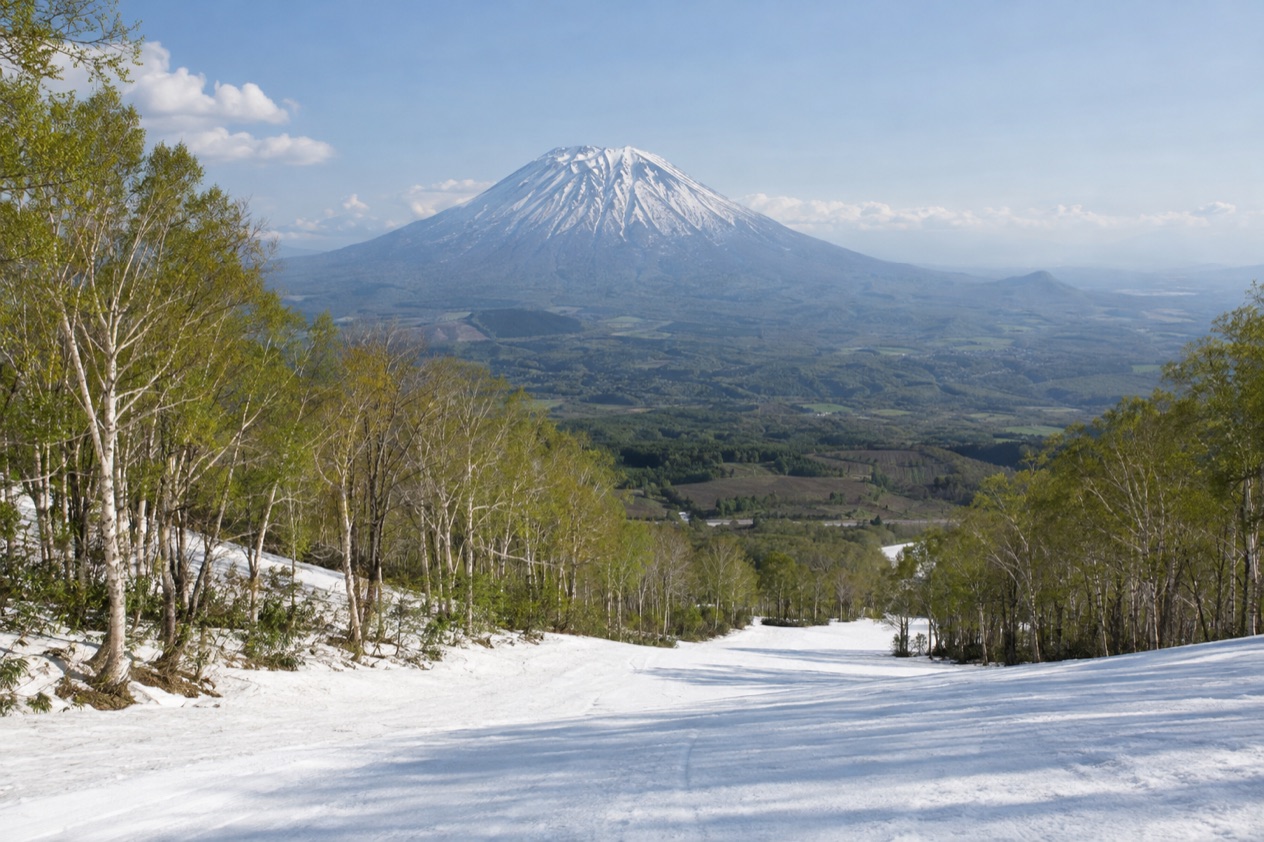
In April, Niseko sits between two seasons. Wet spring snow still drifts down on the slopes, steam rises off the outdoor onsen baths, and bare patches begin to show along the roadsides. Evenings still call for a bowl of something hot, but the afternoons smell faintly of thawing earth. It is a month for travelers who like a mountain town in transition, with winter fading and the greener months not yet here.
What is the weather like in Niseko in April?
April in Niseko is cool and changeable, with a real winter chill in the mornings, mild afternoons and a mix of rain, wet snow and sunshine. At Kutchan, close to Niseko, highs average just under 50°F and lows stay at about freezing, so the month sits on the line between snow and rain.
| Month | Average high (°F) | Average low (°F) | Precipitation (in) | Days with 1 mm or more of precipitation | Hours of sunshine | Daylight on the 15th |
|---|---|---|---|---|---|---|
| March | 37.4 | 21.7 | 3.87 | 17.0 | 121 | 11 h 51 min |
| April | 49.6 | 32.2 | 2.64 | 11.0 | 173 | 13 h 21 min |
| May | 62.4 | 42.8 | 2.98 | 9.8 | 190 | 14 h 37 min |
What this means in practice: a good insulated layer is still part of the outfit, and a waterproof shell matters more than an umbrella, because the month brings both rain and snow or sleet. Snow still falls on roughly ten days of the month at Kutchan, though the total is a fraction of what March delivers. Ground that was white a few weeks earlier turns to slush and mud, so footwear that stays dry earns its place.
The light is the quiet gift of the month. Days are long enough to leave breakfast unhurried and still have a full afternoon outdoors, and sunshine is far more frequent than in March. When the clouds break, the melting snow throws back a glare that makes sunglasses useful. Evenings, though, still feel like winter, and a hat and gloves stay in the daypack.
What to do in Niseko in April
Niseko is a ski area in southwestern Hokkaido, southwest of Sapporo, and it is described as the most famous ski area in Japan, known for powder snow and a welcoming atmosphere, especially popular with foreign visitors. April is the month when that winter identity loosens.
Some days still feel like the heart of the ski season, and others feel like the first page of spring. What you do here depends on how you want to spend that shift.
Spring snow on the four ski areas
Niseko United is one mountain with four resorts: Annupuri, Niseko Village, Grand Hirafu and Hanazono. Each has its own base area, its own cluster of lodges and restaurants, and its own feel. In April you read the mountain differently from midwinter. The snow is heavier and wetter, and the weather can change within an hour from sleet to sun.
Niseko United publishes live lift and weather status reports for every resort on its website, and that is the page to open each morning to see what is running before you commit to a base. The same site sells lift passes online, which it says lets you beat the lines and save money. Even if you do not ski, the resort villages are good places to walk, watch the slopes and stop for coffee.
Much of the Niseko mountain range lies within the Niseko-Shakotan-Otaru Kaigan Quasi-National Park, so the scenery around the lifts is more than ski infrastructure. Walking the edges of the villages in April, you see the winter landscape in retreat: dripping eaves, gleaming roads and snowbanks shrinking day by day.
Onsen evenings
A hot spring bath is the natural reward after a cold, damp day in the mountains of Hokkaido, and the cool April air is what makes an outdoor bath so satisfying. You sit in steaming water while sleet or soft snow falls on your shoulders, a sensation that is hard to match in warmer months. Many lodges in the resort areas have their own baths, and visitors also go to bathhouses for the evening.
Onsen etiquette is a set of habits, learned quickly by watching: you wash before you step into the shared water, and you leave the bath for the changing room afterward to dry off.
A Hokkaido table in spring
Food is a reason to come in any month. Hokkaido is known across Japan for its dairy, its potatoes and its seafood, and the resort areas around Niseko serve them in many forms. Expect grilled lamb, called jingisukan, cooked at the table, along with bowls of miso ramen, soup curry thick with vegetables, and sushi built on Hokkaido seafood.
A cold April day is made for these dishes. Izakaya, the casual Japanese pubs, serve small plates and drinks late into the evening, and bakeries and cafés in the villages are where you warm up with soft-serve ice cream made from local milk, a Hokkaido habit that holds even in cold weather. A rural shop may close early, sometimes as early as 6:00 p.m., so errands belong in the daytime.
Spring also brings the first cherry blossom news from the south. Japan’s blossom front moves north through Honshu in March and April, and the JMA records Hokkaido blooms on the Ezo-yamazakura where the Somei-Yoshino does not grow. The Somei-Yoshino front reaches the northern and eastern parts of Hokkaido around mid-May, so in April Niseko is a place to follow the blossom from the snow, not to see it.
The last days of the month bring Golden Week, which begins on April 29 with Showa Day. It is the start of a run of public holidays across Japan, and the mood in resort towns shifts as holiday travel begins.
A two-day itinerary for Niseko in April
Day 1 is for the mountain. Start with a slow breakfast at your lodge and open the live lift status report for the four resorts, then pick your base for the day.
If the lifts are turning, spend the morning on the snow at Grand Hirafu, the resort village with the largest cluster of restaurants and shops. If the weather turns wet and heavy, walk the village instead and watch the clouds move across the slopes.
Midday is for a long lunch of ramen or soup curry, with a window seat if you can find one. In the afternoon move to Hanazono or Niseko Village to see a different corner of the mountain, with its own slopes and its own atmosphere. When the light starts to fade, return to your lodge for an onsen bath, then go out for jingisukan or a plate of Hokkaido seafood at an izakaya.
Day 2 is for the quieter side of the mountain. Begin at Annupuri, the eastern end of the Niseko volcanic group, and spend the morning there on the slopes or on a walk along the edge of the resort. The sun is stronger now than in winter, so a pair of sunglasses is useful on a clear morning.
Lunch is a bakery or café stop for something warm and a local dairy treat.
Finish the trip with a last onsen soak and a relaxed dinner. If rain or sleet closes in, the rain card is the same as the evening plan, brought forward: a long bath, a café with a view, then a table-side dinner.
Is Niseko busy in April?
April is a transition month in Niseko, and the sense of crowds depends on which end of the month you choose. The first half still belongs to the ski season, and the area keeps the international mood it is known for. The second half begins to turn toward spring, with a different pace in the villages.
The end of the month brings the first Golden Week holiday, Showa Day on April 29, and the rest of the holiday run continues into early May. Four days of Golden Week are officially public holidays, and the period often sends Japanese travelers across the country. Niseko is a ski area that draws many foreign visitors, but how that plays out in the villages across these dates is something the calendar alone cannot tell you.
The lift passes sold online on the Niseko United website are meant to beat the lines and save money, which tells you that lines are part of the resort routine in season. Beyond that, the pace in April is shaped by the weather. A clear, bright day pulls everyone outdoors, while a wet gray one sends people to the onsen and the cafés.
Shops in towns across Japan are generally open from 10:00 a.m. to 8:00 p.m. every day, but in rural areas they often close earlier. In the villages around Niseko, plan your errands in the daytime and keep the evening for dinner and the bath.
What to pack for Niseko in April
The mix of snow, sleet and rain, and the gap between morning chill and sunny afternoons, makes layers the key to the packing list.
- A waterproof shell, because the month brings rain, wet snow and sleet in turn.
- An insulated mid-layer that you can add or shed as the day changes.
- Waterproof boots, since melting snow turns paths and roads to slush.
- A hat and gloves for mornings and evenings that still feel like winter.
- Sunglasses, for the glare of sun on wet snow.
- A set of dry, warm clothes for after the onsen, when the evening air is cold.
Good to know before you go
The practical matters of April are the weather and the calendar. By car, Niseko is about a three-hour drive from both Sapporo and New Chitose International Airport, which is the nearest airport and receives flights from across Japan and some international destinations.
At the end of the month, Golden Week begins on April 29. When a national holiday falls on a Sunday, the next working day becomes a holiday, and a day between two holidays also becomes one, so the calendar can stretch longer than expected. Shops in rural areas often close earlier than those in cities.
Niseko in April vs March and May
Moving the trip four weeks earlier brings you to March, when winter is firmly in charge. The snowfall at Kutchan is many times what April sees, and the snow falls on most days. Highs stay below freezing for much of the time and the days are shorter. If deep winter is what you came for, March is the month to choose.
Four weeks later, May is a different place. Snow or sleet is nearly gone, afternoons are mild and the daylight runs long. The blossom front, which is still moving north through Honshu in April, reaches the northern and eastern parts of Hokkaido around mid-May. The resort villages shift away from their winter identity, and the mountain turns from white to green.
Choose March if the snow is the point of the trip and May if you want mild weather and long light. April suits those who want a bit of both, with spring snow, steaming baths and the feeling of a mountain town changing season.
Is April a good time to visit Niseko?
Yes, for travelers who like a season in transition and are happy to be flexible with the weather. April suits people who enjoy onsen evenings, hearty Hokkaido food and a mountain landscape in the middle of change, and who are comfortable dressing in layers and planning around the lift report.
It is a weaker choice for anyone who needs reliable deep winter or settled warm weather. The month can go from sunshine to sleet in a day, and the end of the month overlaps with the start of Golden Week.
On arrival, open the Niseko United lift and weather report, pick the resort that is running, and plan the first evening around a hot bath. The best of April in Niseko is the contrast: steam rising from an outdoor onsen while wet snow falls around you, and a bowl of miso ramen at the end of a cold afternoon.
Sources
- Japan Meteorological Agency (JMA), Normal values 1991-2020, monthly (https://www.data.jma.go.jp/stats/etrn/view/nml_sfc_ym.php?prec_no=16&block_no=47433), station Kutchan, elevation 176 m, checked October 11, 2026
- Computed from the date and the latitude of the place (sunrise equation, solar elevation -0.833 degrees), October 11, 2026
- Japan Meteorological Agency, cherry blossom first-bloom dates 2021-2026 and 1991-2020 normal (https://www.data.jma.go.jp/sakura/data/sakura003_07.html), checked October 11, 2026
- Japan Meteorological Agency, cherry blossom full-bloom dates 2021-2026 and 1991-2020 normal (https://www.data.jma.go.jp/sakura/data/sakura004_07.html), checked October 11, 2026
- Japan Meteorological Agency, sakura2020.pdf (https://www.data.jma.go.jp/sakura/data/sakura2020.pdf), checked October 11, 2026
- Japan National Tourism Organization, spring in Japan (https://www.japan.travel/en/guide/spring-guide/), checked October 11, 2026
- Japan National Tourism Organization, flowers by season: cherry blossom, plum, wisteria, hydrangea, where and when (https://www.japan.travel/en/see-and-do/flowers/), checked October 11, 2026
- Wikipedia, Wisteria (https://en.wikipedia.org/wiki/Wisteria), checked October 11, 2026
- Japan National Tourism Organization, shop and attraction hours, national holidays (https://www.japan.travel/en/plan/business-hours-and-holidays/), checked October 11, 2026
- Wikipedia, Golden Week (Japan) (https://en.wikipedia.org/wiki/Golden_Week_(Japan)), checked October 11, 2026
- Wikipedia, Public holidays in Japan (https://en.wikipedia.org/wiki/Public_holidays_in_Japan), checked October 11, 2026
- Japan National Tourism Organization, Niseko (https://www.japan.travel/en/destinations/hokkaido/hokkaido/niseko-and-nearby-ski-resorts/), checked October 11, 2026
- Niseko United, winter (https://www.niseko.ne.jp/en/winter/), checked October 11, 2026
- Wikipedia, Niseko (https://en.wikipedia.org/wiki/Niseko), checked October 11, 2026
- Wikivoyage, Niseko (https://en.wikivoyage.org/wiki/Niseko), checked October 11, 2026